




Online Consultation
Please accurately enter the information below.
Quick Cost Consultation
Quick Consultation & Reservation
Cases finding
similar to my profile






Cases finding
similar to my profile
Customer Diagnostics
Postpartum Lower Belly Skin Sagging—How Much Can a Tummy Tuck Improve It? (Abdominoplasty | Tummy Tuck | Postpartum Loose Skin | M-Type Abdominoplasty | Rectus Muscle Repair | Diastasis Recti | Belly Button Reconstruction | Seoul Gangnam Plastic Surgery C
2026-01-13
Today’s case involves a patient who struggled with
loose lower-abdominal skin that developed after childbirth.
Even after successful postpartum weight loss,
the stretched skin and deep creases around the lower belly did not recover,
which caused significant stress and discomfort in daily life.
This led her to consider abdominoplasty (tummy tuck)
to address the loose skin and improve the overall abdominal contour.
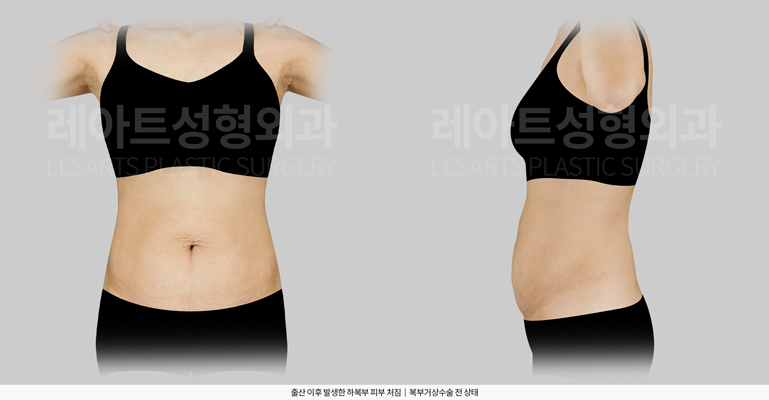
Preoperative Evaluation
During consultation, the patient showed:
-Relatively low fat volume in the abdomen
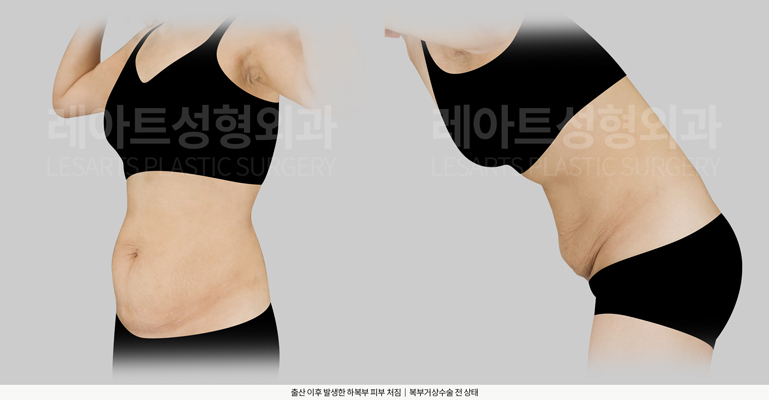
-Clearly visible loose skin and wrinkling in the lower belly
-Significant rectus diastasis (abdominal muscle separation)
-Weakened abdominal wall support, causing
the abdomen to bulge forward and sideways
-Skin laxity that made the lower abdomen appear even more droopy
Because these issues involved both skin and muscle structures,
surgical correction was required to restore stability and contour.
Surgical Plan
To correct the structural and aesthetic issues,
the following procedures were performed:
1. M-Type Abdominoplasty
Removes stretched skin from the upper and lower abdomen,
tightens loose tissue, and improves the entire front abdominal area.
2. Rectus Muscle Repair (Diastasis Recti Correction)
Brings the widely separated rectus muscles back toward the center,
restoring abdominal wall support and correcting the forward/outward bulge.
3. Belly Button (Umbilical) Reconstruction
Redesigns the belly button to match the newly tightened abdominal skin tension and position.
4. Abdominal Liposuction (Line Refinement)
Performed to refine the silhouette,
as the patient did not have significant fat accumulation.
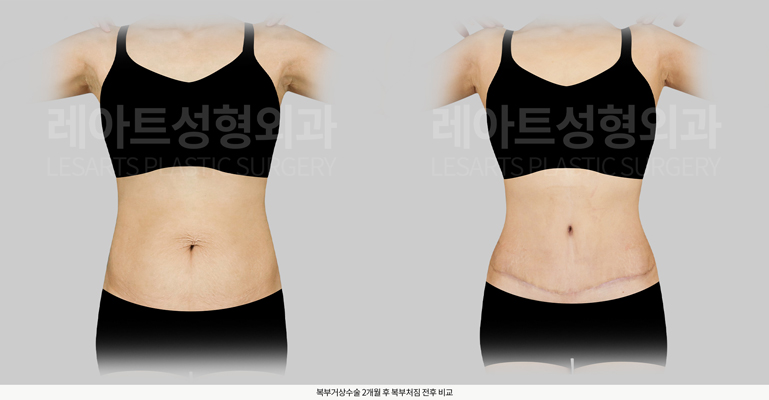
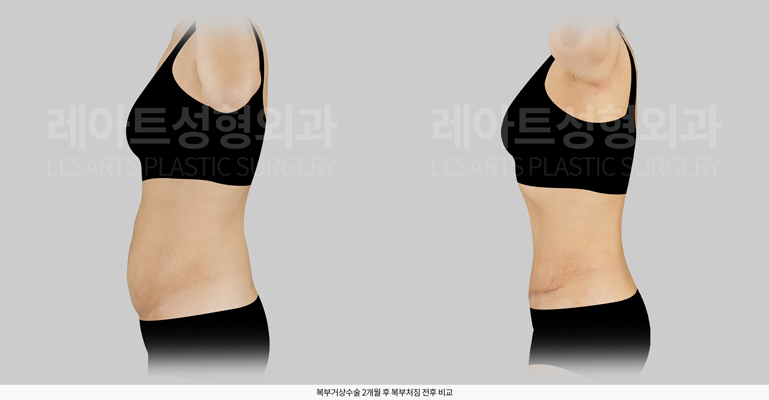
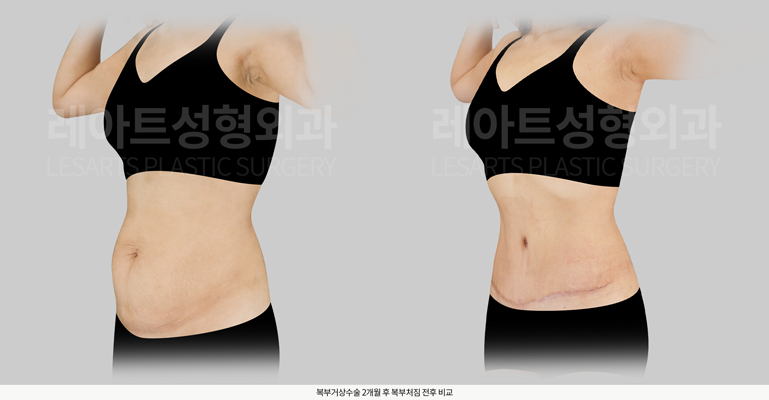
2-Month Postoperative Results
1. Overall Abdominal Change (Upper + Lower Abdomen)
-Stretched skin from the upper abdomen has been tightened
-The previously heavy, drooping lower belly is now lifted and firm
-Vertical wrinkles and creases under the belly button have disappeared
-The skin surface appears smoother and more even
With the loose skin removed, the abdomen now looks cleaner,
flatter, and more stable from top to bottom.
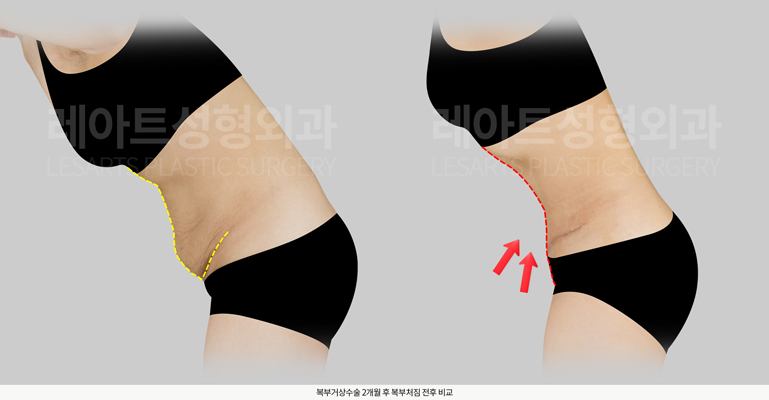
2. Lower Belly Change (Focused Comparison)
Before surgery:
-Deep horizontal wrinkles below the belly button
-Loose skin pooled downward during movement or posture changes
-No visible waistline due to sagging lower tissue
After surgery:
-Skin has tightened evenly without folding
-The waistline appears cleaner and more defined
-The lower-abdominal heaviness has disappeared
-Even with posture changes, the lower belly no longer droops
3. Side View – Flatter Abdomen After Rectus Repair
Rectus muscle repair significantly improved abdominal wall stability:
-The front abdomen appears flat and firm
-Lateral bulging from muscle separation has been corrected
-The waist-to-pelvis line connects more smoothly
-The flared-out shape seen preoperatively has disappeared
-This shows how structural correction,
not just fat removal, dramatically improves contour.
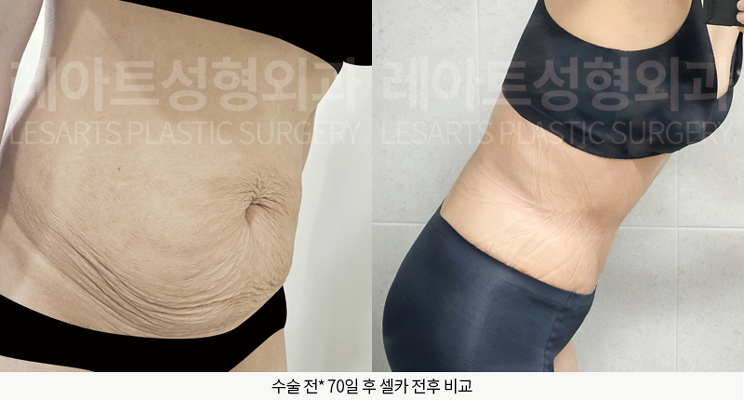
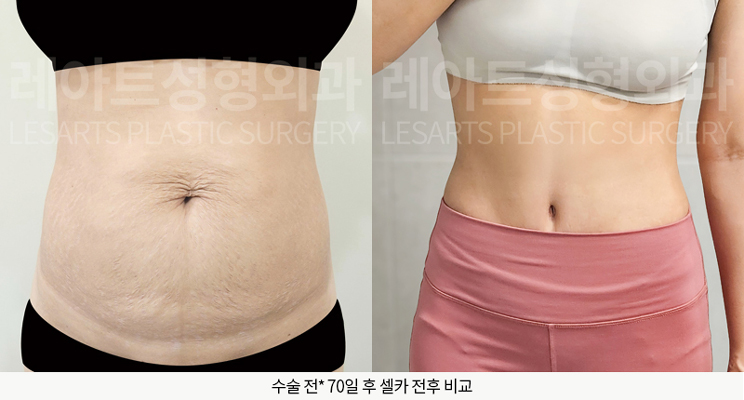
Daily-Life Photo Comparisons
Self-taken daily photos reveal how
naturally the shape settled during recovery:
Before Surgery
-Wide area of sagging skin
-Deep wrinkles near the belly button
-No visible waist definition
The patient avoided showing her abdomen due to insecurity
After Surgery
-A cleaner and more defined abdominal line
-A newly shaped vertical, natural-looking belly button
-Firm skin texture visible even in casual photos
-The patient reported feeling comfortable
with clothing and daily activities
Her recovery has been stable,
and the abdominal shape
is continuing to settle smoothly.
#Abdominoplasty
#M-type
#Abdominal liposuction(M)


Cases finding
similar to my profile
Customer Diagnostics


Select the surgery and
area you are interestedto see real
before andafter changes.


we
make you,
the art
Clinic hours
MON - FRI
10 am – 7pm
SAT
10 am – 4pm
Holiday
SUN, HOLIDAY
Location
Lesarts Moon Clinic Tower 4-5F, 40, Nonhyeon-ro 168-gil,
Gangnam-gu, Seoul, Republic of Korea

Medical institution name Lesarts Plastic Surgery
Address Lesarts Moon Clinic Tower 4-5F, 40, Nonhyeon-ro 168-gil, Gangnam-gu, Seoul, Republic of Korea
Representative Moon sung jun
