




Online Consultation
Please accurately enter the information below.
Quick Cost Consultation
Quick Consultation & Reservation
Cases finding
similar to my profile






Cases finding
similar to my profile
Customer Diagnostics
How Much Can a Tummy Tuck Improve a Sagging Lower Belly After Childbirth? (Abdominoplasty | L-Type Tummy Tuck | Postpartum Belly Sagging | Lower Abdomen Skin Laxity | Diastasis Recti Repair | Belly Button Reconstruction | Abdominal Liposuction | 3-Month R
2026-01-30
The patient in this case experienced increasing skin laxity and
lower abdominal sagging after childbirth and recent weight fluctuations.
Despite attempts to control her weight again,
the abdominal contour did not improve,
and the loose skin continued to fold whenever
she moved—causing discomfort in daily life.
Eventually, she sought consultation to explore
a more fundamental solution: abdominoplasty (tummy tuck).
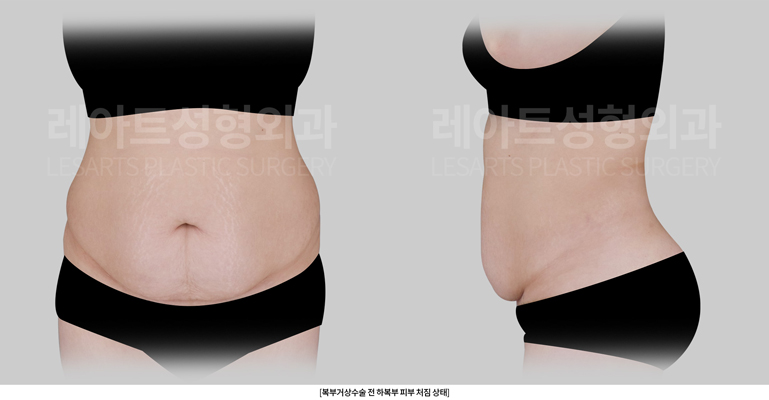
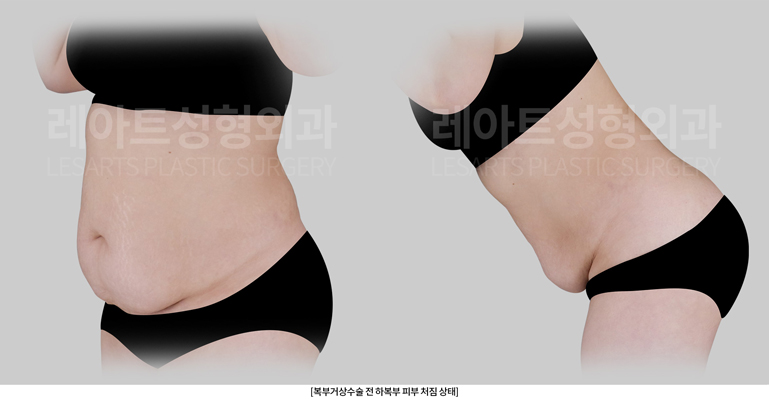
Preoperative Condition
[Lower Belly Sagging, Deep Wrinkles & Structural Weakness]
Before surgery, the following were observed:
-Skin below the belly button hung downward
-Multiple creases formed with movement
-The lower abdomen felt heavy and collapsed
-Wrinkles overlapped prominently under the navel
-Overall abdominal support was weakened,
suggesting structural involvement—not just fat accumulation
Because the issue stemmed from skin laxity
+ abdominal wall weakness, simple weight loss
or exercise had clear limitations.
A structural correction was necessary.
Surgical Plan
[L-Type Abdominoplasty + Muscle Repair + Umbilical Revision + Liposuction]
Based on her anatomy and abdominal condition,
surgery was performed in the following steps:
1. L-Type Extended Abdominoplasty
-Removes sagging skin mainly from the lower abdomen
-Lifts the abdominal skin upward
-Eliminates deep wrinkles and skin folds
-Repositions the entire abdominal contour into a more stable form
2. Rectus Muscle Repair (Diastasis Recti Correction)
-Reinforces weakened abdominal wall
-Corrects the forward bulging appearance
-Improves core stability
3. Belly Button Correction
-Recreates a natural-looking navel after lifting a large area of skin
-Adjusts the position to match the new abdominal contour
4. Abdominal Liposuction
-Removes remaining fat from the front and side abdomen
-Ensures a smooth, continuous torso line
Together, these procedures target both the external shape
and internal structural issues.
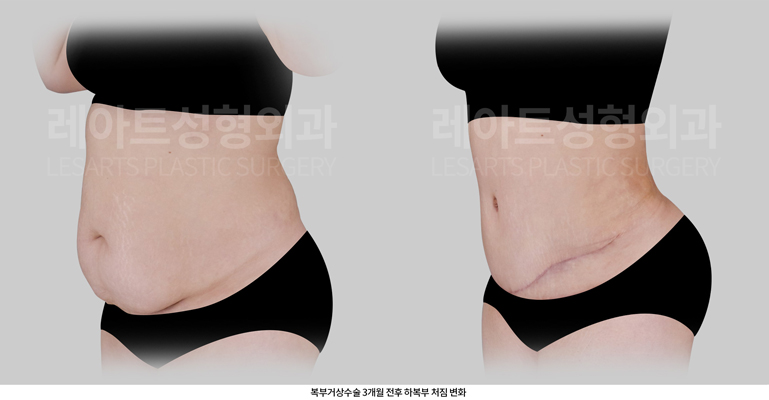


3-Month Before & After
Significant Reduction in Lower Belly Sagging
Comparing photos taken before and 3 months after surgery:
- The sagging lower belly has tightened significantly
- Skin folds under the belly button have smoothed out
- The abdomen no longer collapses forward with movement
- Side-view projection has decreased, creating a lighter appearance
- The abdominal contour now flows naturally from upper to lower abdomen
The overall impression is much more stable and balanced.
The patient especially noted:
-No more folding of skin when bending or moving
-Less discomfort during daily activities
-No longer needing oversized clothing to hide the abdominal area
These improvements had a strong impact on her quality of life.
3-Month 45° Angle Comparison
Improved Contour & Reduced Surface Irregularity
From a 45-degree view:
-Overlapping wrinkles below the navel have resolved
-Surface unevenness has improved
-The forward-bending bulge has softened
-The abdomen maintains its shape more effectively
-This shows how a tummy tuck
can correct both visual laxity and mechanical sagging.
Recovery Notes & Current Status
Some swelling around the belly button and
minor changes in skin condition can appear in early recovery.
These were explained as normal postoperative stages,
and the patient has been progressing well.
She is now in the phase where:
-The abdominal contour continues to stabilize
-Skin quality gradually improves
-The incision line will soften over time
Because abdominoplasty changes both the shape
and structural support, follow-up visits remain
important to monitor healing and optimize long-term results.
#Abdominoplasty
#L-type
#Abdominal liposuction(L)


Cases finding
similar to my profile
Customer Diagnostics


Select the surgery and
area you are interestedto see real
before andafter changes.


we
make you,
the art
Clinic hours
MON - FRI
10 am – 7pm
SAT
10 am – 4pm
Holiday
SUN, HOLIDAY
Location
Lesarts Moon Clinic Tower 4-5F, 40, Nonhyeon-ro 168-gil,
Gangnam-gu, Seoul, Republic of Korea

Medical institution name Lesarts Plastic Surgery
Address Lesarts Moon Clinic Tower 4-5F, 40, Nonhyeon-ro 168-gil, Gangnam-gu, Seoul, Republic of Korea
Representative Moon sung jun
