




Online Consultation
Please accurately enter the information below.
Quick Cost Consultation
Quick Consultation & Reservation
Cases finding
similar to my profile






Doctor's Note
Medical columns by our surgeons
Male Gynecomastia Surgery | Simon Grade IIb with Skin Laxity: 3-Month Progress [Doctor's Note by Dr. Kukhan Lee]
2026-08-12
Male Gynecomastia Surgery | Simon Grade IIb with Skin Laxity: 3-Month Progress [Doctor's Note by Dr. Kukhan Lee]
Can Simon Grade IIb gynecomastia with skin laxity be surgically treated without skin excision?
For Simon Grade IIb or higher gynecomastia accompanied by both breast enlargement and skin laxity,
potential residual skin after volume reduction must be taken into account.
While skin excision may be necessary in some cases,
subcutaneous mastectomy may be performed first based on the patient's age, skin elasticity, and scar burden,
with further corrective steps determined depending on subsequent progress.
▶ View Clinical Cases of Male Gynecomastia Surgery at Lesarts
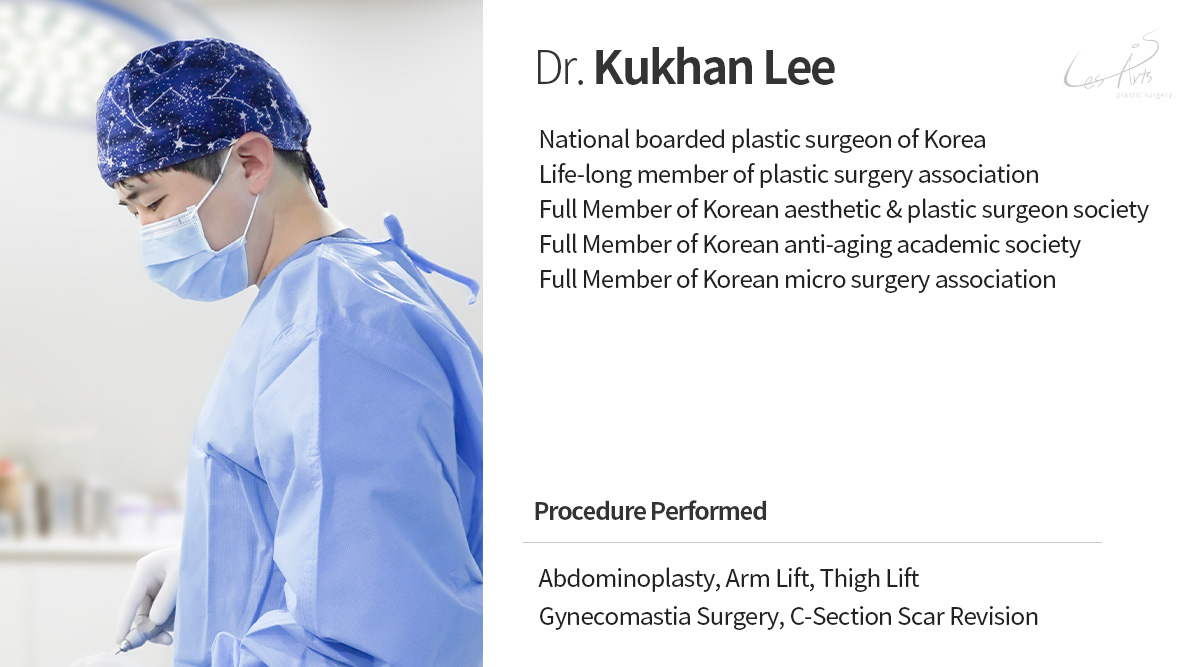
Hello, I am Dr. Kukhan Lee, Board-Certified Plastic Surgeon.
As the weather warms and layers of clothing become lighter,
concerns regarding male chest contours naturally tend to increase.
Chest volume that went unnoticed beneath heavy winter clothing
becomes visible as patients begin wearing light t-shirts or shirts.
In particular, when the central anterior chest projects forward
or the periareolar area appears prominent, chest contours can be noticeable even through clothing,
often causing substantial personal stress.
When patients visit for these concerns, we first conduct a physical examination and ultrasound assessment
to evaluate the degree of glandular breast tissue development
and the distribution of surrounding adipose tissue.
Subsequently, by assessing both chest volume and the degree of skin laxity,
we apply the Simon classification,
and plan a surgical approach tailored to the anatomical presentation.

[Simon Classification for Gynecomastia - Lesarts Plastic Surgery]
A frequently diagnosed stage among gynecomastia patients
is Simon Grade IIa.
Because the chest exhibits moderate enlargement without noticeable skin laxity,
surgical reference cases for this grade are
relatively common.
On the other hand, from Simon Grade IIb onward,
breast enlargement is accompanied by skin laxity.
In Grade III, breast volume and ptosis become even more pronounced;
thus, along with reducing glandular and adipose tissue,
how to manage residual skin must also be evaluated.
In this post, we review the 3-month post-operative progress of a Simon Grade IIb patient
who presented with persistent breast enlargement and ptosis even after substantial weight loss.
The patient was a male in his 20s with a history of significant weight fluctuations.
At the time of consultation, his height was approximately 170 cm with a weight of approximately 80 kg,
and his weight had previously increased up to around 110 kg.
While he reduced substantial weight through exercise and dietary adjustments,
noticeably changing his overall frame,
chest volume and anterior projection
did not decrease as much as he had hoped.
Ultimately, he sought consultation for gynecomastia surgery
to address the persistent breast enlargement and ptosis remaining after weight loss.

[Physical Examination of a Simon Grade IIb Gynecomastia Patient - Dr. Kukhan Lee, Lesarts Plastic Surgery]
Physical examination confirmed moderate-to-severe breast enlargement.
Reflecting his substantial weight loss, skin elasticity was noticeably reduced,
with bilateral downward ptosis presenting as breast sagging.
In particular, ptosis on the left breast was more pronounced
than on the right, demonstrating visible asymmetry.
Taking his overall condition into account,
the presentation was diagnosed as true gynecomastia, Simon Grade IIb.
However, because the Simon classification evaluates breast size and skin laxity,
a degree of clinical judgment is involved in the grading process.
Given the degree of volume and tissue laxity in this patient,
it was close to Grade III depending on clinical interpretation.
To address his presentation, the primary procedure considered
was subcutaneous mastectomy.
Given the chest volume and skin laxity, breast mastopexy (lifting) involving
direct skin excision could theoretically be considered.
However, the patient was relatively young in his 20s,
and incorporating skin excision would involve
comparatively longer surgical scars across the chest,
which required careful consideration.
Therefore, rather than performing extensive skin excision at the outset,
we chose to first perform subcutaneous mastectomy
to debulk the hypertrophied internal breast tissue.
The plan was to observe how the skin would retract
and adapt to the reduced chest volume during recovery, and if laxity remained a significant concern,
secondary corrective skin excision could be considered in a staged manner.
Rather than attempting to address all concerns in a single session,
we selected a staged approach
weighing the trade-off between scar burden and progressive skin adaptation.

[Taping Protocol to Support Redraping After Gynecomastia Surgery - Lesarts Plastic Surgery]
Following surgery, the residual skin needs time to redrape
and settle over the substantially reduced volume.
In patients with diminished skin elasticity and pre-existing ptosis,
how the skin adapts post-operatively is an important consideration.
Bilateral chest taping was applied to help guide remaining skin
to adapt along the newly sculpted chest contour.
Because the left breast presented with more severe ptosis pre-operatively,
we explained pre-op that residual cutaneous creasing could remain on the left side.

[Chest Size Changes Following Gynecomastia Surgery - Dr. Kukhan Lee, Lesarts Plastic Surgery]

[Gynecomastia Surgery Before & After - Dr. Kukhan Lee, Lesarts Plastic Surgery]
Here are the results at 3 months post-op.
While 3 months is still early to evaluate final chest maturation,
compared to pre-operative photos, overall chest volume
and anterior projection have decreased noticeably.
As dependent lower chest volume was reduced,
the anterior chest contour appears flatter, and the upper torso presents a lighter silhouette.

[3-Month Progress for Simon Grade IIb Gynecomastia - Dr. Kukhan Lee, Lesarts Plastic Surgery]
The patient presented with reduced skin elasticity prior to surgery.
Through postoperative taping and recovery, the skin gradually adapted
to the reduced chest volume, and the nipple-areolar complex, which previously appeared pulled downward,
exhibited a relative upward visual repositioning.
With heavy lower-pole volume debulked,
the chest contour shifted toward a more masculine appearance.
The areolar diameter, which appeared stretched and widened pre-operatively, showed partial reduction,
and the thickness and ptosis of the lower chest decreased visibly.

[Anterior Projection Differences Before & After Gynecomastia Surgery - Dr. Kukhan Lee]

[T-Shirt Fit Differences Before & After Gynecomastia Surgery - Dr. Kukhan Lee]
The lateral profile also illustrates the change between pre- and post-op.
Before surgery, overall forward projection placed
the highest focal point directly around the areola.
Post-operatively, lower chest fullness decreased and anterior projection lowered,
creating a more natural transition from the upper pectorals into the torso.
Because skin laxity was present, this recovery stage involves
monitoring how the residual skin continues to redrape over time.
Changes experienced in daily clothing fit were also notable.
Before surgery, the point that pressed first against a t-shirt
was the protruding areolar zone.
Post-op, as central and lower chest volume decreased,
fabric contact shifted relatively toward the upper pectorals,
and the discomfort of the chest protruding through thin t-shirts
was noticeably reduced.
In this patient, enlargement and skin ptosis were more pronounced
on the left breast pre-operatively.
Consequently, at 3 months post-op, some cutaneous creasing remains present on the left breast.
While a degree of bilateral asymmetry may be observed when compared to the right side,
because it is still 3 months post-procedure, the process of skin redraping
over the chest frame can continue further.
Additionally, if pectoral muscle volume increases with subsequent resistance exercise,
the underlying muscular support may help smooth remaining skin,
potentially contributing to a more balanced appearance.
Anticipating these factors during surgical planning,
we avoided primary skin excision that leaves long scars,
opting to first observe recovery progress and consider secondary correction
only if clinically needed.
In gynecomastia with skin laxity, such as Simon Grade IIb or III,
how to manage residual skin after debulking is an important clinical consideration.
Even when ptosis is present, direct skin excision is not necessarily required
for every patient from the outset.
In younger patients where the scar burden from skin excision is significant,
performing subcutaneous mastectomy first to observe how skin adapts
to the reduced chest volume can be a viable clinical approach.
At 3 months post-op, overall chest volume and lower-pole fullness were reduced,
and the nipple-areolar complex exhibited relative upward positioning,
reflecting a more masculine chest contour than before.
However, because residual creasing remains on the left side where ptosis was more pronounced pre-operatively,
continued follow-up is appropriate.
Gynecomastia surgery accompanied by skin laxity cannot be decided
solely by the volume of glandular tissue to resect.
It is essential to consider skin elasticity, bilateral ptosis differences, patient age, and scar tolerance
when deciding whether to perform skin excision primarily,
or to debulk volume first and evaluate progress in stages.
If chest size or sagging causes concern when wearing light clothing,
we recommend consulting on your Simon grade, skin quality,
and anticipated post-operative changes through precise anatomical diagnosis.
▶ View More Male Gynecomastia Cases at Lesarts
Simon Grade IIb Gynecomastia FAQ
1. What characterizes Simon Grade IIb gynecomastia?
It refers to moderate breast enlargement accompanied by skin laxity.
Unlike Grade IIa where ptosis is minimal, potential residual skin
must be accounted for during surgical planning.
2. Is skin excision mandatory for Grade IIb gynecomastia?
It is not necessarily required for all patients.
Depending on skin elasticity, age, degree of ptosis, and scar burden,
subcutaneous mastectomy may be performed first with progress observed over time.
3. Can loose skin retract naturally after gynecomastia surgery?
In younger patients with remaining elasticity,
skin may partially adapt and redrape over the reduced volume.
However, the degree of retraction varies by individual.
4. Why is chest taping used after surgery?
When skin laxity is present,
taping can serve as an aftercare measure to support skin redraping
over the newly contoured chest.
5. Are residual creases at 3 months post-op considered final?
Three months is still within the active recovery period.
Creasing may further soften as tissue matures, and if concerns persist,
secondary corrective options can be evaluated at a later stage.
Dr. Kukhan Lee


Cases finding
similar to my profile
Customer Diagnostics


Select the surgery and
area you are interestedto see real
before andafter changes.


we
make you,
the art
Clinic hours
MON - FRI
10 am – 7pm
SAT
10 am – 4pm
Holiday
SUN, HOLIDAY
Location
Lesarts Moon Clinic Tower 4-5F, 40, Nonhyeon-ro 168-gil,
Gangnam-gu, Seoul, Republic of Korea

Medical institution name Lesarts Plastic Surgery
Address Lesarts Moon Clinic Tower 4-5F, 40, Nonhyeon-ro 168-gil, Gangnam-gu, Seoul, Republic of Korea
Representative Moon sung jun
