




Online Consultation
Please accurately enter the information below.
Quick Cost Consultation
Quick Consultation & Reservation
Cases finding
similar to my profile






Doctor's Note
Medical columns by our surgeons
Arm Liposuction | Do Your Arms Flare Out at Rest? Check the Axillary Region.
2026-09-03
Arm Liposuction | Do Your Arms Flare Out at Rest? Check the Axillary Region.
Q. Why do arms flare outward instead of resting naturally against the torso at attention, making the upper frame appear broader,
and why is a comprehensive design incorporating the axillary region essential for arm liposuction?
A. This occurs due to 'mechanical interference' between the inner upper arm fat and axillary deposits; addressing both regions as a single integrated structure
allows the arms to rest smoothly against the torso, visually reducing the overall upper body frame.
Learn More About Lesarts Arm Liposuction
Hello, I am Dr. Pyongrim Choi of Lesarts Plastic Surgery.
Among patients visiting the clinic ahead of their wedding with concerns about dress fit and upper body contours,
one recurring sentiment is frequently shared:
“My scale weight isn't particularly high, but fullness in my upper arms makes my entire upper frame appear broad.”
Particularly in wedding dress silhouettes where the shoulders and upper body are exposed,
the upper arms and axillary folds draw immediate visual attention even before the waistline.
Far more impactful than a simple circumferential reduction of a few centimeters
is how naturally and slenderly the arms rest against the sides of the torso in a relaxed, standing posture.
The clinical case presented today represents a typical anatomical presentation where
subcutaneous thickness of the arm combines with inner axillary volume,
causing the arms to flare outward even when standing at rest.
[Clinical Case Analysis: Arm & Axillary Liposuction]
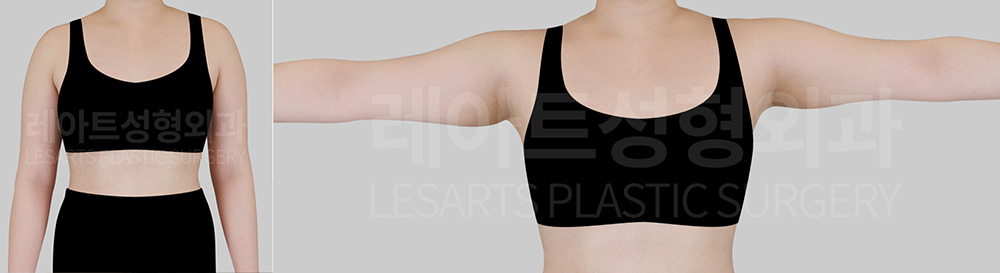
Preoperative Anterior View - Arm Liposuction
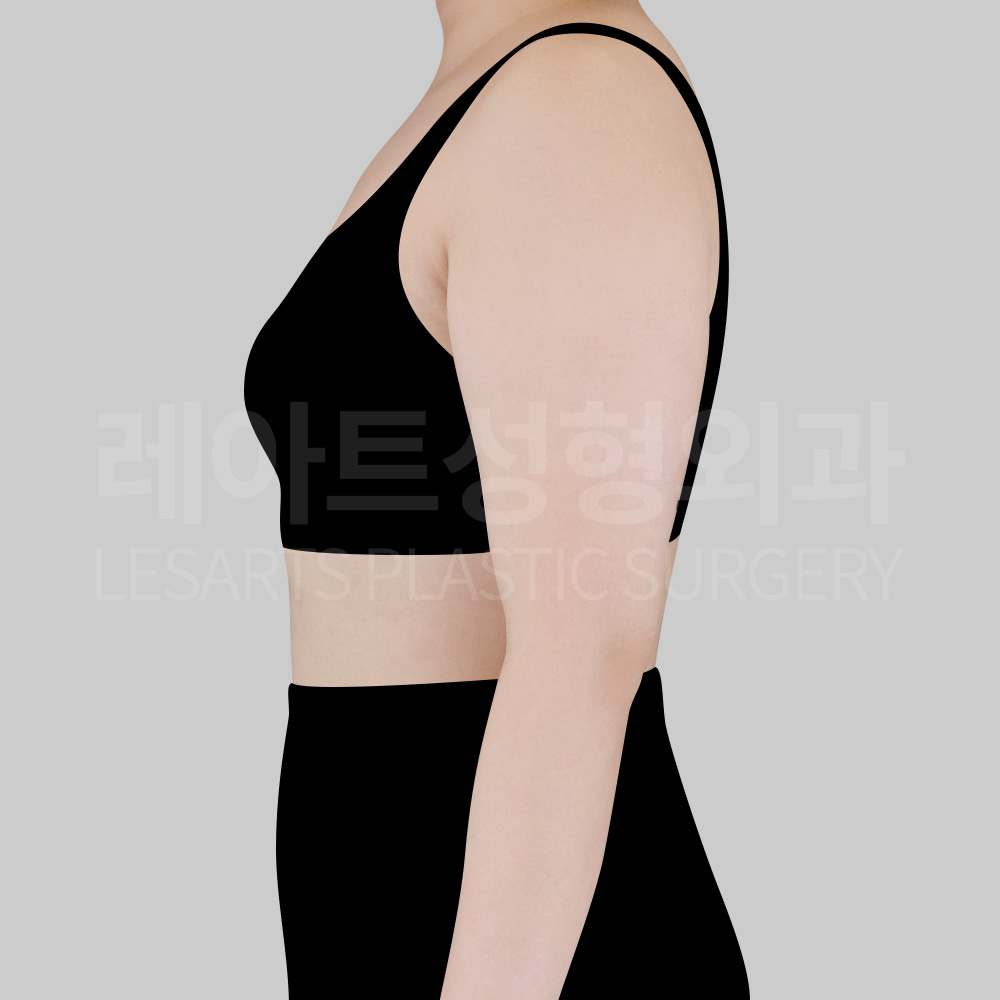
Preoperative Lateral View - Arm Liposuction

Preoperative Posterior View - Arm Liposuction
1. Preoperative Assessment: Why Did the Upper Frame Appear Broader Than Actual Weight?
Patient Profile & Anatomical Characteristics:
- Female in her early 30s / 162 cm / 65 kg
- History of repeated weight cycling: mild reduction in dermal elasticity
- Mixed presentation: firm muscular brachial framework + dense subcutaneous adipose layer
Structural Physical Findings:
- Lateral brachial contour projecting outward along the deltoid-brachial junction
- Mechanical interference where medial arm fat and inner axillary tissue abut thickly
- Consequently, the arms flared outward away from the torso even when standing relaxed at attention
In this anatomical type, debulking only the brachial circumference
might produce a numerically thinner arm,
but fails to achieve the delicate, streamlined upper body silhouette patients truly desire.
2. Key to Upper Frame Reduction: Why Treating the Axilla Is Essential
The primary anatomical factor causing arms to flare outward at rest
is mechanical interference between inner brachial fat and axillary fullness pushing against each other.
Neither reducing the inner arm in isolation nor treating only the axilla provides a complete solution.
By evaluating and contouring these two areas as a single functional unit,
the arm settles naturally against the torso, creating an uninterrupted transition across the shoulder, arm, and flank,
which visibly narrows and refines the entire upper frame.
In this patient's case, an integrated 360-degree approach encompassing the inner axilla
and anterior accessory axillary folds was the critical element for successful contouring.
3. Liposuction Strategy for Muscular-Type Arms
When underlying muscle is developed, surgical technique must prevent
irregular or harsh muscular definition from projecting excessively through the skin.
The lateral brachial line is sculpted smoothly without aggressive gouging to preserve a clean line from the clavicle and acromion,
while inner arm debulking and adjacent axillary volume reduction must achieve balanced synergy.
Furthermore, redundant, pendulous tissue along the posterior triceps bulge is contoured to safe anatomical limits to optimize circumferential reduction.
In summary,
a calibrated regional approach preserving a smooth subcutaneous buffer is essential to prevent prominent muscular edges.

Arm & Axillary Liposuction Outcomes - Dr. Pyongrim Choi, Lesarts
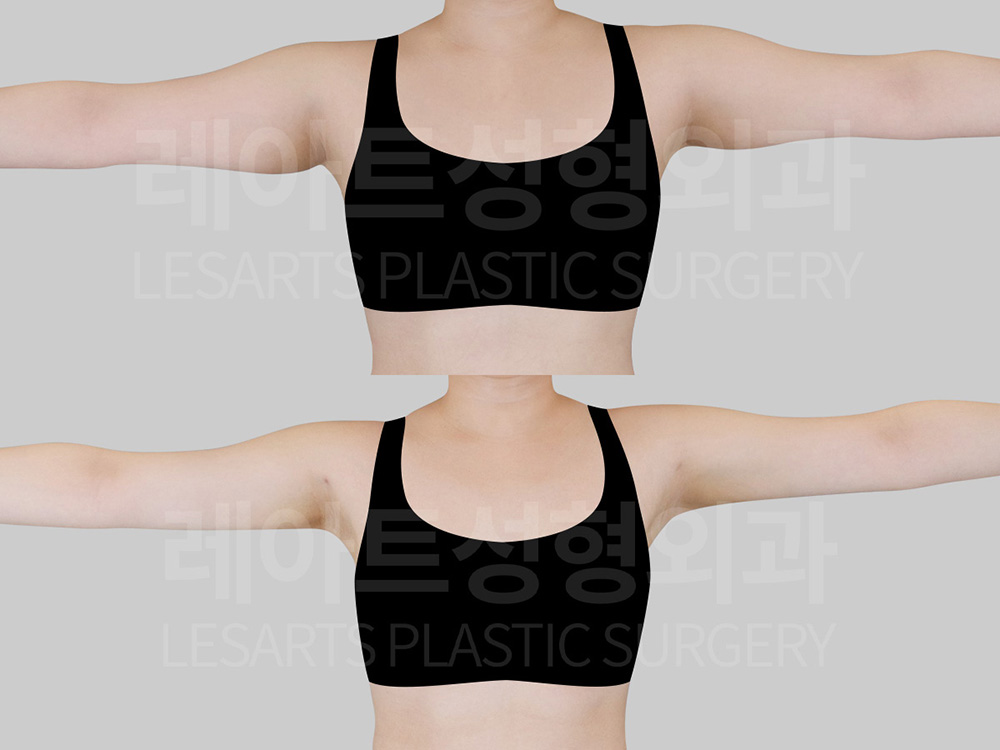
Arm Liposuction Before & After Differences

Posterior Arm Bulge Comparison Before & After - Dr. Pyongrim Choi, Lesarts

3-Month Follow-Up After Arm Liposuction
The most meaningful postoperative change extended beyond numeric circumferential reduction:
it was the anatomical alignment and resting position of the arms relative to the body axis.
- The arms rest naturally and comfortably against the torso without forced effort
- Boundary transitions between the inner axilla and medial arm are smoothly contoured
- The silhouette cascading from the shoulder line down through the arm presents a clean, streamlined contour

Consequently, even at the same body weight as pre-surgery,
the horizontal span of the upper torso appears noticeably narrower from both front and back views,
achieving a visible contour refinement that gives the upper body a smaller, lighter frame.
When contemplating arm liposuction,
many focus exclusively on circumference measurements.
However, the true key to transforming a heavy-appearing upper frame
is viewing the arms and axillae as an interrelated anatomical structure.
If your arms flare out when standing at attention,
or if friction between inner arm fat and axillary folds feels constricting,
incorporating the axilla and accessory breast tissue into a customized three-dimensional design
is essential to achieving a slender, well-proportioned upper silhouette.
For major milestones like weddings or photo sessions,
focusing on comprehensive body contouring that harmonizes the entire upper body frame
delivers more balanced results than simple volume debulking alone.
Arm Liposuction FAQ
Q1. What is the anatomical cause behind arms flaring outward rather than resting against the torso at attention?
A. This is primarily caused by 'mechanical interference' between developed medial arm fat and axillary deposits.
The bulk functions like a cushion, preventing the arm from resting flush against the torso and displacing it outward.
Q2. What is the most critical design consideration when performing liposuction on muscular-type arms?
A. Avoiding over-aspiration that could cause harsh muscular contours to project through the skin.
The lateral line should maintain a smooth transition from the shoulder, inner arm and axillary volume should be balanced, and the posterior bulge refined safely to preserve smooth, feminine lines.
Q3. Why should the axilla and accessory axillary tissue be treated alongside the arms during liposuction?
A. The arm and axilla form an interconnected structural unit. Debulking only the arm leaves axillary fullness
that continues to force the arm outward, keeping the frame wide;
treating both ensures a clean, cohesive boundary between arm and torso.
Q4. What is the 'change in arm resting position' observed as a key milestone at 3 months post-op?
A. Once mechanical interference between the inner arm and axilla resolves, the arm rests closely against the side of the body
without conscious effort. This narrows the perceived horizontal span of the upper torso, making the silhouette appear lighter even without substantial weight loss.
Q5. Why is arm-to-torso adherence more critical than circumferential reduction for brides-to-be wearing wedding dresses?
A. In wedding dress photography, arms flaring outward make the upper frame appear heavier and broader than it actually is.
When the arm rests neatly against the torso, the shoulder line appears cleaner and the overall upper frame looks balanced and refined.
Dr. Pyongrim Choi


Cases finding
similar to my profile
Customer Diagnostics


Select the surgery and
area you are interestedto see real
before andafter changes.


we
make you,
the art
Clinic hours
MON - FRI
10 am – 7pm
SAT
10 am – 4pm
Holiday
SUN, HOLIDAY
Location
Lesarts Moon Clinic Tower 4-5F, 40, Nonhyeon-ro 168-gil,
Gangnam-gu, Seoul, Republic of Korea

Medical institution name Lesarts Plastic Surgery
Address Lesarts Moon Clinic Tower 4-5F, 40, Nonhyeon-ro 168-gil, Gangnam-gu, Seoul, Republic of Korea
Representative Moon sung jun
