




Online Consultation
Please accurately enter the information below.
Quick Cost Consultation
Quick Consultation & Reservation
Cases finding
similar to my profile






Doctor's Note
Medical columns by our surgeons
Early-30s woman with a stubborn lower belly: abdominal liposuction planned around visceral fat, 3-month result.
2026-10-29
Abdominal Liposuction | Why the Lower Belly Is the Last to Go Despite Dieting: A Woman in Her Early 30s at 3 Months [Doctor's Note by Dr. Yongseung Seo]
Q. If the lower belly won't shrink despite diet and exercise, can liposuction solve it?
A. Abdominal liposuction (tummy lipo) can reduce the subcutaneous fat of the lower belly,
but it cannot remove the bulge created when visceral fat pushes the abdominal wall forward.
That is why body fat percentage, visceral fat, and skin condition should be checked before surgery,
and diet and exercise should continue afterward.
[ Learn More About Lesarts Liposuction ]
Written by Dr. Yongseung Seo, Lesarts Plastic Surgery
This column was authored directly by our medical staff.
※ Unauthorized copying, modification, editing, or redistribution is strictly prohibited. ※
Even people who diet and exercise diligently
often share the same concern in consultation.
"When I lose weight, my face and chest go first, and my lower belly is always last."
"Even a little weight gain shows up on my lower belly first."
This happens because fat is not lost or stored
at the same rate throughout the body.
The order and speed of fat loss differ by area and by person,
so for some people the lower belly shrinks relatively late
and is the first place to show weight gain.
As a result, we often hear that the scale goes down, but the lower belly in the mirror stays the same,
and the eye keeps going below the waist in clothes.

[Abdominal Liposuction Before and After - Photos Provided by the Patient]
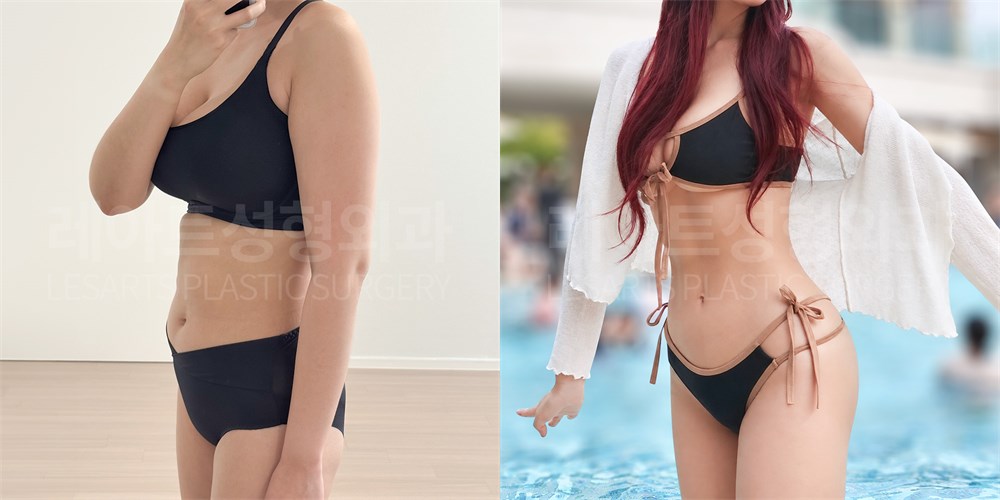
[Abdominal Liposuction Before and After, Side View - Photos Provided by the Patient]
The abdomen is not simply "where the weight went";
body fat percentage, visceral fat, skin condition, and posture all need to be assessed together.
In this column, we review the case of a patient who visited Lesarts for lower belly concerns:
how she was diagnosed, how surgery was planned, and what changed.
[Patient Information]
Age: early 30s
Height: 164 cm
Weight: 57.5 kg (62 kg seven years ago, then maintained at 52 kg, recently regained)
BMI: 21.4 kg/m²
Body fat percentage: 36.0%
Visceral fat level: 9
※ Liposuction results may vary between individuals, even with a similar body profile.
[Pre-Op Body Analysis for Abdominal Liposuction]
"My lower belly bothers me most, and I want to look slimmer overall."

[Pre-Op Body Analysis for Abdominal Liposuction (Front, Back, Side) - Dr. Yongseung Seo, Lesarts]
1. Before Surgery: Only the Lower Belly Protruded
On visual examination before surgery,
the lower abdomen below the navel projected forward,
so from the side only the lower belly stuck out compared with the upper abdomen.
Because of this, the front line of the torso did not flow smoothly,
and with a shallow waist curve, the line between the ribs and pelvis
looked flat from the front and back.
Her visceral fat level was also high at 9.
Visceral fat builds up inside the abdominal wall and around the organs,
pushing the abdominal wall forward from within,
so it can make the lower belly look prominent even after subcutaneous fat is reduced.
Her lower belly bulge was likely influenced
by visceral fat as well as subcutaneous fat.
Ultrasound measurements
Upper abdomen: 32 mm
Lower abdomen: 30 mm
Flanks: 12/12 mm
Love handles: 17/16 mm
These showed a substantial amount of subcutaneous fat.
2. Surgical Plan and Post-Op Care
"There is abundant subcutaneous fat in every area, so there is ample room to reduce size and refine the lines."
However, removing as much as possible everywhere can lead to complications, so we planned
to remove fat generously in safe areas
and more conservatively in areas with a higher risk of side effects.
Because visceral fat was a factor,
we explained in detail that liposuction alone could not fully resolve the lower belly bulge
and that diet and exercise must continue after surgery.
She had lost weight and then regained it, and she did not exercise much,
so we stressed that this would be especially important for maintaining the result.
In addition, her flanks were asymmetric, with different curves and volume on each side,
and we explained in advance that as liposuction reduces the fat that had been masking it,
the left-right difference could become more noticeable.
Finally, she had a horizontal crease above the navel.
If the abdomen is folded or compressed right after liposuction,
fat in that area can shift up and down and leave a deep horizontal groove.
So we advised her to avoid tightening the abdomen with belts or elastic waistbands
and sitting hunched over for long periods in the early recovery period.
[Abdominal Liposuction: Before and After at 3 Months]
(Taken 3 months after surgery under the same lighting and conditions)
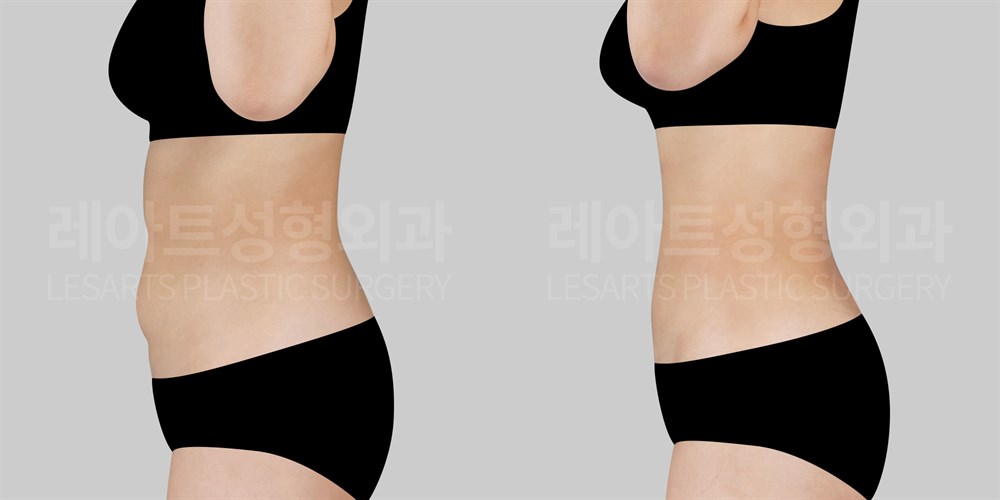
[Lower Belly Liposuction Before and After at 3 Months - Dr. Yongseung Seo, Lesarts]
3. The Protruding Lower Belly Has Clearly Decreased
The forward bulge of the lower belly, her main concern, has decreased significantly.
That said, the abdomen is not completely flat; a natural curve remains in the lower abdomen.
This is because the part where visceral fat pushes the abdominal wall forward
cannot be reduced with liposuction.
Even so, this result was possible
because she managed her weight diligently after surgery and reduced her visceral fat,
so we encouraged her to keep it up.

[Abdominal Liposuction Before and After - Dr. Yongseung Seo, Lesarts Plastic Surgery]
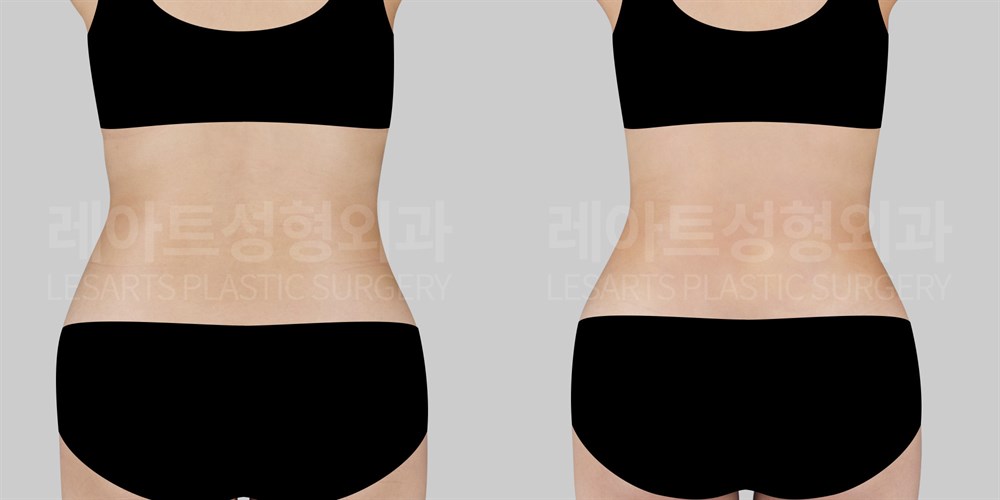
[Flank Line Changes After Abdominal Liposuction - Lesarts Plastic Surgery]
4. Changes in the Waistline and Flanks
Her waistline, which had been flat,
now curves clearly inward after surgery, creating a defined S-line.
As anticipated, however, the flank asymmetry she had before surgery
became a little more visible as the fat decreased,
though it did not bother her much.
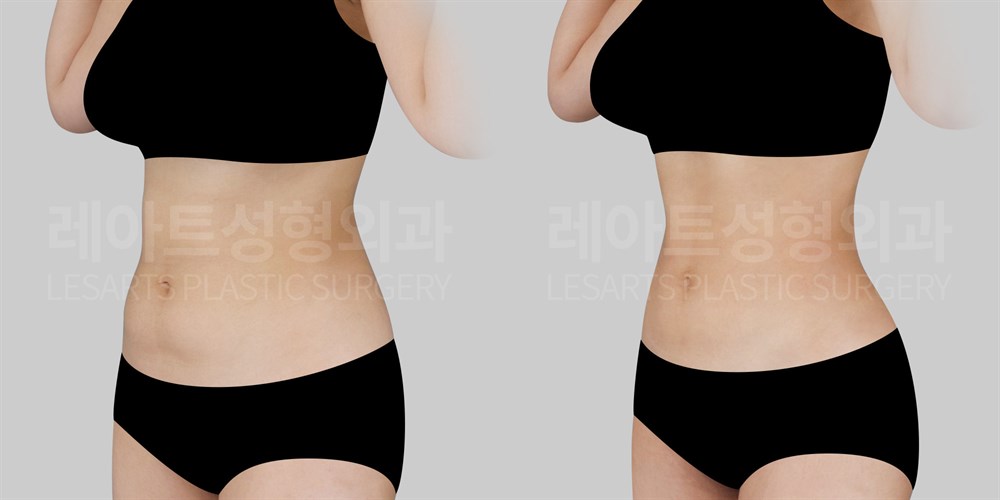
[Waist and Lower Belly Line Changes After Abdominal Liposuction - Dr. Yongseung Seo, Lesarts]
From the side, the front-to-back thickness of her torso decreased markedly,
giving her a much slimmer silhouette.
The line from the waist to the buttocks has also been refined,
resulting in a body that is slim yet still has volume.
[ View More Abdominal Liposuction Cases ]
[Lower Belly Liposuction: Why the Cause Must Be Identified First]
Like this patient, many people come in asking,
"Why won't my lower belly go away even when I diet?"
But expecting liposuction to resolve every concern at once is premature.
A protruding lower belly can be caused by
not only subcutaneous fat but also body fat percentage, visceral fat, skin condition, posture, and lifestyle.
Especially when visceral fat is high, even after liposuction reduces the subcutaneous fat,
diet and exercise must go hand in hand for the lower belly line to improve and last.
That is why it is so important to check the causes carefully before surgery
and plan with a clear understanding of what is possible and what the limits are.
If your lower belly has bothered you for a long time, don't struggle alone—
get an accurate diagnosis at Lesarts.
Lower Belly Liposuction FAQ
Q1. Why is the lower belly the last place to slim down when dieting?
Fat is not lost or stored at the same rate throughout the body.
For some people, the lower belly slims down late and is the first to show weight gain.
Q2. Is abdominal liposuction effective if I have a lot of visceral fat?
Liposuction reduces subcutaneous fat.
The bulge caused by visceral fat pushing the abdominal wall can remain,
so managing visceral fat with diet and exercise after surgery is important.
Q3. Can flank asymmetry become more noticeable after abdominal liposuction?
If asymmetry was present before surgery,
it can become more visible once the fat that masked it is reduced.
It is best to have it checked and explained before surgery.
Q4. Are there positions to avoid early after abdominal liposuction?
If the abdomen is folded or compressed, fat can shift and leave a horizontal groove.
In the early recovery period, avoid tightening the abdomen with belts or elastic bands and sitting hunched over for long periods.
Dr. Yongseung Seo


Cases finding
similar to my profile
Customer Diagnostics


Select the surgery and
area you are interestedto see real
before andafter changes.


we
make you,
the art
Clinic hours
MON - FRI
10 am – 7pm
SAT
10 am – 4pm
Holiday
SUN, HOLIDAY
Location
Lesarts Moon Clinic Tower 4-5F, 40, Nonhyeon-ro 168-gil,
Gangnam-gu, Seoul, Republic of Korea

Medical institution name Lesarts Plastic Surgery
Address Lesarts Moon Clinic Tower 4-5F, 40, Nonhyeon-ro 168-gil, Gangnam-gu, Seoul, Republic of Korea
Representative Moon sung jun
