




Online Consultation
Please accurately enter the information below.
Quick Cost Consultation
Quick Consultation & Reservation
Cases finding
similar to my profile






Doctor's Note
Medical columns by our surgeons
Can gynecomastia surgery release inverted nipples? How it works, and limits like necrosis risk and asymmetry.
2026-10-29
[Medical Column] Can Gynecomastia Surgery Also Correct Inverted Nipples? Possibilities and Limits [Doctor's Note by Dr. Jihoon Moon]
Q. Can gynecomastia surgery also improve nipples that are pulled inward (inverted nipples)?
A. During gynecomastia surgery (male breast reduction), excising the glandular tissue and releasing the subcutaneous tissue
can loosen the fibrous bands that pull the nipple inward, and the inverted nipple sometimes improves.
However, there are limits to how far the dissection can go in order to protect blood flow to the nipple,
and results can differ between sides, so a 100% improvement cannot be promised.
[ Learn More About Lesarts Male Gynecomastia Surgery ]
Written by Dr. Jihoon Moon, Lesarts Plastic Surgery
This column was authored directly by our medical staff.
※ Unauthorized copying, modification, editing, or redistribution is strictly prohibited. ※
1. Most Patients Worry About Protruding Nipples—But What If Inversion Comes With It?
Most patients who visit for gynecomastia
say their greatest stress is chest volume or nipples that protrude
and show through their clothes.
In other words, nipple protrusion
is the concern we hear most often in gynecomastia consultations.
Occasionally, however, we meet patients with the opposite concern as well:
gynecomastia and inverted nipples at the same time.
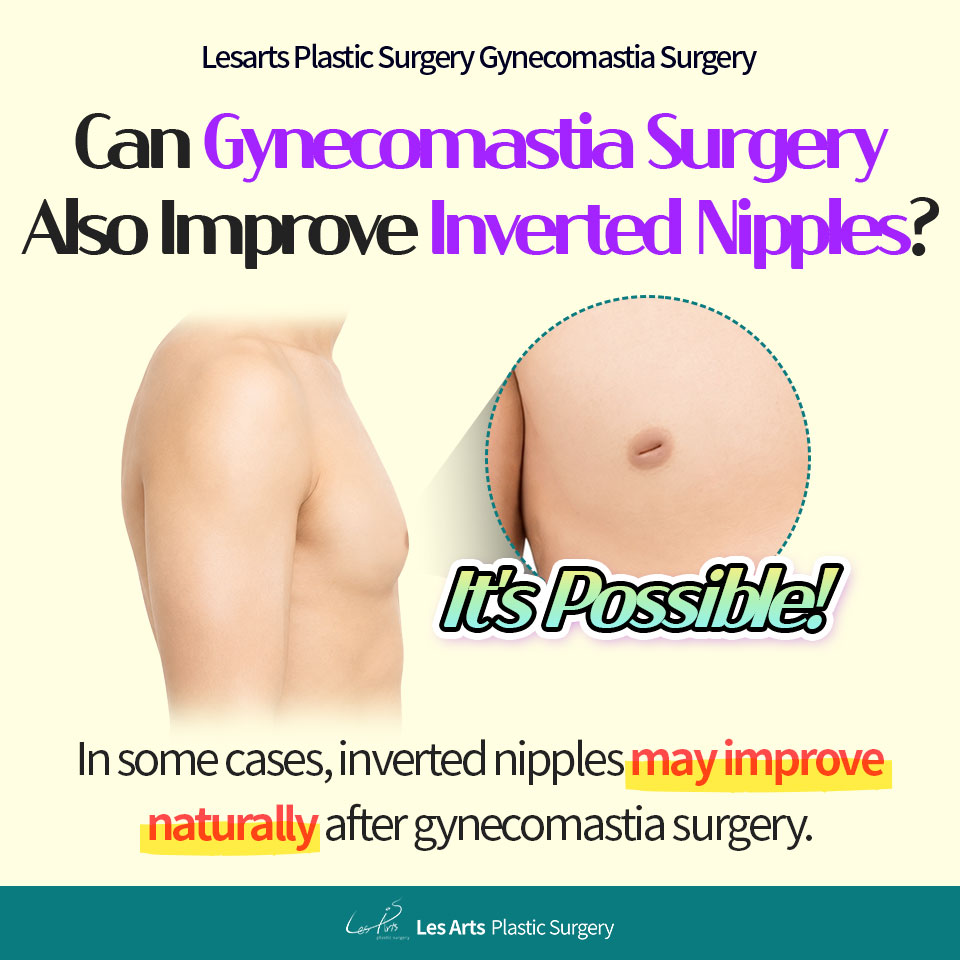
"Doctor, my chest sticks out more than other people's, but my nipples are actually pulled in.
If I have gynecomastia surgery, could the inverted nipples come out too?"
Though not very common, it can mean twice the stress for those affected.
Today, let's talk about inverted nipples that accompany gynecomastia.
To give the conclusion first: there are cases in which inverted nipples
improve naturally after gynecomastia surgery.
However, there are also medical limits and precautions you must keep in mind.
2. What Causes Inverted Nipples, and Where Does Gynecomastia Surgery Come In?
How can an operation for gynecomastia bring a buried nipple outward?
To understand this, we first need to look at the structures that hold the nipple inward.
Medically speaking, beneath the nipple lie
the lactiferous ducts and the fibrous bands that surround them.

To make it easier for patients to understand,
I often describe them as "ligaments pulling the nipple downward."
These fibrous tissues tether the nipple deep into the chest like ropes,
so the nipple cannot rise outward and stays inverted.
Interestingly, an essential step of gynecomastia surgery
overlaps with the process of releasing these fibrous tissues.
Gynecomastia surgery consists of two main steps:
1. Direct excision of overdeveloped glandular tissue
2. Liposuction of the surrounding fat and dissection of the subcutaneous tissue
While removing the firm glandular tissue gathered right under the nipple and refining the surrounding subcutaneous layer,
the fibrous bands and ductal structures that pulled the nipple down
are naturally divided or relaxed.
*Note: Unlike women, men have no particular need to preserve the lactiferous ducts.
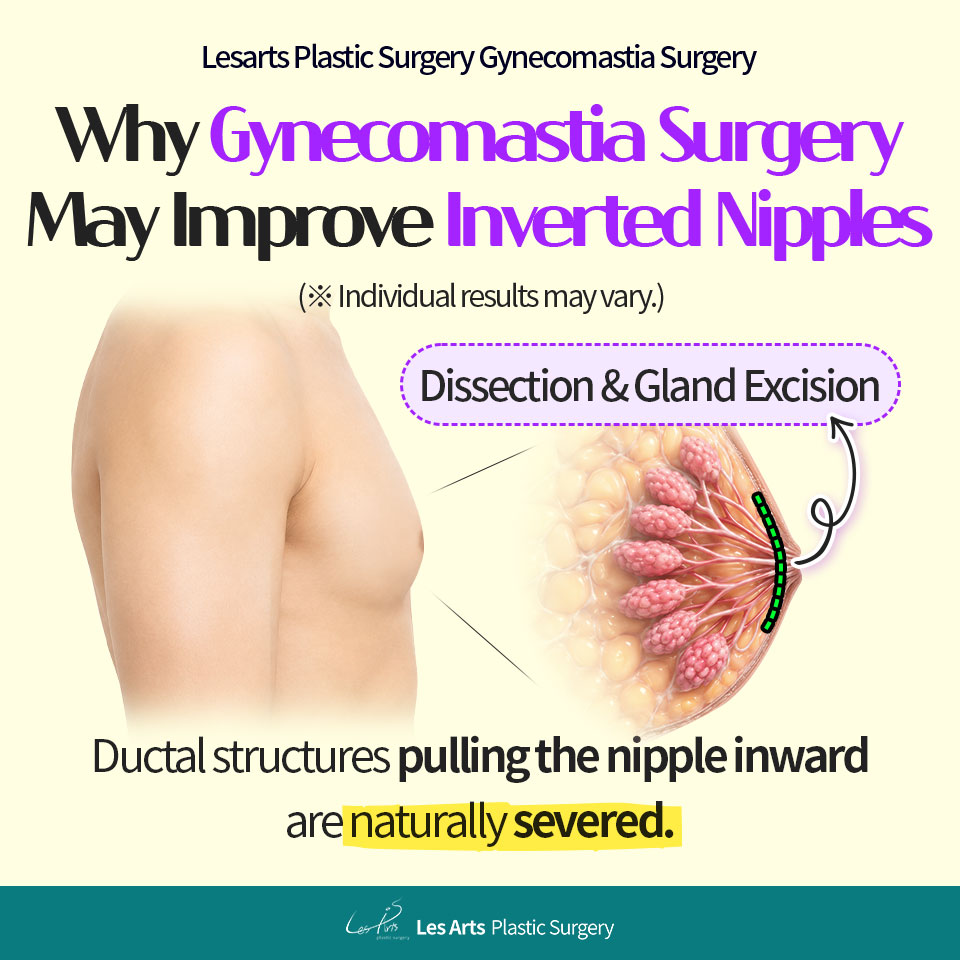
Like a tightly tied rope being loosened, the pulling force on the nipple disappears,
and the nipple that had been trapped inside comes out naturally after surgery—
a welcome result.
3. What I Tell Patients Honestly: "It Can Improve, but I Can't Guarantee It"
You might then ask, "So if I have gynecomastia surgery, will my inverted nipples definitely be fixed?"
But in consultation, I never give that guarantee.
"There are certainly cases where inverted nipples improve after gynecomastia surgery. But I cannot promise it 100%."
There are two clear reasons for this cautious explanation.

First, the risk of an unwanted complication: nipple necrosis
If the skin dissection and subcutaneous tissue removal under the nipple
are performed too aggressively in an effort to pull the nipple out at all costs,
serious problems can occur.
The nipple and areola have a dense vascular network
and are delicate areas that depend on a fine blood supply.
If the tissue under the nipple is shaved or cut too deeply and widely just to release the inversion,
the tiny blood vessels supplying the nipple can be damaged.
In the worst case, this can lead to nipple necrosis,
an irreversible outcome.
The essence of gynecomastia surgery is creating a flat, natural contour across the whole chest.
We cannot accept aggressive dissection that threatens the survival of the nipple
for the secondary goal of correcting an inverted nipple.

Second, uncertainty with bilateral inversion (the possibility of uneven improvement)
When both sides have gynecomastia and inverted nipples,
even if the same surgeon operates on both sides with the same technique,
one side may improve completely while the other improves only partially.
The human body is never perfectly symmetrical,
and the thickness of the fibrous bands, the degree of fibrosis, and the depth of glandular adhesion
differ from side to side.
Therefore, it is important to understand in advance
that the shape of the two nipples may differ after surgery.
4. Inversion on Only One Side? Other Causes Must Be Considered
If only one nipple is inverted—unilateral nipple inversion—
there is one more thing to examine.
If only one side has become inverted suddenly or markedly,
the cause may not simply be glandular traction or congenital fibrous bands.
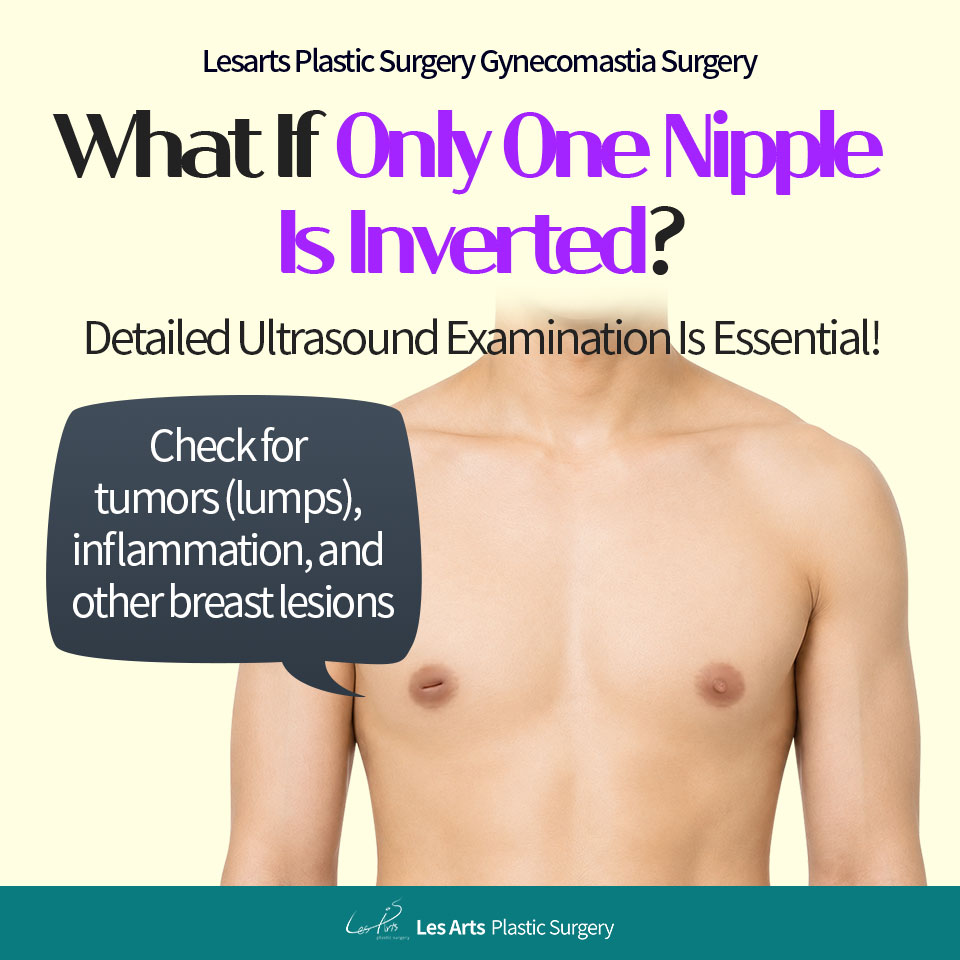
This is because we cannot rule out the possibility that a tumor (lump), an inflammatory condition, or another lesion within the breast
under the nipple is pulling on the surrounding tissue and drawing the nipple inward.
So for a gynecomastia patient with inversion on only one side,
a detailed ultrasound examination must come before gynecomastia surgery
to carefully confirm whether any cause other than glandular tissue is hidden under the nipple.
[ View More Gynecomastia Surgery Cases ]
5. Closing: Doing Our Best Within the Bounds of Safety
In summary, the gland excision and subcutaneous dissection performed during gynecomastia surgery
can be an excellent opportunity to release inverted nipples.
When I operate, along with fully resolving the gynecomastia,
I do everything I can as the surgeon
to also improve the inverted nipples that have troubled the patient.
But I guard against overreaching beyond the line of safety.
If you are dealing with both gynecomastia and inverted nipples,
I recommend approaching it with a realistic and safe perspective:
"Stay open to the possibility of correction through gynecomastia surgery, but operate within a safe range."
Gynecomastia and Inverted Nipples FAQ
Q1. Why can gynecomastia surgery improve inverted nipples?
Beneath the nipple are lactiferous ducts and fibrous bands that pull it inward.
When glandular tissue is excised and the subcutaneous tissue is dissected during gynecomastia surgery,
these structures can be divided or relaxed, allowing the nipple to come out.
Q2. Will gynecomastia surgery always correct inverted nipples?
Improvement is possible, but it cannot be guaranteed 100%.
Dissection is limited to protect blood flow to the nipple,
and because the fibrous bands differ on each side, results can differ between the left and right.
Q3. Can't more dissection be done to make sure the nipple comes out?
The nipple and areola depend on a fine blood supply,
so removing tissue under the nipple too deeply or widely can damage blood vessels
and, in the worst case, lead to nipple necrosis.
Q4. What examination is needed for gynecomastia with inversion on only one side?
If only one side has become inverted suddenly or markedly,
there may be another cause, such as a tumor or inflammatory condition,
so a detailed ultrasound examination is needed before surgery.
Dr. Jihoon Moon


Cases finding
similar to my profile
Customer Diagnostics


Select the surgery and
area you are interestedto see real
before andafter changes.


we
make you,
the art
Clinic hours
MON - FRI
10 am – 7pm
SAT
10 am – 4pm
Holiday
SUN, HOLIDAY
Location
Lesarts Moon Clinic Tower 4-5F, 40, Nonhyeon-ro 168-gil,
Gangnam-gu, Seoul, Republic of Korea

Medical institution name Lesarts Plastic Surgery
Address Lesarts Moon Clinic Tower 4-5F, 40, Nonhyeon-ro 168-gil, Gangnam-gu, Seoul, Republic of Korea
Representative Moon sung jun
