




Online Consultation
Please accurately enter the information below.
Quick Cost Consultation
Quick Consultation & Reservation
Cases finding
similar to my profile






Doctor's Note
Medical columns by our surgeons
Abdominal Liposuction | Weight Going Up and Down While Your Lower Belly Stays the Same? 4-Month Changes in a Patient in Her 20s [Doctor's Note by Dr. Pyongrim Choi]
2026-11-23
Abdominal Liposuction | Weight Going Up and Down While Your Lower Belly Stays the Same? 4-Month Changes in a Patient in Her 20s [Doctor's Note by Dr. Pyeong-rim Choi]
Written by - Dr. Pyeong-rim Choi, Lesarts Plastic Surgery
This post was written directly by the attending medical staff.
※ Unauthorized copying, processing, editing, and redistribution are prohibited ※
Q. If fat on your lower abdomen and flanks has increased
after repeated cycles of losing and regaining weight,
can abdominal liposuction change your body line?
A. For abdominal liposuction, it is important to determine the surgical range
by checking fat distribution not only in the upper and lower abdomen,
but also in the flanks and love handles.
Especially if there have been repeated weight fluctuations,
the amount of fat removed should be adjusted while considering skin elasticity and contraction potential.
[ Learn more about Lesarts Abdominal Liposuction ]
When consulting about abdominal liposuction,
it is not only people with higher body weight—
there are also quite a few women in their 20s who feel their abdominal line has changed
after repeatedly losing weight and then gaining it back.
In particular, when fat increases in the abdomen,
not only does the belly protrude forward,
but the flanks and love handles also thicken,
changing the body shape so the waist looks less defined.
In this post, we will examine the 4-month post-operative changes
of a woman in her mid-20s who decided on abdominal liposuction
after fat increased across her abdomen following frequent weight fluctuations.
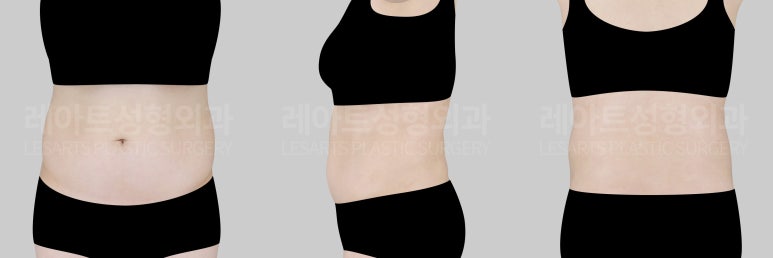
[Condition before abdominal liposuction surgery - Lesarts Plastic Surgery]
1. Before surgery, we must check not only fat volume but also skin elasticity.
The patient was a woman in her mid-20s, measuring 158 cm and weighing 61 kg.
She had recently experienced weight fluctuations of about 5–6 kg several times,
and as previously lost weight returned,
fat had accumulated throughout her abdomen.
Examining her abdomen, fat layers were present in both the upper and lower abdomen,
with fat around the flanks and love handles especially prominent.
With this body type, reducing only the lower belly seen from the front
may make it difficult to achieve the desired waistline.
If volume remains on the flanks,
the waist can look wide from the front,
and from the back, the lower waist
can look blocky or less defined.
Another important factor we checked was skin elasticity.
Being in your 20s does not mean
that all skin has the same elasticity.
Depending on repeated weight fluctuations, changes in the fat layer,
and individual skin characteristics,
there can also be differences in how much
the skin contracts after liposuction.
Therefore, in this case, rather than simply removing a large amount of fat,
it was important to check the thickness and distribution of the fat layer
while also considering how much the skin
could contract after surgery.
2. There were three goals for this abdominal liposuction.
The first was, when viewed from the front,
to reduce volume on both sides of the waist to create a slimmer line.
The second was to reduce lower abdominal protrusion
so that the lower belly looks noticeably flatter.
The third was, when viewed from the side,
to reduce the thickness of the forward-protruding abdomen and flanks
while preserving her natural pelvic contour.
These three goals are not separate from one another;
they are connected.
Rather than focusing on just one area,
we planned the surgery to design the overall abdominal contour
so the upper abdomen, lower abdomen, and flanks flow naturally together.
3. How to minimize skin sagging while refining fat?
When considering skin sagging in abdominal liposuction,
it is just as important to examine current skin condition and fat layer structure
as it is to consider how much fat is removed.
If you remove excessive fat unconditionally
when skin elasticity is reduced,
the skin may not contract enough,
causing remaining skin to look loose
or feel uneven on the surface.
Therefore, after checking the thickness and distribution of the fat layer,
skin elasticity, and overall abdominal shape,
we must determine an appropriate removal range.
Rather than how much fat was removed,
what matters is how balanced the volume
of the needed areas was refined.
Also, making only a specific area overly thin
can create height differences with surrounding areas
or make the abdominal surface look bumpy.
We need a balanced refinement tailored to each area's characteristics
without excessively removing the fat layer directly beneath the skin.
Right after liposuction, swelling and tissue changes remain,
making it difficult to judge the final line immediately.
Over time, swelling decreases, tissues heal,
and the skin continues to contract.
Wearing a compression garment and activity levels
are also best guided according to
each individual's surgical extent and recovery status.
4 months after abdominal liposuction surgery
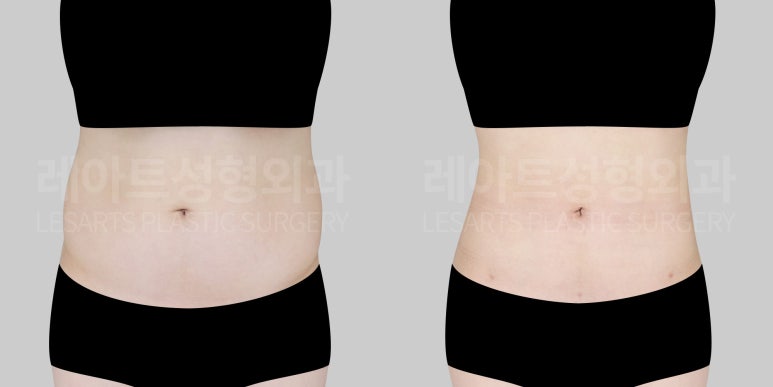
[Before and after comparison of abdominal liposuction - Dr. Pyeong-rim Choi, Lesarts]
From the front, as volume on both sides of the waist decreases,
you can see how the waistline has changed.
Here, rather than looking only at waist width,
we should also check whether the transition from the upper abdomen to the flanks
and the connection above the pelvis flow naturally.
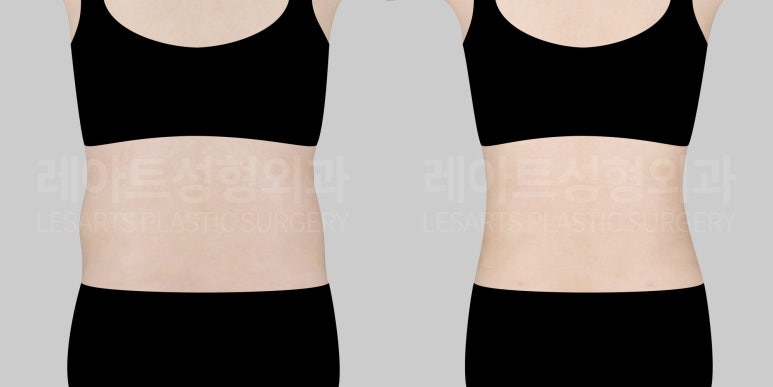
[Flank line changes after liposuction - Dr. Pyeong-rim Choi, Lesarts]
From the back, you can compare how much volume in the love handle area was reduced
and how the silhouette flowing from the lower back to the waist
has changed.

[Line changes after abdominal liposuction - Lesarts Plastic Surgery]
From the side, you can check the degree of lower abdominal protrusion
and overall abdominal thickness changes.
Whether the lower belly looks flatter than before
and whether the contour from the upper to lower abdomen
connects naturally are also important comparison points.
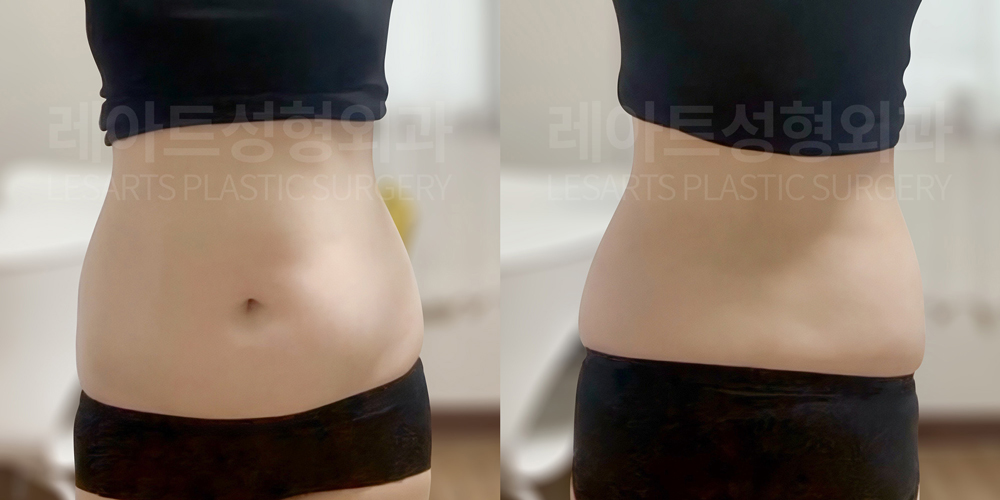
[Selfie before Lesarts abdominal liposuction - provided by patient]

[Selfie after Lesarts abdominal liposuction - provided by patient]
Because the patient already had somewhat reduced skin elasticity before surgery,
we also needed to check not only the reduction in fat volume, but also whether the skin surface stayed even
and whether any noticeable sagging or unevenness appeared.
Especially if you have experienced repeated weight fluctuations, you must consider both fat volume and skin elasticity.
If you are considering abdominal liposuction, rather than simply how much fat can be removed,
first check which areas of your body shape should be refined and which curves should be maintained
to create a natural line.
Because suitable surgical methods and expected changes can vary
depending on individual fat distribution and skin condition,
it is best to make a plan tailored to you through thorough consultation and examination.
[ Learn more about Lesarts Abdominal Liposuction ]
[ Learn more about Lesarts Abdominal Liposuction cases ]
Abdominal Liposuction FAQ
Q1. Can repeated weight loss and gain reduce abdominal skin elasticity?
When the volume of the fat layer changes due to repeated weight fluctuations,
it can also affect how well the skin contracts.
However, skin elasticity varies not only with age
but also with individual skin characteristics.
Q2. Will liposuction on just the lower belly also make my waistline slimmer?
If fat on the flanks and love handles also affects your waist width,
reducing only the lower abdomen may not be enough to create your desired line.
You need to check overall fat distribution together.
Q3. Is it better to remove as much fat as possible in abdominal liposuction?
Not necessarily. If you remove an excessive amount without considering skin elasticity
and fat layer thickness, skin sagging or surface unevenness
can become more noticeable,
so adjusting the removal amount for each area is important.
Q4. Can you see the final line right after abdominal liposuction?
Immediately after surgery, swelling and tissue changes remain,
making it difficult to judge the final line right away.
You need to observe the process as swelling subsides and skin contracts
during recovery.
Q5. Do I definitely have to wear a compression garment after abdominal liposuction?
How and how long to wear a compression garment can vary
depending on the surgical extent and individual recovery status.
After surgery, it is best to wear it as guided by your medical team
and adjust your activity level accordingly.
Dr. Pyongrim Choi


Cases finding
similar to my profile
Customer Diagnostics


Select the surgery and
area you are interestedto see real
before andafter changes.


we
make you,
the art
Clinic hours
MON - FRI
10 am – 7pm
SAT
10 am – 4pm
Holiday
SUN, HOLIDAY
Location
Lesarts Moon Clinic Tower 4-5F, 40, Nonhyeon-ro 168-gil,
Gangnam-gu, Seoul, Republic of Korea

Medical institution name Lesarts Plastic Surgery
Address Lesarts Moon Clinic Tower 4-5F, 40, Nonhyeon-ro 168-gil, Gangnam-gu, Seoul, Republic of Korea
Representative Moon sung jun
