




Online Consultation
Please accurately enter the information below.
Quick Cost Consultation
Quick Consultation & Reservation
Cases finding
similar to my profile






Doctor's Note
Medical columns by our surgeons
Gynecomastia | Is Male Breast Enlargement (Gynecomastia) Hereditary?
2026-07-09
Gynecomastia | Is Male Breast Enlargement (Gynecomastia) Hereditary?
Is Gynecomastia Really a Genetic Condition?
Gynecomastia is not an inherited genetic disease.
Rather, it typically arises from temporary hormonal fluctuations during infancy, puberty, or midlife,
and can be effectively treated following an accurate medical evaluation.
▶ Lesarts Gynecomastia Surgery Overview
Hello, I am Dr. Kukhan Lee, Plastic Surgeon at Lesarts Plastic Surgery Clinic.
Recently, a growing number of male patients visit our clinic asking,
"Could I have gynecomastia?"
with deep concerns about their chest appearance.
Men of all age groups, from teenagers to men in their 50s,
seek consultation due to prominent chest enlargement.
One of the most frequent questions asked during consultations is:
"Is gynecomastia genetic?"

Do Fathers and Sons Share the Same Gynecomastia Concerns?
In clinical practice, it is quite common for family members to visit together inquiring whether gynecomastia runs in families.
Fathers accompanying their teenage sons often remark:
"I also had a slightly enlarged chest when I was young, and my son seems similar. Is this hereditary?"
Additionally, men in their 20s and 30s preparing for marriage frequently ask:
"If I have a son in the future, could he develop enlarged chest tissue like me?"
So, is gynecomastia truly a hereditary condition?
To state the medical fact clearly:
Gynecomastia is not a hereditary disorder.

The fundamental cause of male gynecomastia is endocrine imbalance.
Rather than being dictated by inherited genetics, it typically develops when the ratio between testosterone and estrogen shifts,
triggering glandular tissue proliferation.
Therefore, understanding the 'three key hormonal transitional stages' in a man's life
provides clarity on why this occurs.

Gynecomastia can manifest during three distinct life stages in men.
① Infancy (Neonatal Period)
Due to the transplacental passage of maternal estrogens during pregnancy,
newborn males may experience transient breast bud swelling or mild galactorrhea.
This is a completely normal physiological phenomenon that resolves spontaneously over time.
② Puberty (Adolescence)
This is the most prevalent window of onset.
During early puberty, temporary shifts in sex hormone ratios
allow relative estrogen activity to stimulate breast glandular tissue growth.
In most adolescents, testosterone levels gradually surge with secondary sexual characteristics, leading to regression;
however, in certain cases, hypertrophic glandular tissue persists
and remains as visible chest fullness well into adulthood.
In fact, a significant proportion of adult patients seeking medical care trace their gynecomastia back to this stage.
③ Midlife and Older Age (Andropause)
As men advance into midlife, circulating testosterone levels steadily decline.
With the onset of male andropause,
reductions in vitality are often accompanied by alterations in body composition and chest contours.
Even men who never had prominent breast tissue in their youth
may develop localized protrusion or chest ptosis later in life.
Is Gynecomastia Entirely Driven by Hormonal Transitions Rather than Genetics?
Gynecomastia is not a hereditary disease;
in the vast majority of cases, it develops under the influence of physiological endocrine shifts across the life cycle.
To summarize, while men face three physiological stages
where breast tissue may enlarge,
the etiology stems from acquired hormonal shifts rather than direct genetic transmission.
"Did my son inherit gynecomastia from his father?"
"My husband has enlarged breasts; will our son inevitably develop them too?"
There is no need to carry unnecessary anxiety regarding hereditary transmission.
Gynecomastia is not hereditary.
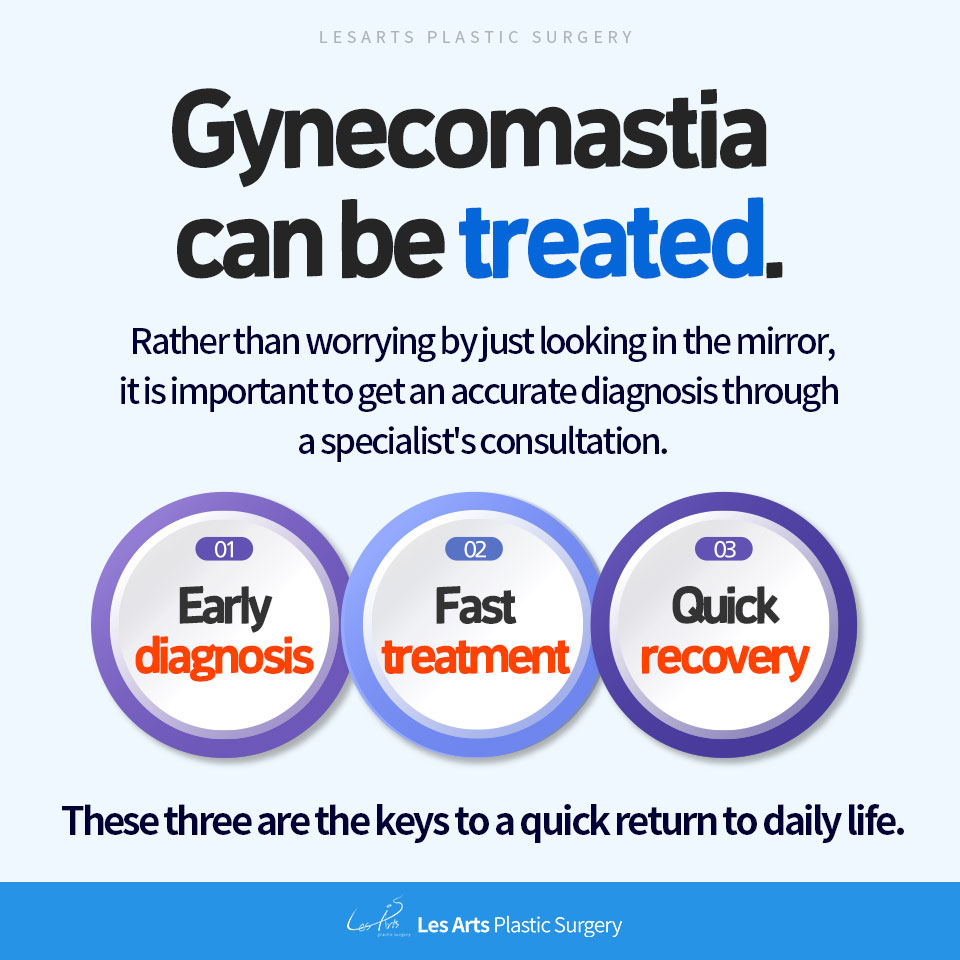
Furthermore, gynecomastia is a fully treatable medical condition.
Even if gynecomastia has become established due to hormonal imbalances,
it can be definitively corrected through surgical treatment (glandular excision combined with liposuction).
Rather than worrying alone, consulting a specialized surgeon
to determine the precise underlying cause is the most effective first step.
Early Diagnosis
Prompt Treatment
Rapid Recovery
These three pillars ensure a safe and swift return to confident everyday life.

Keep this key fact in mind:
Gynecomastia is not genetic.
However, reliable correction is readily available.
Rather than carrying silent stress, schedule a professional consultation
to obtain an accurate ultrasound evaluation and establish a tailored surgical plan designed for your chest anatomy.

FAQ
Q1. Is gynecomastia hereditary?
A. Gynecomastia is not a hereditary disorder. While familial tendencies related to shared metabolic environments
or body types can exist, it is not classified as a directly inherited condition.
Q2. What causes male gynecomastia to develop?
A. The most common underlying factor is hormonal imbalance between androgens (testosterone) and estrogens.
It frequently emerges during major endocrine transitional phases such as infancy, puberty, and midlife andropause.
Q3. If a father has gynecomastia, will his son definitely develop it?
A. No. Having a father with gynecomastia does not guarantee that a son will develop the condition.
Development depends entirely on individual endocrine regulation and overall physiological health.
Q4. Does pubertal gynecomastia resolve spontaneously?
A. In the vast majority of adolescent boys, chest tissue normalizes naturally as hormone levels stabilize.
However, if proliferative glandular tissue fails to regress and persists into adulthood, consulting a specialist for ultrasound diagnosis is recommended.
Q5. Is gynecomastia completely treatable?
A. Yes. Once the root cause is established through precise diagnosis, tailored clinical management yields high success rates,
with surgical excision and chest contouring providing definitive, lasting correction when indicated.
Dr. Kukhan Lee


Cases finding
similar to my profile
Customer Diagnostics


Select the surgery and
area you are interestedto see real
before andafter changes.


we
make you,
the art
Clinic hours
MON - FRI
10 am – 7pm
SAT
10 am – 4pm
Holiday
SUN, HOLIDAY
Location
Lesarts Moon Clinic Tower 4-5F, 40, Nonhyeon-ro 168-gil,
Gangnam-gu, Seoul, Republic of Korea

Medical institution name Lesarts Plastic Surgery
Address Lesarts Moon Clinic Tower 4-5F, 40, Nonhyeon-ro 168-gil, Gangnam-gu, Seoul, Republic of Korea
Representative Moon sung jun
