Thigh Liposuction | Does Maximum Fat Removal Mean Better Legs? No! Adipose Preservation for Balanced Contours
Q. Why is intentional fat preservation more critical than excessive fat removal in thigh liposuction?
A. To soften underlying muscular irregularity and create a continuous, streamlined contour connecting the skeletal frame with adjacent body curves.
Excessive, aggressive fat evacuation exposes raw muscular ridges,
paradoxically making the thighs look bulkier, masculine, or causing gluteal sagging.
Strategic preservation of thin adipose layers—such as along the mid-inner thigh, the sub-iliac transition, and the lateral fibrous band—is crucial to buffer underlying anatomy,
producing elongated, natural, and feminine hip-to-thigh transitions.
▶ Learn More About Lesarts Liposuction
Hello, I am Dr. Yongseung Seo, Plastic Surgeon at Lesarts Plastic Surgery Clinic.
Almost every woman has envisioned
slender, beautifully sculpted lower limbs.
However, there is a common misconception that 'legs with zero subcutaneous fat are the most aesthetically pleasing.'
Is that truly the case?
When nearly all subcutaneous fat is stripped away, the underlying muscular silhouette becomes starkly visible.
Because lower extremity musculature exhibits irregular bulges and deep grooves rather than uninterrupted curves,
feminine contour smoothness is diminished.
Overly defined muscle outlines not only disrupt aesthetic harmony,
but can also create the optical illusion of wider, heavier legs.
Human visual perception naturally focuses on lateral protrusions and convex contours before noticing hollow indents.
In other words, rather than appreciating slim hollows, projecting muscular bulges catch the eye,
yielding a bulky overall impression.
Therefore, when fat is removed excessively, residual anatomical bulges become accentuated,
often making the legs appear thicker than anticipated.
In this clinical case, comprehensive thigh and hip line liposuction reduced stubborn volume while preserving strategic adipose buffers,
establishing a smooth, harmonious, and elongated lower body silhouette.
Patient Profile
Age : Late 20s
Height : 168 cm
Weight : 64 kg
BMI : 22.7 kg/m²
※ Liposuction outcomes may vary individually even among patients with similar physical characteristics depending on adipose distribution and dermal elasticity.
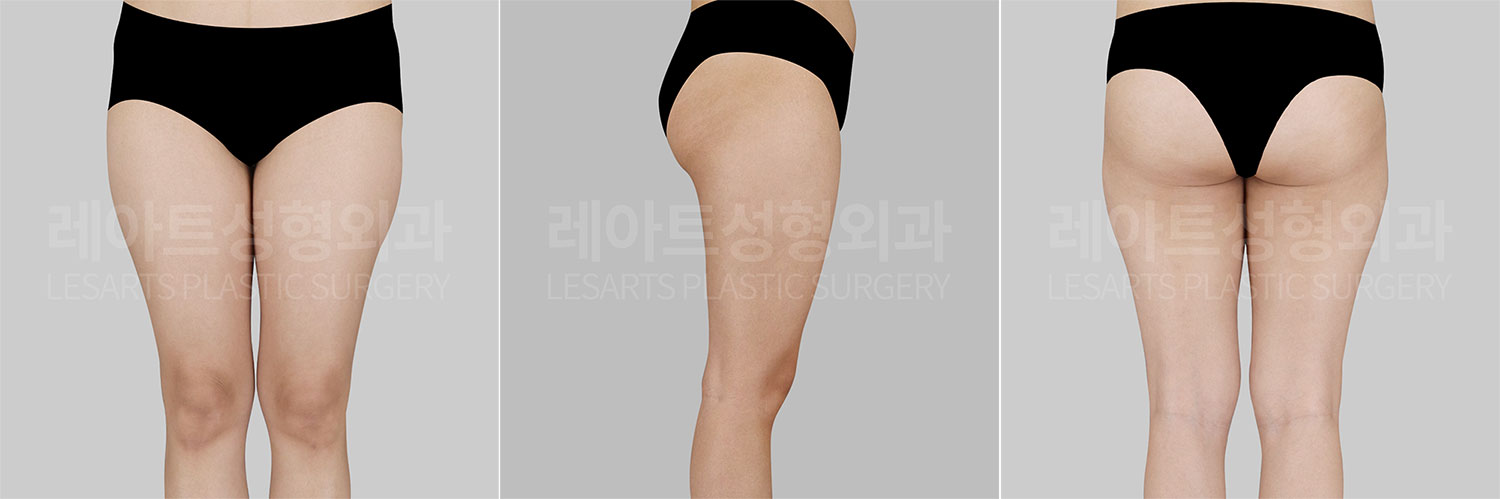
Lesarts Thigh & Hip Line Liposuction: Pre-Operative Assessment
[Pre-Operative Body Contour Assessment]
The patient did not engage in regular strenuous exercise.
Recent weight gain over the past 1–2 years had progressively increased her thigh circumference.
Clinical evaluation identified:
1. Medial Thigh (Inner Aspect)
Lack of an inner thigh gap created a heavy, crowded appearance,
with noticeable fat accumulation across the upper inner thigh and medial knee pads,
while the middle inner zone was relatively hollow, disrupting line continuity.
This step-off exaggerated the perceived thickness of the upper thigh and knee regions.
2. Lateral Thigh (Outer Aspect)
Pronounced trochanteric saddlebags contributed to a broad, heavy thigh silhouette,
visually shortening the lower body proportions.
Furthermore, saddlebag projection overshadowed the natural curve of the lateral pelvic line.
High-resolution ultrasound imaging confirmed adequate, extractable subcutaneous fat
across most areas, with thinner adipose layers along the posterior hamstrings.
[Surgical Design: Circumferential Thigh & Hip Line Liposuction for Circumference Reduction and Line Correction]
The patient's primary goals were effective reduction of the inner thighs and lateral saddlebags,
avoiding an over-resected, skeletonized appearance while accentuating a smooth pelvic curve
through maximal removal of unnecessary fat paired with anatomical preservation.

Surgical Approach: Inner Thigh (Medial Aspect) Liposuction
1. Medial Aspect
Bulging fat along the upper inner thigh was thoroughly debulked to
create a natural, clean inner thigh gap.
Subcutaneous fat around the medial knee was sculpted to blend seamlessly into the calves,
visually elongating the leg lines.
Conversely, a thin adipose layer was intentionally preserved in the slight mid-thigh depression (bold arrow)
to avoid contour step-offs and preserve line continuity,
yielding a straight, continuous inner leg profile.
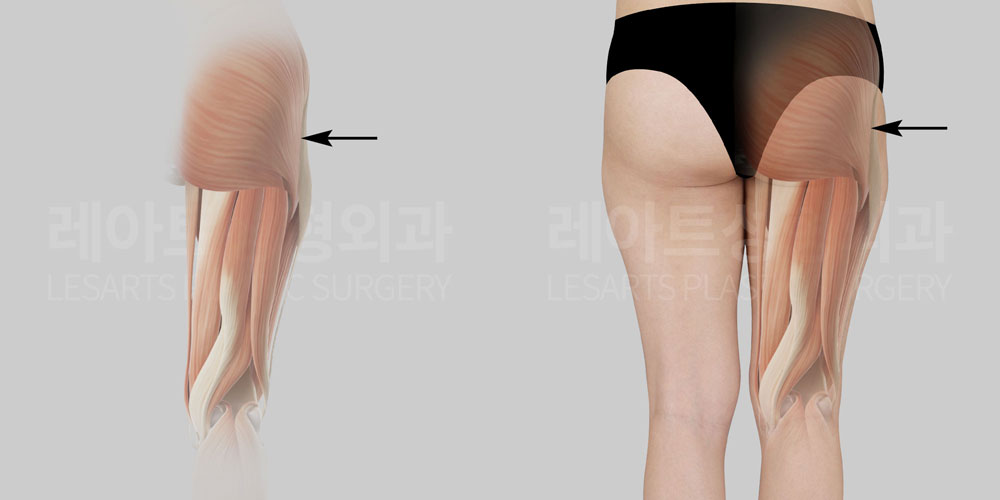
Surgical Approach: Saddlebag (Lateral Aspect) Liposuction
2. Lateral Aspect
While lateral trochanteric fat was extensively aspirated, because the patient desired to preserve pelvic curvature,
the widest pelvic apex was structurally preserved.
Directly below this apex, where the thigh transitions into the lower gluteus,
complete evacuation would cause an unnatural indentation (bold arrow);
therefore, a controlled layer of fat was preserved to maintain a smooth
and natural transition from the hips into the thighs.
This approach creates an optical lengthening of the legs while highlighting feminine hip proportions.
Furthermore, because the patient sought substantial overall reduction,
we explained that concurrent hip line contouring would smooth the lower gluteal transition,
optimizing full lower-body balance.
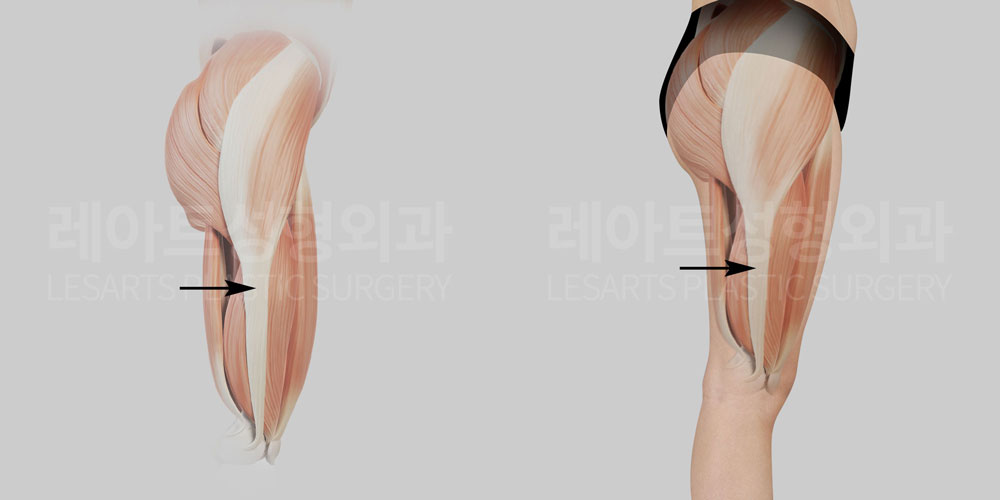
Surgical Approach: Outer Mid-Thigh Liposuction
The mid-lateral thigh contains a dense fibrous tract (iliotibial band)
firmly anchoring the muscle (bold arrow);
excessive fat extraction here creates a sunken lateral depression,
exaggerating a masculine, muscular contour.
Accordingly, a delicate layer of subcutaneous fat was retained across this tract
to maintain a gentle transition between anterior and posterior muscle compartments.
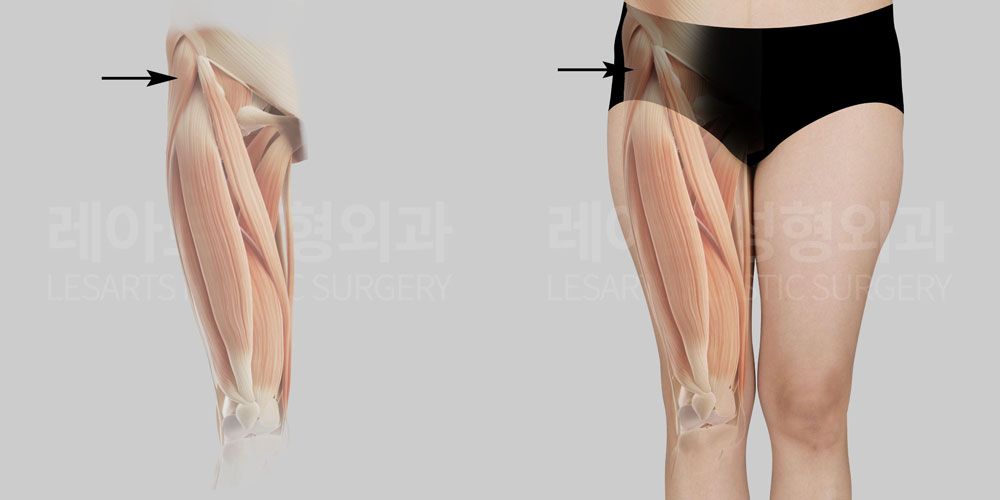
Surgical Approach: Anterior Thigh Liposuction
3. Anterior Aspect
Because the anterior quadriceps exhibits a natural convex anterior curvature,
artificially attempting a flat profile by preserving upper or suprapatellar fat pads
can make the leg appear heavy and unrefined.
The primary objective was thorough removal of superficial anterior fat,
with micro-adjustments between sides explained pre-operatively
to correct slight baseline muscular asymmetries.
Additionally, complete fat evacuation from the upper-outer quadrant
can cause a hollow step-off (bold arrow);
thus, a balanced adipose buffer was preserved to blend smoothly into the pelvic curvature.

4. Posterior Aspect
Because posterior subcutaneous fat is naturally thinner, drastic circumferential reduction is limited;
prominent muscular convexities were feathered and aspirated within safe physiological margins (red arrow).
Conversely, over-resecting subgluteal fat (black arrow) exposes hamstring borders and can trigger buttock ptosis,
so the infra-gluteal roll was conservatively contoured to preserve structural support and lift.
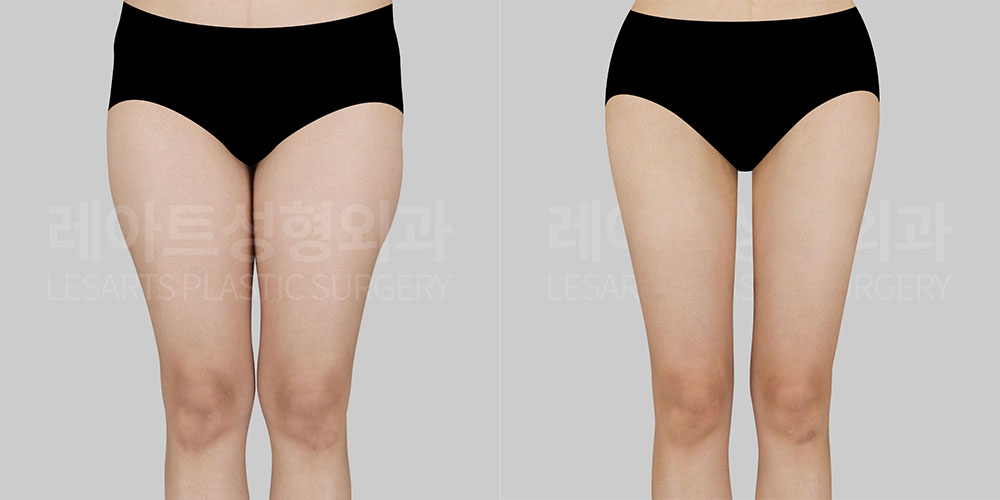
Thigh & Hip Line Liposuction: Before & After (Anterior View)
[Thigh Liposuction Before & After: Anterior View]
(Photographed 5 months post-op under standardized lighting and positioning.)
Pre-operatively, the patient presented with generalized lower limb fullness,
with significant adipose concentration in the saddlebags and medial thighs.
Contour irregularities were visible, and the lateral hip transition was relatively flat.
Carefully factoring in her anatomy and aesthetic expectations,
saddlebags and inner thigh fat were systematically reduced
while maintaining natural pelvic width.
The overall design prioritized uninterrupted leg lines and refined contours.
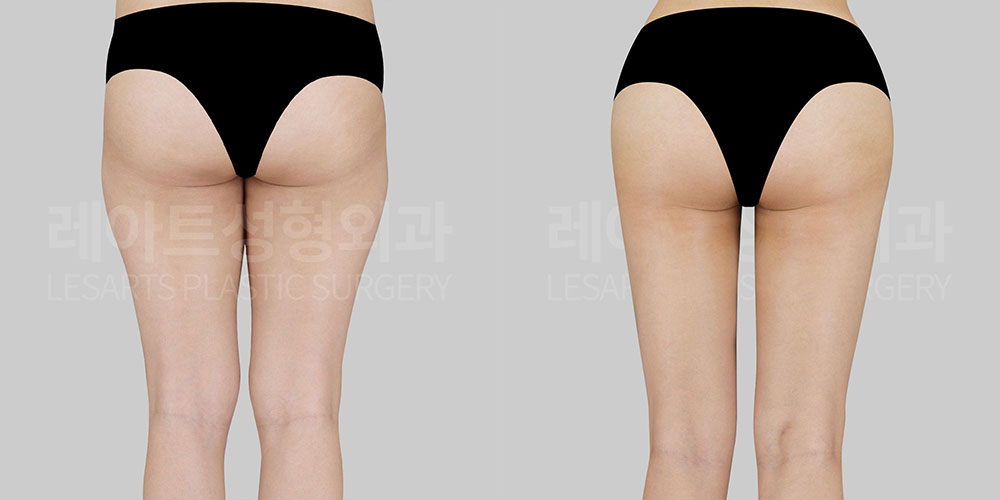
Thigh & Hip Line Liposuction: Before & After (Posterior View)
[Thigh & Hip Line Liposuction Before & After: Posterior View]
(Photographed 5 months post-op under standardized lighting and positioning.)
Medially, a natural, streamlined inner thigh gap was formed,
and medial knee sculpting aligned smoothly
with the calf line for a sleek, cohesive silhouette.
Laterally, eliminating saddlebag bulges slimmed overall thigh circumference,
flowing smoothly into the pelvic contour
to establish an elegant, feminine hip-to-thigh transition.
※ Minor visual differences between right and left thighs in photos
are artifacts of photographic stance and angle;
bilateral contours are symmetrical in clinical evaluation.
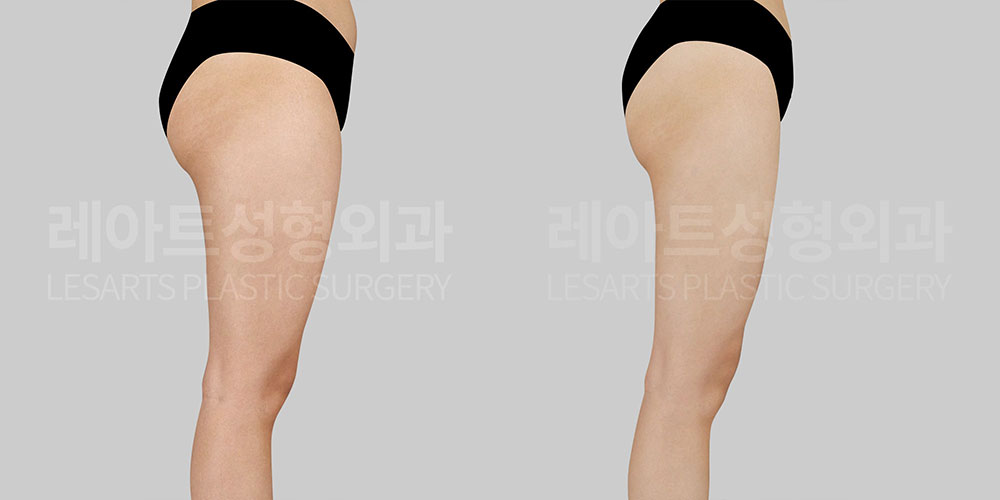
Thigh & Hip Line Liposuction: Before & After (Lateral View)
[Thigh & Hip Line Liposuction Before & After: Lateral View]
(Photographed 5 months post-op under standardized lighting and positioning.)*
On the lateral profile, the prominent anterior thigh convexity
was softened into a gentle curve and a noticeably slimmer silhouette.
Posteriorly, as planned, contour blending was favored over aggressive reduction
to preserve natural gluteal balance.
Because the patient did not want an over-resected, hollowed appearance,
surgery was executed with close attention to muscular architecture,
selectively preserving delicate fat buffers in key anatomical transition zones.
This successfully reduced thigh circumference while uniting feminine curves with proportional volume.
The outcome closely aligned with the patient's aesthetic goals,
and consistent post-operative lifestyle management
will support long-term maintenance of these refined lines.
FAQ
Q1. Why is complete, maximal fat removal discouraged in thigh liposuction?
A. Total fat evacuation unmasks irregular underlying muscular topography.
Because human visual perception registers uneven muscular ridges as added volume,
aggressive fat removal can ironically make legs appear rougher and thicker.
Q2. How is a sleek, continuous line achieved along the inner thigh (medial aspect)?
A. Adipose tissue is thoroughly reduced at the upper inner thigh and medial knee to create an inner thigh gap,
while a subtle fat buffer is intentionally preserved in the slight mid-thigh hollow.
This prevents mid-leg indentation and maintains an uninterrupted, continuous medial contour.
Q3. How do you sculpt the outer thigh (saddlebags) while preserving feminine hip curves?
A. The widest point of the lateral pelvis is preserved, and a delicate layer of fat is retained
directly beneath it where the thigh meets the lower gluteal fold.
Over-resecting this junction causes deep hollows that flatten hip curves; strategic preservation maintains a smooth transition, elevating visual leg length.
Q4. What complications can arise on the anterior and posterior thighs, and how are they avoided?
A. Anterior Thigh: Due to the natural curvature of the quadriceps, meticulous micro-sculpting is needed
to balance bilateral muscular thickness without creating unnatural steps.
Posterior Thigh/Subgluteal Fold: Over-aspirating the subgluteal banana roll can overexpose hamstring borders and trigger buttock sagging (gluteal ptosis); conservative contouring is required to retain structural gluteal support.
Q5. What is the most critical takeaway for patients seeking thigh liposuction?
A. Rather than pursuing extreme, skeletonized reduction, patients benefit most from personalized designs tailored to their unique muscular and skeletal anatomy.
Balancing thorough debulking in target areas with deliberate preservation in transition zones is essential to ensure smooth, feminine, 360-degree curves.












