




Online Consultation
Please accurately enter the information below.
Quick Cost Consultation
Quick Consultation & Reservation
Cases finding
similar to my profile






Doctor's Note
Medical columns by our surgeons
7 Types of Tummy Tuck (Abdominoplasty): Which Surgical Technique Suits Your Abdomen? [Lesarts Plastic Surgery Clinic]
2026-07-13
7 Types of Tummy Tuck (Abdominoplasty): Which Surgical Technique Suits Your Abdomen? [Lesarts Plastic Surgery Clinic]
Do tummy tuck surgical techniques vary based on the degree of skin laxity?
Abdominoplasty techniques differ significantly depending on the extent of redundant skin laxity, the presence of rectus diastasis (muscle separation), umbilical position,
and whether skin sagging extends laterally into the flanks and back.
From mini tummy tucks targeting only the lower abdomen to circumferential 360 lower body lifts addressing the entire torso,
selecting the precise surgical scope based on accurate diagnostic assessment is essential.
▶ [Lesarts Tummy Tuck Surgery Overview]
When looking in the mirror, if lower abdominal skin sags or folds over, or if the entire abdomen protrudes outward,
it is necessary to distinguish whether the underlying cause is simply excess subcutaneous fat
or a combination of severe dermal laxity and abdominal wall structural separation.
Abdominal liposuction effectively debulks subcutaneous adipose volume,
but cannot directly excise overstretched skin or repair separated rectus abdominis muscles.
Conversely, a tummy tuck (abdominoplasty) surgically resects redundant, sagging skin
and plicates separated rectus muscles to reconstruct a firm, flat abdominal wall.
Depending on patient indications, liposuction and umbilical transposition or remodeling can be performed concurrently.
Therefore, evaluating candidacy for abdominoplasty requires more than just checking abdominal convexity;
it demands a comprehensive evaluation of dermal elasticity, anatomical zones of ptosis, and the severity of rectus diastasis.
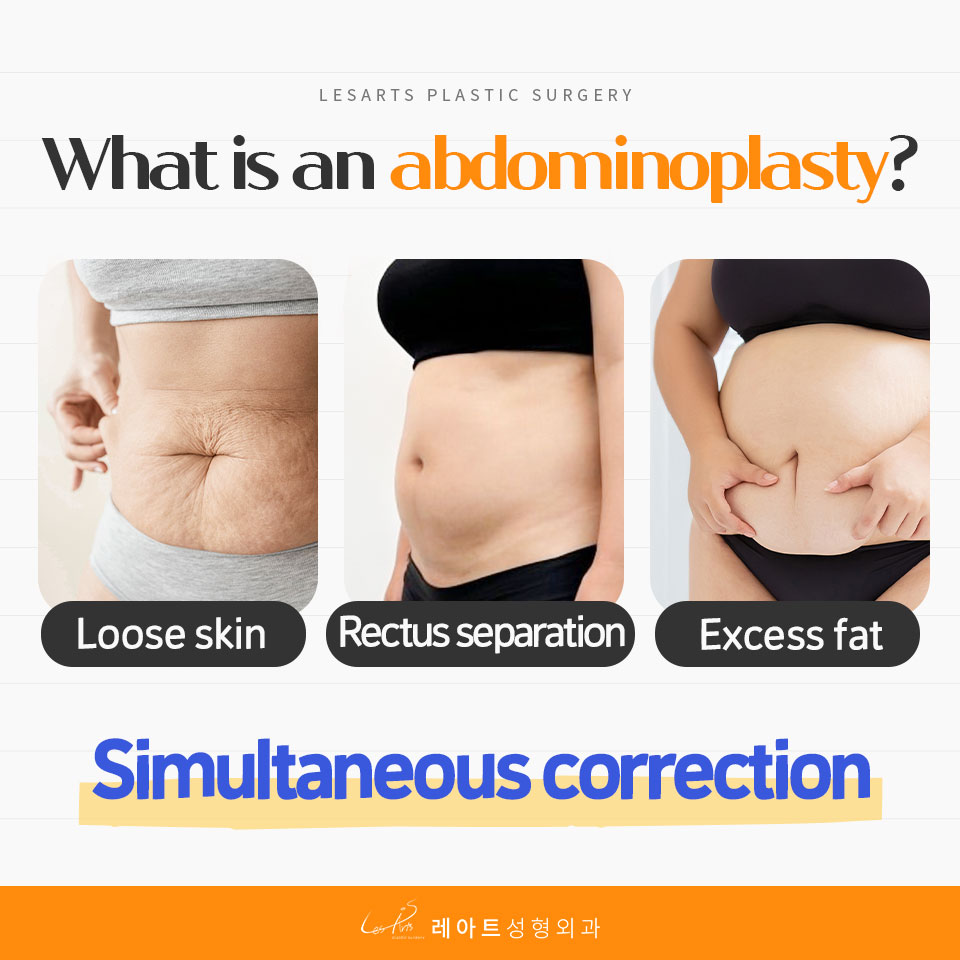
Even with similar obstetric histories or comparable massive weight loss,
the anatomical distribution of loose skin and abdominal wall laxity varies distinctly among individuals.
This explains why incision lengths, vector directions for skin redraping,
and umbilicoplasty techniques differ across tummy tuck procedures.
In this clinical guide, we detail the primary types of abdominoplasty categorized by the anatomical extent of tissue laxity.
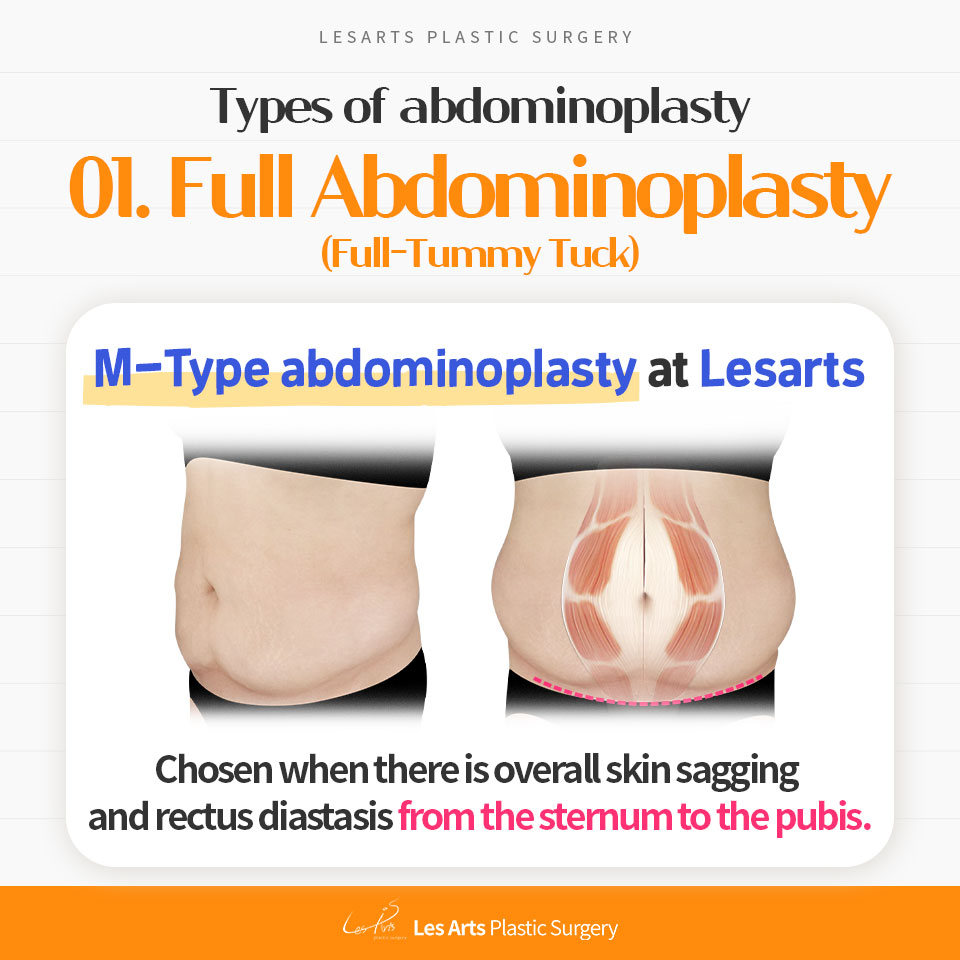
1. Full Tummy Tuck (Standard Abdominoplasty)
A full tummy tuck is indicated when extensive skin laxity spans from the epigastrium (upper abdomen)
down to the suprapubic area,
accompanied by confirmed rectus diastasis across the abdominal midline.
At Lesarts Plastic Surgery Clinic, this is classified as the Type M Tummy Tuck.
When supraumbilical skin has lost elasticity or the belly button appears horizontally flattened and hooding,
a mini tummy tuck that pulls only the lower abdomen
cannot provide sufficient or uniform tightening.
In a full tummy tuck, a suprapubic incision is made,
tissue is extensively undermined up to the costal margin of the upper abdomen,
and the redundant abdominal apron is mobilized downward
for maximum surgical resection.
Rectus diastasis is reinforced by plicating both upper and lower muscle layers,
while the original umbilicus remains anchored to the abdominal wall musculature
and is exteriorized through a precisely designed aperture in the redraped skin.
While this comprehensively resolves full-abdominal laxity and deep fascial separation in a single operation,
the surgical dissection plane and incision length
are naturally more extensive than in a mini tummy tuck.

2. Mini Tummy Tuck (Partial Abdominoplasty)
A mini tummy tuck is suitable when skin redundancy is isolated below the umbilicus
and upper abdominal skin elasticity remains relatively well preserved.
At Lesarts Plastic Surgery Clinic, this is classified as the Type S Tummy Tuck.
Patients often assume the designation 'mini' implies a very short incision;
in clinical reality, it indicates that surgical correction is confined to the infraumbilical zone.
If lower abdominal skin laxity extends broadly across the pelvis laterally,
the horizontal incision line must be elongated accordingly to achieve smooth, dog-ear-free excision.
This approach is ideal when there is minimal upper abdominal laxity or muscle diastasis,
and the primary complaints are lower belly skin creasing or step-offs and puckering
around a prior Cesarean section (C-section) scar.
Because the tissue dissection is localized compared to a full abdominoplasty,
surgical recovery is faster, and there is no need
to reposition or re-exteriorize the umbilicus.
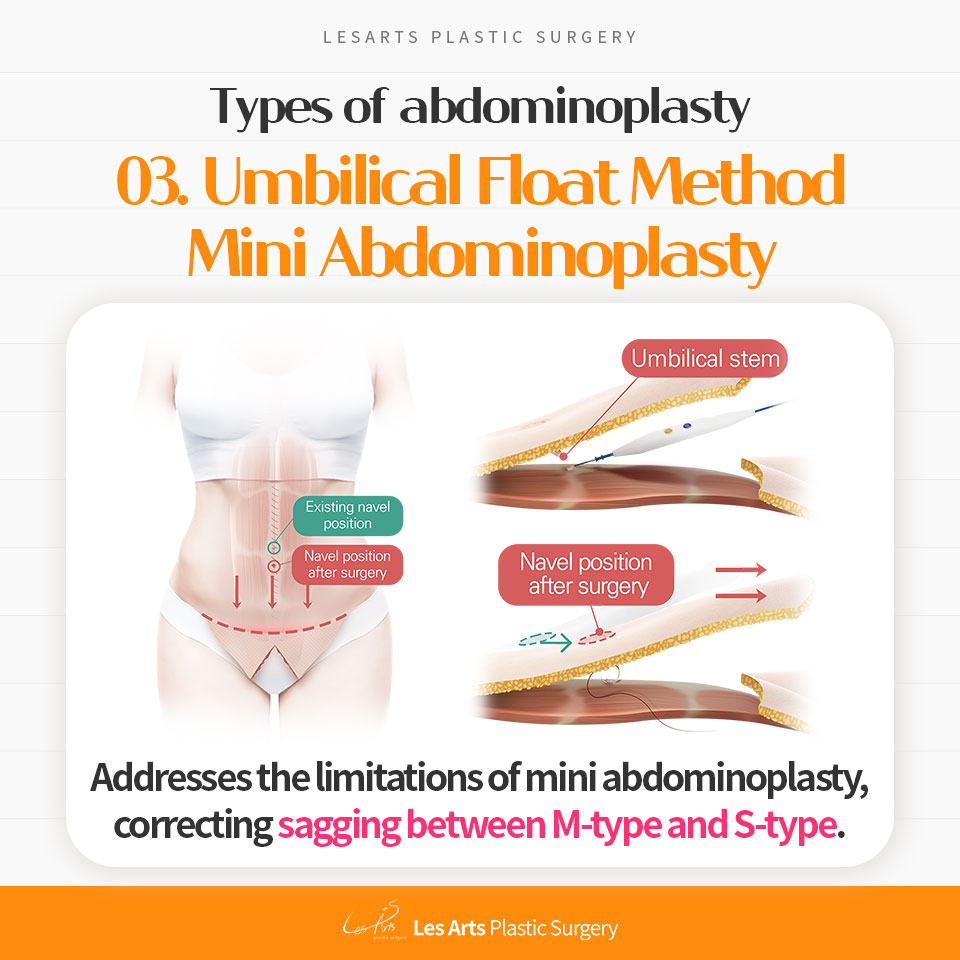
3. Floating Umbilicus Mini Tummy Tuck
The floating umbilicus technique serves as an intermediate solution bridging
a conventional mini abdominoplasty and a full tummy tuck.
It is indicated when redundant skin is primarily located in the lower abdomen,
yet upper rectus diastasis requires functional muscle plication.
Because a conventional mini tummy tuck limits dissection below the belly button,
direct surgical access to repair upper abdominal rectus diastasis is anatomically restricted.
In the floating technique, the umbilical stalk is temporarily detached from the underlying fascia,
allowing the surgeon to undermine superiorly into the epigastrium to perform full midline plication.
The umbilicus is then refixed to the newly tightened fascial layer.
Depending on downward skin tension, the final resting position of the umbilicus may shift slightly inferiorly;
therefore, pre-operative umbilical height and torso proportions must be carefully analyzed.
This procedure is not recommended if the baseline umbilical position is already low,
and cases with pronounced upper abdominal skin excess are better addressed through a standard full tummy tuck.
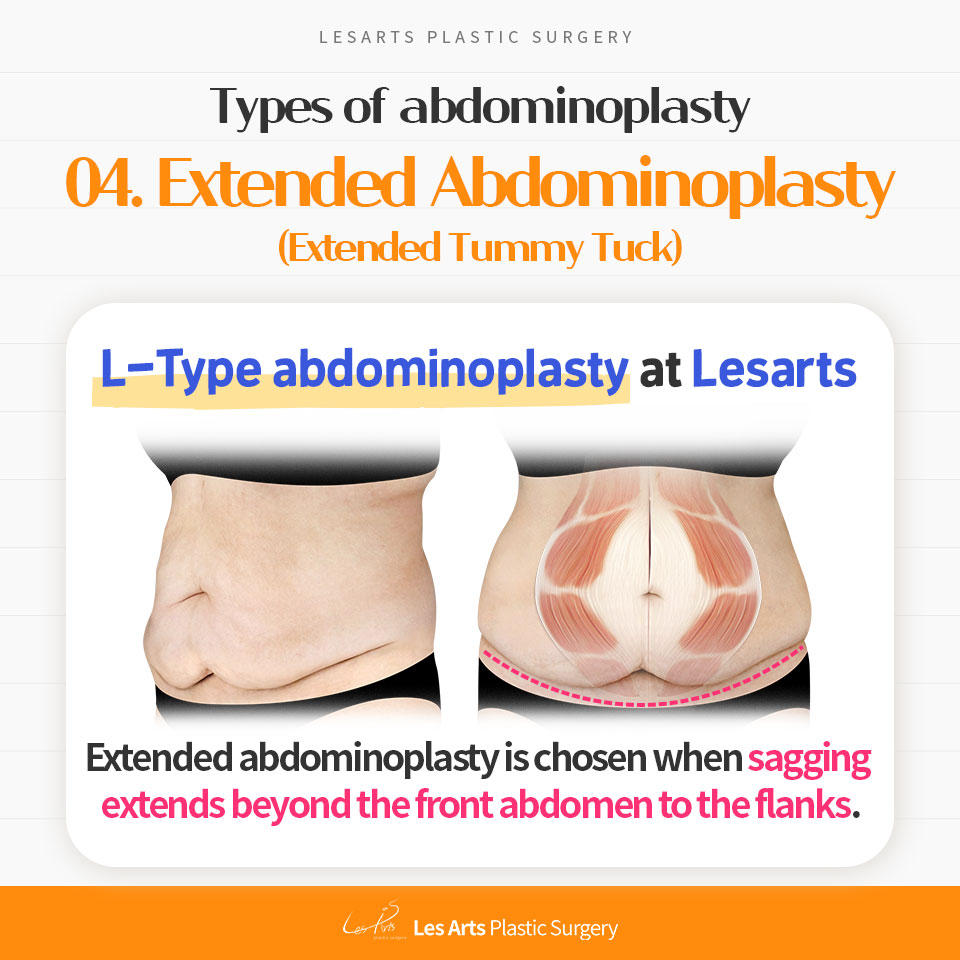
4. Extended Tummy Tuck (Extended Abdominoplasty)
An extended abdominoplasty is performed when skin laxity extends past the anterior abdomen
into the lateral flanks, waistline, and love handles.
At Lesarts Plastic Surgery Clinic, this is classified as the Type L Tummy Tuck.
The core surgical sequence follows that of a full tummy tuck,
with the horizontal incision extended further laterally past the anterior superior iliac spine (ASIS)
to excise lateral skin redundancy along the torso.
Following childbearing or substantial weight loss, if sagging skin affects both the front abdomen
and lateral flank tissue, redraping the anterior wall alone
will leave conspicuous lateral skin folds and dog-ears.
While an extended tummy tuck delivers dramatic waist tapering and 360-degree anterior-lateral tightening,
the patient must understand that the lateral incision scar extends longer than in a standard abdominoplasty.
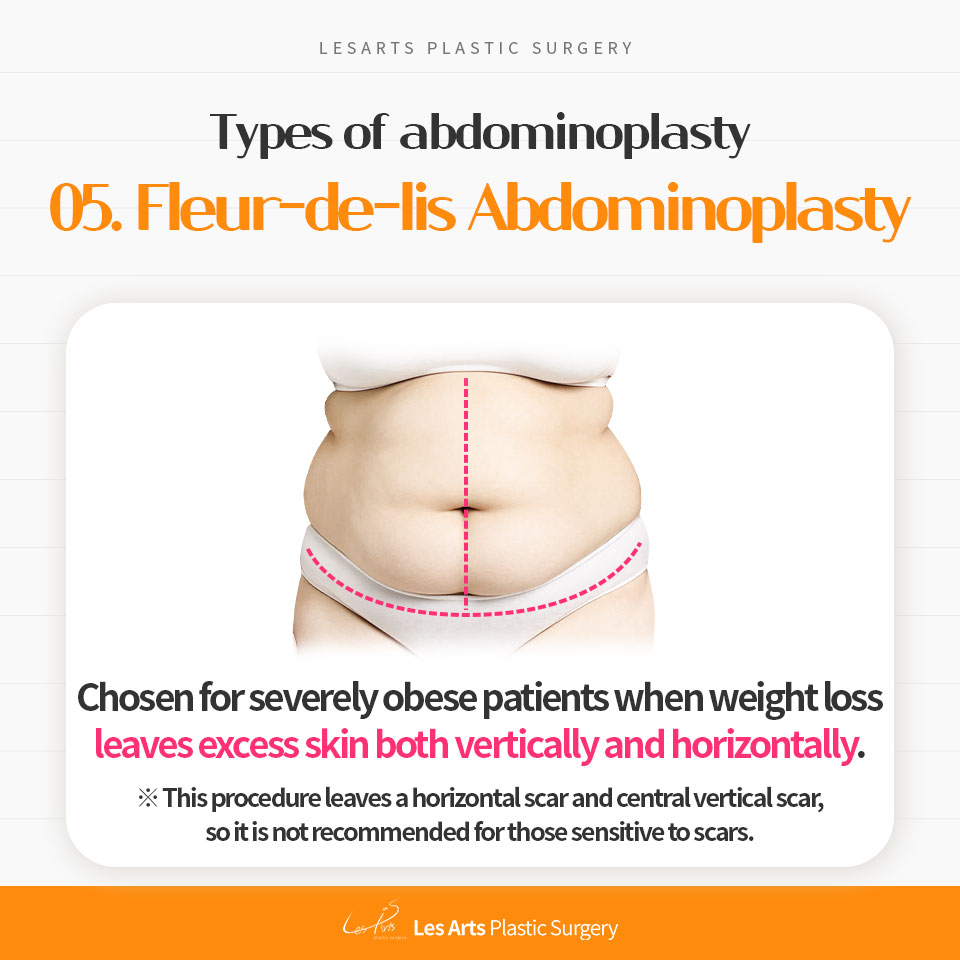
5. Fleur-de-Lis Abdominoplasty (Vertical Incision Tummy Tuck)
A Fleur-de-Lis (FDL) abdominoplasty is designed for post-massive weight loss patients who retain
severe skin excess in both the vertical and horizontal (circumferential) vectors.
Standard tummy tuck techniques pull tissue predominantly in a vertical direction (superior to inferior),
which often leaves significant horizontal waist width and transverse skin laxity unaddressed in extreme cases.
To correct dual-axis laxity, a suprapubic horizontal incision is combined
with a midline vertical excision (forming an inverted T or anchor shape).
This allows massive simultaneous resection along both vertical and horizontal planes,
providing exceptional waist narrowing for patients with extreme tissue surplus; however, alongside the low bikini incision,
a visible midline vertical scar down the center of the abdomen is permanent.
Accordingly, patients must weigh the substantial functional and contour benefits
against the trade-off of a central vertical scar prior to surgery.
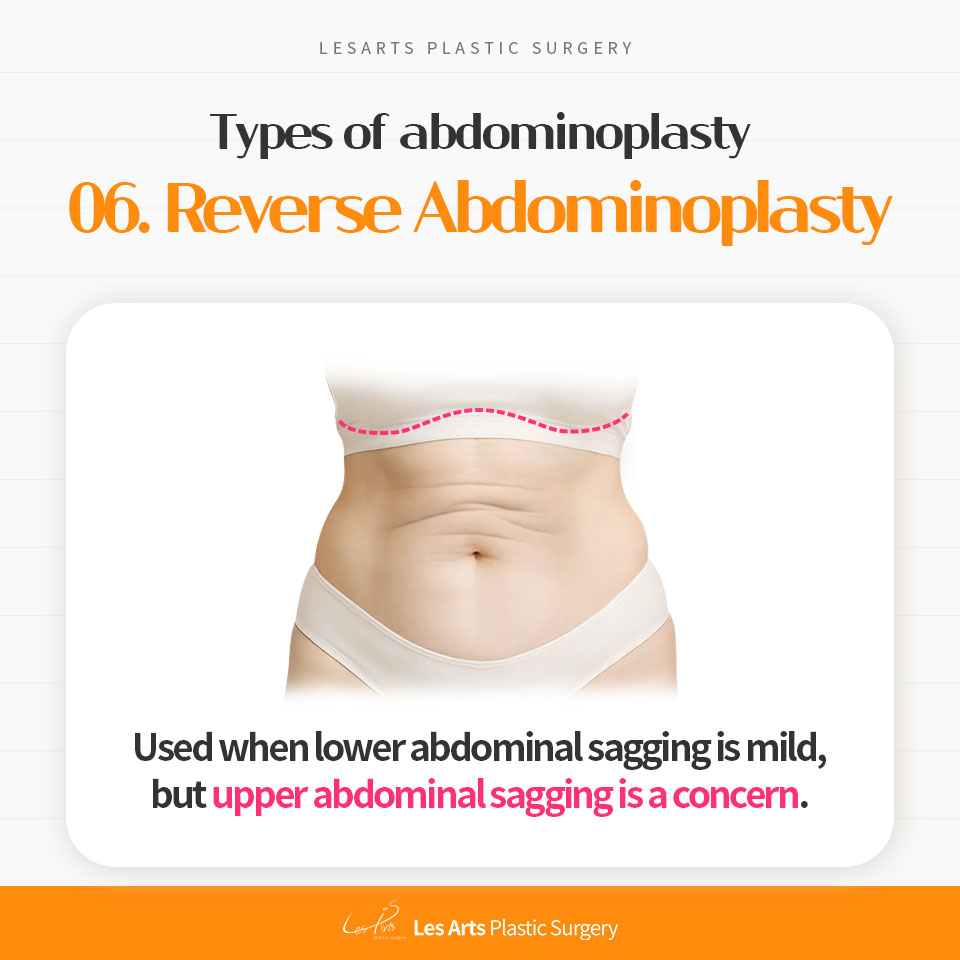
6. Reverse Tummy Tuck (Reverse Abdominoplasty)
A reverse tummy tuck is an uncommon, specialized procedure selectively indicated
when skin redundancy is isolated primarily to the upper epigastric region rather than the lower abdomen.
Unlike conventional abdominoplasty, which places the incision along the lower pelvis
and advances skin downward,
a reverse tummy tuck places the incision within the inframammary folds (submammary crease)
and pulls epigastric tissue superiorly (upward).
While the scar can be concealed along the breast creases,
excessive wound tension can cause the inframammary fold to displace inferiorly
or lead to scar widening, requiring advanced surgical planning.
Because anatomical indications are highly restrictive, this is not a universally performed procedure,
requiring precise diagnostic confirmation of isolated upper laxity, prior scarring, and submammary crease anatomy.
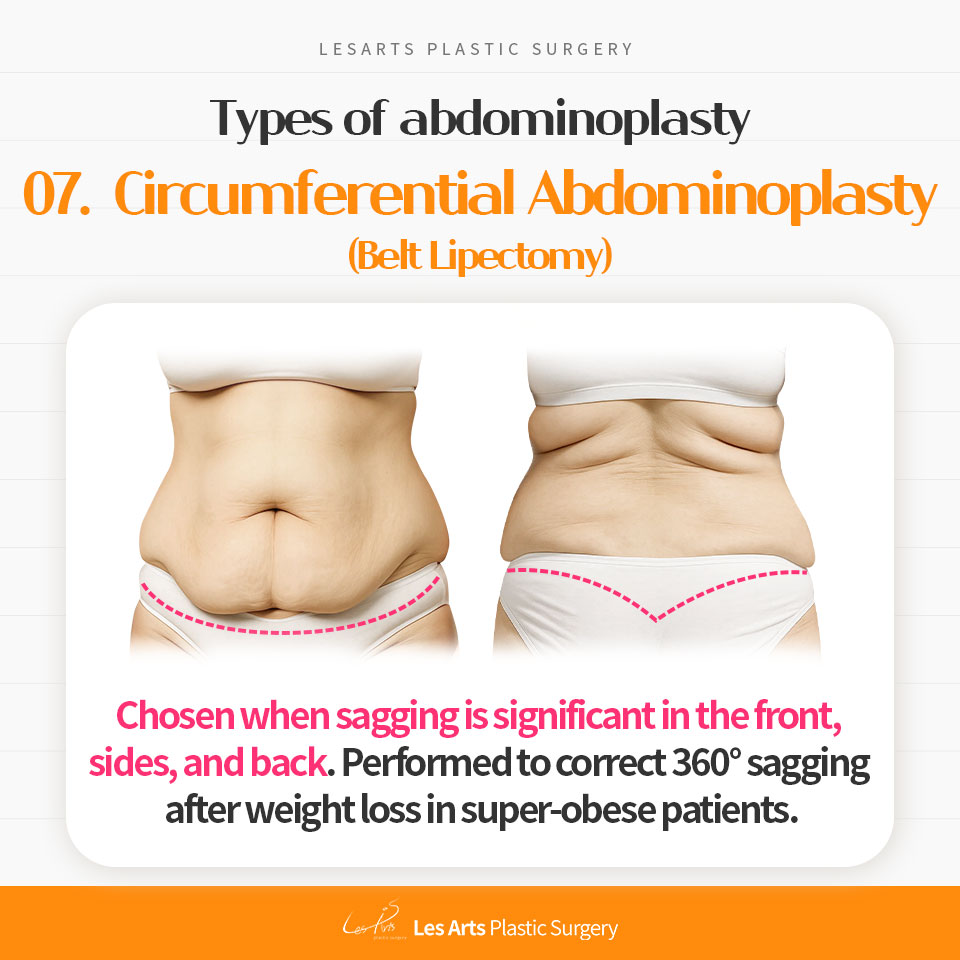
7. Circumferential 360° Tummy Tuck (Belt Lipectomy / Lower Body Lift)
A circumferential 360 abdominoplasty (belt lipectomy) is indicated when severe dermatochalasis
encircles the entire lower torso, involving the anterior abdomen, flanks, lower back, and superior gluteal zones.
It is most frequently performed following bariatric surgery or dramatic weight loss (e.g., 30–50+ kg)
where residual skin sags like a continuous apron around the pelvis.
The incision extends 360 degrees around the waistline like a belt,
simultaneously flattening the abdomen, cinching the waist, and elevating sagging buttocks and lateral thighs.
Due to the extensive operative scope, surgical duration and recovery timelines are extended,
requiring diligent post-operative mobility protocols and specialized scar management.
Patient hemodynamic stability, nutritional status, residual skin elasticity, and intra-operative
position changes must be comprehensively coordinated by an experienced surgical team.
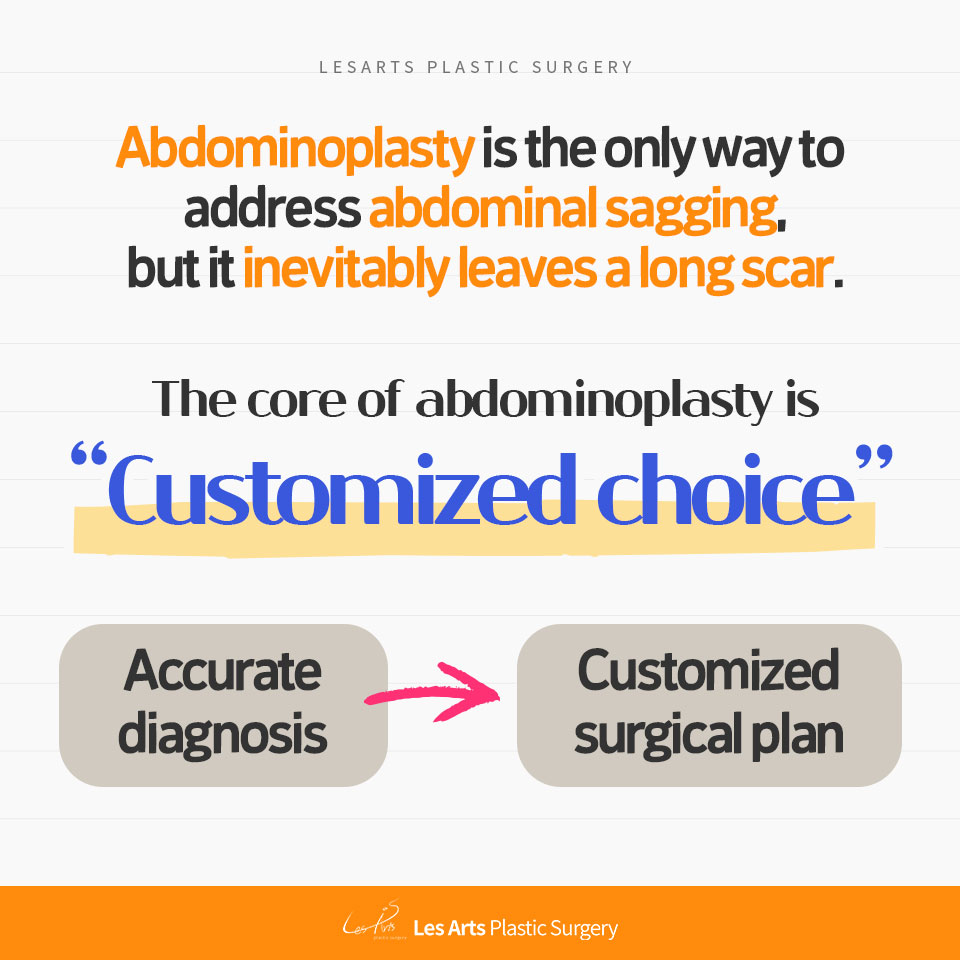
Pre-Operative Assessment Trumps Surgical Naming
Even under the same procedure name,
abdominoplasty cannot be executed identically across patients.
Whether tissue laxity is strictly infraumbilical or extends superiorly,
and whether rectus diastasis spans the entire linea alba, dictates the appropriate surgical approach.
Umbilical position, pre-existing C-section scars, striae (stretch marks),
and lateral flank redundancy must be thoroughly mapped.
Rather than fixating on minimizing incision length at all costs, the priority must be
accurately assessing true skin resection volume, preventing residual dog-ears,
and placing final scars discreetly along natural bikini and underwear lines.
While abdominoplasty definitively reconstructs lax skin and loose abdominal wall musculature,
it inherently entails a permanent surgical incision scar.
Consequently, patients should proceed only after receiving detailed guidance regarding expected contour improvements,
incision placement, umbilical aesthetics, recovery milestones, and long-term scar care.
The core goal is not selecting an arbitrary procedure name in advance,
but customizing the surgical vector to your unique abdominal anatomy.
An accurate clinical diagnosis establishing precise margins for skin resection
and muscle repair ensures an optimal surgical plan—
neither excessive nor insufficient.
FAQ
Q1. What is the fundamental difference between a tummy tuck and abdominal liposuction?
Abdominal liposuction purely debulks subcutaneous fat,
whereas a tummy tuck (abdominoplasty) surgically excises redundant, sagging skin
and repairs rectus diastasis (muscle separation).
When adiposity coexists with dermal laxity, liposuction is routinely combined with abdominoplasty.
Q2. Does a mini tummy tuck always result in a short scar?
Not necessarily.
'Mini' designates that treatment is confined to the infraumbilical zone;
if loose skin extends widely across the lower pelvis,
the horizontal incision must be extended to prevent dog-ear deformities.
Q3. Does a full tummy tuck eliminate the belly button?
No, the original umbilicus is not discarded.
The belly button remains anchored to the abdominal wall musculature, and after the redraped skin is advanced downward,
a new aperture is sculpted to exteriorize and aesthetically shape the umbilicus.
Q4. Does rectus diastasis always require abdominoplasty?
It depends on the severity of fascial separation, core symptoms, and associated dermal laxity.
If muscle separation is mild and skin elasticity is intact,
non-surgical core rehabilitation may be considered following specialist evaluation.
Q5. Which tummy tuck technique is universally considered the best?
There is no single superior technique suitable for everyone.
The best procedure is the one tailored to your specific anatomical condition—evaluating the distribution of skin laxity,
rectus diastasis, umbilical height, and pre-existing surgical scars.
Dr. Kukhan Lee


Cases finding
similar to my profile
Customer Diagnostics


Select the surgery and
area you are interestedto see real
before andafter changes.


we
make you,
the art
Clinic hours
MON - FRI
10 am – 7pm
SAT
10 am – 4pm
Holiday
SUN, HOLIDAY
Location
Lesarts Moon Clinic Tower 4-5F, 40, Nonhyeon-ro 168-gil,
Gangnam-gu, Seoul, Republic of Korea

Medical institution name Lesarts Plastic Surgery
Address Lesarts Moon Clinic Tower 4-5F, 40, Nonhyeon-ro 168-gil, Gangnam-gu, Seoul, Republic of Korea
Representative Moon sung jun
