




Online Consultation
Please accurately enter the information below.
Quick Cost Consultation
Quick Consultation & Reservation
Cases finding
similar to my profile






Doctor's Note
Medical columns by our surgeons
Thigh Liposuction | "Size XS on Top, Size M/L on the Bottom?" Putting an End to an Unhealthy, Skeletally Emaciated Physique!
2026-07-24
Thigh Liposuction | "Size XS on Top, Size M/L on the Bottom?" Putting an End to an Unhealthy, Skeletally Emaciated Physique!
Q. If someone is underweight (BMI in the 17s) or has a slender frame but struggles with upper-to-lower body disproportion or localized fat (such as saddlebags), can it be improved through liposuction?
A. Yes, it is achievable. Liposuction in a slender frame is not an operation aimed at extracting massive volumes of fat;
rather, it is a procedure designed to 'sculpt contour lines and harmonize upper-to-lower body balance.'
Losing weight through dieting often depletes the upper body further while the problematic lower body deposits
remain intact, exacerbating the disproportion. In slender patients, rather than uncalibrated large-volume aspiration,
surgery focuses on delicately debulking stubborn localized fat pockets like the saddlebags
and smoothing the medial inner thigh lines.
Refining lower extremity volume and silhouette in this manner establishes
a natural, balanced transition that complements an already slender upper body.
▶ Learn More About Lesarts Plastic Surgery Liposuction
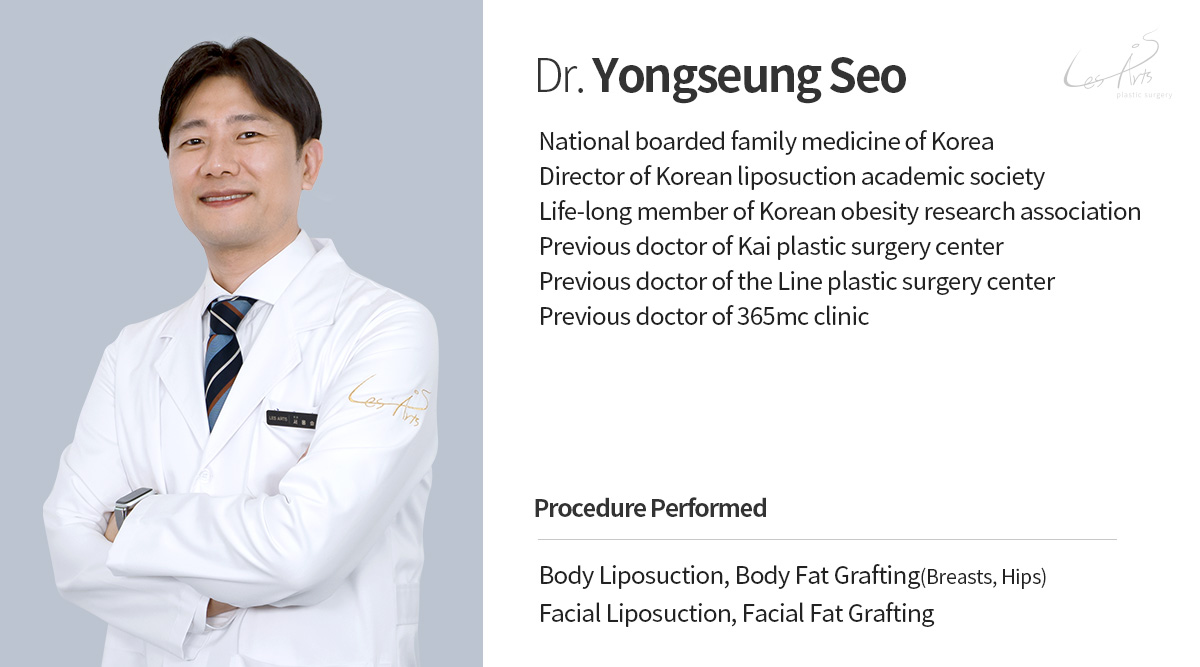
Hello, this is Dr. Yongseung Seo from Lesarts Plastic Surgery.
Women who have attempted weight reduction often share a common,
deeply frustrating anatomical dilemma:
"When I lose weight, my facial fullness and breast volume disappear first,
while the thigh fat I most want to lose stays completely untouched."
The number on the scale clearly decreases,
yet the silhouette in the mirror appears increasingly unbalanced.
The upper torso becomes emaciated and frail,
while the lower body looks relatively heavy and full, creating severe wardrobe frustration.
In an attempt to resolve this disparity, drastically cutting calories or excessively increasing
lower-body resistance training can lead to an emaciated, skeletal frame
or cause specific muscle groups to hypertrophy,
moving further away from a graceful, harmonious body silhouette.
The patient presented today measured 163 cm and 45.9 kg,
presenting with a lean BMI of 17.3;
she visited our clinic specifically to address a pronounced upper-to-lower body disproportion.
This case did not center on sheer subcutaneous fat evacuation;
it required a delicate surgical design to preserve the patient's native, attractive curves
while meticulously calibrating the proportional balance between the upper and lower body.
Let us examine how her lower extremity contours transformed
after resisting both diet and workouts.

[Preoperative Diagnostic Evaluation for Thigh Liposuction]
[Patient Profile & Physical Measurements]
Age Group: Early 30s
Height: 163 cm
Weight: 45.9 kg (customarily maintains 43–44 kg)
BMI: 17.3 kg/m² (underweight range)
Body Fat Percentage: 22.1%
(※ Even with identical or similar physical measurements, liposuction outcomes may vary individually depending on skeletal structure and dermal elasticity.)
[Preoperative Diagnosis & Primary Aesthetic Goals]
"I want to look more slender, but I do not want to look gaunt, skeletal, or sickly."
The patient consistently maintained strict physical conditioning through aerobic running and resistance training;
however, as she intensified lower body training, she encountered a significant impasse:
1. Upper-to-Lower Body Disproportion:
Relative to her overall low body weight, her thigh contours appeared heavy and full, disrupting upper-to-lower body harmony.
2. Clear Biological Boundaries of Dieting:
Whenever she dieted to reduce lower body circumference, her already lean upper torso volume depleted first.
3. Aesthetic Silhouette Objectives:
While open to slight additional reduction, she strongly wished to avoid an emaciated appearance with protruding skeletal landmarks.
Physical inspection and diagnostic ultrasound revealed that while global body fat was low,
Saddlebags (lateral): 24 / 19 mm,
Medial (inner thigh): 9 / 10 mm,
Anterior: 12 / 13 mm,
Posterior: 6 / 7 mm
were recorded, confirming localized adipose concentration along the lateral saddlebags.
Along the inner thighs, while absolute fat volume was moderate,
the absence of medial clearance and irregular contour borders created an optical illusion
making the legs appear comparatively shorter and heavier.

[Tailored Lower Extremity Design Plan for Slender Physiques]
Having previous aesthetic surgery experience (facial contouring, rhinoplasty, submental contouring),
the patient had refined aesthetic discernment and sought meticulous contour refinement.
Accordingly, we established the following surgical plan:
1. Correcting Lateral Saddlebag Asymmetry:
Preoperative evaluation confirmed bilateral asymmetry in both adipose volume and curvature between the saddlebags.
While liposuction strives for balanced symmetry, we counseled her preoperatively
that subtle bilateral differences stemming from native skeletal and muscular anatomy could remain perceptible.
2. Smoothing Medial Lines and Establishing a Natural Thigh Gap:
Because extractable fat along the inner thigh was limited,
rather than aggressive circumferential reduction, surgery focused on creating a natural medial clearance
by feathering undulating borders smoothly.
3. Recognizing Anatomical Limits of the Anterior and Posterior Thighs:
Prominence over the lower anterior thigh (above the patella) reflected muscular development rather than fat.
Because posterior fat depth was also minimal, we clearly explained that these areas required gentle contour smoothing
rather than large-volume debulking.
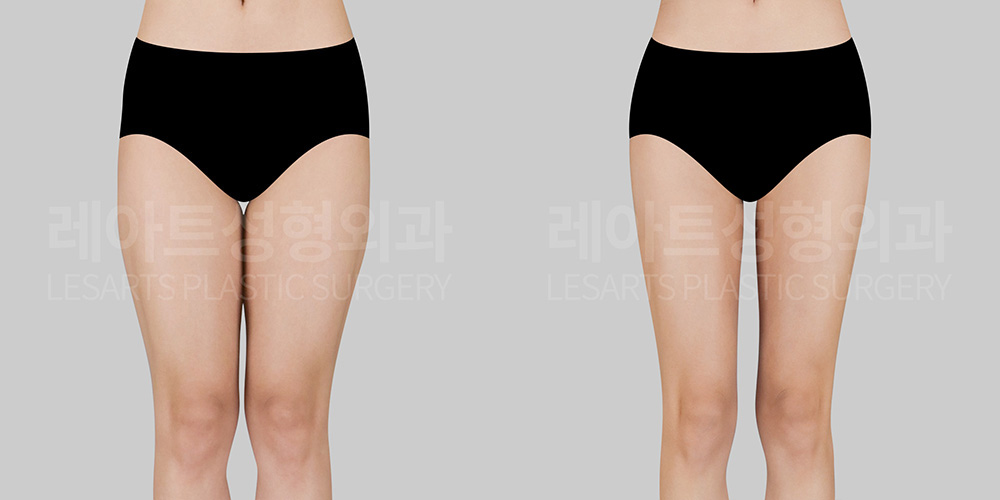
[Thigh Liposuction Before-and-After Follow-Up Comparison]
(※ Photographed at 3 months postoperatively under identical lighting and clinical conditions.)
Preoperatively, lateral saddlebag fullness expanding below the pelvis
made her legs appear visually shorter and heavier than her actual frame.
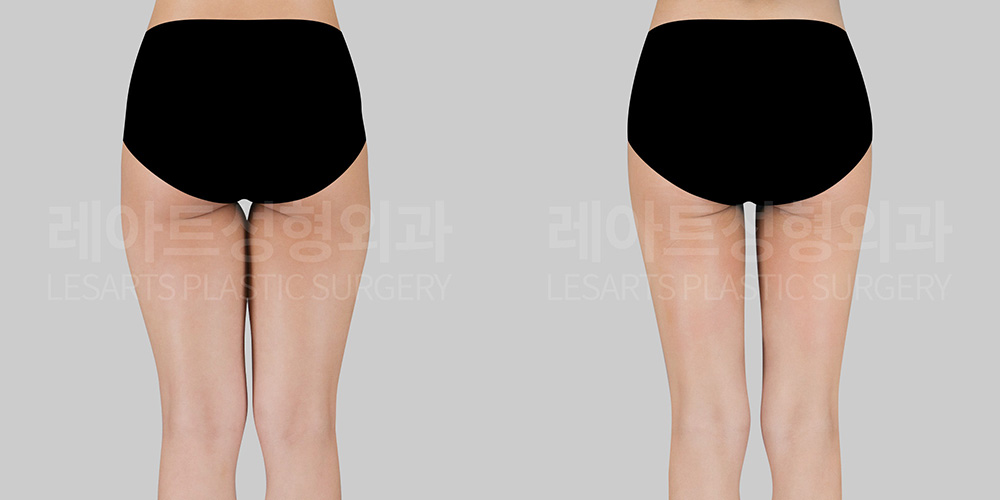
Postoperatively, debulking this outward lateral projection
established a clean, elongated line falling from the pelvis to the ankles, creating an optical lengthening effect.
Micro-liposuction of upper medial thigh fullness eliminated inner crowding, sculpting a clean medial clearance.
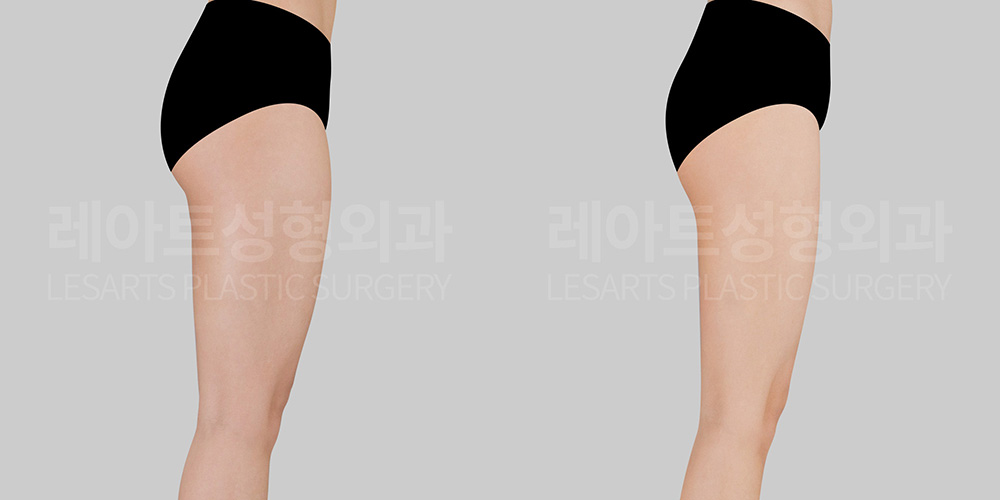
While suprapatellar fullness could not be flattened completely due to muscular bulk,
debulking contiguous subcutaneous fat softened the rigid, muscular impression significantly.
With balanced lower extremity contour refinement,
the overall body silhouette settled into a harmonious, slender balance, resolving prior disproportion.
"Liposuction is not an operation aimed at arbitrary weight loss;
it is a procedure designed to sculpt your natural contours harmoniously."
Underweight patients with BMIs in the 17s frequently seek liposuction consultations.
This stems not from generalized excess fat, but because
'stubborn deposits in specific problem areas resist diet and exercise.'
Attempting aggressive, high-volume extraction in slender patients is counterproductive and risky.
Aspirating precisely where fat is excessive,
preserving buffer layers where dimension is needed,
accounting for individual muscularity and skeletal anatomy,
and balancing pre-existing asymmetries
demands delicate, handcrafted surgical technique.
Because the patient adhered diligently to post-operative care guidelines,
ecchymosis and primary edema subsided smoothly.
At 3 months postoperatively, as residual fine swelling continues to resolve,
maintaining ongoing lifestyle care will preserve the balanced, seamless silhouette she sought.
If localized body contours resist independent diet and exercise efforts,
we welcome you to visit Lesarts Plastic Surgery for precise diagnostic evaluation to identify a tailored contouring solution.
FAQ
Q1. Why do slender or underweight individuals undergo lower body liposuction?
A. Dieting often depletes upper body volume further while resistant lower body deposits like saddlebags remain, worsening disproportion.
Liposuction is performed not to reduce scale weight, but to debulk resistant focal deposits and restore full-body balance.
Q2. What is the most critical surgical consideration when performing lower body liposuction in underweight patients?
A. Avoiding indiscriminate high-volume extraction and executing a precise contour design that balances upper and lower proportions.
Aspirating selectively where fat protrudes while preserving buffer layers prevents a frail, skeletal appearance, achieving a smooth, healthy silhouette.
Q3. What clinical results can be expected from inner thigh liposuction in a slender frame?
A. While absolute extraction volume is modest,
debulking upper medial fullness establishes a natural thigh gap.
This eliminates inner thigh crowding, creating an optical effect where legs appear longer and straighter.
Q4. Can suprapatellar knee or anterior thigh bulging be completely flattened through liposuction?
A. If prominence is driven by muscular development rather than adipose tissue, surgery cannot eliminate it completely.
Liposuction removes subcutaneous fat to soften muscular edges and smooth transitions; diagnosing the ratio of muscle to fat preoperatively is essential.
Q5. Can skeletal or muscular asymmetry be completely corrected through saddlebag liposuction?
A. Asymmetry resulting from differing adipose volumes can be balanced as closely as possible through calibrated aspiration.
However, innate skeletal alignment or muscular asymmetries cannot be altered via liposuction; understanding these boundaries during preoperative consultation is essential.
Dr. Yongseung Seo


Cases finding
similar to my profile
Customer Diagnostics


Select the surgery and
area you are interestedto see real
before andafter changes.


we
make you,
the art
Clinic hours
MON - FRI
10 am – 7pm
SAT
10 am – 4pm
Holiday
SUN, HOLIDAY
Location
Lesarts Moon Clinic Tower 4-5F, 40, Nonhyeon-ro 168-gil,
Gangnam-gu, Seoul, Republic of Korea

Medical institution name Lesarts Plastic Surgery
Address Lesarts Moon Clinic Tower 4-5F, 40, Nonhyeon-ro 168-gil, Gangnam-gu, Seoul, Republic of Korea
Representative Moon sung jun
