




Online Consultation
Please accurately enter the information below.
Quick Cost Consultation
Quick Consultation & Reservation
Cases finding
similar to my profile






Cases finding
similar to my profile
Customer Diagnostics
Loose Lower Abdomen After Weight Loss 3-Month Before & After Review of Mini Tummy Tuck (S-Type with Umbilical Floating) (Mini Abdominoplasty | Lower Abdominal Sagging | Seoul Gangnam Plastic Surgery Clinic)
2026-03-04
When Weight Loss Doesn’t Fully Restore the Abdomen
The patient in this case had experienced prior
weight gain followed by significant weight reduction.
Although her weight had stabilized,
the lower abdomen showed persistent:
-Skin wrinkling
-Central lower abdominal sagging
-Structural contour irregularities
She also had a history of pregnancy and Cesarean section,
which required careful evaluation of abdominal wall
structure before surgical planning.
At consultation, her weight was stable,
but the abdominal contour remained uneven
and lacked smoothness.
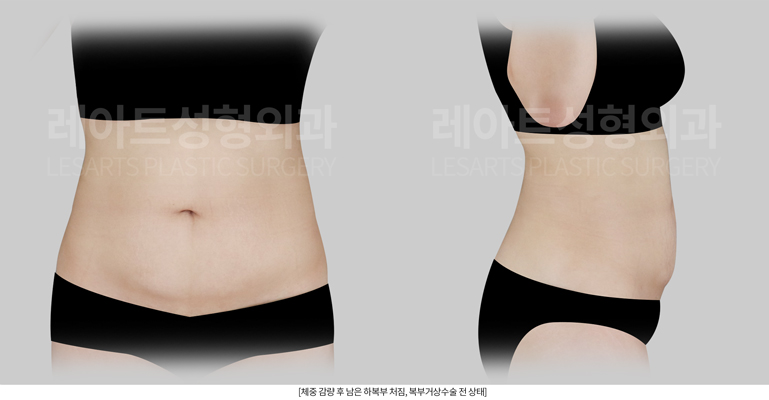
Preoperative Assessment
Lower Abdominal Sagging After Weight Loss
Clinical examination revealed:
-Prominent skin folds centered below the navel
-Increased folding when bending forward
-Mild upper abdominal skin laxity
-A relatively high-positioned navel
-Partial rectus diastasis
-Adhesion tissue from prior abdominal liposuction
-Localized fat deposits
Although mild upper abdominal laxity was present,
performing a full M-type abdominoplasty would have extended
scar length and altered scar positioning.
Because the patient’s primary concern was the lower abdominal fold and
central sagging, a Mini Abdominoplasty (S-Type) with
Umbilical Floating was selected as the optimal approach.

Surgical Plan
1. Mini Abdominoplasty
(S-Type with Umbilical Floating)
-Focused correction of lower abdominal skin
wrinkling and contour deformity
-Slight umbilical repositioning through floating technique
-Designed to address high navel position and mild upper laxity
2. Rectus Muscle Repair
-Restoration of abdominal wall
support through rectus plication
-Simultaneous upper and lower abdominal wall
correction made possible via the floating approach
3. Abdominal Liposuction & Adhesion Release
-Removal of adhesion tissue from previous liposuction
-Smoothing of overall abdominal contour
-Prevention of step-off deformities
between upper and lower abdomen
This combined structural approach ensured
both aesthetic and functional correction.
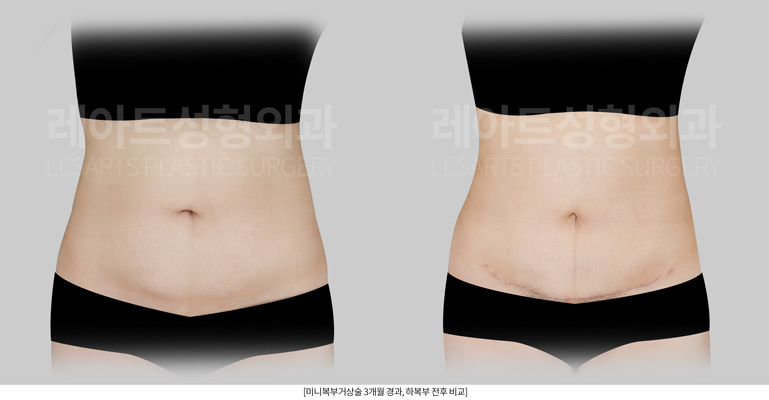
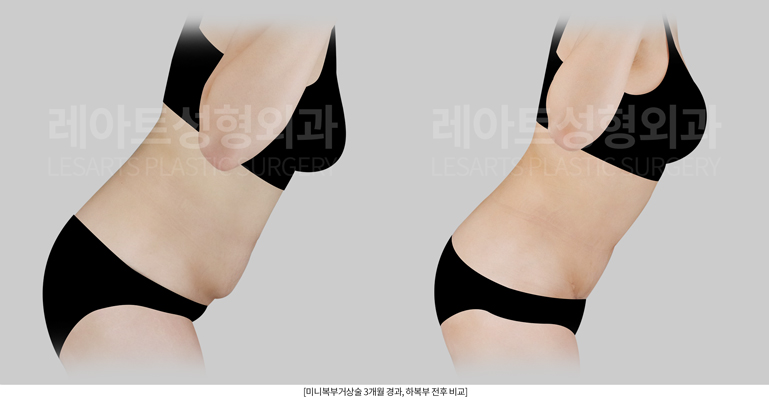
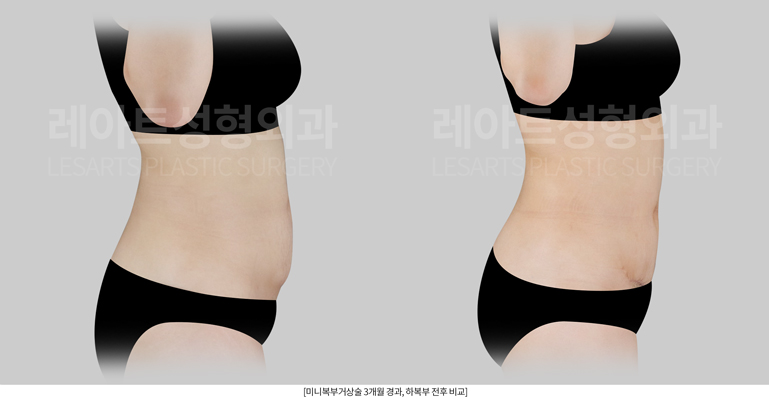
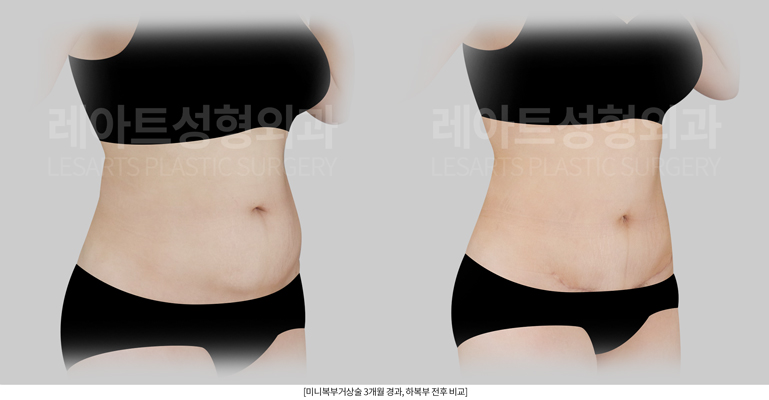
3-Month Postoperative Results
Lower Abdomen Before & After
At 3 months post-op:
-Previously sagging lower abdominal skin is visibly tightened
-The central abdominal flow appears smoother and more structured
-Prominent lower belly folds have been significantly reduced
-The heavy appearance concentrated in the lower abdomen has resolved
Improvement of rectus diastasis restored abdominal wall support,
allowing the central abdomen to maintain a firmer contour.
Despite slight repositioning, the navel appears natural and proportionate.
There is no visual impression of a lowered waistline or unnatural placement.
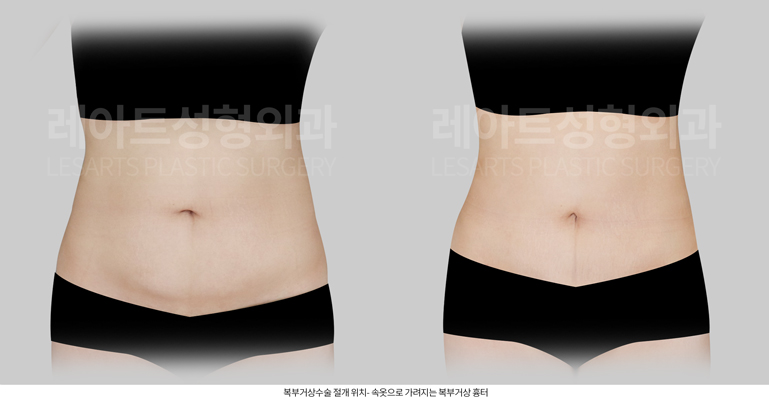
Incision Placement & Scar Consideration
One of the patient’s primary concerns was the fold forming above
the previous C-section scar, which created a visible step-off deformity.
Now:
-The previous C-section scar has been removed
-The step deformity has been eliminated
-The lower abdomen appears smooth and continuous
The incision was strategically placed low enough to
remain fully concealed within underwear or swimwear.
At 3 months:
-Mild firmness in some tissues remains
-Some redness along the scar is still visible
These are typical healing phases and
are expected to gradually improve over time.
Key Takeaway
Mini Abdominoplasty
is not simply about removing excess skin.
When properly designed, it can:
-Restore abdominal wall function
-Correct rectus diastasis
-Address post-liposuction adhesions
-Eliminate C-section-related contour deformities
-Create a smoother and structurally balanced lower abdomen
At 3 months, the patient demonstrates stable
improvement in both contour and support.
#Abdominoplasty
#S-type
#Abdominal liposuction(S)


Cases finding
similar to my profile
Customer Diagnostics


Select the surgery and
area you are interestedto see real
before andafter changes.


we
make you,
the art
Clinic hours
MON - FRI
10 am – 7pm
SAT
10 am – 4pm
Holiday
SUN, HOLIDAY
Location
Lesarts Moon Clinic Tower 4-5F, 40, Nonhyeon-ro 168-gil,
Gangnam-gu, Seoul, Republic of Korea

Medical institution name Lesarts Plastic Surgery
Address Lesarts Moon Clinic Tower 4-5F, 40, Nonhyeon-ro 168-gil, Gangnam-gu, Seoul, Republic of Korea
Representative Moon sung jun
