




Online Consultation
Please accurately enter the information below.
Quick Cost Consultation
Quick Consultation & Reservation
Cases finding
similar to my profile






Cases finding
similar to my profile
Customer Diagnostics
Concerned About Chest Projection? How Much Does Gynecomastia Surgery Change the Appearance? (Gynecomastia Surgery | Gland Removal | T-Shirt Fit Improvement | Seoul Gangnam Plastic Surgery Clinic)
2026-03-05
When Early-Onset Gynecomastia Does Not Resolve
If gynecomastia that began in adolescence persists into adulthood,
accurate diagnosis and proper treatment planning become essential.
In many cases, the condition is mistakenly attributed to simple weight gain.
As a result, prolonged glandular enlargement may lead to additional issues over time,
such as decreased skin elasticity or mild sagging,
which can complicate postoperative management.
Even when not constantly noticeable,
chest projection often becomes a significant psychological burden during:
-Group activities
-Social interactions
-Situations requiring fitted clothing
-Circumstances where the upper body is exposed
Addressing the condition at an appropriate time
can prevent prolonged stress and improve overall confidence.
Patient Background
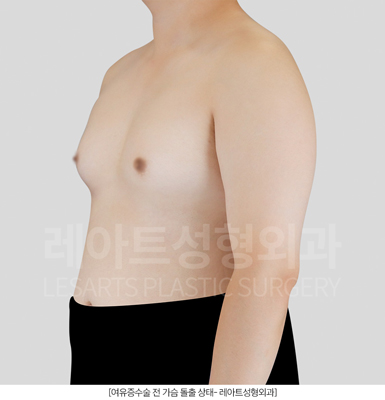
-Age: 30s
-Height/Weight: 183 cm / 105 kg (BMI 31)
-Diagnosis: Simon Grade 2A
-Type: True Gynecomastia
The patient first noticed symptoms
in his early 20s during military service.
Despite multiple attempts at body management over the years,
the persistent chest enlargement and projection remained unresolved,
leading him to seek surgical correction.
Preoperative Examination
Identifying the Cause of Chest Projection
Clinical findings included:
-Firm glandular tissue palpated beneath the areola
-Ultrasound confirmation of glandular hypertrophy
-No nipple discharge
-No significant pain
-No major skin laxity or sagging
-Prominent nipple projection accentuating the chest silhouette
The projection was primarily caused by true glandular enlargement
rather than simple fat accumulation.
Surgical Plan for Simon Grade 2A
Because the diagnosis was Simon Grade 2A true gynecomastia,
the surgical plan included:
1. Glandular Excision
Removal of hypertrophied glandular tissue to reduce
chest volume and correct projection.
2. Tissue Redraping
Rearrangement of surrounding tissue to create a smooth contour.
3. Chest Liposuction
Refinement of the transition from:
- Chest to upper abdomen
- Lateral chest to flank
This combination ensures a natural upper body silhouette
rather than simple volume reduction.
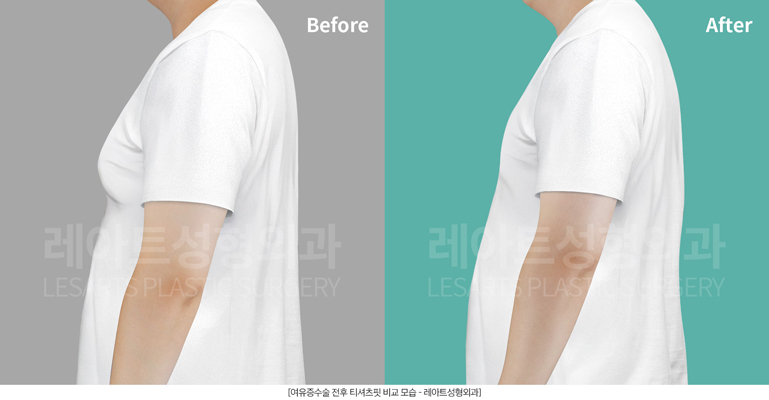
2-Month Postoperative Results
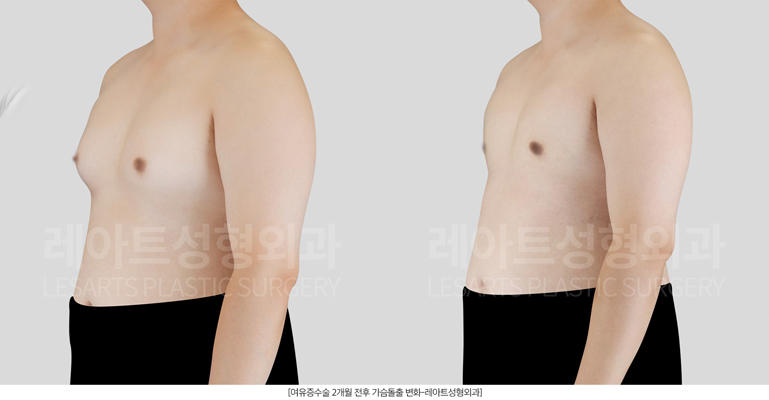
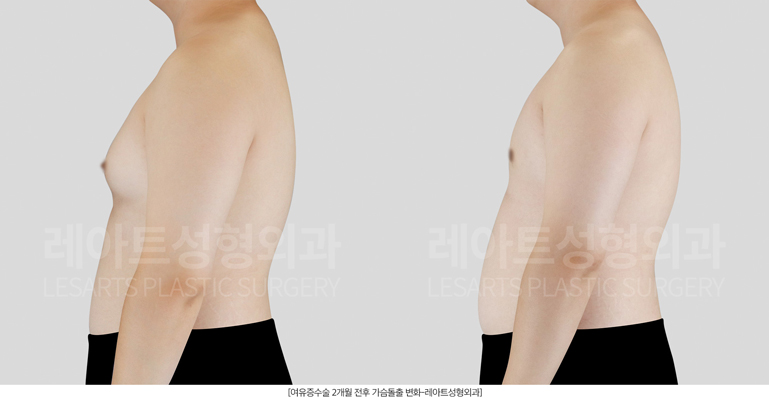
Before & After Comparison
At 2 months post-op:
- Overall chest size has visibly decreased
- Previously projected nipples appear corrected
- Lower chest fullness has resolved
- The upper body line appears cleaner and more masculine
Because both gland removal and liposuction were performed,
the result reflects improved contour stability rather than just size reduction.
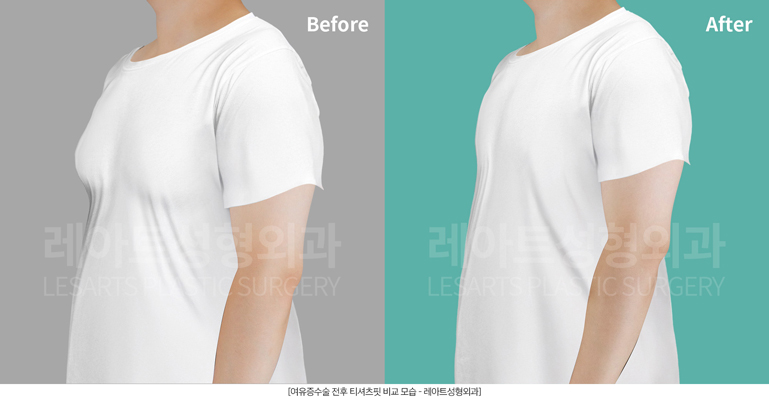
T-Shirt Fit Comparison
One of the most noticeable changes is seen in clothing fit.
After surgery:
- The bulky chest silhouette has disappeared
- The transition from upper chest to abdomen appears stable
- Clothing fits more comfortably and naturally
- The patient reports increased confidence in daily life
The chest now presents a flatter,
more defined masculine contour without unnatural depression.
Key Takeaway
True gynecomastia is not simply a fat-related issue.
For Simon Grade 2A cases:
-Accurate diagnosis is critical
-Gland removal is essential
-Liposuction alone is insufficient
-Structural contouring improves long-term silhouette stability
At 2 months, this case demonstrates significant improvement
in chest projection and upper body proportion.
#Male body contouring
#Gynecomastia
#Grade2-A #true gynecomastia #Side chest liposuction


Cases finding
similar to my profile
Customer Diagnostics


Select the surgery and
area you are interestedto see real
before andafter changes.


we
make you,
the art
Clinic hours
MON - FRI
10 am – 7pm
SAT
10 am – 4pm
Holiday
SUN, HOLIDAY
Location
Lesarts Moon Clinic Tower 4-5F, 40, Nonhyeon-ro 168-gil,
Gangnam-gu, Seoul, Republic of Korea

Medical institution name Lesarts Plastic Surgery
Address Lesarts Moon Clinic Tower 4-5F, 40, Nonhyeon-ro 168-gil, Gangnam-gu, Seoul, Republic of Korea
Representative Moon sung jun
