




Online Consultation
Please accurately enter the information below.
Quick Cost Consultation
Quick Consultation & Reservation
Cases finding
similar to my profile






Cases finding
similar to my profile
Customer Diagnostics
5 Months After Abdominoplasty – How Much Did Lower Abdominal Bulging and Sagging Improve? Postpartum Tummy Tuck Results at a Plastic Surgery Clinic in Gangnam, Seoul, Korea
2026-03-26
In this case, the patient underwent abdominoplasty (tummy tuck surgery) after noticing
that her abdominal shape did not recover even
long after giving birth naturally twice.
She explained that even after trying to lose weight after childbirth,
the contour of her abdomen did not return to its previous shape.
This was not simply a matter of weight gain.
Several issues were affecting the abdominal shape
at the same time, including:
- Increased abdominal fat
- Structural changes that caused the abdominal wall to push outward
- Weak support from the abdominal muscles
- Sagging skin in the lower abdomen
Because of these combined factors,
the abdomen lost its smooth and stable contour.
Postpartum Abdominal Changes That Did Not Improve Over Time
The patient said that the most uncomfortable part was how the lower
abdomen looked folded under clothing and
how the abdomen projected forward.
Over time, this became a major body shape
concern and source of stress.
Even though she exercised about three times a week,
the lower abdominal sagging and bulging did not improve.
This was because the problem was not only fat,
but also involved abdominal structure and loose skin.
Since the abdominal contour did not recover naturally over time,
the patient decided to proceed with surgery
at our plastic surgery clinic in Gangnam, Seoul, Korea.
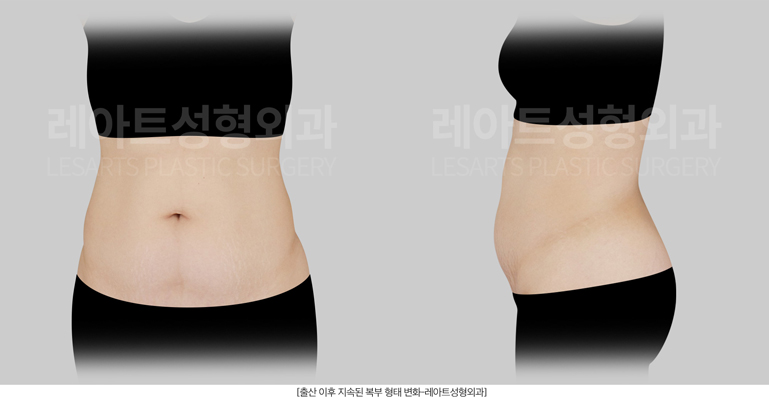
Pre-Surgery Evaluation
Why Liposuction Alone Was Not Enough
During consultation,
the abdomen showed several important findings:
- Increased fat throughout the abdomen
- Presence of visceral fat
- Rectus diastasis, causing the abdominal wall to push outward
- Sagging skin and reduced elasticity in the lower abdomen
Because the abdominal wall was protruding outward,
the abdomen looked even more prominent and
uneven than expected based on body fat alone.
In addition, depending on posture,
the abdominal skin folded more deeply,
making the contour look less smooth.
In cases like this,
liposuction alone is not the right solution.
If only fat is removed:
- The loose skin may fold even more
- The protruding abdominal wall may become more visible
-The abdominal surface may look more uneven
For this reason, the surgery needed to correct fat,
skin, and muscle structure together.
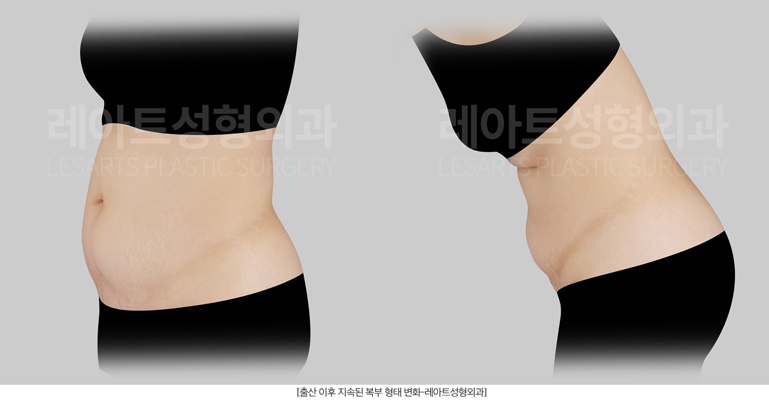
[M-Type Abdominoplasty with Muscle Repair and Liposuction]
M-Type Abdominoplasty
An M-type tummy tuck was planned to remove loose skin extending
from the upper abdomen down to the lower abdomen.
This approach helped tighten the entire abdominal
contour and improve skin folds.
Rectus Muscle Repair
Because the abdominal muscles had separated,
rectus muscle repair was performed to strengthen support
in the center of the abdomen and reduce the outward
bulging of the abdominal wall.
Belly Button Reconstruction
During the abdominoplasty procedure,
the original belly button had to be removed as the abdominal skin
was repositioned. A new belly button was then created in a more ideal position.
Abdominal Liposuction
Liposuction of the entire abdomen was performed to improve
both contour and skin redraping, helping the abdomen look firmer and smoother.
Mons Pubis Liposuction
Liposuction was also performed in the mons pubis area.
After reducing the abdominal volume, this area can sometimes appear relatively more prominent,
so refining it helped maintain a smoother and more natural transition across the lower abdomen.
Important Note About Visceral Fat
The patient was also informed that subcutaneous fat can be improved through liposuction,
but visceral fat must be managed through diet and exercise.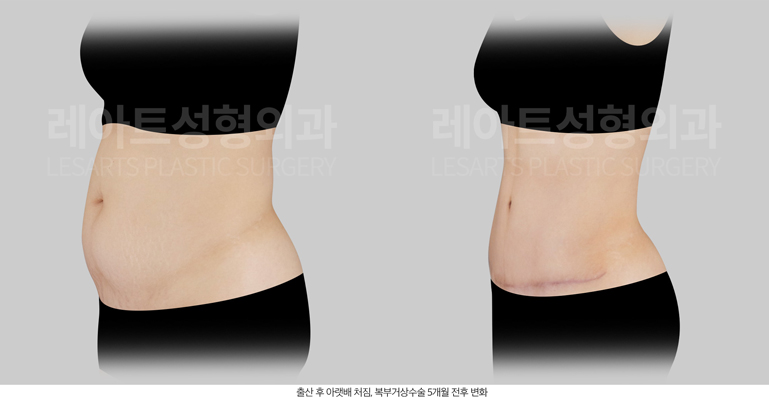
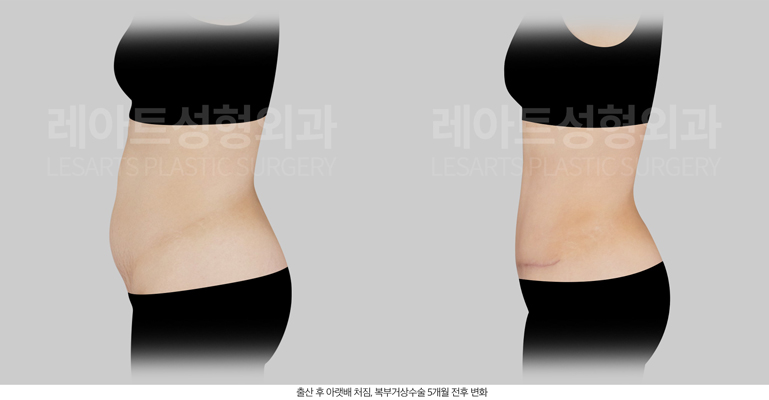
5-Month Results After Abdominoplasty
Before and After Comparison
When comparing the photos taken 5 months after abdominoplasty,
several improvements can be clearly seen.
Before surgery:
- The entire abdomen projected forward
- The lower abdomen looked heavy and sagging
- The overall abdominal line looked uneven
After surgery:
- The abdominal contour became smoother
- The abdomen appears firmer and more supported
- The lower abdominal line looks much cleaner than before
In particular, the excess loose skin
that had sagged from the upper abdomen downward was removed,
which helped the lower abdomen connect more smoothly
with the rest of the abdominal contour.
At the same time, rectus muscle repair improved the central abdominal bulging,
creating a flatter and more balanced appearance.
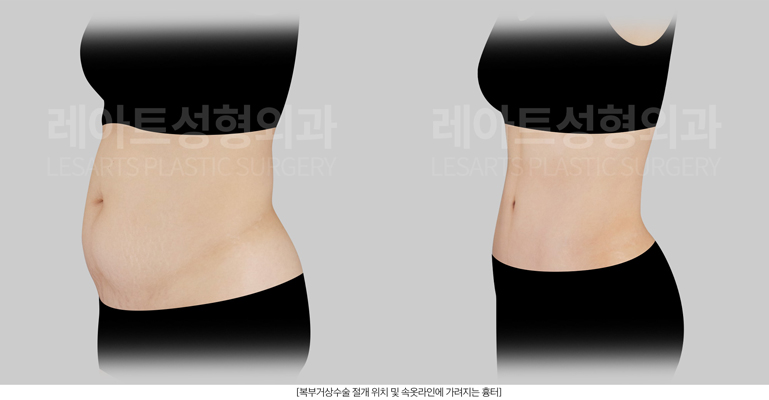
Scar Placement
Low Incision Hidden Under Underwear
The abdominoplasty incision was placed as low as possible
so that it could be hidden under the underwear line.
The patient’s previous cesarean section scar was removed during surgery,
and the area was replaced with the new tummy tuck scar, creating a cleaner overall result.
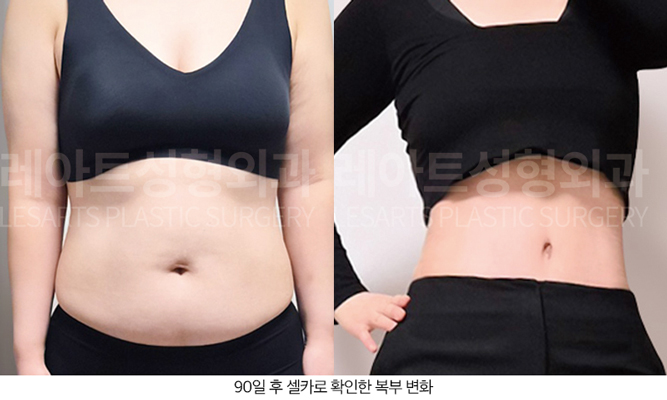
Abdominal Change Seen in Selfies After 90 Days
The patient also shared selfies taken after surgery,
which showed that the concerns she had
when wearing clothes had improved significantly.
The folded appearance of the lower abdomen
that used to be noticeable under clothing was greatly reduced,
and the abdominal silhouette looked much smoother.
Because abdominoplasty has a relatively long recovery period,
continued scar care and postoperative recovery management remain
important for achieving a more stable and satisfying long-term result.
Why This Case Matters
This case shows that postpartum abdominal changes
are not always caused by fat alone.
When the problem includes:
- Loose skin
- Muscle separation
- Abdominal wall protrusion
- Localized fat accumulation
a combined approach such as abdominoplasty with muscle repair and
liposuction may be more appropriate than liposuction alone.
At our plastic surgery clinic in Gangnam, Seoul, Korea, surgical planning is tailored
to the patient’s body structure to create a smoother,
firmer, and more balanced abdominal contour.
#Liposuction #Abdominoplasty
#Thigh #Abdomen #M-type
#BMIbelow30(thigh) #BMIbelow30(Abs) #Abdominal liposuction(M)


Cases finding
similar to my profile
Customer Diagnostics


Select the surgery and
area you are interestedto see real
before andafter changes.


we
make you,
the art
Clinic hours
MON - FRI
10 am – 7pm
SAT
10 am – 4pm
Holiday
SUN, HOLIDAY
Location
Lesarts Moon Clinic Tower 4-5F, 40, Nonhyeon-ro 168-gil,
Gangnam-gu, Seoul, Republic of Korea

Medical institution name Lesarts Plastic Surgery
Address Lesarts Moon Clinic Tower 4-5F, 40, Nonhyeon-ro 168-gil, Gangnam-gu, Seoul, Republic of Korea
Representative Moon sung jun
