




Online Consultation
Please accurately enter the information below.
Quick Cost Consultation
Quick Consultation & Reservation
Cases finding
similar to my profile






Cases finding
similar to my profile
Customer Diagnostics
Chest Protrusion Since His 20s – Changes After Gynecomastia Surgery in His 40s 2-Month Before and After Results at a Plastic Surgery Clinic in Gangnam, Seoul, Korea
2026-03-27
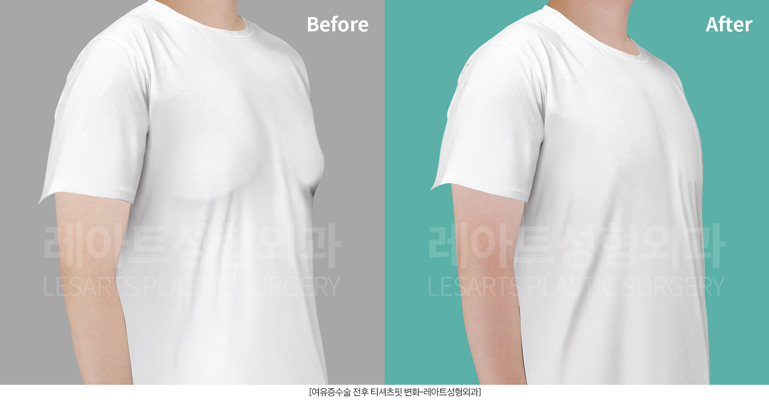
Why Long-Lasting Chest Protrusion Should Not Be Ignored
Some men live with chest protrusion for many years,
assuming it is only related to weight gain and
not taking any specific action.
However, if the shape and size do not change over time,
or if the protrusion is especially noticeable around the areola and nipple area,
it may be difficult to explain it as a simple weight issue.
In these cases, it is important not to leave the condition untreated.
A proper medical evaluation is needed to identify the cause and
decide on the right treatment plan.
When enlarged male breast tissue remains for a long time,
the concern is not only chest size.
Over time, additional changes such as skin laxity
or contour irregularity can also develop.
Pre-Surgery Evaluation
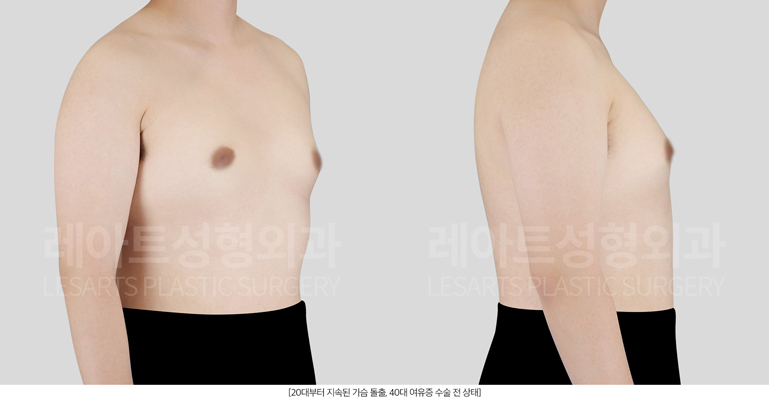
In this case, the patient was a man in his 40s
who had first noticed gynecomastia symptoms in his 20s and
had been concerned about them ever since.
The most noticeable feature before surgery
was the central chest protrusion around the areola.
Fortunately, the chest did not show significant sagging.
However, the nipple and areola area appeared puffy and raised,
making the chest look more prominent.
During the physical examination,
firm tissue was felt around both nipples and areolas,
and ultrasound confirmed that this was overgrown glandular tissue.
This glandular enlargement was the reason the chest appeared
larger and the areola area looked swollen.
For proper gynecomastia treatment,
it was necessary to remove the glandular tissue and
also perform liposuction of the accumulated fat
to create a smoother and flatter chest contour.
Front View Changes After Gynecomastia Surgery
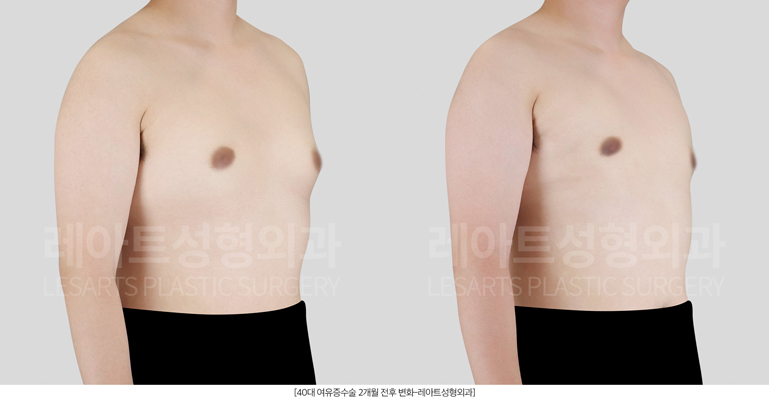
After gynecomastia surgery,
the volume that had been concentrated
in the center of the chest was reduced,
making the rib cage line look much more natural.
In particular, the chest contour that had appeared raised around the areola
before surgery was corrected, resulting in a flatter and
more stable shape without any obvious protrusion.
Most importantly, the change was not limited to a smaller chest size.
The upper body contour from the chest to the abdomen
now appears smoother and more masculine overall.
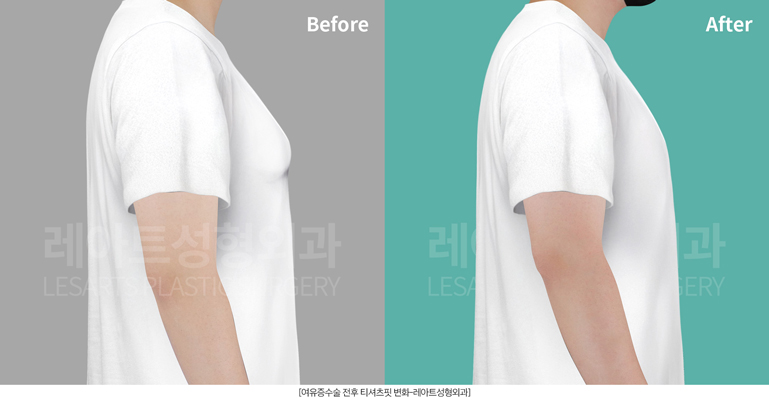
Side View Changes After Gynecomastia Surgery
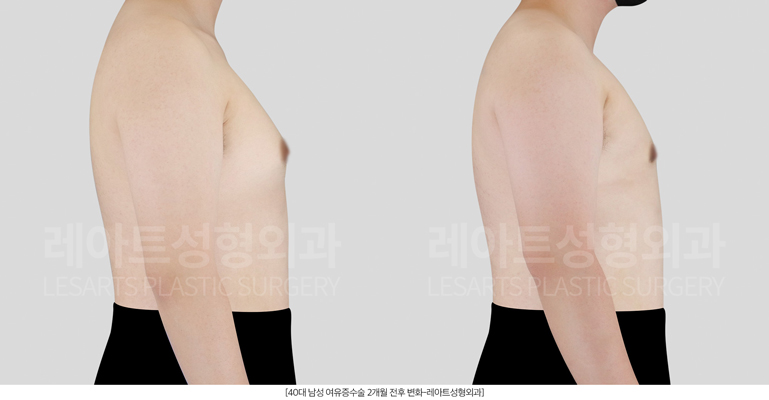
From the side view as well,
the central part of the chest that had projected forward was corrected,
making the upper body silhouette look much more natural,
and the area around the nipple also became flatter.
The patient had felt uncomfortable and self-conscious whenever
he wore thin T-shirts in spring or summer.
After surgery, he said that when wearing clothes
that show the chest contour, his chest no longer looked overly large,
and instead appeared firmer and more natural,
which relieved a great deal of stress.
Because he had lived with this chest protrusion for a long time and
had experienced daily discomfort because of it, he expressed satisfaction
not only with the visible improvement in the photos,
but also with the reduction in psychological stress
after gynecomastia surgery.
Current Recovery Stage
2 Months After Surgery
At this point, about 2 months after surgery,
the patient is still in the recovery stage,
when mild residual swelling may remain and
the surgical tissues continue to stabilize.
With continued exercise and healthy diet management,
the results are expected to settle further,
creating an even more defined and
attractive upper body contour over time.
#Male body contouring
#Gynecomastia
#Grade2-A #true gynecomastia #Side chest liposuction


Cases finding
similar to my profile
Customer Diagnostics


Select the surgery and
area you are interestedto see real
before andafter changes.


we
make you,
the art
Clinic hours
MON - FRI
10 am – 7pm
SAT
10 am – 4pm
Holiday
SUN, HOLIDAY
Location
Lesarts Moon Clinic Tower 4-5F, 40, Nonhyeon-ro 168-gil,
Gangnam-gu, Seoul, Republic of Korea

Medical institution name Lesarts Plastic Surgery
Address Lesarts Moon Clinic Tower 4-5F, 40, Nonhyeon-ro 168-gil, Gangnam-gu, Seoul, Republic of Korea
Representative Moon sung jun
