




Online Consultation
Please accurately enter the information below.
Quick Cost Consultation
Quick Consultation & Reservation
Cases finding
similar to my profile






Cases finding
similar to my profile
Customer Diagnostics
3-Month Results of Gynecomastia Surgery in a Man in His 40s How Much Did the Chest Protrusion Improve? | Plastic Surgery Clinic in Gangnam, Seoul, Korea
2026-04-01
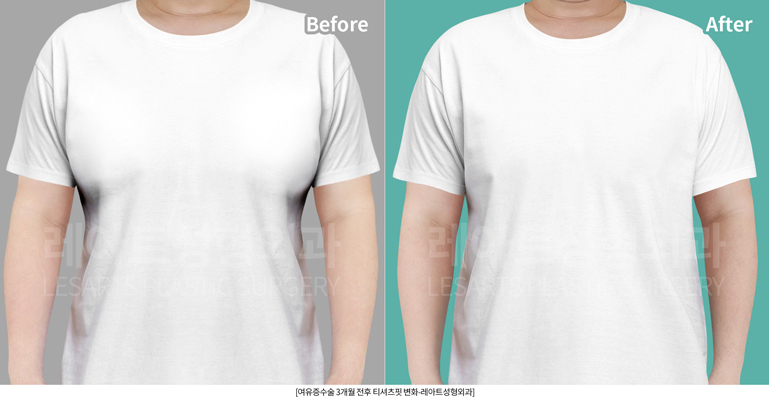
When diagnosing gynecomastia,
it is important to confirm whether the enlarged chest is caused mainly
by fat accumulation or by a structural issue such as glandular tissue enlargement.
This is especially important in patients who have had gynecomastia for a long time.
In these cases, doctors should evaluate not only the degree of gland development,
but also whether there is reduced skin elasticity or mild sagging of the chest skin.
The goal is not simply to reduce chest size.
It is also important to predict how the skin will recover after surgery and
whether there is a risk of wrinkling,
so that the final result can be more stable and satisfying.
In this case, the patient was a man in his 40s
who had first noticed gynecomastia symptoms in his 30s.
Even after losing weight, he did not see much improvement,
so he decided to undergo surgery at our plastic surgery
clinic in Gangnam, Seoul, Korea.
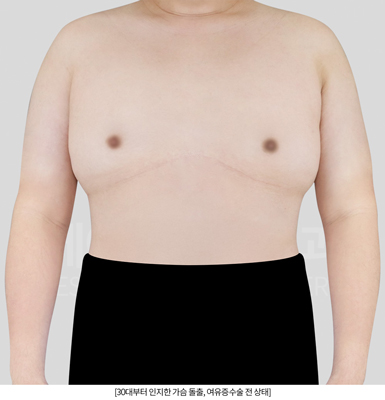
Pre-Surgery Evaluation
Chest Protrusion and Areola Fullness Before Gynecomastia Surgery
Before surgery, the patient showed:
- Increased chest volume
- Puffiness around the nipple and areola area
- Forward projection of the central chest on both sides
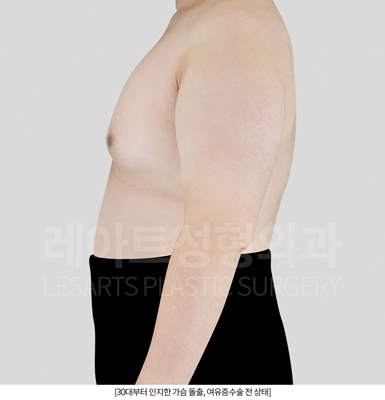
From the side view,
the chest protrusion was even more noticeable.
During the physical examination, firm tissue was felt around the areola,
and ultrasound confirmed that this tissue was glandular tissue.
In addition, the patient showed:
- Slightly reduced skin elasticity
- Mild chest sagging
Based on these findings,
the condition was diagnosed as true gynecomastia,
Simon grade 2B.
Why Skin Condition Matters in Long-Standing Gynecomastia
In patients with long-standing gynecomastia,
the concern is not only how much the chest protrudes.
When the condition has continued for many years,
the chest skin may gradually lose elasticity,
and mild sagging can also appear. In this type of case,
proper surgical planning is important because treatment must consider:
- Removal of glandular tissue
- Contour improvement
- Postoperative skin recovery
- The risk of skin wrinkling after surgery
For this reason, successful gynecomastia surgery
requires more than simple chest reduction.
It should also include a plan for how the skin will settle after surgery.
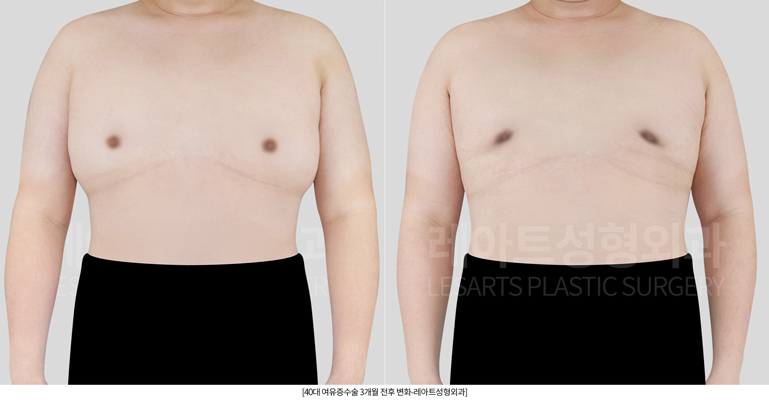
3-Month Results After Gynecomastia Surgery
Front View Changes
At 3 months after gynecomastia surgery,
the prominent central chest contour had clearly improved.
As the forward chest projection decreased,
not only the chest itself, but also the overall upper body contour
became more natural.
Before surgery, the transition from the chest to the abdomen
looked interrupted around the lower chest fold.
After surgery, this area became smoother,
allowing the side line of the upper body to connect
more naturally without an awkward bulge.
The patient had been especially stressed not only by chest size,
but also by the puffy appearance around the nipple and areola.
After surgery, that swollen appearance improved,
and he said he felt much more comfortable wearing T-shirts.
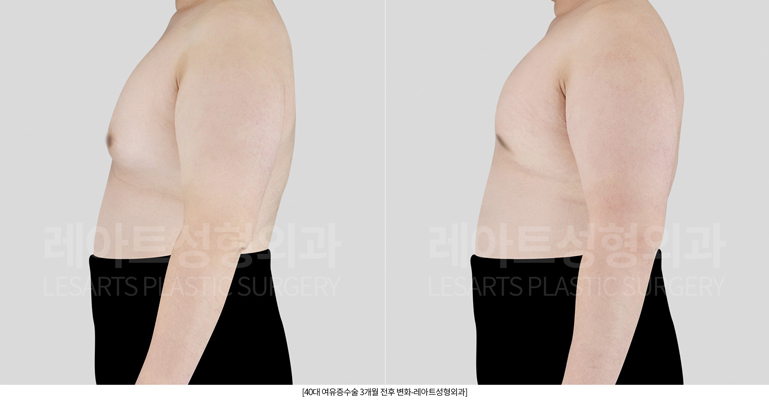

Side View Improvement
A Flatter and More Natural Upper Body Silhouette
The side view also shows an important change.
Before surgery, the center of the chest projected forward noticeably. After surgery,
that protruding contour became flatter,
which helped the upper body look more natural and balanced.
Because the chest no longer stands out as much in fitted or lightweight clothing,
the patient felt that the chest looked less embarrassing and much easier to hide in daily life.
Current Recovery Stage
3 Months After Surgery
This patient had lived with chest enlargement and protrusion for quite a long time.
Since mild sagging was also present,
it was especially important to monitor skin
elasticity and recovery after surgery.
In this type of case,
postoperative care is important for reducing the risk of:
- Poor skin settling
- Wrinkling
- Delayed recovery of chest contour
For that reason,
patients are guided on several recovery
methods based on their condition, including:
- Use of lifting tape
- Proper use and timing of compression garments
- Regular follow-up visits
The patient was also advised that with careful follow-up,
consistent weight control, and regular exercise,
the chest contour can continue to improve and look even better over time.
Why Accurate Diagnosis and Aftercare Matter in Gynecomastia Surgery
This case shows that in middle-aged patients with long-standing gynecomastia,
treatment planning should not focus only on reducing chest size.
When the patient has:
- Glandular enlargement
- Puffiness around the areola
- Reduced skin elasticity
- Mild sagging
it is important to create a treatment plan that also considers skin
recovery and postoperative contour stability.
At our plastic surgery clinic in Gangnam, Seoul, Korea,
gynecomastia surgery is planned carefully based on the cause of chest enlargement,
skin condition, and overall upper body balance to create a flatter,
more natural, and more masculine chest contour.
#Male body contouring
#Gynecomastia
#Grade2-B #true gynecomastia #Side chest liposuction


Cases finding
similar to my profile
Customer Diagnostics


Select the surgery and
area you are interestedto see real
before andafter changes.


we
make you,
the art
Clinic hours
MON - FRI
10 am – 7pm
SAT
10 am – 4pm
Holiday
SUN, HOLIDAY
Location
Lesarts Moon Clinic Tower 4-5F, 40, Nonhyeon-ro 168-gil,
Gangnam-gu, Seoul, Republic of Korea

Medical institution name Lesarts Plastic Surgery
Address Lesarts Moon Clinic Tower 4-5F, 40, Nonhyeon-ro 168-gil, Gangnam-gu, Seoul, Republic of Korea
Representative Moon sung jun
