




Online Consultation
Please accurately enter the information below.
Quick Cost Consultation
Quick Consultation & Reservation
Cases finding
similar to my profile






Cases finding
similar to my profile
Customer Diagnostics
Teenage Gynecomastia – If Surgery Is Done in the 20s, Will There Be Loose Skin? Early Changes 2 Weeks After Gynecomastia Surgery at a Plastic Surgery Clinic in Gangnam, Seoul, Korea
2026-04-08
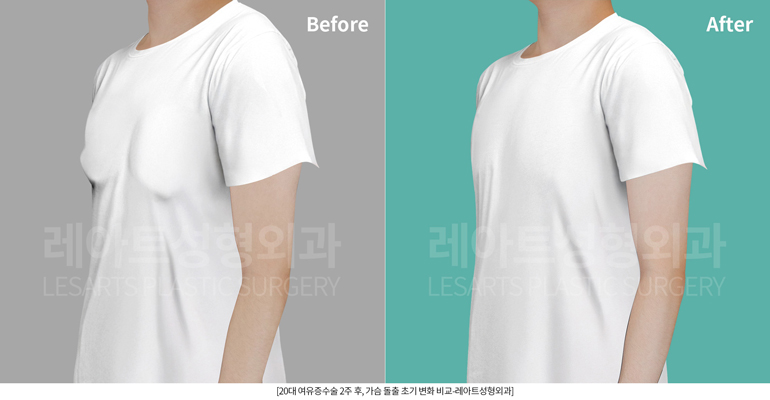
Gynecomastia in adolescence can sometimes be a temporary physical change
that happens during growth. However, if the symptoms do not improve
naturally over time, treatment may be needed.
That is why, in teenage gynecomastia cases,
it is often important to monitor the condition after the initial diagnosis
and check how it changes over time.
Some patients also ask whether having gynecomastia surgery
in their 20s could lead to skin wrinkling or loose skin,
especially if the chest has remained enlarged for many years.
For this reason,
if gynecomastia has continued since adolescence,
it is helpful not to wait too long,
but to receive a proper evaluation and
discuss the most appropriate treatment.
In this case, the patient had shown gynecomastia symptoms since his teenage years.
In this post, we will explain how his chest changed after surgery and
whether there were any notable postoperative concerns
at our plastic surgery clinic in Gangnam, Seoul, Korea.
Patient Information
Age: Early 20s
Height / Weight: 178 cm / 65 kg
BMI: 21
Gynecomastia Grade: Simon Grade 2A
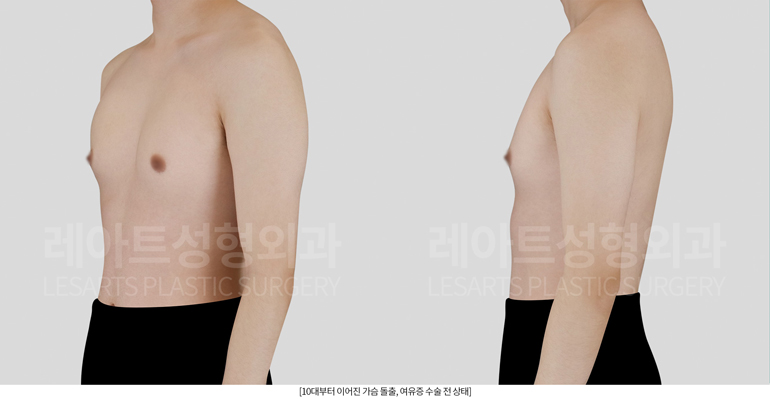
Pre-Surgery Evaluation
Chest Protrusion That Continued Since the Teenage Years
The patient had a generally slim body type,
but showed clear chest enlargement and
noticeable protrusion of the nipple and areola area.
Ultrasound examination confirmed developed
glandular tissue in both sides of the chest.
Fortunately, the patient did not show
significant skin laxity or obvious chest sagging.
Because of this, the surgical plan focused on:
- Removing the glandular tissue
that caused the chest enlargement and protrusion
- Rearranging the internal tissue
to create a new and more natural chest shape
- Performing liposuction of the lateral chest area
to improve the balance of the upper body contour
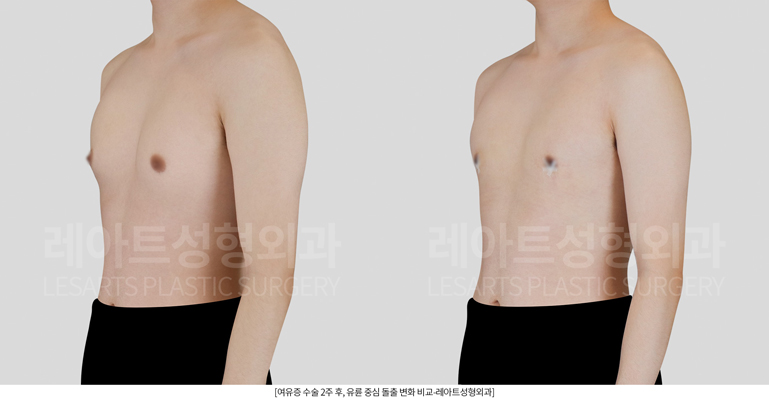
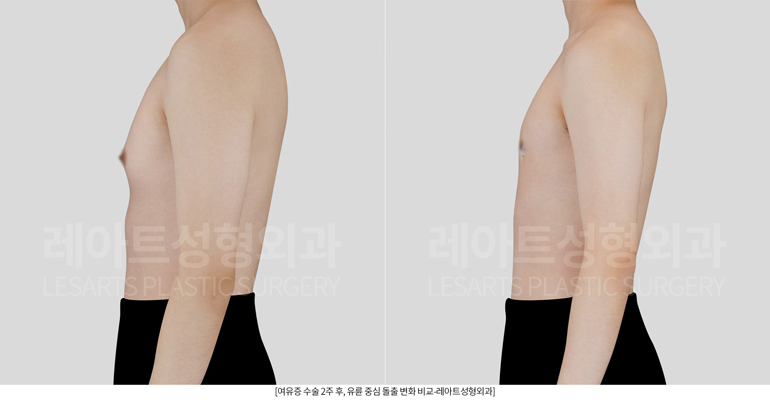
2 Weeks After Gynecomastia Surgery
Improvement in Areola-Centered Chest Protrusion
When comparing the before and after results,
the chest protrusion that had been most noticeable
around the areola was clearly reduced after surgery.
As that central protrusion improved,
the overall front chest contour
became more defined and masculine.
Because this was true gynecomastia
caused mainly by glandular tissue development,
it would have been difficult to achieve
this type of change through exercise or dieting alone.
In this case, the procedure did not involve only gland removal.
Tissue rearrangement and liposuction were performed together
to create a smoother connection between the chest and upper body,
resulting in a firmer, more athletic-looking chest shape.
At 2 weeks after surgery,
the patient was still in the early recovery stage,
so some swelling and BioBond-related firmness
(internal tissue firmness) were still present.
This means the chest had not yet reached its final shape.
Even so, the chest size had already decreased,
and the prominent nipple projection that had caused
embarrassment before surgery was clearly improved,
so the patient’s satisfaction was naturally high.
Although this was a case of
gynecomastia that had continued since adolescence,
the patient’s skin elasticity was relatively good,
so there were no visible problems such as
loose skin or wrinkling after surgery.
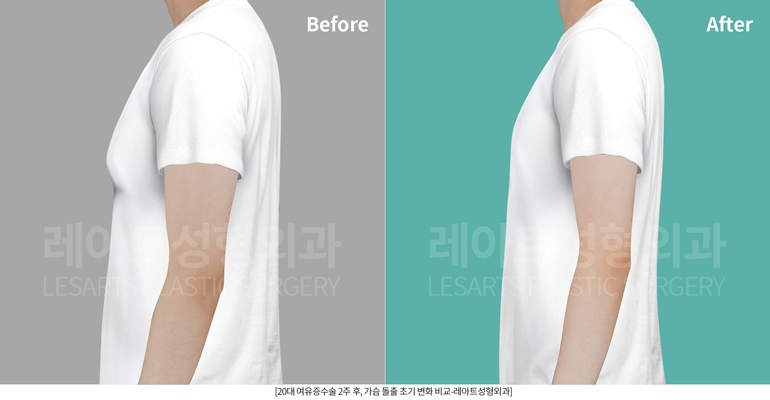
Early Clothing Fit Changes
A Big Difference Even in the Early Recovery Stage
Even though this was still the early recovery period,
the difference in clothing fit was already noticeable.
The patient was especially pleased that the long-term stress
he had felt about his chest had improved,
and that he no longer had to worry as much
about how his chest looked in clothes.
Although gynecomastia surgery often shows
visible external improvement quite quickly,
it is still a procedure that requires enough
time for the internal tissues to heal fully.
For that reason, the patient was advised to continue:
- Wearing the compression garment
- Following the recommended recovery care
- Paying close attention to postoperative management
during the early healing stage
It was also explained that once the early recovery stage passes,
continued daily care and regular exercise
can help maintain an even better upper body shape.
Why Early Evaluation Matters in Long-Standing Gynecomastia
This case shows that even when gynecomastia begins in the teenage years,
surgery performed in the 20s does not always lead to loose skin.
What matters most is the patient’s:
- Skin elasticity
- Degree of chest enlargement
- Amount of glandular tissue
- Overall chest shape and balance
At our plastic surgery clinic in Gangnam, Seoul, Korea,
gynecomastia surgery is planned carefully
based on each patient’s chest condition to create a flatter,
more natural, and more masculine chest contour
while minimizing concerns about loose skin.
#Male body contouring
#Gynecomastia
#Grade2-A #true gynecomastia #Side chest liposuction


Cases finding
similar to my profile
Customer Diagnostics


Select the surgery and
area you are interestedto see real
before andafter changes.


we
make you,
the art
Clinic hours
MON - FRI
10 am – 7pm
SAT
10 am – 4pm
Holiday
SUN, HOLIDAY
Location
Lesarts Moon Clinic Tower 4-5F, 40, Nonhyeon-ro 168-gil,
Gangnam-gu, Seoul, Republic of Korea

Medical institution name Lesarts Plastic Surgery
Address Lesarts Moon Clinic Tower 4-5F, 40, Nonhyeon-ro 168-gil, Gangnam-gu, Seoul, Republic of Korea
Representative Moon sung jun
