




Online Consultation
Please accurately enter the information below.
Quick Cost Consultation
Quick Consultation & Reservation
Cases finding
similar to my profile






Cases finding
similar to my profile
Customer Diagnostics
Loose Lower Belly When Bending Forward – How Did It Change After Abdominoplasty? 2-Month Results After Full Tummy Tuck at a Plastic Surgery Clinic in Gangnam, Seoul, Korea
2026-04-08
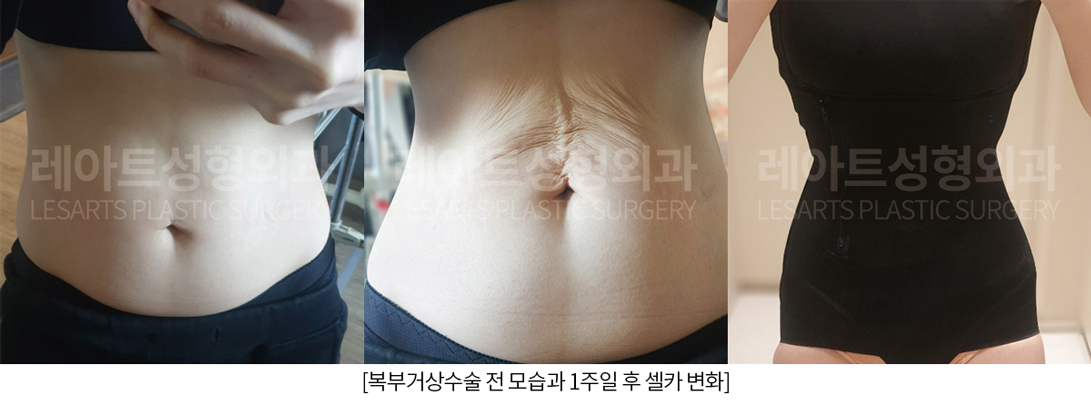
In this case, the patient underwent abdominoplasty
(tummy tuck surgery) to improve loose abdominal skin and
upper abdominal wrinkling that developed after a previous cesarean section.
Before surgery, the patient had a relatively slim body type.
However, the shape of the abdomen did not improve,
and this continued to cause discomfort in daily life.
Her main concerns were:
- Upper abdominal wrinkling
- A loose lower abdomen that sagged downward when bending forward
- A feeling that the abdomen did not have enough strength or support
Because of these concerns,
the patient chose to undergo surgery
at our plastic surgery clinic in Gangnam, Seoul, Korea.
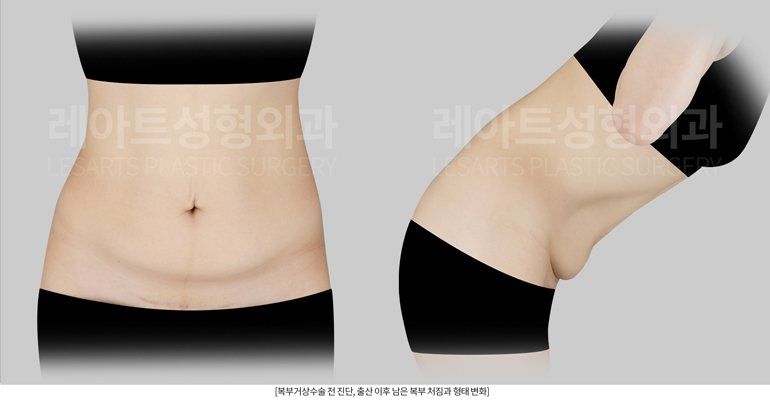
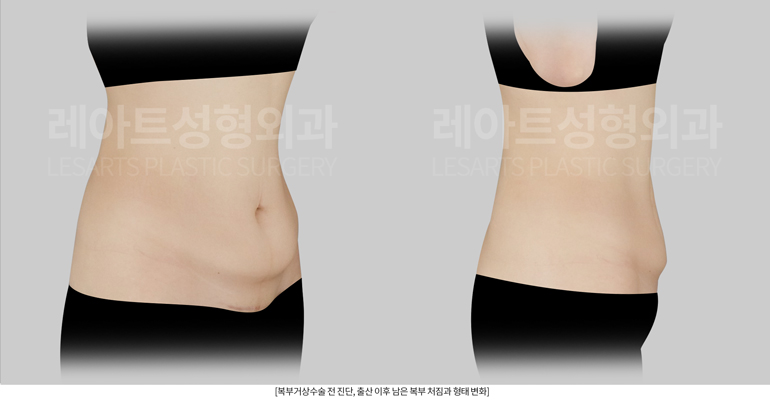
Pre-Surgery Evaluation
Postpartum Abdominal Sagging and Structural Changes
During examination,
the patient showed several important findings.
The skin was thin and had reduced elasticity,
and rectus diastasis was found in both the upper and lower abdomen.
In addition, loose skin was concentrated in the lower abdomen,
and the abdominal contour looked uneven.
Although the patient did not have a large amount of abdominal fat,
there were adhesive tissues in the front abdomen that made
the contour look less smooth. These areas also
needed to be corrected during surgery.
Because the patient’s previous C-section scar was
positioned quite low, it was also important to explain before surgery
that if the upper abdominal skin could not be pulled down enough,
there was a possibility that two scar lines could remain.
After receiving a full explanation,
the patient decided to proceed with surgery.
Surgical Plan
Full Abdominoplasty with Muscle Repair and Belly Button Reconstruction
The surgery was planned as a full abdominoplasty (M-type).
This was the appropriate option because the patient needed improvement
not only in the lower abdominal sagging, but also
in the upper abdominal wrinkles and the overall abdominal contour.
Since rectus diastasis was present in both the upper and lower abdomen,
rectus muscle repair was also included
in the plan to restore abdominal wall support.
In a full tummy tuck, the skin must be pulled downward from the upper abdomen,
so belly button repositioning and reconstruction are also necessary.
For this reason, the surgical plan included creating
a new belly button in a more ideal position.
As mentioned earlier, the patient did not have a large amount of abdominal fat.
However, because of the adhesive tissue in the front abdomen,
the surgery needed to include both:
- Removal of the adhesions
- Liposuction for contour refinement
This combined approach was planned
to create a smoother and firmer abdominal line.
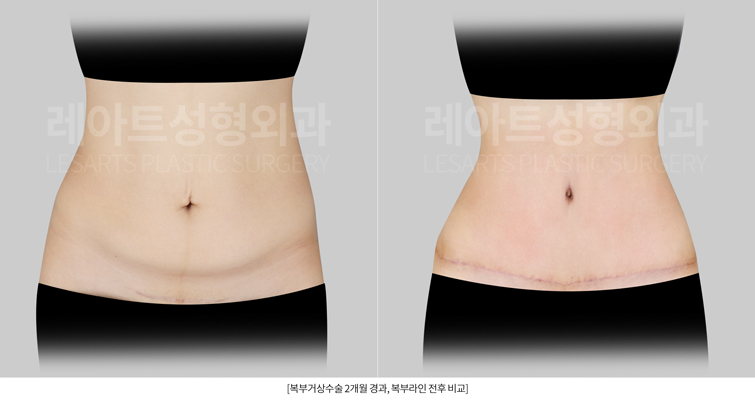
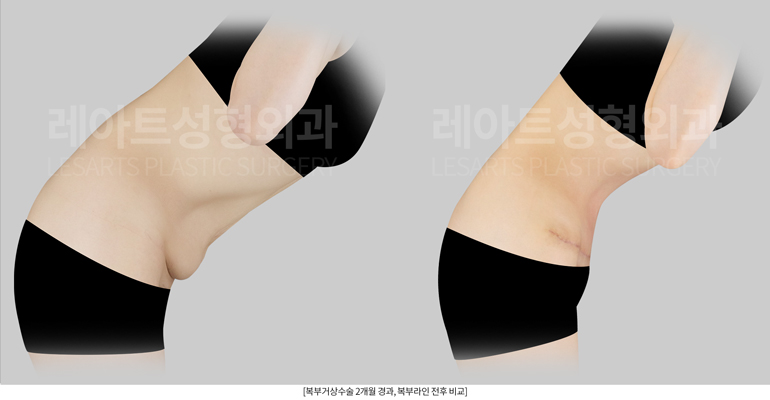
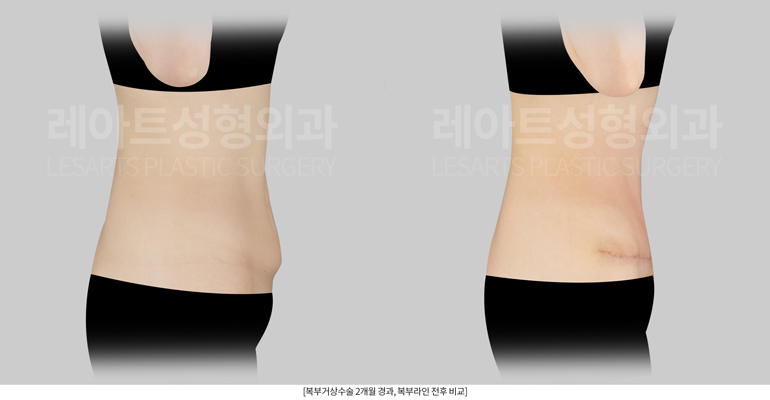
2-Month Results After Abdominoplasty
Smoother, Firmer, and More Stable Abdominal Contour
When comparing the photos taken before surgery and
2 months after abdominoplasty,
the patient’s main concerns showed clear improvement.
Before surgery, the patient was bothered by:
- Loose abdominal skin
- Upper abdominal wrinkles
- A heavy, sagging feeling when bending forward
- A lack of abdominal firmness
After surgery, most of these issues improved significantly.
The line from the waist to the lower abdomen became much smoother,
and the abdomen changed from a sagging and
forward-projecting shape to a firmer and flatter contour.
In particular, after rectus muscle repair,
the contour of the central and lower abdomen
became more stable and tidy than before.
The uncomfortable feeling that the abdomen lacked
support also improved, and the uneven,
weak-looking abdominal shape was no longer visible.
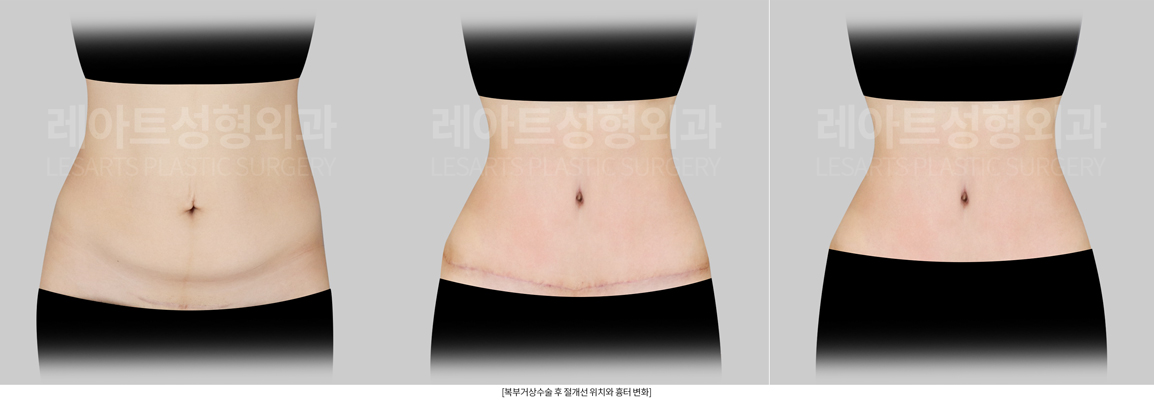
Scar Placement After Tummy Tuck
Low Scar Position Hidden Under Underwear
Because abdominoplasty involves removing a large amount of loose skin,
it is always important to check the position
of the incision and how the scar changes over time.
In this case, the position of the previous C-section scar
was already quite low, so it was especially important to explain
how the new scar might remain after surgery.
The old cesarean scar was removed,
and the new tummy tuck scar was placed as low as possible
in the lower abdomen so that it could be
easily hidden under underwear.
The patient is still in the early recovery stage,
so the scar is still somewhat red.
However, overall healing is progressing in a stable way.
Current Recovery Stage
Early Healing Progress After Surgery
Overall, this patient was very satisfied because the main concerns before surgery—
lower abdominal sagging, upper abdominal wrinkling,
and the uneven abdominal shape—were all significantly improved.
As recovery continues, ongoing scar care and
proper daily management will be important.
With continued aftercare, the patient can expect:
A more stable abdominal contour
Further improvement in scar appearance
A more natural long-term result
Why Full Abdominoplasty Was Important in This Case
This case shows that even in a relatively slim patient,
the abdomen may still need surgical correction when there are:
- Loose skin after pregnancy
- Upper abdominal wrinkling
- Lower abdominal sagging when bending forward
- Rectus diastasis
- Adhesions that disturb the smooth abdominal contour
In these situations, full abdominoplasty with muscle repair and
contour refinement can provide much better results than simple fat removal alone.
At our plastic surgery clinic in Gangnam,
Seoul, Korea, each tummy tuck procedure is planned carefully
based on the patient’s skin condition, abdominal structure,
and recovery needs to create a smoother,
firmer, and more natural abdominal contour.
#Abdominoplasty
#M-type
#Abdominal liposuction(M)


Cases finding
similar to my profile
Customer Diagnostics


Select the surgery and
area you are interestedto see real
before andafter changes.


we
make you,
the art
Clinic hours
MON - FRI
10 am – 7pm
SAT
10 am – 4pm
Holiday
SUN, HOLIDAY
Location
Lesarts Moon Clinic Tower 4-5F, 40, Nonhyeon-ro 168-gil,
Gangnam-gu, Seoul, Republic of Korea

Medical institution name Lesarts Plastic Surgery
Address Lesarts Moon Clinic Tower 4-5F, 40, Nonhyeon-ro 168-gil, Gangnam-gu, Seoul, Republic of Korea
Representative Moon sung jun
