




Online Consultation
Please accurately enter the information below.
Quick Cost Consultation
Quick Consultation & Reservation
Cases finding
similar to my profile






Cases finding
similar to my profile
Customer Diagnostics
Male Chest Protrusion Since Teenage Years: True Gynecomastia Surgery & 2-Month T-Shirt Fit Change | Best Plastic Surgery Clinic in Gangnam, Seoul, Korea
2026-06-08

Gynecomastia can affect not only the chest shape,
but also posture, clothing choices,
and daily confidence.
Some men with chest protrusion tend to round
their shoulders or try to hide their chest line without realizing it.
Gynecomastia is generally
divided into three types.
The first type is pseudo-gynecomastia,
where fat accumulation around the chest
makes the chest look larger.
The second type is true gynecomastia,
where overgrown glandular tissue under the nipple and
areola is the main cause of chest enlargement.
The third type is mixed-type gynecomastia,
where both fat and glandular tissue
affect the chest shape.
Although these types may all look similar from the outside,
the actual cause can be different.
This is why an accurate examination is important
before deciding on the surgical plan.
It is also important to check not only glandular tissue and fat,
but also medication history, underlying health conditions,
and skin elasticity before planning gynecomastia surgery
at a plastic surgery clinic in Gangnam, Seoul, Korea.
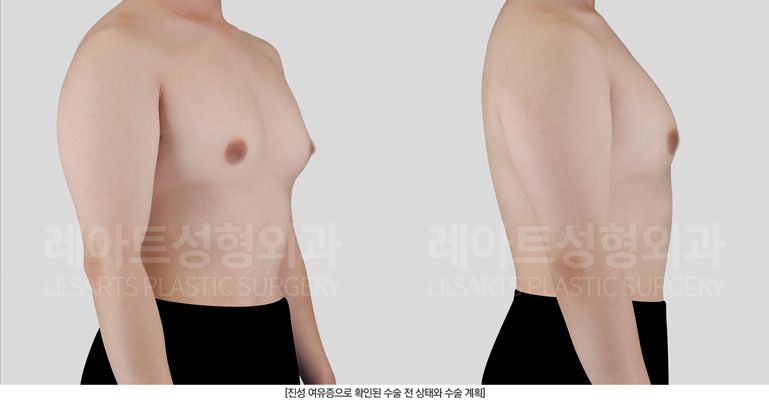
Patient Information
Age: Late 20s
Height: 173 cm
Weight: 79 kg
Diagnosis: Simon Grade 2A gynecomastia
Before Surgery Analysis
This patient had been concerned
about gynecomastia symptoms
since middle school.
There was a period when his weight increased,
and later he tried weight loss and gym workouts.
However, even after losing weight and exercising,
the enlarged chest and puffy shape around the nipple and
areola did not improve significantly.
During consultation,
the chest protrusion was mainly centered
around the nipple and areola.
The overall chest size was also enlarged, and based on the Simon classification,
the condition was diagnosed
as Simon Grade 2A true gynecomastia.
Ultrasound examination confirmed developed glandular tissue
under the nipple and areola on both sides.
Fortunately, the patient had good skin elasticity,
and no significant chest sagging was found.
Surgical Plan
The surgery was planned to remove the main cause of gynecomastia
while creating a natural male chest contour.
The surgical plan included:
- Glandular tissue removal
- Chest liposuction
- Tissue reshaping
- Chest contour correction
for a smoother masculine line
The goal was not simply to reduce chest size.
The surgery focused on improving the protrusion
around the nipple and areola,
reducing excess chest volume,
and creating a smoother chest line that looked natural
from the front and side.
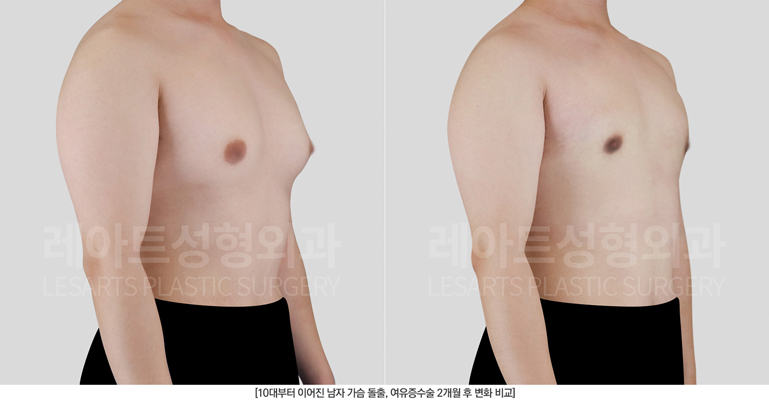
2-Month After Gynecomastia Surgery Results
When comparing the before and 2-month after photos,
the change in the chest line is clearly visible.
Before surgery, the areola was enlarged
and protruded forward.
After surgery, the volume around the nipple and areola decreased,
and the front chest contour became much smoother.
The puffy areola shape also improved.
Even though some mild swelling and tissue firmness could still remain
at 2 months after surgery, the skin settled naturally and
the chest looked smooth enough that past gynecomastia symptoms
were no longer obvious.
The patient’s upper body changed from a protruding chest shape
into a more masculine and stable chest contour.
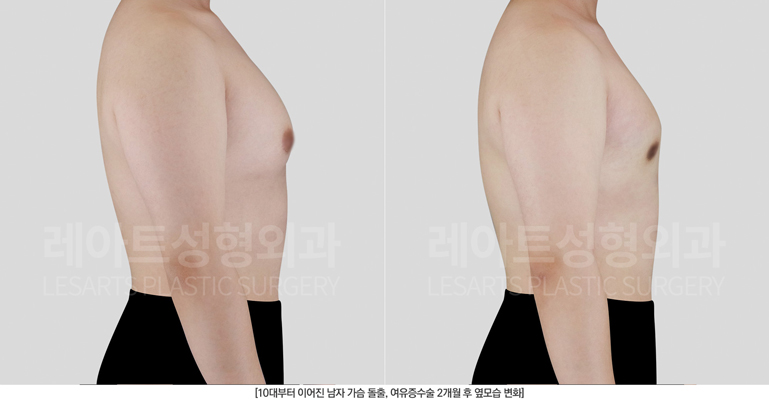
Side View Changes
From the side view, the improvement
is even more noticeable.
Before surgery, the nipple and areola area protruded forward,
making the chest line stand out.
After surgery, this protrusion was reduced,
and the front chest line became more natural.
The chest no longer looked rounded
or puffy from the side.
This helped create a more balanced
upper body shape and a firmer-looking chest line.
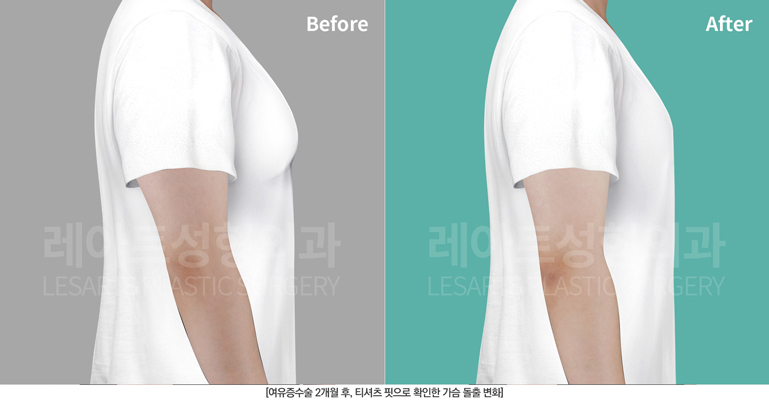
T-Shirt Fit Change
One of the biggest changes was
the improvement in T-shirt fit.
Before surgery, the patient had become used to hiding his chest line
because he had been concerned about gynecomastia since middle school.
After surgery, the chest line
looked much smoother under a T-shirt.
The chest no longer protruded through clothing as much,
and the upper body looked more natural and balanced.
The patient was highly satisfied with the change
in chest shape soon after surgery and
shared that he was able to return to daily life
without major discomfort during recovery.
Why Exercise Alone May Not Be Enough
This case shows that chest protrusion does not always
improve with weight loss or exercise.
If the main cause is overgrown glandular tissue,
chest workouts or dieting may not fully correct the shape.
Even after body weight decreases, the puffy nipple and
areola area may remain if true gynecomastia is present.
That is why ultrasound examination and accurate diagnosis are important
before deciding on treatment.
Conclusion
If male chest protrusion has continued since the teenage years
and does not improve with weight loss or exercise,
it may be true gynecomastia rather than simple chest fat.
In this case, removing glandular tissue and
combining chest liposuction helped improve the chest protrusion
and create a smoother T-shirt fit.
Through consultation at a trusted plastic surgery clinic or hospital in Gangnam,
Seoul, Korea, patients can identify the exact cause of gynecomastia and
choose a treatment plan that fits their condition.
For men who have been concerned about chest protrusion, puffy areola,
or hiding their chest line for many years, gynecomastia surgery
in Korea may help create a flatter,
smoother, and more confident upper body shape.
#Male body contouring
#Gynecomastia
#Grade2-A #true gynecomastia


Cases finding
similar to my profile
Customer Diagnostics


Select the surgery and
area you are interestedto see real
before andafter changes.


we
make you,
the art
Clinic hours
MON - FRI
10 am – 7pm
SAT
10 am – 4pm
Holiday
SUN, HOLIDAY
Location
Lesarts Moon Clinic Tower 4-5F, 40, Nonhyeon-ro 168-gil,
Gangnam-gu, Seoul, Republic of Korea

Medical institution name Lesarts Plastic Surgery
Address Lesarts Moon Clinic Tower 4-5F, 40, Nonhyeon-ro 168-gil, Gangnam-gu, Seoul, Republic of Korea
Representative Moon sung jun
