




Online Consultation
Please accurately enter the information below.
Quick Cost Consultation
Quick Consultation & Reservation
Cases finding
similar to my profile






Cases finding
similar to my profile
Customer Diagnostics
Mini Tummy Tuck for Lower Belly Sagging After C-Section: 3-Month Results | Best Plastic Surgery Clinic in Gangnam, Seoul, Korea
2026-06-08
Some patients experience lower belly sagging after C-section delivery,
even when their body weight is well managed.
In this case, the patient had maintained a stable
weight through diet after childbirth.
However, she was concerned about loose lower abdominal skin,
wrinkles, and a protruding lower belly shape.
Although she did not have much abdominal fat,
the lower belly line did not look smooth even when standing.
When bending forward or moving,
the skin folding became even more noticeable.
Because the main concern was loose skin and
lower abdominal laxity rather than fat volume,
the patient decided to undergo mini tummy tuck surgery
at a plastic surgery clinic in Gangnam, Seoul, Korea.
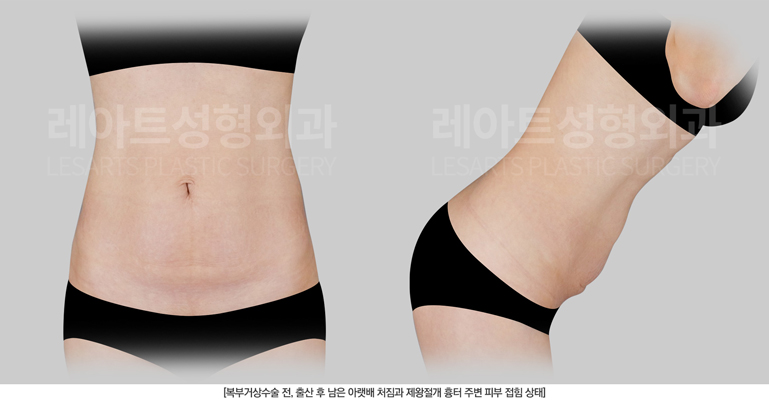
Before Surgery Analysis
Before surgery, the patient had a C-section scar
located relatively low on the lower abdomen.
Above the scar, the lower abdominal skin had sagged downward,
creating a folded and protruding shape.
The main concerns included:
- Lower belly sagging after C-section
- Skin folding around the C-section scar
- Loose lower abdominal skin
- Lower abdominal protrusion
- Rectus diastasis in the lower abdomen
- Weak abdominal wall support
- Wrinkled lower belly skin when bending forward
This was not simply a case of loose skin.
Because lower abdominal rectus diastasis was also found,
the lower abdomen did not have enough internal support.
As a result, the lower belly looked weak,
widened, and protruded.
When the patient bent forward,
the lower abdominal skin sagged downward with gravity,
making the skin fold even more visible around the C-section scar.
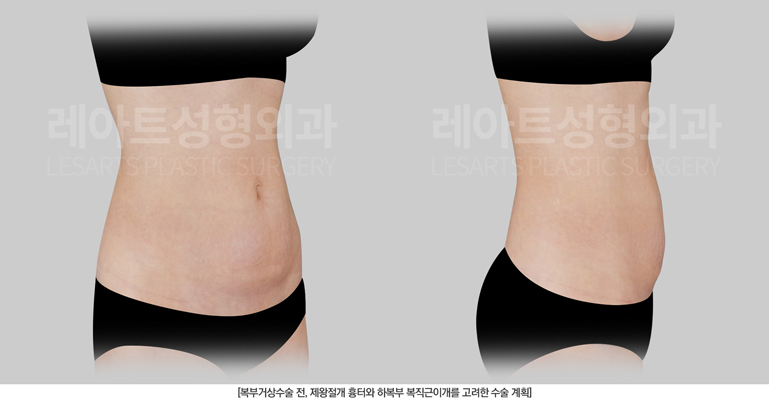
Surgical Plan
The surgery was planned as an S-type mini tummy tuck,
focused mainly on the lower abdomen.
The goal was to remove the sagging skin below the navel and
correct the lower abdominal wall.
The surgical plan included:
- S-type mini abdominoplasty
- Lower abdominal skin removal
- Rectus muscle repair
- Abdominal wall tightening
- C-section scar correction
- No abdominal liposuction
The existing C-section scar was planned to be removed
together with the sagging lower abdominal skin.
Because the amount of skin that needed to be removed was relatively large,
the patient was informed that even though the procedure
was an S-type mini tummy tuck,
the incision length could be slightly longer.
Since the patient did not have much abdominal fat,
abdominal liposuction was not performed.
Instead, the surgery focused on removing loose skin and
correcting the weakened rectus muscle and fascia.
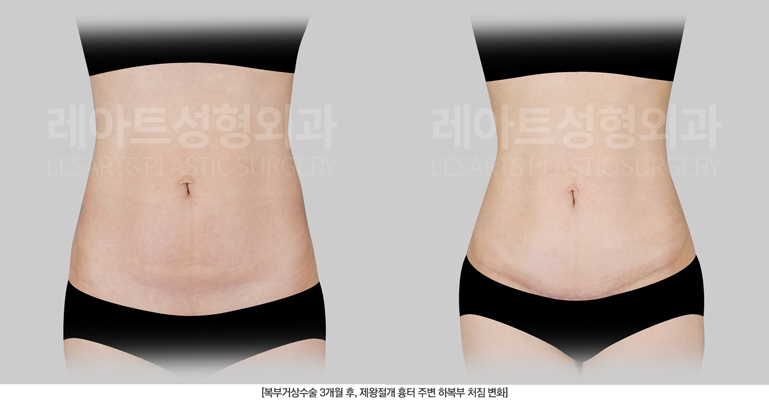
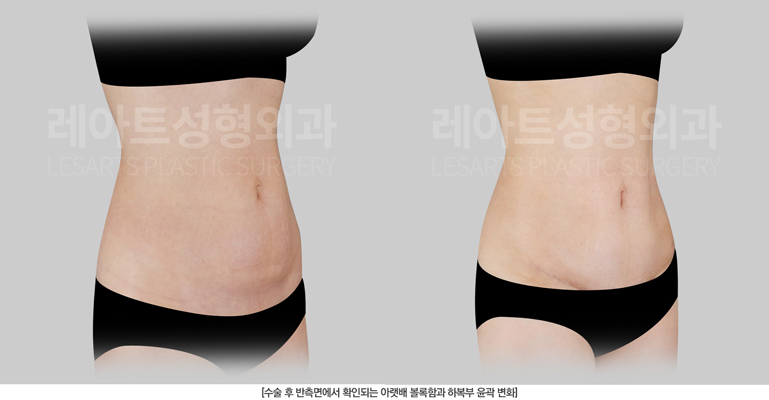
3-Month After Mini Tummy Tuck Results
When comparing the before and 3-month after photos,
the improvement in the lower abdomen is clearly visible.
Before surgery,
the skin from below the navel to the lower belly
sagged downward and created a bulging shape.
The skin folding around the C-section scar
also made the lower abdominal line look uneven.
After surgery:
- The loose lower belly skin was removed
- The folded skin around the C-section scar improved
- The lower abdominal protrusion was reduced
- The front abdominal line looked firmer
- The center abdominal line appeared more stable
- The waistline looked more defined
Through mini tummy tuck surgery,
the sagging skin in the lower abdomen was corrected,
and the abdomen looked more lifted and neat.
The rectus muscle repair also helped improve the weak
and widened-looking front abdominal line.
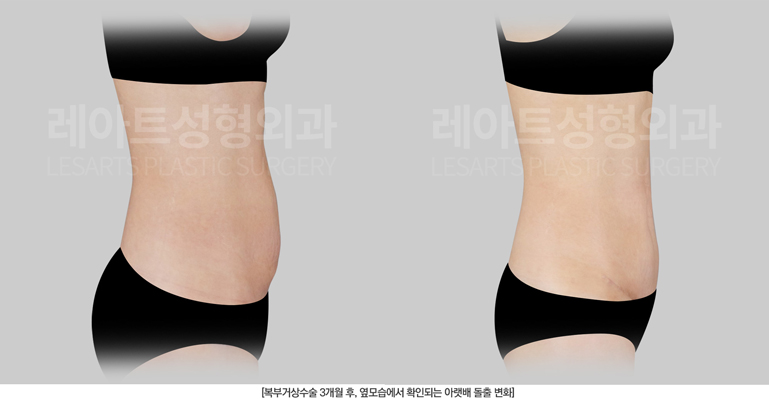
Side View Changes
From the side view, the lower belly protrusion
became much smoother.
Before surgery, the lower abdomen protruded forward,
especially from below the navel to the C-section scar area.
After surgery, the uneven lower belly bulge was improved,
creating a smoother and more elastic-looking abdominal line.
Even though this was only 3 months after surgery,
the abdomen already showed a firmer
and more lifted shape.
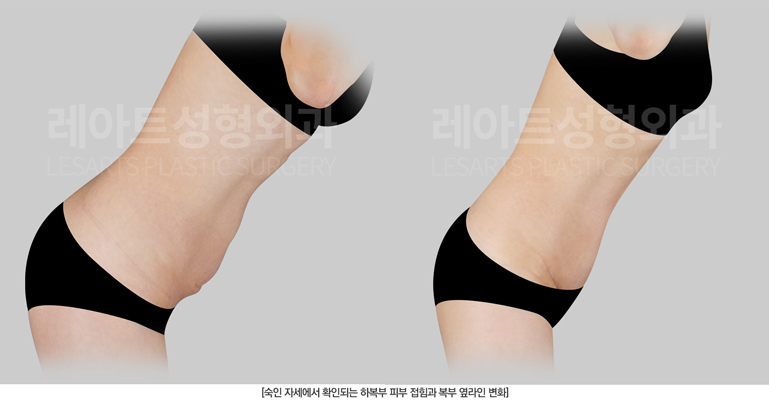
Bending View Changes
The improvement was also noticeable
when the patient bent forward.
Before surgery, the lower abdominal skin wrinkled
and folded in a sagging way.
After surgery, the loose skin was removed,
and the lower abdominal side line became cleaner.
The lower belly no longer folded as heavily with posture changes,
and the abdominal contour looked more stable.
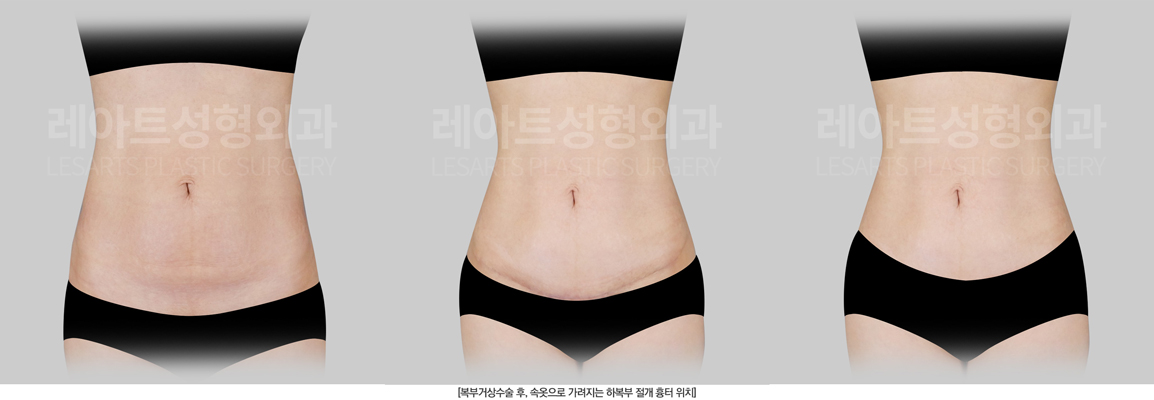
Scar Location & Recovery
During surgery, the previous C-section scar was removed,
and only the tummy tuck incision scar remained.
Because the vertical length of skin removed was relatively long,
the incision length also became slightly longer.
However, this helped avoid under-correction and problems
such as dog-ear formation at the ends of the incision.
The incision was placed low in the lower abdomen
so that it could be naturally hidden when wearing underwear.
At 3 months after surgery, swelling and
tissue firmness may still remain.
This is also the time when scar laser care often begins.
With continued scar care and follow-up treatment,
the scar is expected to gradually fade and
become more stable over time.
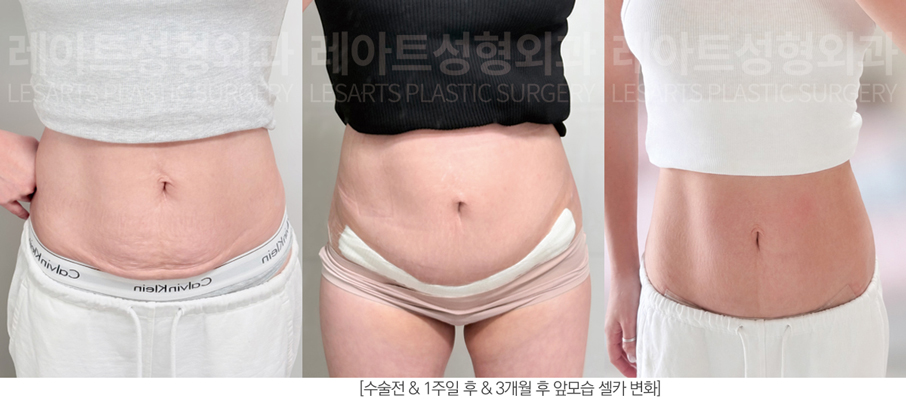
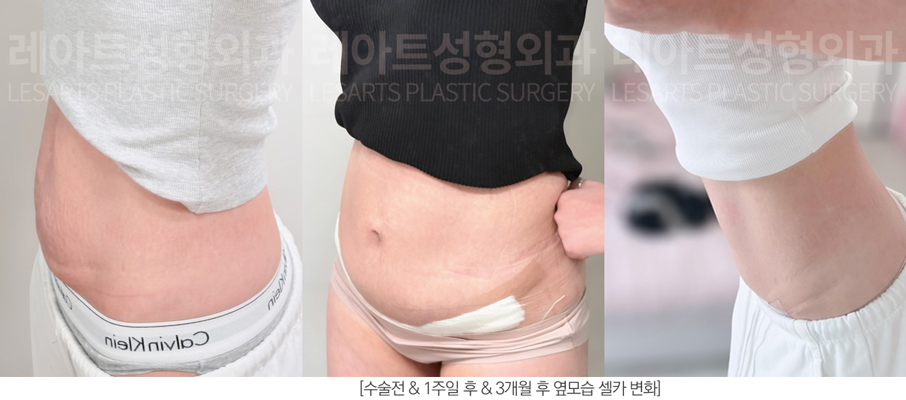
Selfie Comparison After Surgery
In the patient’s own photos taken before surgery, 1 week after surgery,
and 3 months after surgery, the recovery process and
satisfaction can be clearly seen.
The most noticeable change was the improvement
in the wrinkled lower belly sagging.
Even with posture changes, the lower abdomen maintained
a firmer and smoother shape than before.
The patient was especially satisfied
that the lower belly concern improved and that
the waistline also looked more defined through the lifting effect.
Why Mini Tummy Tuck Was Suitable
Even if body weight is well maintained,
loose skin or weakened abdominal muscles may not improve
with diet or exercise alone.
In this case, the patient did not need wide abdominal liposuction
because fat volume was not the main issue.
Instead, the main concerns were:
- Loose lower abdominal skin
- C-section scar folding
- Lower abdominal rectus diastasis
- Weak abdominal wall support
- Lower belly protrusion
For patients with concerns mainly below the navel,
an S-type mini tummy tuck may be considered
when the correction range is suitable.
However, even a mini tummy tuck requires
careful planning because scar location,
skin removal amount, rectus muscle repair,
and lower abdominal contour all need
to be considered together.
Conclusion
Lower belly sagging after C-section
is not always caused by fat.
If the lower abdomen remains loose or protruded despite weight management,
the cause may be loose skin, rectus diastasis,
or weakened abdominal wall support.
Through detailed consultation at a trusted plastic surgery clinic
or hospital in Gangnam, Seoul, Korea, patients can determine
whether a mini tummy tuck or
full tummy tuck is more suitable for their condition.
For patients with lower belly sagging, C-section scar folding,
and lower abdominal skin laxity,
S-type mini abdominoplasty with rectus muscle repair
and abdominal wall tightening can help create a smoother,
firmer, and more confident abdominal contour.
#Abdominoplasty
#S-type


Cases finding
similar to my profile
Customer Diagnostics


Select the surgery and
area you are interestedto see real
before andafter changes.


we
make you,
the art
Clinic hours
MON - FRI
10 am – 7pm
SAT
10 am – 4pm
Holiday
SUN, HOLIDAY
Location
Lesarts Moon Clinic Tower 4-5F, 40, Nonhyeon-ro 168-gil,
Gangnam-gu, Seoul, Republic of Korea

Medical institution name Lesarts Plastic Surgery
Address Lesarts Moon Clinic Tower 4-5F, 40, Nonhyeon-ro 168-gil, Gangnam-gu, Seoul, Republic of Korea
Representative Moon sung jun
