




Online Consultation
Please accurately enter the information below.
Quick Cost Consultation
Quick Consultation & Reservation
Cases finding
similar to my profile






Cases finding
similar to my profile
Customer Diagnostics
Can Weight Gain Cause Gynecomastia? Male Chest Protrusion Surgery Results After 2 Weeks | Best Plastic Surgery Clinic in Gangnam, Seoul, Korea
2026-06-24
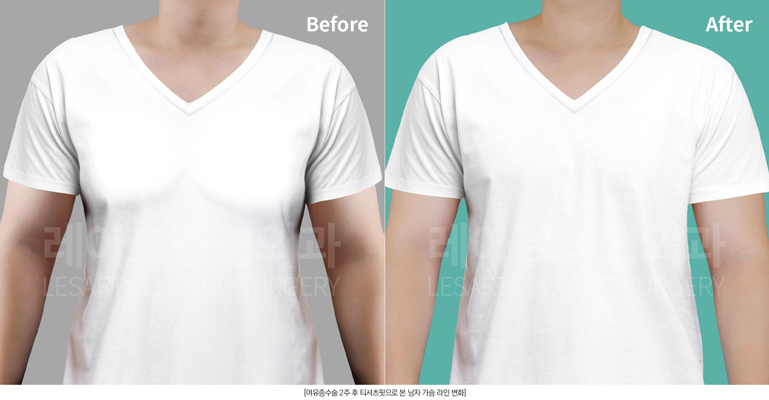
Many men who are concerned about gynecomastia visit a clinic
because they want to know whether their chest enlargement is caused
by weight gain or by developed glandular tissue.
This is especially common in patients
who first noticed chest changes during puberty.
Some men gain weight during their teenage years
and begin to notice chest protrusion at that time.
Even after entering their 20s or 30s,
the same concern may remain.
Some patients think, “Maybe I just gained weight,”
or “If I lose weight later, it will get better.”
However, if the chest protrusion does not improve with diet or exercise,
it may be necessary to check whether glandular tissue is involved.
In this case, the patient had been concerned
about gynecomastia since puberty.
Because exercise and dieting did not improve the symptoms,
he visited LesArts Plastic Surgery, a plastic surgery clinic in Gangnam,
Seoul, Korea, for surgical treatment in his late 20s.
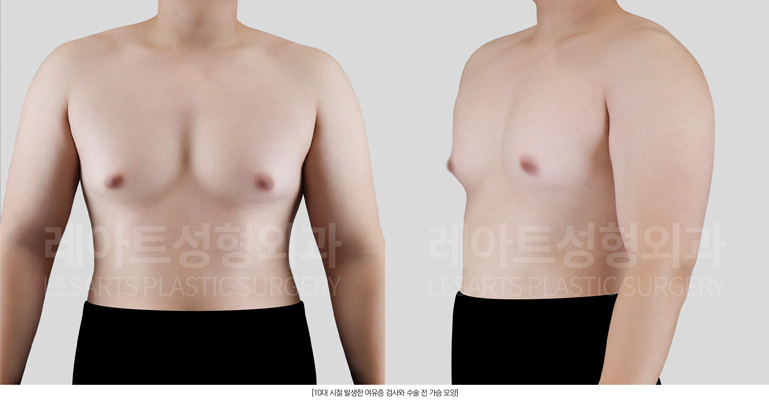
Patient Information
Age: Late 20s
Height: 175 cm
Weight: 85 kg
Diagnosis: Mixed-type gynecomastia
Simon Grade: 2A
Skin elasticity: Moderate
Before Surgery Analysis
Before surgery, both sides of the patient’s chest
were visibly enlarged and protruded forward.
The nipple and areola area also looked swollen and puffy.
Based on the external appearance,
the condition was diagnosed as Simon Grade 2A gynecomastia.
Ultrasound examination confirmed
the presence of overgrown glandular tissue.
When the area was palpated, firm lump-like tissue
could be felt under the nipple and areola.
This was different from pseudo-gynecomastia,
which is mainly caused by soft fat accumulation.
However, the patient did not have glandular tissue only.
Fat accumulation around the side chest and
lower chest also made the chest look larger and more curved.
Because both glandular tissue and fat were involved,
the patient was diagnosed with mixed-type gynecomastia.
Surgical Plan
The surgery was planned to remove the cause of gynecomastia
and create a natural male chest contour.
The surgical plan included:
- Glandular tissue removal
- Chest liposuction
- Side chest liposuction
- Lower chest contour correction
- Tissue reshaping
- Male chest line refinement
The goal was not only to reduce chest size.
The surgery also focused on improving the puffy nipple and areola area,
reducing the side and lower chest volume,
and creating a more masculine chest line
through tissue reshaping.
This approach helped create a smoother chest shape
without an awkward or hollow-looking result.
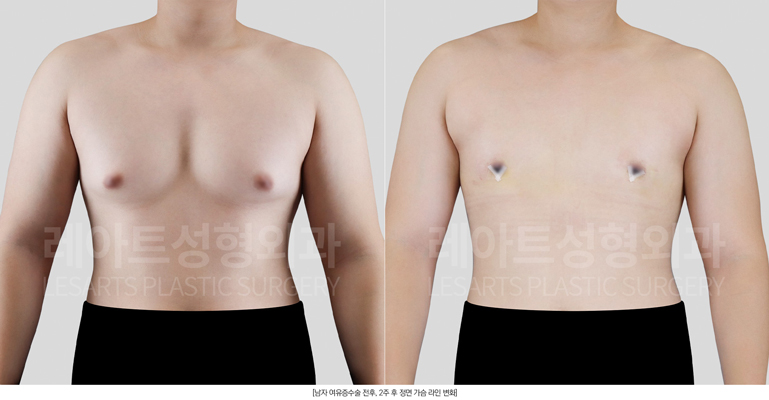
2-Week After Gynecomastia Surgery Results
The photos were taken 2 weeks after gynecomastia surgery,
during the early recovery stage after suture removal.
Before surgery, the front chest protruded forward,
and the chest shadow made the upper body line look less natural.
After surgery:
- The chest protrusion was reduced
- The puffy nipple and areola area improved
- The chest size looked smaller
- The front chest line became smoother
-The shadow around the chest contour became less noticeable
- The chest looked more natural and masculine
Because this was only 2 weeks after surgery, swelling,
bruising, and tissue firmness could still remain.
However, the patient was already satisfied because the main concerns
— chest size, protrusion, and puffy nipple shape — had clearly improved.
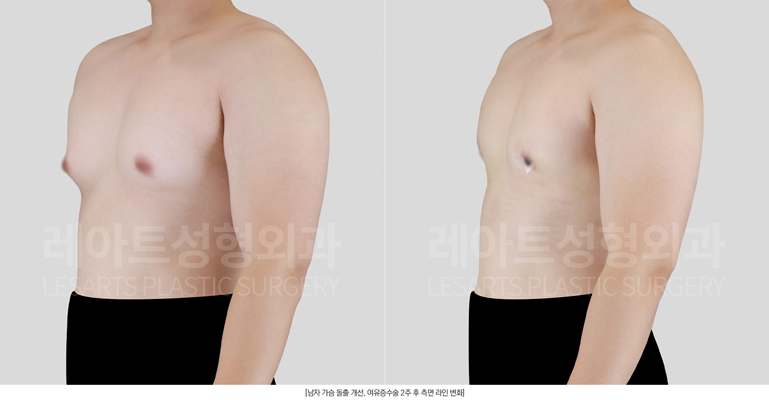
Side View Changes
From the side view, the difference before
and after surgery was even more noticeable.
Before surgery, the chest projected forward,
creating a noticeable angle from the chest to the upper abdomen.
After gynecomastia surgery,
the protruding angle decreased.
The line from the chest wall to the upper abdomen
became smoother and more natural.
The pointed projection around the nipple and
areola also became lower and less noticeable.
As a result, the side chest contour looked
more masculine and less awkward.
Side Chest and Lower Chest Line Improvement
In this case, chest liposuction was performed
together with glandular tissue removal.
This helped improve not only the central chest protrusion,
but also the side chest and lower chest shadow.
Before surgery, fat around the side chest and lower chest
made the chest curve look more prominent.
After liposuction, the shadowed area
from the side chest to the rib area improved,
and the chest line looked cleaner.
This helped create a smoother upper body
silhouette from multiple angles.
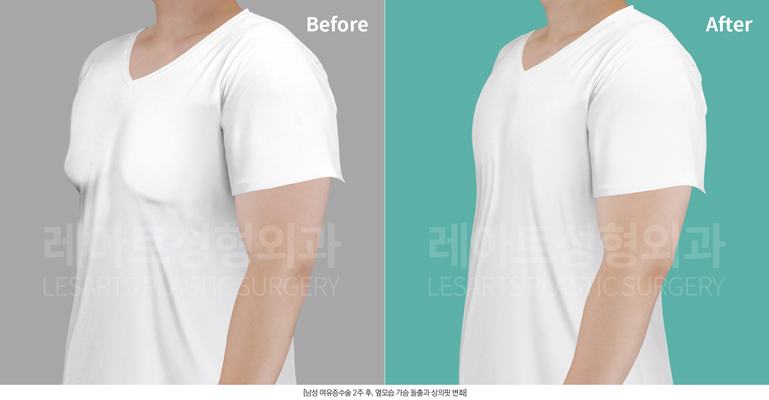
T-Shirt Fit Change
Many gynecomastia patients feel the most stress
when wearing clothes.
This patient also felt uncomfortable
because the chest line was visible through clothing.
After surgery, even when wearing just one T-shirt,
the chest line looked much more natural.
The patient shared that he felt more comfortable in daily life
because he no longer had to worry about the chest shape showing through his shirt.
At 2 weeks after surgery,
the result was still in the early healing stage.
As swelling and tissue firmness gradually improve,
the chest line is expected to settle into a more stable and refined shape.
Can Weight Gain Cause Gynecomastia?
Weight gain can increase fat around the chest
and make the chest look larger.
However, if glandular tissue has developed,
losing weight alone may not fully improve the chest protrusion.
This is why some patients continue to have puffy nipples, areola protrusion,
or chest enlargement even after dieting or exercising.
In this case, ultrasound examination confirmed
that the patient had both glandular tissue and fat.
That is why surgery needed to include both glandular tissue
removal and chest liposuction.
Why Accurate Diagnosis Matters
Male chest enlargement can have different causes.
Some patients have mostly fat accumulation.
Some patients have developed glandular tissue.
Others have both fat and glandular tissue, which is called mixed-type gynecomastia.
Because the treatment plan depends on the cause,
accurate diagnosis is important.
An ultrasound examination can help determine
whether the chest enlargement is caused by fat,
glandular tissue, or both.
At a trusted plastic surgery clinic or hospital in Gangnam, Seoul, Korea,
a customized surgical plan can be created based on the patient’s chest shape,
skin elasticity, fat distribution, and glandular tissue condition.
Conclusion
If male chest protrusion started during puberty and
does not improve with diet or exercise,
it may not be caused by weight gain alone.
In mixed-type gynecomastia, both glandular tissue and
fat can make the chest look enlarged and protruded.
In this case, gynecomastia surgery in Korea helped reduce the chest size,
improve puffy nipple and areola protrusion,
and create a smoother T-shirt fit within 2 weeks after surgery.
For men who are unsure whether their chest concern is caused by fat or true gynecomastia,
consultation at a trusted plastic surgery clinic in Gangnam, Seoul,
Korea can help identify the exact cause and
choose the most suitable treatment plan.
#Male body contouring
#Gynecomastia
#Grade2-A #true gynecomastia


Cases finding
similar to my profile
Customer Diagnostics


Select the surgery and
area you are interestedto see real
before andafter changes.


we
make you,
the art
Clinic hours
MON - FRI
10 am – 7pm
SAT
10 am – 4pm
Holiday
SUN, HOLIDAY
Location
Lesarts Moon Clinic Tower 4-5F, 40, Nonhyeon-ro 168-gil,
Gangnam-gu, Seoul, Republic of Korea

Medical institution name Lesarts Plastic Surgery
Address Lesarts Moon Clinic Tower 4-5F, 40, Nonhyeon-ro 168-gil, Gangnam-gu, Seoul, Republic of Korea
Representative Moon sung jun
