




Online Consultation
Please accurately enter the information below.
Quick Cost Consultation
Quick Consultation & Reservation
Cases finding
similar to my profile






Cases finding
similar to my profile
Customer Diagnostics
Tummy Tuck After Childbirth: Lower Belly Sagging and Skin Fold Results After 1 Year 3 Months | Best Plastic Surgery Clinic in Gangnam, Seoul, Korea
2026-06-25
Even years after childbirth,
some patients continue to struggle
with lower belly sagging.
After pregnancy and delivery,
the abdominal skin can become stretched,
and loose skin may gather below the navel.
This can create a deep fold in the lower abdomen.
If the main causes are reduced skin elasticity
or loosened abdominal muscles,
exercise or weight loss alone may have limitations.
In this case, the patient had noticeable lower abdominal sagging and
skin folding after C-section delivery.
The lower belly skin folded more clearly when she bent forward,
especially above the underwear line.
She visited LesArts Plastic Surgery, a plastic surgery clinic in Gangnam,
Seoul, Korea, to improve the heavy lower belly line and
create a smoother abdominal silhouette.
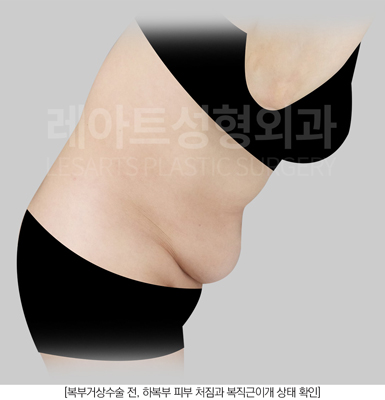
Before Surgery Analysis
Before tummy tuck surgery, the patient showed
loose skin mainly below the navel and in the lower abdomen.
The main concerns included:
- Lower belly sagging after childbirth
- Deep lower abdominal skin fold
- Loose skin above the underwear line
- Rectus diastasis
- Abdominal wall laxity
- Heavy and dull-looking lower belly line
- Lower abdominal protrusion when bending forward
The patient also had looseness
in the front abdominal area after childbirth.
Because the lower abdominal skin was pushed downward,
the abdomen looked heavy and less defined.
This was not simply a fat problem.
The abdominal skin laxity and rectus diastasis
made the front abdominal line look weak and less supported.
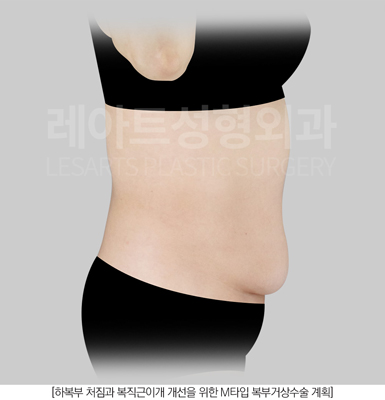
Surgical Plan
Because skin sagging and rectus diastasis were found from the upper abdomen,
a wider surgical range was needed.
The surgery was planned as an M-type full abdominoplasty.
The surgical plan included:
- M-type full tummy tuck
- Rectus muscle repair
- Abdominal wall tightening
- Fascia repair
- Abdominal liposuction
- Lower abdominal skin removal
- Front abdominal contour correction
Since the patient had a straight waist structure with similar upper abdominal
and pelvic width, the goal was not to dramatically narrow the waist.
Instead, the plan focused on removing the lower belly sagging and
skin fold while creating a smoother line from the
front abdomen to the lower abdomen.
Abdominal liposuction was also planned together with the tummy tuck
to refine the dull front abdominal line and
create a more natural lower abdominal silhouette.
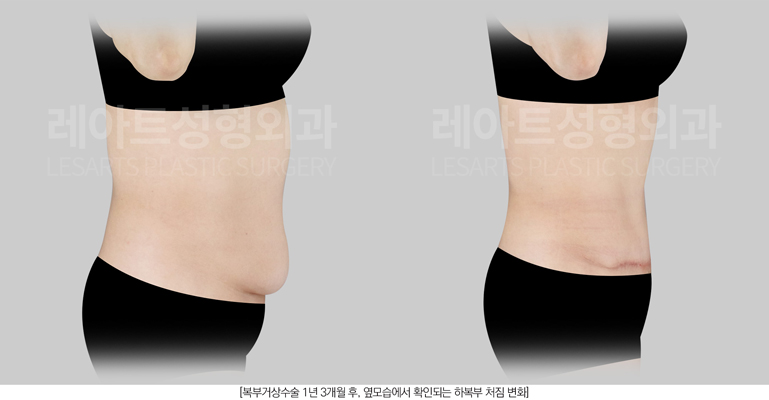
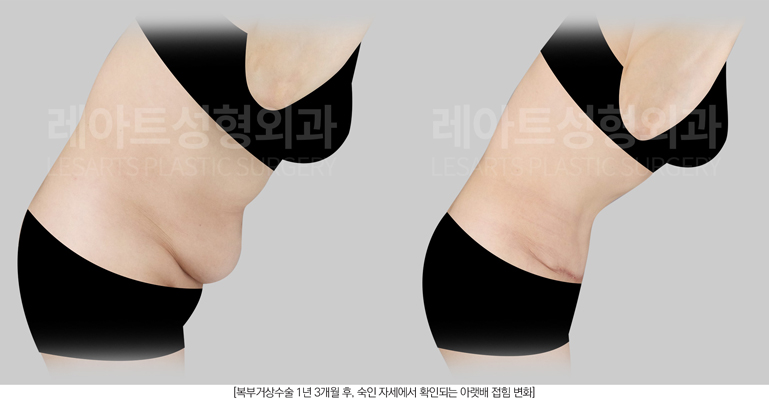
1 Year 3 Months After Tummy Tuck Results
At 1 year and 3 months after tummy tuck surgery,
the abdominal line showed a clear improvement.
Before surgery, the front abdomen looked protruded and uneven,
with a folded lower belly line.
After surgery:
- The lower belly sagging was reduced
- The folded lower abdominal skin was removed
- The front abdominal line became smoother
- The heavy lower belly volume improved
- The abdomen looked firmer and more stable
- The weak-looking abdominal wall was corrected
- The overall silhouette looked cleaner
The loose skin that had sagged
from the upper abdomen to the lower abdomen was removed,
and the heavy lower belly appearance improved.
Because rectus diastasis repair was performed together,
the front abdominal laxity that had looked weak and
pushed forward also became firmer.
Side View Changes
From the side view, the lower belly sagging improved noticeably.
Before surgery, the lower abdomen protruded forward
and created an uneven shape.
After tummy tuck surgery,
the abdominal line looked smoother and more stable.
The heavy lower abdominal fold was reduced,
and the front abdominal contour became more naturally
connected from the upper abdomen to the lower abdomen.
Bending View Changes
The improvement was even more visible when the patient bent forward.
Before surgery, the lower abdominal skin moved downward with gravity,
creating a clear fold above the underwear line.
After surgery, the front abdominal line stayed more firmly supported
even in the same bent position.
This change was possible not only because the loose skin was removed,
but also because the weakened abdominal wall support was improved.
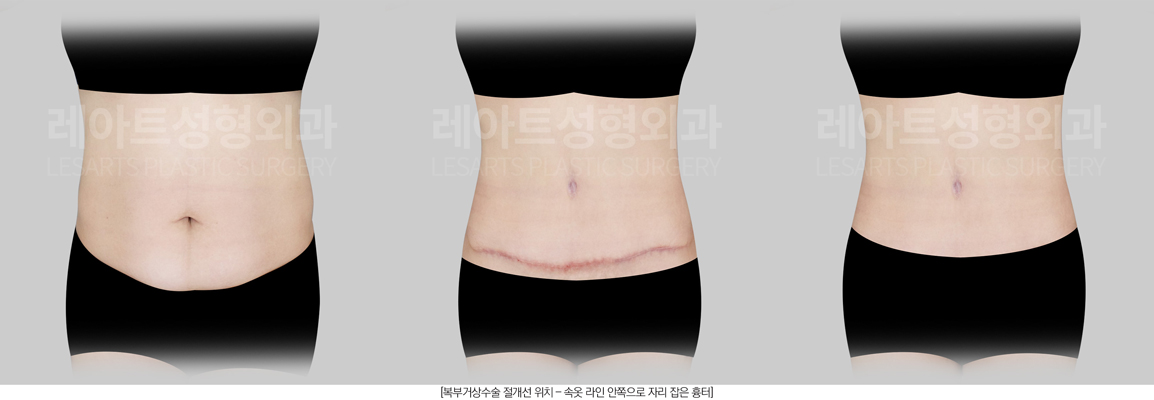
Scar Location and Recovery
Tummy tuck surgery requires an incision
because loose skin must be removed.
For this patient, the incision was placed low in the lower abdomen
so that the scar could be hidden inside the underwear line.
This allowed the scar to be less noticeable
in daily life when wearing underwear.
However, scar recovery can vary depending on
each patient’s skin condition and healing speed.
In this case, recovery was slightly slower,
so regular follow-up care was planned to monitor
both the scar and abdominal line carefully.
Why Tummy Tuck May Be Needed After Childbirth
Lower belly sagging after childbirth is not always caused by fat.
In many cases, the cause may include:
- Loose abdominal skin
- Reduced skin elasticity
- Rectus diastasis
- Weakened abdominal wall support
- Lower abdominal skin folding
- Changes after C-section delivery
When skin laxity and muscle separation are involved,
liposuction or weight loss alone may not be enough.
A tummy tuck can address both the visible loose skin
and the deeper abdominal wall weakness.
Why Customized Planning Matters
Not every patient needs the same tummy tuck design.
For this patient, the waist was naturally straight,
so the surgical plan focused on smoothing the lower abdominal line
rather than making the waist dramatically smaller.
This type of planning is important because tummy tuck results depend on:
- Skin laxity range
- Rectus diastasis severity
- Abdominal wall support
- Waist and pelvic structure
- Scar location
- Whether liposuction is needed
- The patient’s natural body proportions
A customized plan helps create a result
that looks smoother and more natural
for the patient’s own body.
Conclusion
Lower belly sagging and skin folds after childbirth can
remain even after exercise or weight loss.
If loose skin and rectus diastasis are present,
the abdomen may continue to look heavy, folded, or protruded.
In this case, M-type full abdominoplasty with
rectus muscle repair, abdominal wall tightening,
and abdominal liposuction helped improve the lower belly sagging and
create a smoother abdominal silhouette after 1 year and 3 months.
For patients who are concerned about lower belly sagging after childbirth or C-section delivery,
consultation at a trusted plastic surgery clinic or hospital in Gangnam,
Seoul, Korea can help determine the most suitable tummy tuck plan.
A customized tummy tuck in Korea may help create
a firmer, smoother, and more stable abdominal line.
#Abdominoplasty
#M-type
#Abdominal liposuction(M)


Cases finding
similar to my profile
Customer Diagnostics


Select the surgery and
area you are interestedto see real
before andafter changes.


we
make you,
the art
Clinic hours
MON - FRI
10 am – 7pm
SAT
10 am – 4pm
Holiday
SUN, HOLIDAY
Location
Lesarts Moon Clinic Tower 4-5F, 40, Nonhyeon-ro 168-gil,
Gangnam-gu, Seoul, Republic of Korea

Medical institution name Lesarts Plastic Surgery
Address Lesarts Moon Clinic Tower 4-5F, 40, Nonhyeon-ro 168-gil, Gangnam-gu, Seoul, Republic of Korea
Representative Moon sung jun
