




Online Consultation
Please accurately enter the information below.
Quick Cost Consultation
Quick Consultation & Reservation
Cases finding
similar to my profile






Cases finding
similar to my profile
Customer Diagnostics
Thigh Liposuction and Hip Dip Fat Grafting for Better Lower Body Proportion: 2-Month Results | Best Liposuction Clinic in Gangnam, Seoul, Korea
2026-07-24
Thigh Liposuction | Can Refining Inner Thighs & Saddlebags
With Hip Fat Grafting Change Lower-Body Proportions?
Does making the thighs slimmer alone
create the lower-body proportions you want?
Contouring the inner thighs and saddlebags
can reduce leg width and heaviness,
but in body types with hollowing at the hip dips,
the transition between the hips and thighs can still look angular.
When needed, thigh liposuction and
hip fat grafting can be planned together
to fill in lacking areas while refining protruding ones.
Many people researching thigh liposuction today
care more about overall proportions and contour flow
from the hips down to the legs
than simply reducing thigh circumference.
This is because making the thighs thinner alone
may not achieve the lower-body line you envisioned.
In particular, if outer thigh saddlebags are prominent
while hip dips indent inward,
the hips can look narrow while lower-body heaviness
appears concentrated in the thighs.
This body type can also make the thighs feel short and heavy
regardless of actual leg length.
In such cases, you can consider combining **Thigh Liposuction Surgery**
to refine the inner thighs and saddlebags,
while grafting fat into the lacking hip dip areas
to balance the proportions between the hips and thighs
together.
In this post, we will examine the surgical plan and results
through the case of a patient who had her inner thighs and saddlebags refined
alongside hip fat grafting.
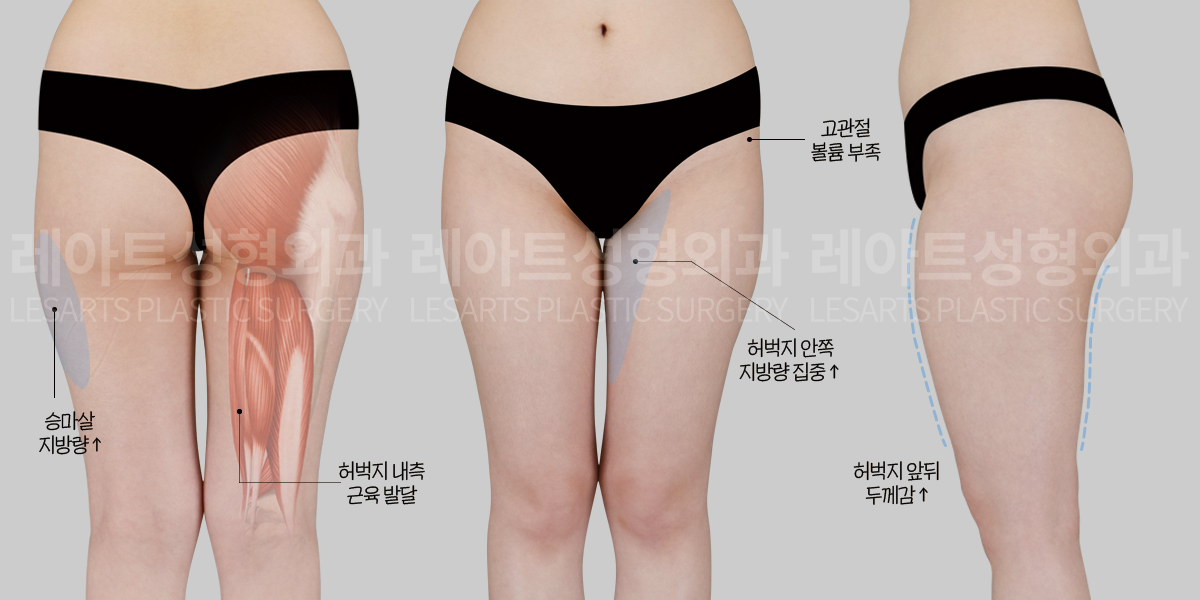
[Pre-Operative Body Type and Surgical Plan for Thigh Liposuction and Hip Fat Grafting]
[Patient Information]
Height: 155 cm
Weight: 46 kg
BMI: 19.2
The patient usually maintained a weight around 43–44 kg
and visited the clinic after a slight recent weight gain.
Although her overall weight was not high,
she was concerned about her lower-body contours because her inner thigh fat and outer saddlebags
did not refine sufficiently even when dieting.
The change the patient hoped for
was a clear gap between her inner thighs,
along with filling in her hollow hip dips so that her hips
would flow in a rounded, smooth curve.
Before surgery, inner thigh volume caused
both legs to sit close together, while outwardly protruding saddlebags
made the horizontal width of her lower body look broad.
Meanwhile, her hip dip areas indented inward,
creating an uneven curve from her hips down to her thighs.
In this body type, reducing only the outer thighs
could make the hip hollowing stand out even more,
so a plan addressing both protruding and deficient areas
together was needed.
Surgical results for other body types can also be viewed
on the page below.
▶ View Lesarts Plastic Surgery Thigh Liposuction Cases
[Surgical Plan Accounting for Thigh and Hip Proportions]
To create the lower-body line the patient wanted,
we recommended thigh liposuction, love-handle liposuction,
and hip fat grafting together.
We planned to reduce overall thigh thickness focusing on the inner thighs and saddlebags,
while connecting and refining the love-handle area
so the contour from the waist to the hips
would emerge naturally.
Healthy harvested fat was purified
and grafted into the hollow hip dip areas
to enhance the outer hip contour.
[Why Hip-Line Liposuction Was Not Recommended]
The patient hoped to shorten the vertical length of her buttocks
for a slightly shorter, rounder
hip line.
However, overly aggressive liposuction beneath the buttocks
can weaken skin support
or accentuate buttock sagging.
Considering her current fat volume and skin elasticity,
the risk of sagging or contour irregularity outweighed
the potential benefit of liposuction in that area,
so hip-line liposuction was not recommended.
Liposuction is not about aggressively reducing every desired area;
distinguishing which fat should be left behind—considering overall flow and skin condition—
is essential.
[Guidance Regarding Left-Right Body Asymmetry]
The patient had differences in the shape and
degree of development of her left and right thigh muscles.
Even when fat volume is adjusted evenly,
surgery cannot make inherent differences in bone structure
and muscle completely identical.
After explaining in advance that perfect left-right symmetry
is difficult to achieve after surgery,
we adjusted suction volume and hip fat grafting volume by area
so that the contours would look as natural as possible from every angle.
[2-Month Changes After Thigh Liposuction and Hip Fat Grafting]
Let's examine the changes in her hip and thigh contours
through photos taken before surgery and about 2 months afterward.
At 2 months after surgery, major swelling has subsided enough
to see early contour changes, though residual swelling and firmness
may still remain,
and the grafted fat is also still in the process of taking and stabilizing.

[2 Months After Thigh Liposuction and Hip Fat Grafting: Changes in Hip and Thigh Contours]
Before surgery, her inner thighs sat close together
and protruding outer saddlebags made lower-body heaviness
appear concentrated in the thighs.
At 2 months after surgery, with reduced inner thigh volume,
the natural thigh gap the patient wanted has appeared.
The line rising from the inner knees to the upper thighs
also appears straighter than before, making the inner length
of her legs noticeably clearer.
With saddlebags refined and volume added to the hollow hip dips at the same time,
the line flowing from the hips to the outer thighs
connects smoothly.
Even though the photos were taken in the same position and lighting, balancing the proportions of her waist, hips,
and thighs makes her legs look
longer and lighter than before.
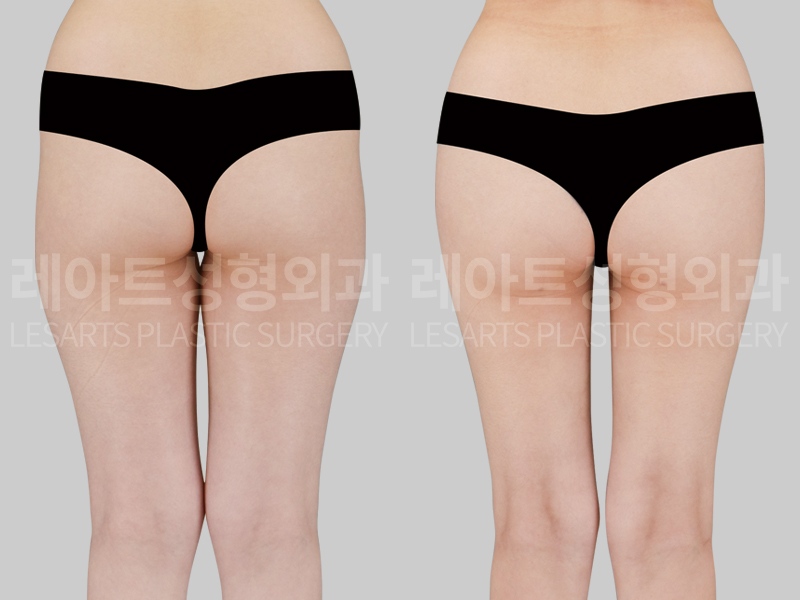
[2 Months After Thigh Liposuction and Hip Fat Grafting: Changes in Saddlebags and Lower Buttock Line]
In the pre-operative back view, indented hip dips
and outwardly extending saddlebags
made the buttocks look angular and wide.
After surgery, with saddlebag volume reduced
and the hip dips filled in, the outer buttock contour
flows rounder and smoother than before.
Although no surgical buttock lift was performed,
addressing side hip hollowing and outer thigh protrusion together
can visually make the buttocks look slightly higher and rounder.
Whereas before surgery her legs seemed to start below the buttocks,
after surgery the transition from hips to thighs is clearly revealed,
making the starting point of her legs look higher than before.

[2 Months After Thigh Liposuction and Hip Fat Grafting: Side-View Changes in Thigh Thickness and Hip Contours]
In the side view, reduced front-to-back thigh thickness
visibly lightens the lower body.
Reduced volume in the previously rounded front thighs
makes the line flowing from the hips toward the knees
straighter than before.
On the back thighs as well, an appropriate fat layer was left so muscle curves would not show overly sharply,
maintaining a relatively smooth transition
from below the buttocks down to the thighs.
With hip volume enhanced, the hip shape seen from the side
also connects more naturally than before.
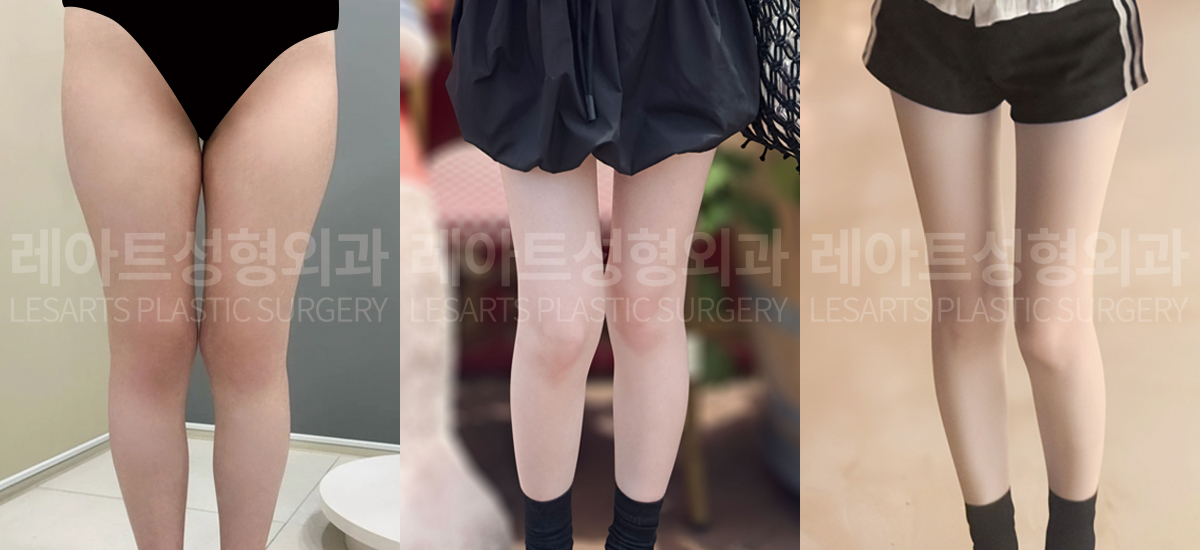
[Thigh Liposuction and Hip Fat Grafting: Selfie Comparison Before, 3 Months After, and 6 Months After Surgery]
Changes in her inner thighs and hip line can also be seen
in the photos the patient took herself before surgery and at 3 and 6 months afterward.
Before surgery, inner thigh volume kept
both legs close together,
whereas as healing progressed, a natural gap has been maintained.
Hollowing along the outer hips has also been smoothly filled in,
making the line from the waist through the hips
to the outer thighs feel smoother than before.
Rather than simply the reduction in thigh circumference,
the patient shared that seeing her legs look longer and straighter overall
through refined hip-to-leg proportions
was the most satisfying change.
Is More Fat Always Better in Hip Fat Grafting?
Hip fat grafting is not a procedure meant
to make the hips as wide as possible.
Grafting a large amount of fat without considering
the patient's bone structure, waist width, buttock size, and saddlebag position
can cause the hip area alone to protrude excessively
or make the lower body look
wider and heavier instead.
In addition, not all grafted fat remains permanently—
some is absorbed during recovery,
while the remaining fat settles into place.
Therefore, rather than concentrating an excessive amount in one spot,
it is important to assess the exact location and extent of hip hollowing
and graft an appropriate volume in divided layers so it blends naturally with surrounding tissue.
Fat retention can vary depending on the quality of grafted fat, blood circulation,
individual healing, post-operative pressure,
and weight changes.
Why Thigh Liposuction and Hip Fat Grafting Are Performed Together
Reducing areas where fat is concentrated—such as the inner thighs and saddlebags—
while supplementing areas lacking volume like the hip dips
allows upper and lower proportions of the lower body to be balanced together.
Combining the two procedures can be especially worth considering in the following body types:
- When inner thigh fat causes both legs to touch broadly
- When outwardly protruding saddlebags make the legs look shorter
- When hollowing at the hip dips is pronounced
- When the thighs appear wider than the hips
- When the line from the waist to the hips and thighs looks angular
However, not every thigh liposuction patient
needs hip fat grafting.
If hip volume is already sufficient or refining the saddlebags alone
creates a natural transition,
skipping fat grafting may be more appropriate.
The surgical scope should be decided by distinguishing deficient areas from protruding areas
and considering the overall proportions
that will result after surgery.
Lower-Body Contouring Requires Evaluating Both What to Remove and What to Preserve
When localized fat and lacking hip volume make
overall lower-body proportions feel unbalanced, you may find yourself
constantly trying to cover those areas when getting dressed.
In such cases, it is difficult to achieve the desired result
simply by losing more weight or
removing as much thigh fat as possible.
It is important to evaluate where fat is distributed,
how the widths of the hips and thighs connect,
and the state of skin elasticity and muscle shape together.
Refining needed areas with liposuction while filling deficient areas
with fat grafting can help adjust not only thigh circumference,
but also the overall proportions flowing
from the hips down to the legs.
However, it is important to understand that congenital bone and muscle asymmetry can remain after surgery,
and that fat retention in the hips also varies
from person to person.
Distinguishing areas that need refining from areas where fat should be preserved
based on your current body type and desired lower-body line is key.
Thigh Liposuction & Hip Fat Grafting FAQ
1. Can thigh liposuction alone improve hip dips?
Refining the saddlebags can make hip dip hollowing
look relatively less noticeable.
However, when actual hip volume is lacking,
liposuction alone cannot directly fill the hollowing,
so fat grafting can be considered together.
2. Does hip fat grafting make the hips much wider?
This depends on the grafting volume and scope.
Rather than widening the hips excessively, the goal is to blend
hollow areas naturally with surrounding contours,
adjusting the grafted volume to suit each patient's frame.
3. Does all of the fat grafted into the hips survive?
Part of the grafted fat is absorbed during recovery,
while fat that establishes a stable blood supply remains.
Exact retention rates vary depending on individual constitution, surgical technique,
and recovery.
4. Can a clear gap be created between the inner thighs?
Achievable changes vary depending on inner thigh fat volume, muscle,
and bone structure.
When sufficient fat is present, reducing inner volume
can create a gap,
but in body types strongly influenced by muscle and bone structure,
creating a wide space may be difficult.
5. Are the results final at 2 months after surgery?
At 2 months, major swelling has subsided enough
to see contour changes,
but residual swelling and firmness in the thighs may remain,
and grafted fat is still stabilizing.
Because changes typically continue over several months,
regular follow-up checks are needed.
#Liposuction #Etc
#Thigh #body fat graft
#Muscle type #Fat type #Thigh Gap #Lateral thigh #BMIbelow20(thigh) #Pelvic dimple fat graft #Hip fat graft


Cases finding
similar to my profile
Customer Diagnostics


Select the surgery and
area you are interestedto see real
before andafter changes.


we
make you,
the art
Clinic hours
MON - FRI
10 am – 7pm
SAT
10 am – 4pm
Holiday
SUN, HOLIDAY
Location
Lesarts Moon Clinic Tower 4-5F, 40, Nonhyeon-ro 168-gil,
Gangnam-gu, Seoul, Republic of Korea

Medical institution name Lesarts Plastic Surgery
Address Lesarts Moon Clinic Tower 4-5F, 40, Nonhyeon-ro 168-gil, Gangnam-gu, Seoul, Republic of Korea
Representative Moon sung jun
