




Online Consultation
Please accurately enter the information below.
Quick Cost Consultation
Quick Consultation & Reservation
Cases finding
similar to my profile






Cases finding
similar to my profile
Customer Diagnostics
Tummy Tuck in the 60s After C-Section: 3.5-Month Abdominal Lifting and Scar Removal Results | Best Tummy Tuck Clinic in Gangnam, Seoul, Korea
2026-07-27
Abdominoplasty in Your 60s | Cesarean Scar and Lower Abdominal Sagging: How Did It Change After 3.5 Months?
Can you still undergo abdominoplasty in your 60s?
Eligibility for surgery is not determined
by age alone.
It is important to thoroughly check not only abdominal skin and abdominal wall condition,
but also current overall health and any medications being taken,
before planning a surgical scope suited to the patient.
▶ Lesarts Abdominoplasty Information
Body shape changes after childbirth often remain
unaddressed for a long time while focusing
on raising children and daily life.
In particular, once people reach their 50s and 60s, as children grow up
and daily life becomes a bit more relaxed,
many begin to look back at their own bodies,
which they had put off caring for.
It is not uncommon for patients to visit the clinic later in life
to improve abdominal skin sagging remaining after childbirth
or folding around a cesarean scar.
Abdominoplasty is a procedure in which the required surgical method varies
depending on the location and extent of skin sagging.
Because the operating time is relatively long, it is important not only
to examine the outward appearance of the abdomen,
but also to carefully check current health status
and pre-operative condition.
The patient we are sharing in this case is a woman in her 60s who visited the clinic
to improve overall abdominal skin sagging and a vertical scar
remaining after two cesarean deliveries.

[Before Abdominoplasty: Assessing Abdominal Skin Sagging and Cesarean Scar]
Before surgery, the patient's abdomen had reduced skin elasticity
overall, starting from the upper abdomen.
As stretched skin sagged downward toward the lower abdomen,
it overlapped deeply over the lower belly, showing distinct skin folds
even while standing upright.
The rectus abdominis muscles and fascia were also stretched
starting from the upper abdomen, making the front abdomen
look heavy overall.
As surrounding skin sagged downward, the navel appeared stretched horizontally
and deeply recessed, and a vertical scar from past cesarean deliveries
was also present along the center of the abdomen.
Especially when bending forward, the stretched skin
shifted further downward, prominently creasing
into multiple folds.
Abdominal skin sagging differs from a concern caused
simply by excess fat accumulation.
This is because skin that has already lost elasticity and stretched
may not tighten as much as desired even with weight loss
or fat removal alone.

[Before Abdominoplasty: Surgical Plan Considering Abdominal Skin Sagging and Cesarean Scar]
After a comprehensive evaluation of the patient's abdominal condition,
rather than addressing only the lower abdomen, it was necessary to improve
the skin sagging extending from the upper abdomen together.
Therefore, we planned to thoroughly pull down and remove stretched skin
through an M-type full abdominoplasty,
while also repairing the lax rectus abdominis muscles
and abdominal wall together.
For the navel, which had been stretched horizontally by surrounding skin sagging,
we planned umbilicoplasty to reconstruct it
in proportion to her updated abdominal contours.
We also set the surgical scope to contour remaining abdominal fat together
so that not only skin firmness, but also front abdominal thickness
and her waistline would improve naturally.
The vertical cesarean scar remaining at the center of her abdomen
would be removed together in the process
of excising the stretched skin.
Before surgery, we also thoroughly explained that instead,
a new horizontal abdominoplasty incision line would remain
at a relatively low position on the lower abdomen.
Abdominoplasty is not simply a procedure
that cuts away loose skin.
What matters is re-contouring the entire abdominal line
by evaluating the extent of skin sagging, abdominal wall laxity,
fat distribution, and navel position
all together.

[3.5 Months After Abdominoplasty: Changes in Abdominal Skin Sagging and Vertical Scar]
Let's compare the changes through photos taken
3.5 months after abdominoplasty.
Before surgery, stretched skin below the navel
overlapped the lower abdomen, creating deep folds
and interrupting the smoothness of the abdominal contour
where the skin creased.
After surgery, with excess lower abdominal skin removed,
the overlapping fold over the lower abdomen disappeared.
Skin that had previously hung over the waistband of her underwear
was also refined, leaving the front abdomen
flatter and lighter than before.
The previously horizontally folded navel
was reconstructed to suit her updated waistline,
and the long vertical cesarean scar at the center of her abdomen
can also be seen removed along with the sagging skin.

[3.5 Months After Abdominoplasty: Oblique-View Changes in Abdominal Protrusion and Lower Abdominal Contours]
This patient also underwent abdominal liposuction
together with abdominoplasty.
Because tightening only the skin can leave thickness in the abdomen and flanks
unchanged, we contoured the necessary areas together
based on her fat distribution.
After surgery, abdominal thickness decreased
and her waistline became more naturally defined than before.
The front abdominal line flowing from the upper to lower abdomen
looks noticeably lighter,
and reduced flank volume gives her overall silhouette
a smoother, more refined appearance.
▶ View Abdominal Liposuction Before & After Cases

[3.5 Months After Abdominoplasty: Side-View Changes in Lower Abdominal Protrusion and Abdominal Thickness]
In the pre-operative side view, loose skin and abdominal wall laxity
made the lower abdomen protrude heavily forward.
After repairing the rectus abdominis muscles and abdominal wall and removing excess skin,
lower abdominal protrusion decreased, making the front abdomen
noticeably flatter.
The contour from the upper abdomen through the navel to the lower abdomen
also appears smoother and firmer than before.

[3.5 Months After Abdominoplasty: Changes in Lower Abdominal Skin Folds When Bending Forward]
Before surgery, bending forward caused the stretched skin
to shift downward, folding into multiple layers
in the lower abdomen.
After surgery, with the sagging skin removed
and the abdominal wall repaired together, folding that used to appear
when changing posture has noticeably decreased.
As the abdominal skin sits closer to the torso than before,
the lower abdominal contour stays much smoother
even when bending forward.

[3.5 Months After Abdominoplasty: Incision Line Inside the Panty Line and Lower Abdominal Changes]
The vertical cesarean scar that had remained at the center of the abdomen below the navel before surgery
was removed together during the process
of excising the sagging skin.
Instead, a horizontal abdominoplasty incision line
remains low on the lower abdomen.
Currently, the incision line sits in a position
that is naturally concealed when wearing underwear.
At 3.5 months after surgery,
laser scar care has also begun.
Because this is not yet the stage where scar color and firmness have completely stabilized,
it is important to continue regular follow-up checks
and care tailored to the scar's condition.
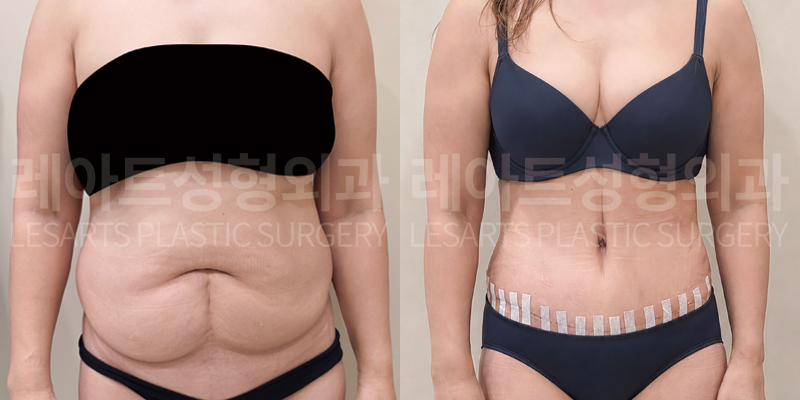
[Abdominoplasty in Your 60s: Selfie Comparison Before and 2 Weeks After Surgery]
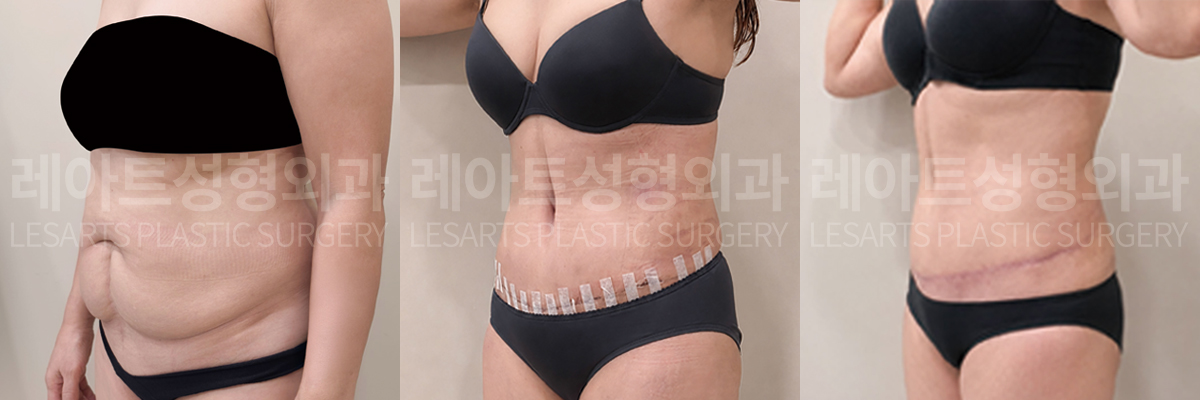
[Abdominoplasty in Your 60s: Selfie Comparison Before, 2 Weeks After, and 3 Months After Surgery]
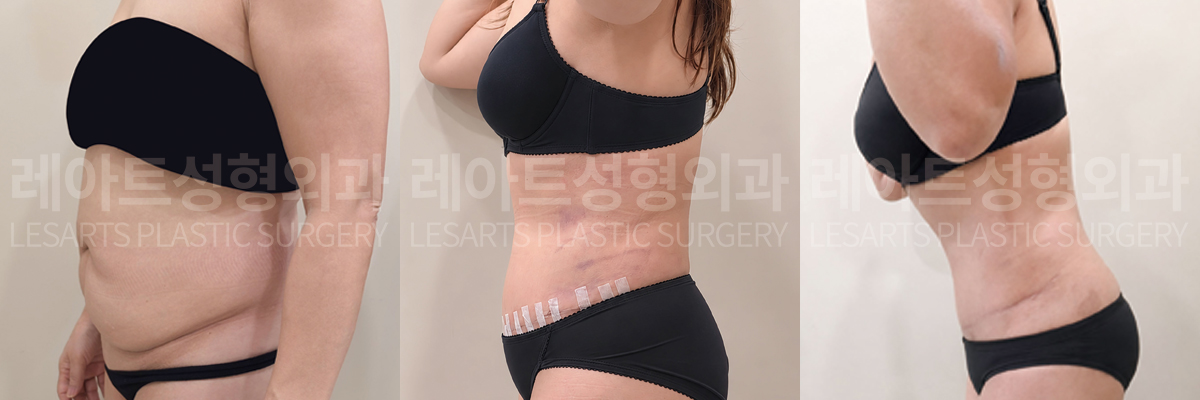
[Abdominoplasty in Your 60s: Selfie Comparison Before, 2 Weeks After, and 3 Months After Surgery]
Changes in her abdominal contours could also be seen
in the 2-week and 3-month selfies
the patient shared herself.
With the heavily sagging skin removed,
lower abdominal protrusion and folds decreased,
and her entire abdomen looked lighter than before.
With her lower abdomen standing out less through clothing,
she was able to wear a wider variety of outfits
more comfortably than before.
The patient was most satisfied that her abdomen looked less prominent
and that a body-shape concern that had bothered her for a long time
was relieved.
Even many years after childbirth, some people still experience discomfort
from lower abdominal skin sagging
or folding around a cesarean scar.
However, abdominoplasty in your 60s
should not be decided solely
on outward aesthetic changes.
Before surgery, current health status, medications,
and overall physical condition must be carefully evaluated,
and regular follow-up monitoring and care are also needed afterward.
Please keep in mind that planning a surgical scope suited to your condition
and following the medical team's guidance during recovery
are key to achieving
stable results.
Abdominoplasty in Your 60s FAQ
1. Can you undergo abdominoplasty in your 60s?
Eligibility for surgery is not decided by age alone.
Whether surgery is possible and the appropriate scope are determined
after checking current health status, medications, and test results.
2. Can a vertical cesarean scar also be removed through abdominoplasty?
If the existing scar falls within the area of skin being excised,
it can be removed together with the sagging skin.
Exact feasibility depends on checking the scar's location
and the extent of skin sagging.
3. Where does the scar remain after abdominoplasty?
In general, a horizontal incision line remains on the lower abdomen.
The exact position and length can vary depending on the amount of skin removed
and the original abdominal shape.
4. Can abdominoplasty and liposuction be performed together?
Depending on abdominal fat volume and skin condition,
liposuction can be performed together.
Combining the two is considered when both skin sagging
and abdominal thickness need to be addressed at the same time.
5. Are the results final at 3 months after surgery?
At 3 months, major swelling has subsided enough
to see changes in the abdominal contour,
but the scar and internal tissues are still healing.
Scar color and firmness can continue
to stabilize gradually afterward.
#Abdominoplasty
#M-type
#Abdominal liposuction(M)


Cases finding
similar to my profile
Customer Diagnostics


Select the surgery and
area you are interestedto see real
before andafter changes.


we
make you,
the art
Clinic hours
MON - FRI
10 am – 7pm
SAT
10 am – 4pm
Holiday
SUN, HOLIDAY
Location
Lesarts Moon Clinic Tower 4-5F, 40, Nonhyeon-ro 168-gil,
Gangnam-gu, Seoul, Republic of Korea

Medical institution name Lesarts Plastic Surgery
Address Lesarts Moon Clinic Tower 4-5F, 40, Nonhyeon-ro 168-gil, Gangnam-gu, Seoul, Republic of Korea
Representative Moon sung jun
