




Online Consultation
Please accurately enter the information below.
Quick Cost Consultation
Quick Consultation & Reservation
Cases finding
similar to my profile






Cases finding
similar to my profile
Customer Diagnostics
Arm Liposuction for Keloid-Prone Skin: 7.5-Month Slim Arm and Scar Recovery Results | Best Liposuction Clinic in Gangnam, Seoul, Korea
2026-08-04
Arm Liposuction | Is Keloid-Prone Skin Okay? Scar and Arm Contour Changes After 7.5 Months
If you have keloid-prone skin, will arm liposuction scars be larger?
Having experienced keloid-type scars in the past
does not necessarily mean that liposuction incision sites
will heal in the same way.
However, considering the possibility of prominent scarring,
it is important to keep the incision sites stable
and consistently monitor their condition
throughout the recovery process.
▶ Learn About Arm Liposuction at Lesarts
When considering liposuction, scarring is a concern
just as common as the post-operative contour changes.
In particular, if you have previously developed a keloid reaction
at an ear piercing or past injury site
and needed separate treatment,
even liposuction—which uses small incisions—
can feel difficult to decide on.
To manage liposuction scars well, it is important during surgery
to keep the incision sites stable so they do not
widen unnecessarily,
and after surgery to consistently check the thickness, color,
and healing progress of the scars.
When needed, continuing with treatments tailored
to the scar's current condition is also important.
▶ Watch Video on Scar Care After Liposuction
In this post, through the arm liposuction case of a patient
with keloid-prone skin, we will look at
how her arm contours and incision scars
healed 7.5 months after surgery.
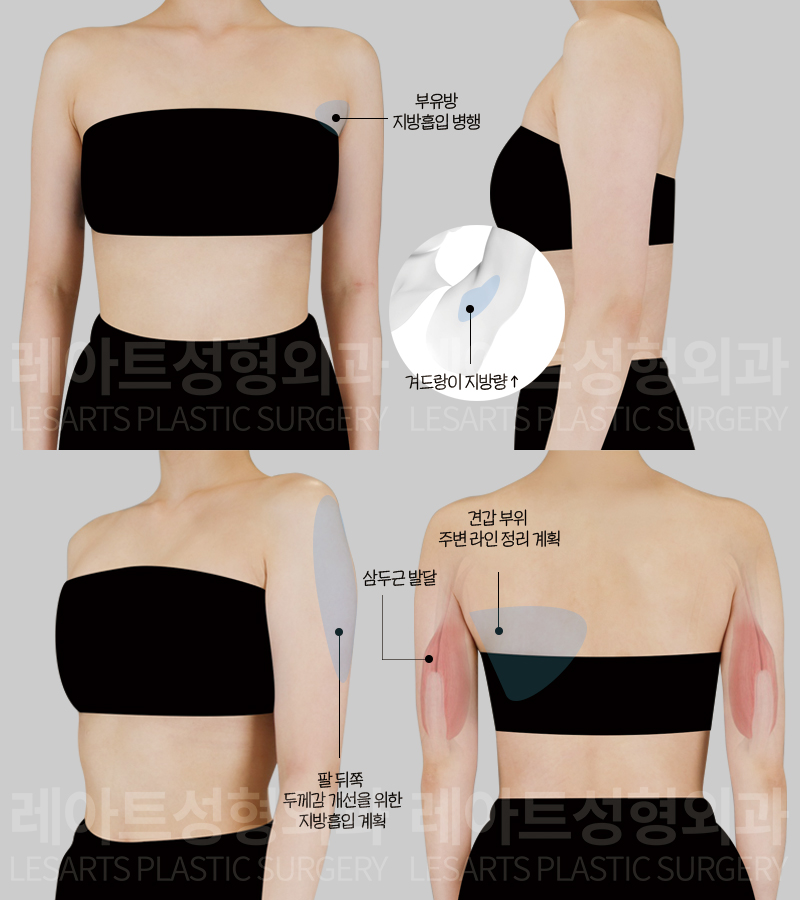
[Before Arm Liposuction: Body Type Analysis and Surgical Plan]
At 169 cm tall, 49.6 kg, and a BMI of 17.4,
the patient had an overall slim build.
Although her weight did not fluctuate much,
residual fat at the back of her upper arms
made her upper body look wider and
heavier than her actual frame, which was her main concern.
Because she was already quite slim, rather than trying to lose
more weight, she wanted to contour the fat making her arms look thick
and achieve naturally straighter
arm contours.
[Why We Evaluated the Axillary Breast, Underarms, and Shoulder Blades Along With the Arms]
If only the back of the arms is slimmed, remaining fat where the arms connect to the torso
can make the contour look disconnected partway through.
Therefore, for this patient, we evaluated the axillary breast,
underarms, and shoulder-blade areas along with the back of the arms.
The axillary breast and underarms determine
the width where the arms begin,
while fat around the shoulder blades affects how the arms
and back contours connect from behind.
Even in someone with a slim build overall like this patient,
localized fat remaining in these areas can make
the arms stand out alone or make the upper body
feel wider than it actually is.
We therefore planned the surgical scope to reduce overall arm thickness
while allowing the surrounding areas to connect naturally.
▶ View More Arm Liposuction Before & After Cases
[Planning Straighter Arms Without Accentuated Triceps]
One area we paid special attention to in this surgery was
the triceps at the back of the upper arms.
Because the patient's arm muscles
were moderately developed,
focusing solely on removing as much fat as possible
could have made the muscle borders stand out.
In that case, rather than the soft, straighter arm line she wanted,
a more athletic, muscular contour
could have been emphasized.
We therefore planned to reduce the fat creating arm thickness
while leaving an appropriate fat layer around the triceps,
allowing a straight, smooth flow from the shoulders to the elbows
without overly exposing the muscle.
For the axillary breast area as well, because excessive fat removal
can cause skin folding or wrinkling,
we carefully moderated the suction volume.
Since the shoulder-blade area did not have
a large amount of fat,
we explained that rather than dramatically reducing thickness,
we would refine it just enough for a smooth back contour.
Taking her keloid-prone skin into account,
we proceeded with surgery after thoroughly explaining
the possibility of prominent incision scars and the post-operative
care that would be needed.
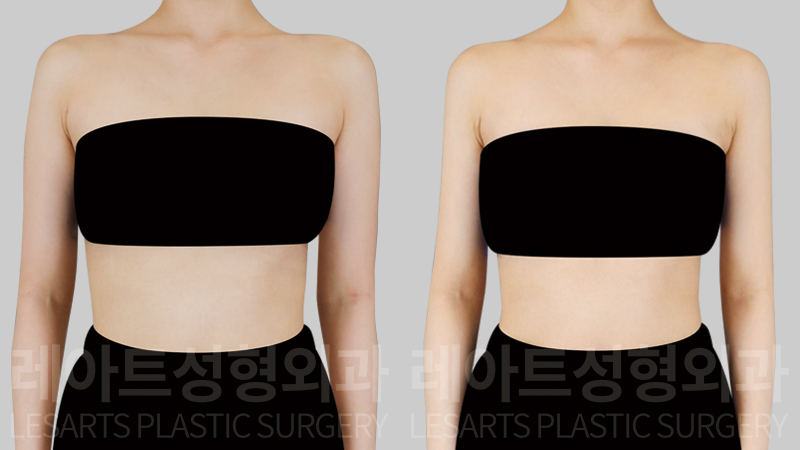
[7.5 Months After Arm Liposuction: Front-View Changes in Arm Thickness and Upper-Body Width]
Here are the before-and-after photos taken 7.5 months after surgery.
Before surgery, thickness along the back and outer sides of the arms
made her arms appear to spread wide on both sides of her torso.
After surgery, as the fat defining the outer arm contour was refined,
a straighter arm shape emerged
flowing smoothly from below the shoulders to the elbows.
As the horizontal width of her arms narrowed, her torso also
looks narrower and lighter than before,
creating upper-body proportions that suit
her height and weight.
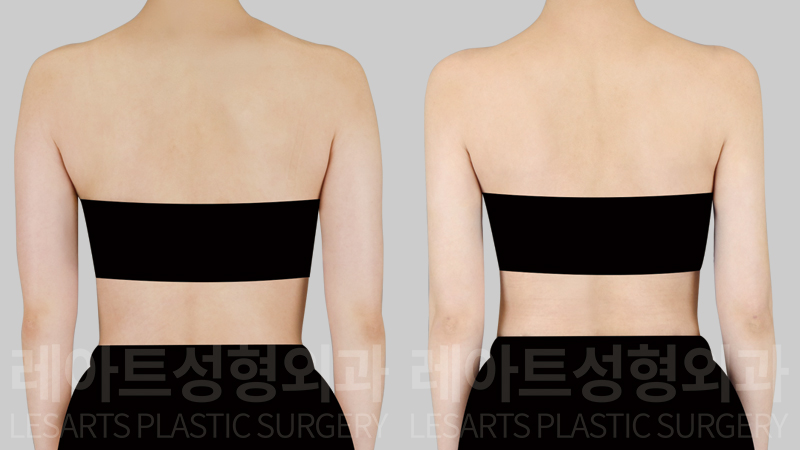
[7.5 Months After Arm Liposuction: Back-View Changes in Posterior Arms and Shoulder Blades]
In the back view, both the thickness at the back of the arms
and the contours around the shoulder blades
appear refined together.
As residual fat at the back of the arms decreased,
the line from the shoulders to the elbows
flows noticeably lighter.
The shoulder-blade area was refined smoothly without excessive fat removal,
preventing any abrupt boundary
between the arms and back.
Contouring the axillary breast, underarms, and shoulder blades along with the arms
resulted in a natural connection across the entire upper body,
rather than simply making the arms
look thin on their own.
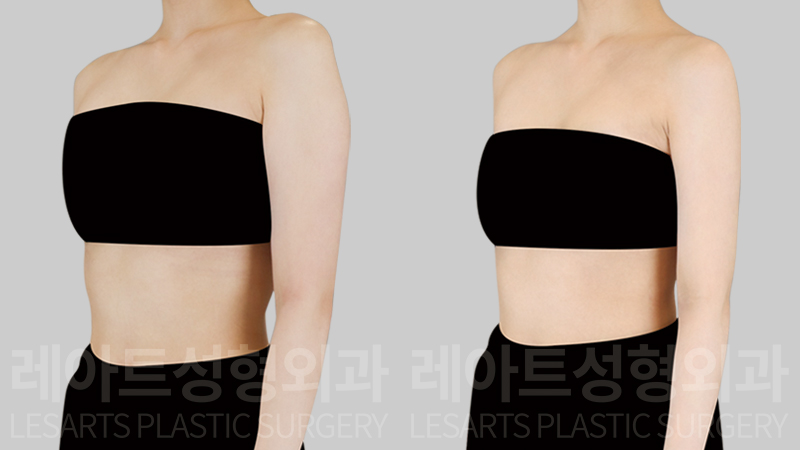
[7.5 Months After Arm Liposuction: Oblique-View Changes in Posterior Arm and Underarm Contours]
From an oblique angle, the change in thickness
flowing from the back of the arms to the underarms
is even more distinct.
Before surgery, volume where the arms met the torso
made the starting point of the arms look heavy and wide.
After surgery, with the underarms and axillary breast area contoured together,
the arms appear naturally separated from the torso,
and thickness at the back of the arms looks noticeably lighter.
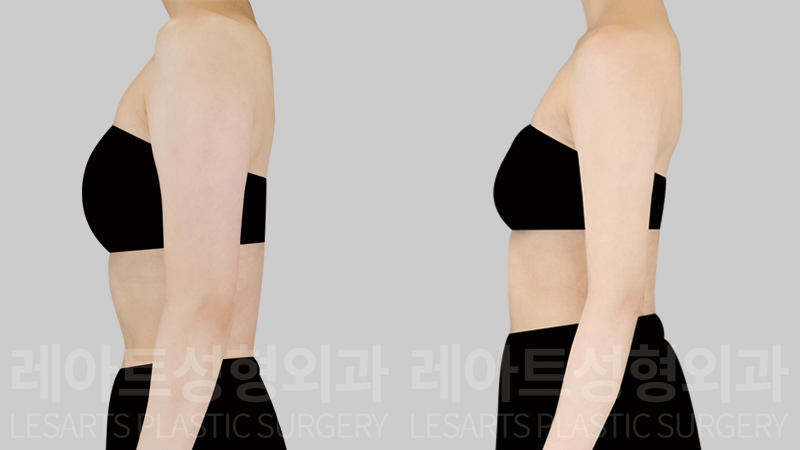
[7.5 Months After Arm Liposuction: Side-View Changes in Arm Thickness and Straighter Arm Contours]
In the side view, reduced thickness along the back of the arms
and beneath the underarms makes the front-to-back width
of the arms visibly lighter.
With the backward bulge that used to show when resting her arms naturally
smoothed out, her arm circumference decreased, revealing a longer,
straighter line from top to bottom.
Because the triceps borders are not overly exposed,
her arms achieved the soft, straighter shape
she had hoped for.
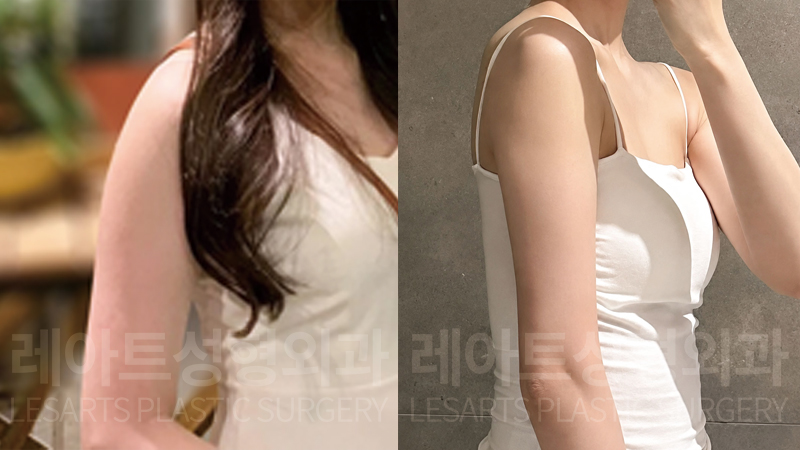
[Arm Liposuction: Selfie Comparison Before and 7.5 Months After Surgery]
Here are the patient's own photos taken before surgery
and 7.5 months afterward.
Before surgery, despite her slim build, the back of her arms stood out,
making her self-conscious when taking photos
or wearing sleeveless tops.
After surgery, she expressed satisfaction with the reduced thickness
at the back of her arms and her naturally refined
overall arm contours.
She also shared her satisfaction that, because connecting areas such as the axillary breast
and underarms were contoured together rather than just slimming the arms alone,
her upper body looks noticeably more delicate
in sleeveless tops.
[Healing Status of the Liposuction Scars She Was Concerned About]
Because of her keloid-prone skin,
the patient had been quite worried about liposuction incision scars
even before surgery.
However, at 7.5 months after surgery, the incision sites
had healed stably without becoming
thickly raised or aggravated.
Having experienced keloid-type scars in the past
does not mean that every liposuction incision site
will necessarily heal in the same way.
Still, because skin characteristics can carry a risk
of prominent scarring, thorough consultation before surgery
is essential,
and after surgery, changes at the incision sites should be
consistently monitored with ongoing care
tailored to their condition.
Although this patient had a slim build overall,
residual fat along the back of her arms, axillary breast, underarms, and shoulder blades
made her upper body appear wide and heavy.
Because her triceps were moderately developed,
we focused on creating naturally straighter arms
from the shoulders to the elbows by leaving appropriate volume
around the muscle rather than removing fat
excessively.
At 7.5 months after surgery, thickness at the back of her arms had decreased
and the horizontal width of her upper body looked noticeably lighter.
The patient also expressed high satisfaction that the arm contours
that had bothered her when taking photos or wearing sleeveless tops
were cleanly refined.
The incision scars she had been most worried about before surgery
also healed stably without
becoming thickly raised
or aggravated.
Having keloid-prone skin does not automatically mean
you cannot undergo arm liposuction,
but the risk of scarring and the recovery process
must be carefully considered.
After accurately evaluating not only your arm fat and muscle distribution
but also your skin characteristics and past scar reactions,
consult thoroughly with a medical team that can consistently oversee
everything from surgery to post-operative scar care.
▶ Learn About Liposuction Methods at Lesarts
Arm Liposuction for Keloid-Prone Skin FAQ
1. Can I not get arm liposuction if I have keloid-prone skin?
Having experienced keloid scars alone
does not automatically make liposuction impossible.
However, considering the possibility of prominent scarring,
your skin condition and past scar reactions should be
thoroughly evaluated before surgery.
2. Can liposuction incision scars also turn into keloids?
Depending on individual skin characteristics, there is a possibility that scars
may heal thicker or wider.
However, it cannot be assumed that they will heal
in the exact same way as every past scar.
3. Can slim body types also benefit from arm liposuction?
Even if overall body weight is low, if fat is concentrated
at the back of the arms, axillary breast, or underarm areas,
contouring those areas can improve arm and upper-body lines.
4. If I have developed arm muscles, is it better to remove a lot of fat?
Removing too much fat can cause the borders
of the triceps to stand out.
If you want soft, straighter arms,
an appropriate fat layer should be left based on your muscle shape.
5. How long should arm liposuction scars be managed?
The time it takes for scars to stabilize varies from person to person.
It is best to consistently monitor the color, thickness,
and elevation of the incision sites after surgery and proceed with
appropriate care as needed.
#Liposuction
#Arm #Etc
#Straight Arm #Right angle shoulder #BMIbelow20(Arm) #Axilla #Accessory breast


Cases finding
similar to my profile
Customer Diagnostics


Select the surgery and
area you are interestedto see real
before andafter changes.


we
make you,
the art
Clinic hours
MON - FRI
10 am – 7pm
SAT
10 am – 4pm
Holiday
SUN, HOLIDAY
Location
Lesarts Moon Clinic Tower 4-5F, 40, Nonhyeon-ro 168-gil,
Gangnam-gu, Seoul, Republic of Korea

Medical institution name Lesarts Plastic Surgery
Address Lesarts Moon Clinic Tower 4-5F, 40, Nonhyeon-ro 168-gil, Gangnam-gu, Seoul, Republic of Korea
Representative Moon sung jun
