




Online Consultation
Please accurately enter the information below.
Quick Cost Consultation
Quick Consultation & Reservation
Cases finding
similar to my profile






Cases finding
similar to my profile
Customer Diagnostics
Long-Term Tummy Tuck Results After Abdominal Sagging: 1 Year 3 Month Results | Best Tummy Tuck Clinic in Gangnam, Seoul, Korea
2026-08-05
Abdominoplasty | Will the Results Still Hold Up Well After 1 Year and 3 Months?
Do the abdominal contours achieved after abdominoplasty last a long time?
When loose skin is removed and abdominal liposuction is performed together,
you can see that lower abdominal sagging and
abdominal thickness remain refined even after time has passed.
However, the surgical scope should be determined by considering skin sagging, abdominal wall condition,
and even future pregnancy plans.
▶ View Lesarts Abdominoplasty Cases
When significant weight gain
continues for a long period, fat is not the only thing that accumulates in the abdomen.
Along with overall thickening of the abdomen,
the skin below the navel can stretch,
or the lower abdomen can fold over the underwear line.
In such cases, rather than viewing it simply as excess body fat,
it is important to assess skin elasticity, where the sagging starts,
and whether the abdominal wall is protruding forward.
This patient had fat widely distributed across her entire abdomen,
and was concerned about loose skin below her navel
folding in a long crease over her underwear line.

[Before Abdominoplasty: Assessing Skin Sagging Below the Navel and Abdominal Thickness]
Examining her abdomen before surgery, fat was widely distributed
from the upper to the lower abdomen,
creating a sense of thickness throughout the entire abdomen.
On top of that, the lower abdominal skin
sagged heavily downward,
making the volume of the lower abdomen look even larger.
Skin shifting downward from the upper abdomen
folded horizontally around the navel,
deforming the navel into a long, compressed shape.
Wide stretch marks—signs of significant skin stretching—
also remained across the lower abdomen
and flanks.

[Before Abdominoplasty: Surgical Plan Considering Lower Abdominal Skin Sagging and Incision Scope]
Viewed from the side, both the upper and lower abdomen
protruded forward
around the navel.
This was assessed as involving not only subcutaneous fat and loose skin,
but also a structural issue in which the abdominal wall
was pushed outward.
Along with abdominal liposuction to contour fat across the entire abdomen,
she needed an M-type full abdominoplasty to pull down
and remove loose skin starting from the upper abdomen.
Because the original navel had shifted in position
along with the stretched skin,
we also planned umbilicoplasty to create
a new navel during the abdominoplasty.
[Why Rectus Abdominis Muscle Repair Was Excluded Due to Future Pregnancy Plans]
The patient was unmarried and had plans
for marriage and pregnancy in the future.
Although her abdominal wall was protruding forward,
we also had to consider the possibility that her abdomen
would stretch again during a future pregnancy.
After thorough consultation, we decided for this surgery
to exclude rectus abdominis muscle repair and proceed with abdominal liposuction,
M-type full abdominoplasty, and umbilicoplasty.
The approach for abdominoplasty is not decided
solely based on the current appearance of the abdomen.
The required surgical scope should be chosen by considering not only
the extent of skin sagging and abdominal wall condition,
but also childbirth history and future pregnancy plans.
▶ View Abdominal Liposuction Before & After Cases

[1 Year and 3 Months After Abdominoplasty: Front-View Changes in Lower Abdominal Sagging and Navel Shape]
Let's compare her appearance before surgery
and 1 year and 3 months after surgery.
Before surgery, lower abdominal skin folded in a long crease over the underwear line,
and the lower abdomen looked heavily sagged downward.
After surgery, with the loose skin removed,
the lower abdominal fold disappeared, leaving the lower abdomen
noticeably smoother and firmer.
As fat distributed across the entire abdomen was also reduced,
her waistline is now much more clearly defined than before.

[1 Year and 3 Months After Abdominoplasty: Oblique-View Changes in Lower Abdominal Protrusion and Flank Contours]
From an oblique angle, the reduction in overall abdominal volume
and changes along the flanks are even more clearly visible.
By removing loose skin through abdominoplasty
and performing abdominal liposuction together, the front abdomen—
which had looked thick and heavy—became noticeably lighter.
With flank fat contoured as well, her waist tapers in naturally,
and the contour from the central abdomen to the hips
has become smoother than before.
The navel, which had been compressed horizontally by stretched skin,
was reshaped into a vertical form suited to her waistline,
restoring balance to the center of the abdomen.

[1 Year and 3 Months After Abdominoplasty: Side-View Changes in Lower Abdominal Protrusion and Abdominal Contours]
In the side view, you can see the reduction in downward-sagging skin
and overall abdominal volume.
Before surgery, both the upper and lower abdomen
protruded forward,
and sagging skin further emphasized
the heavy appearance of the lower abdomen.
At 1 year and 3 months after surgery, with loose skin and abdominal fat contoured,
the front abdomen flows firmer and smoother than before.

[1 Year and 3 Months After Abdominoplasty: Changes in Lower Abdominal Skin Folds When Bending Forward]
Abdominal skin sagging can appear even more pronounced
when bending the upper body forward than when standing upright.
Before surgery, bending forward caused excess skin
to shift downward, creating deep folds in the lower abdomen.
After surgery, with the loose skin removed, even when bending forward
the lower abdomen no longer creases into multiple folds or spills downward,
maintaining a firm abdominal shape.

[1 Year and 3 Months After Abdominoplasty: Incision Placement Concealed by Underwear and Scar Healing Progress]
With 1 year and 3 months having passed since abdominoplasty,
redness along the lower abdominal incision line has faded considerably,
and the scar has settled into a stable state.
Because the incision line sits relatively low on the lower abdomen,
it is naturally concealed when wearing underwear.
We explained to the patient that with continued care,
the color of the scar can fade
even further than it is now.
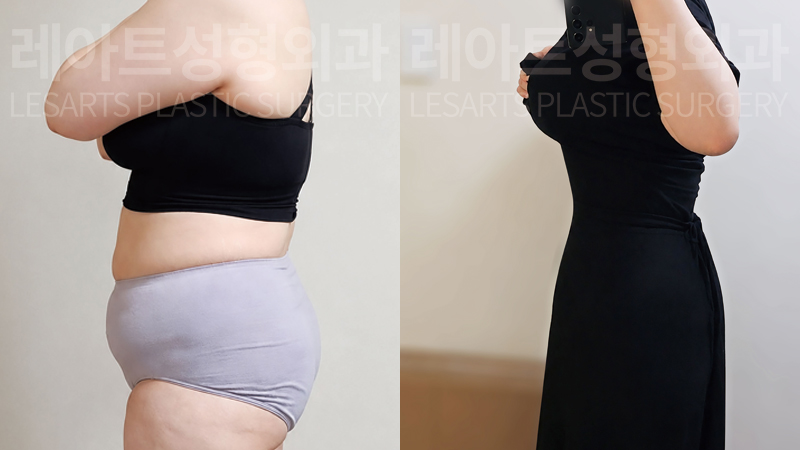
[Abdominoplasty: Front-View Selfie Comparison Before and After Surgery]

[Abdominoplasty: Front-View Selfie Comparison Before and After Surgery]
The changes in her lower abdomen can also be seen
in the before-and-after photos the patient took herself.
Before surgery, downward-sagging skin caused her lower abdomen
to stand out in fitted clothing, giving her entire abdomen
a bulky, heavy appearance.
After surgery, with the lower abdominal skin smoothed
and her waistline revealed, her lower abdomen no longer stands out
as before even in fitted clothes.
Even when wearing a lightweight, flowing dress,
her lower abdomen no longer pushed forward
or stood out through the fabric as before.
The patient expressed high satisfaction that her abdomen—
which had looked heavy due to skin sagging—became firm and smooth,
allowing her to choose outfits without worrying about
her lower abdomen.
This patient had wide fat accumulation across her entire abdomen following weight gain,
along with skin stretching from the upper abdomen
that sagged heavily down to the lower abdomen.
Through abdominal liposuction combined with M-type full abdominoplasty
and umbilicoplasty, even 1 year and 3 months after surgery
the reduced lower abdominal folds and firmer
abdominal contours were well maintained.
Although rectus abdominis muscle repair was excluded in consideration of future pregnancy plans,
addressing both loose skin and abdominal fat together
reduced abdominal volume and revealed a more defined waistline than before.
The patient was also pleased that her lower abdomen no longer stood out
in fitted clothes or dresses, and that her abdomen looked
lighter and smoother.
When abdominal fat and skin sagging appear together
as in this case, it can be difficult to achieve the desired changes
through repeated exercise and dieting alone.
Have an accurate evaluation to determine whether your current abdominal thickness
is due to fat alone or whether stretched skin and abdominal wall condition
should also be addressed, and consult on the surgical method
best suited to you.
▶ View More Abdominoplasty Before & After Cases
Abdominoplasty FAQ
1. Do abdominoplasty results last over time?
The changes achieved by removing loose skin can be maintained over the long term.
However, significant weight fluctuations or pregnancy after surgery
can alter abdominal skin and contours again.
2. Can abdominal liposuction alone improve lower abdominal skin sagging?
Because abdominal liposuction is a procedure that reduces fat,
if a wide area of loose skin remains,
it is difficult to sufficiently improve skin sagging with liposuction alone.
3. Can unmarried patients undergo abdominoplasty?
Even if you are unmarried, surgery can be considered
depending on your current abdominal condition.
However, future pregnancy plans should be reviewed to carefully decide
whether to include rectus abdominis repair and the overall surgical scope.
4. Does the navel also change after abdominoplasty?
In an M-type full abdominoplasty, umbilicoplasty may also be needed
during the process of pulling loose skin
downward.
In this case, the horizontally compressed navel
was reshaped into a vertical form.
5. Can an abdominoplasty scar be concealed with underwear?
The incision line is designed to sit low on the lower abdomen.
However, the exact position and length of the scar
can vary depending on the degree of skin sagging
and the extent of excision.
#Abdominoplasty
#M-type


Cases finding
similar to my profile
Customer Diagnostics


Select the surgery and
area you are interestedto see real
before andafter changes.


we
make you,
the art
Clinic hours
MON - FRI
10 am – 7pm
SAT
10 am – 4pm
Holiday
SUN, HOLIDAY
Location
Lesarts Moon Clinic Tower 4-5F, 40, Nonhyeon-ro 168-gil,
Gangnam-gu, Seoul, Republic of Korea

Medical institution name Lesarts Plastic Surgery
Address Lesarts Moon Clinic Tower 4-5F, 40, Nonhyeon-ro 168-gil, Gangnam-gu, Seoul, Republic of Korea
Representative Moon sung jun
