




Online Consultation
Please accurately enter the information below.
Quick Cost Consultation
Quick Consultation & Reservation
Cases finding
similar to my profile






Cases finding
similar to my profile
Customer Diagnostics
Full Tummy Tuck for Upper Abdominal Skin Sagging: 3-Month Results After Previous Liposuction | Best Tummy Tuck Clinic in Gangnam, Seoul, Korea
2026-08-10
Abdominoplasty | Skin Sagging Starting From the Upper Abdomen: Abdominal Changes After 3 Months
If the lower abdomen looks saggy, did the skin sagging actually start
in the lower abdomen?
Even when wrinkles and folds appear concentrated in the lower abdomen,
abdominal skin sagging can actually begin in the upper abdomen.
This happens because loose skin shifts downward
with gravity and gathers in the lower abdomen.
Therefore, when planning abdominoplasty, rather than looking only at the lower abdomen,
it is important to assess both the extent of skin sagging from the upper to lower abdomen
and the condition of the abdominal wall together.
▶ View Lesarts Abdominoplasty Cases
When abdominal skin sags, the most noticeable wrinkles
or folds typically appear around the navel and in the lower abdomen.
Because of this, looking at one's own abdomen,
it is easy to assume that "only the lower abdominal skin is sagging."
In reality, however, skin that has lost elasticity starting from the upper abdomen
can descend downward, creating wrinkles around the navel
and causing excess skin to gather and fold in the lower abdomen.
This patient was also a case where skin sagging
that began in the upper abdomen extended
around the navel and down to the lower abdomen.
Before Abdominoplasty: Skin Sagging Extending From the Upper Abdomen

[Before Abdominoplasty: Assessing Upper Abdominal Skin Sagging and Wrinkles Around the Navel]
The patient had previously undergone
abdominal liposuction at another clinic,
but skin sagging remained, leaving her concerned
that her abdomen looked thick and heavy.
What bothered her most in particular
were the wrinkles in the upper abdomen and around the navel.
Before surgery, skin elasticity was already reduced
starting from the upper abdomen,
and as excess skin shifted downward,
it created wrinkles and folds around the navel.
The navel had also been pulled by the loose skin,
altering its original shape.
When bending forward, the excess skin folded even more,
and combined with the forward-protruding abdominal wall,
the front of the abdomen appeared uneven.
Surgical Plan Accounting for Residual Adhesions From Previous Abdominal Liposuction

[Before Abdominoplasty: Surgical Plan Considering Upper Abdominal Skin Sagging and Previous Liposuction Adhesions]
In addition to skin sagging, the patient also had
residual adhesions in the area
of her previous abdominal liposuction.
These adhesions made the abdominal surface less smooth
and further accentuated its uneven appearance.
Therefore, during abdominoplasty,
it was necessary to release the existing adhesions
while dissecting the skin.
We planned to thoroughly pull down and remove the loose skin
starting from the upper abdomen toward the lower abdomen, while also repairing the separated rectus abdominis muscles
to correct the forward-protruding abdominal wall.
In addition, the navel—which had been deformed into an inverted V-like shape due to skin sagging—
was planned to be reshaped during the abdominoplasty.
▶ View Abdominal Liposuction Cases
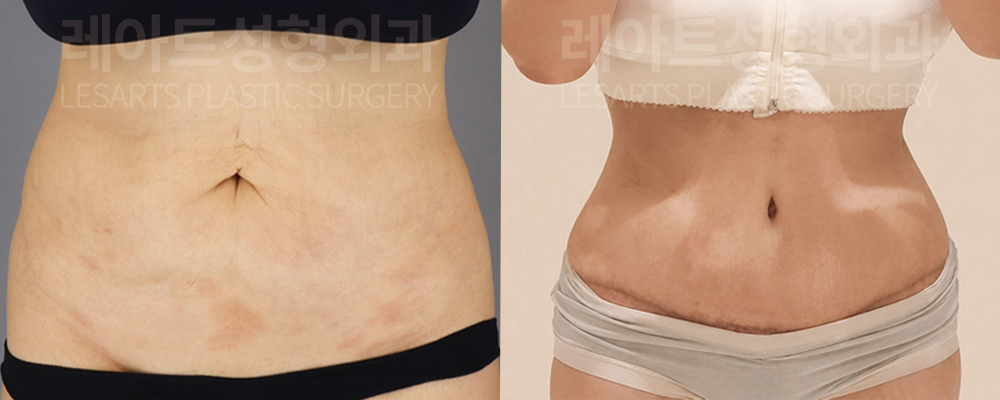
Front-View Changes 3 Months After Abdominoplasty

[3 Months After Abdominoplasty: Front-View Changes in Upper Abdominal Skin Sagging and Wrinkles Around the Navel]
The patient addressed the skin sagging extending from the upper abdomen
through an M-type full abdominoplasty.
Three months after surgery, the wrinkles and folds that had extended
from the upper abdomen around the navel appear noticeably smoother.
By releasing the residual adhesions from her previous liposuction,
the previously irregular abdominal surface was also smoothed out.
With both the loose skin and the forward-protruding abdominal wall corrected together,
the entire front abdomen appears firmer than before,
and the deformed navel has been reshaped into a vertical form.
How Did Anterior Abdominal Protrusion and the Waistline Change?

[3 Months After Abdominoplasty: Changes in Anterior Abdominal Protrusion and Waistline]
Before surgery, as upper abdominal skin descended downward,
the center of the abdomen looked thick,
and irregular contours around the navel
kept the waistline from showing clearly.
After surgery, with the skin contoured from the upper to lower abdomen
and the abdominal wall repaired together,
the fullness of the front abdomen has decreased.
The previously uneven contours around the navel have become smoother,
and with the newly formed vertical navel positioned at the center of the abdomen,
the waistline also appears more naturally defined than before.
Side-View Changes in the Upper and Lower Abdominal Contours

[3 Months After Abdominoplasty: Side-View Changes in Anterior Abdominal Protrusion and Upper/Lower Abdominal Contours]
In the side view, you can see how the thickness of the front abdomen
changed through skin tightening and abdominal wall repair.
Before surgery, the area from the upper abdomen to the lower abdomen
protruded forward loosely overall.
After surgery, anterior abdominal protrusion has decreased,
and the contour flows much more smoothly from the upper to the lower abdomen.
In particular, as the irregular contours that accompanied skin sagging
were smoothed out, the entire abdomen looks lighter than before.
Changes in Skin Folds When Bending Forward

[3 Months After Abdominoplasty: Changes in Upper Abdominal Skin Sagging and Folds Around the Navel When Bending Forward]
This patient's skin sagging
was even more pronounced when bending forward.
Before surgery, bending the upper body forward caused the loose skin
to shift downward, creating multiple layers of wrinkles
and folds around the navel.
Three months after surgery, even in postures involving movement,
the skin no longer shifts heavily downward as before,
and folding around the navel is noticeably reduced.
The front abdomen, which had previously looked loose,
is now maintained in a firmer state.
 [3 Months After Abdominoplasty: Lower Abdominal Incision Scar and Healing Progress]
Three months after surgery is not yet the point
at which an abdominoplasty scar has completely stabilized.
In the photo as well, redness can still be seen
along the lower abdominal incision line.
We explained to the patient that this is part of the normal healing process,
and that the color can gradually fade
as scar care begins afterward.
Because the incision line is placed relatively low on the lower abdomen,
it is naturally concealed when wearing underwear.
[Abdominoplasty: Selfie Comparison Before and 3 Months After Surgery]
The changes in the central abdomen can also be seen
in the photos the patient took and shared herself.
The patient expressed satisfaction that the wrinkles in her upper abdomen
and around her navel—her biggest concerns before surgery—had been reduced.
Even in her selfies, the central abdomen looks firmer and smoother than before,
and her waistline is more naturally defined.
With the irregular abdominal shape caused by previous liposuction adhesions and the bulky-feeling
flanks addressed together, the contour flowing from the waist to the hips
has become noticeably smoother.
As in this patient's case, just because skin gathers in the lower abdomen
does not always mean the sagging started in the lower abdomen.
Skin that has lost elasticity starting from the upper abdomen can shift downward,
creating wrinkles around the navel and eventually leading to folds in the lower abdomen.
In this case, we assessed the skin sagging originating from the upper abdomen, residual adhesions from previous liposuction,
separated rectus abdominis muscles, and the deformed navel together
before planning an M-type full abdominoplasty.
Three months after surgery, wrinkles in the upper abdomen and around the navel were smoothed,
and the skin folds that had been prominent when bending forward
were also noticeably reduced.
The patient was pleased that her upper abdomen and the area around her navel—her greatest concerns—became smoother,
and that the contour from her waist to her hips
looked naturally refined.
Therefore, if you are considering abdominoplasty, rather than judging the surgical scope
simply by pinching the loose skin in your lower abdomen, it is important to assess
how the skin is descending from the upper abdomen, along with the condition of the abdominal wall,
navel, and any previously treated areas.
▶ View More Abdominoplasty Before & After Cases
Abdominoplasty FAQ
1. If the lower abdomen is sagging, is a mini abdominoplasty enough?
Even if skin appears to gather in the lower abdomen, the actual sagging
may have started in the upper abdomen.
The required surgical scope should be determined after checking
upper abdominal skin condition and whether diastasis recti is present.
2. Can skin sagging remaining after abdominal liposuction be improved with another liposuction?
Because liposuction is a procedure that reduces subcutaneous fat,
it has limits in removing already stretched skin.
If skin sagging is widespread, abdominoplasty may be needed.
3. Is abdominoplasty possible even if there are adhesions from previous abdominal liposuction?
If adhesions are present in a previously liposuctioned area,
they must be accounted for during surgery. Because they can affect skin movement,
the extent and severity of adhesions are evaluated together before surgery.
4. Can abdominoplasty also change the shape of the navel?
In an M-type full abdominoplasty, as loose skin is shifted downward,
it is sometimes necessary to reshape and reposition the navel.
5. Is the scar still very red 3 months after abdominoplasty?
At 3 months, the scar is still in the process of stabilizing,
so redness may still remain.
As healing and scar care continue afterward,
its color and appearance can gradually change.
#Abdominoplasty
#M-type
#Abdominal liposuction(M)


Cases finding
similar to my profile
Customer Diagnostics


Select the surgery and
area you are interestedto see real
before andafter changes.


we
make you,
the art
Clinic hours
MON - FRI
10 am – 7pm
SAT
10 am – 4pm
Holiday
SUN, HOLIDAY
Location
Lesarts Moon Clinic Tower 4-5F, 40, Nonhyeon-ro 168-gil,
Gangnam-gu, Seoul, Republic of Korea

Medical institution name Lesarts Plastic Surgery
Address Lesarts Moon Clinic Tower 4-5F, 40, Nonhyeon-ro 168-gil, Gangnam-gu, Seoul, Republic of Korea
Representative Moon sung jun
