




Online Consultation
Please accurately enter the information below.
Quick Cost Consultation
Quick Consultation & Reservation
Cases finding
similar to my profile






Cases finding
similar to my profile
Customer Diagnostics
Postpartum Abdominal Liposuction for Lower Belly and Waistline: 2-Month Results | Best Liposuction Clinic in Gangnam, Seoul, Korea
2026-08-11
Abdominal Liposuction | Stubborn Postpartum Lower Belly Fat: 2-Month Waistline Changes
If your weight has returned after childbirth but lower belly fat remains, can liposuction help?
If postpartum abdominal changes are largely caused by subcutaneous fat,
abdominal liposuction can reduce lower belly thickness
and contour the flanks.
However, if reduced skin elasticity, visceral fat,
or diastasis recti is also present,
there are limits to what liposuction alone can address,
so it is important to assess your current abdominal condition first.
▶ View Lesarts Abdominal Liposuction Cases
Some people continue dieting even after losing
a fair amount of weight following childbirth
because their lower belly remains noticeably stubborn.
Even after returning close to their pre-pregnancy weight,
the area below the navel may still bulge, or the flanks may remain full,
keeping the waistline from showing clearly.
In such cases, rather than assuming you simply haven't lost enough weight,
it is worth examining what is actually causing
the abdomen to look thick.
After childbirth, not only can fat increase,
but changes in skin elasticity or a stretched abdominal wall
can also create a different abdominal shape than before.
Therefore, when planning abdominal liposuction, it is important to assess not only
how much fat is in the lower abdomen,
but also flank fat distribution, skin condition, and the influence of
diastasis recti or visceral fat.
This patient also planned abdominal liposuction to improve
her lower belly and waistline
that remained after two childbirths.
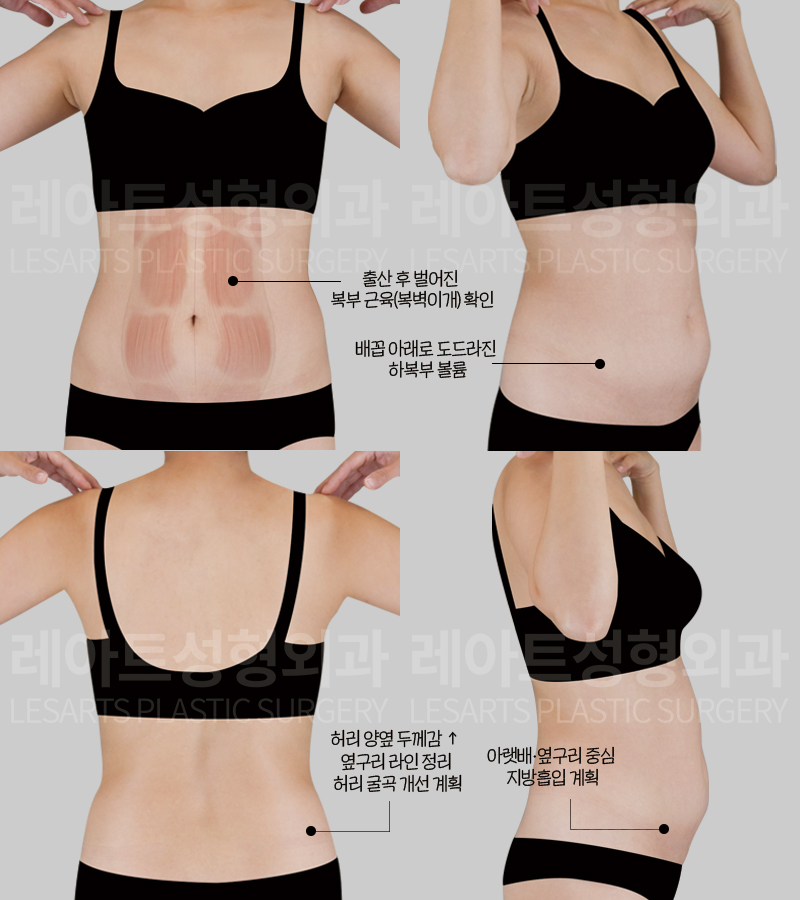
[Before Abdominal Liposuction: Assessment of Postpartum Lower Belly and Waistline]
At 160 cm tall, weighing 49.3 kg, with a BMI of 19.3,
the patient had a relatively slim build overall
and had given birth twice.
Although her overall weight was not high,
her biggest concern was the lower abdomen
and flanks that remained after childbirth.
From the front, her lower abdomen projected forward,
and residual fat along the flanks
made her waist appear straight.
As a result, her midsection appeared heavy relative to her actual height and weight,
giving her overall figure
a less defined look.
[Why the Lower Abdomen and Flanks Were Contoured Together]
The change the patient wanted
was not simply a smaller abdominal circumference.
It was important to reduce the thickness of the protruding lower belly
while also addressing the remaining flank fat
so that her waistline would curve inward
naturally when viewed from the front.
If liposuction is performed only on the central abdomen while leaving
flank volume untouched, the lower belly may look lighter,
but a straight-looking waist may not change much.
Therefore, in this surgery, we assessed fat distribution across both
the lower abdomen and flanks together,
planning to reduce central abdominal volume
while allowing her waistline to emerge naturally.
▶ Learn About Abdominal Liposuction Methods
[Factors That Liposuction Alone Could Not Address]
During the pre-operative evaluation, in addition to subcutaneous fat,
visceral fat and postpartum diastasis recti were also identified.
Because visceral fat is located inside the abdominal cavity,
it cannot be directly removed with liposuction,
and forward protrusion of the abdominal wall caused by diastasis recti
is also difficult to correct with liposuction alone.
We therefore explained to the patient in advance that while abdominal liposuction
can reduce subcutaneous fat in the lower abdomen and flank thickness,
there may be limits to changing every aspect of postpartum abdominal shape
through liposuction alone.
When planning postpartum abdominal liposuction like this,
rather than focusing only on "how much fat can be removed,"
it is important to distinguish between what liposuction can improve
and what requires separate management.
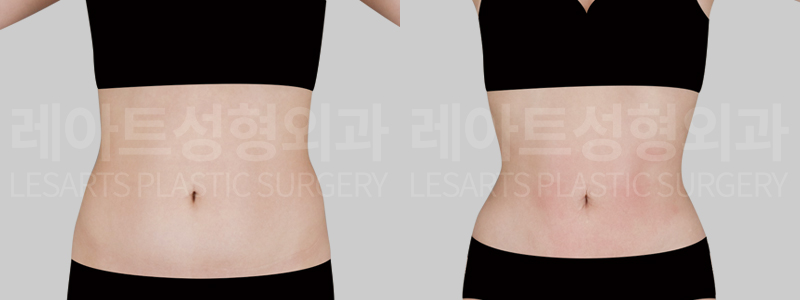
[2 Months After Abdominal Liposuction: Front-View Changes in Lower Belly Thickness and Waistline]
Here are the photos 2 months after surgery.
Before surgery, flank volume made her waist appear straight,
but after surgery, reducing fat on both sides
allowed her waist to curve inward naturally.
As her waist circumference decreased, the heavy feeling
concentrated in the center of her abdomen also became lighter.
Because she already had a slim build overall,
contouring the abdomen and flanks brought out a waistline
that naturally suited her frame.
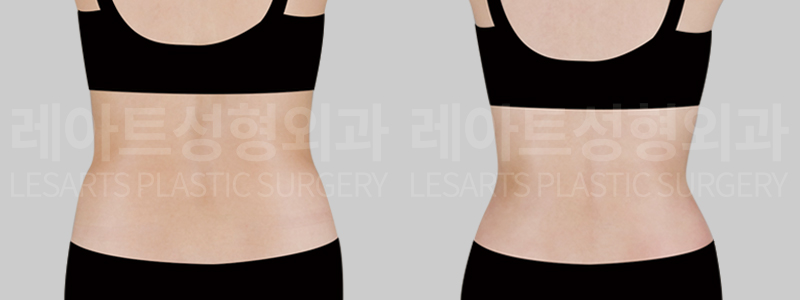
[2 Months After Abdominal Liposuction: Back-View Changes in the Flanks and Waistline]
The reduction in waist circumference is also visible from the back.
Before surgery, the transition from the lower back to the flanks
descended relatively straight, hiding the curve of the waist.
After surgery, reduced flank thickness allowed the waist to curve inward,
making the contour from the back to the hips appear more natural than before.
As the area that had made her abdomen feel disproportionately heavy for her height and weight
decreased, her overall upper-body proportions also looked lighter.

[2 Months After Abdominal Liposuction: Oblique-View Changes in the Lower Belly and Flank Contour]
From an oblique angle, you can see how the width of the abdomen changed
as both the lower belly and flanks were contoured together.
Before surgery, forward protrusion of the lower abdomen combined with
thickness extending into the flanks made the midsection look bulky.
After surgery, as volume in both areas decreased together,
the transition between the front abdomen and flanks looks more natural.

[2 Months After Abdominal Liposuction: Side-View Changes in Abdominal Protrusion and Lower Belly Thickness]
In the side view, the change in the lower belly—
the patient's biggest concern—is even clearer.
Before surgery, protrusion below the navel made
the lower belly alone look thick relative to her overall build.
After surgery, as the forward-projecting subcutaneous fat was reduced,
the lower abdomen became noticeably flatter than before.
Thickness from the upper abdomen to the lower abdomen also decreased,
creating a lighter, smoother contour across the entire front abdomen.

[Abdominal Liposuction: Selfie Comparison Before and 3 Weeks After Surgery]
Three weeks after surgery is still an early recovery period
when swelling and tissue firmness may remain.
Even so, the patient's own photos show that compared with before surgery,
lower belly volume had already decreased and her waistline
was beginning to emerge.

[Abdominal Liposuction: Selfie Comparison Before and 2 Months After Surgery]
At 2 months, her narrower waistline from reduced flank volume
and her lighter lower abdomen look even more natural.
Not only in standardized before-and-after photos, but also in everyday shots,
the reduction in central abdominal volume is clearly visible.
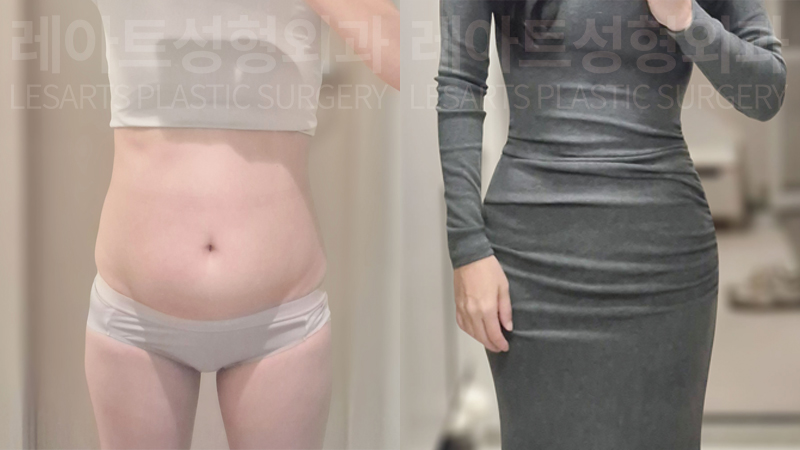
[Abdominal Liposuction: Selfie Comparison Before and 5 Months After Surgery]
At 5 months after surgery, as the abdomen settled further,
the improvements in her lower belly and waistline
look natural even in everyday poses.
The patient expressed satisfaction that the stubborn lower belly bulge had been reduced
and that her waistline was more clearly defined.
She also shared that she was pleased her body no longer felt heavier
and bulkier than her actual build because of her postpartum lower belly,
and that the natural curve of her waist had returned.
This patient had managed her weight relatively well after two childbirths,
but planned abdominal liposuction because her lower abdomen and flanks
did not improve as much as she wanted.
After surgery, the thickness of the protruding lower belly decreased,
and with the flanks contoured together, a waistline that had previously been hidden
emerged naturally.
The patient was also pleased that without needing to lose more weight,
the heavy feeling in her abdomen decreased
and the curve of her waist became more defined.
However, because postpartum diastasis recti and visceral fat
were also present in this patient's case, we explained that ongoing management
would still be needed afterward for the factors
that liposuction alone cannot resolve.
If you have succeeded in losing weight after childbirth
but your lower belly still protrudes or your flanks remain full,
you do not necessarily need to focus only on losing more weight.
It is important to accurately identify whether abdominal thickness is caused by subcutaneous fat,
or whether visceral fat and diastasis recti are also contributing,
and plan surgery while distinguishing between the changes liposuction can achieve
and its limitations.
If repeated dieting has not changed your lower belly and waistline as much as you hoped,
have your current abdominal condition evaluated
to find the approach best suited to you.
▶ View More Lesarts Abdominal Liposuction Cases
Postpartum Abdominal Liposuction FAQ
1. Can postpartum lower belly fat be difficult to lose through dieting alone?
If subcutaneous fat remains in the lower abdomen after childbirth,
thickness in that specific area may persist
even after losing some weight.
Because skin elasticity and abdominal wall condition can also play a role,
it is best to evaluate the underlying causes together.
2. Does abdominal liposuction also improve diastasis recti?
Because abdominal liposuction removes subcutaneous fat,
it is not a procedure that repairs separated rectus abdominis muscles.
3. Can visceral fat also be removed with abdominal liposuction?
Liposuction removes subcutaneous fat located beneath the skin.
Visceral fat located deeper inside the abdomen cannot be treated with liposuction.
4. Can a straight postpartum waist also change with abdominal liposuction?
If there is sufficient subcutaneous fat distributed along the flanks,
contouring that area together can help bring out
a more natural waist curve.
The degree of change varies depending on bone structure and abdominal wall condition.
5. Is 2 months after abdominal liposuction the final result?
At 2 months, changes in the lower belly and waistline are already visible,
but recovery is still ongoing.
As swelling subsides and the tissues stabilize afterward,
the abdominal contour may continue to settle more naturally.
#Liposuction
#Abdomen
#Lower abdomen #Upper abdomen #BMIbelow20(Abs)


Cases finding
similar to my profile
Customer Diagnostics


Select the surgery and
area you are interestedto see real
before andafter changes.


we
make you,
the art
Clinic hours
MON - FRI
10 am – 7pm
SAT
10 am – 4pm
Holiday
SUN, HOLIDAY
Location
Lesarts Moon Clinic Tower 4-5F, 40, Nonhyeon-ro 168-gil,
Gangnam-gu, Seoul, Republic of Korea

Medical institution name Lesarts Plastic Surgery
Address Lesarts Moon Clinic Tower 4-5F, 40, Nonhyeon-ro 168-gil, Gangnam-gu, Seoul, Republic of Korea
Representative Moon sung jun
