




Online Consultation
Please accurately enter the information below.
Quick Cost Consultation
Quick Consultation & Reservation
Cases finding
similar to my profile






Cases finding
similar to my profile
Customer Diagnostics
Postpartum Full Tummy Tuck After 20 Years: 1-Year Skin Sagging and Belly Button Reconstruction Results | Best Tummy Tuck Clinic in Gangnam, Seoul, Korea
2026-08-12
Abdominoplasty | Postpartum Lower Abdominal Sagging: Why a Full Tummy Tuck Was Needed
Could a full tummy tuck be needed even if only the lower abdomen appears to sag after childbirth?
Even when sagging skin appears concentrated in the lower abdomen,
skin laxity may actually begin in the upper abdomen.
If the rectus abdominis muscles and abdominal wall have also stretched after childbirth,
addressing only the lower abdomen may not achieve sufficient improvement,
so both the extent of skin sagging and the condition of the abdominal wall must be assessed together.
▶ View Lesarts Abdominoplasty Cases
Pregnancy and childbirth bring
a variety of changes to the abdomen.
When skin that has stretched significantly during pregnancy
does not fully retract after childbirth,
excess skin may sag or form wrinkles in the lower abdomen.
If the rectus abdominis muscles and fascia that support the abdomen from within
have also stretched, the front of the abdomen may still protrude loosely
even after body weight returns to normal.
These changes are different from simply having excess body fat.
Even with a stable weight and regular exercise,
it can be difficult to restore already stretched skin
or a weakened abdominal wall to the desired extent.
Abdominoplasty is one option to consider when addressing
both postpartum skin sagging and abdominal wall changes together.
This patient planned surgery to improve abdominal skin sagging
that had remained for a long time following
a vaginal delivery approximately 20 years earlier.
 [Before Abdominoplasty: Assessing Skin Sagging Around the Navel and Abdominal Wall Condition]
Before surgery, the abdomen did not have
a large amount of fat overall.
However, skin elasticity was reduced starting from the upper abdomen,
with loose skin extending downward
around the navel and into the lower abdomen.
The navel was pulled into a horizontally widened shape,
and loose excess skin had accumulated in the lower abdomen,
making the abdominal surface appear uneven.
The sagging was especially noticeable
further down the abdomen.
Moreover, stretched skin was not the only issue.
The rectus abdominis muscles were also relaxed and no longer adequately supporting the abdominal wall,
which caused the front of the abdomen to appear
loosely widened and protruding forward.
 [Before Abdominoplasty: Surgical Plan Accounting for Lower Abdominal Sagging and Abdominal Wall Condition]
Before the consultation, the patient had thought
the skin sagging was mainly limited to the lower abdomen.
This was because the most visible folds and loose skin
appeared concentrated in the lower abdominal area.
However, examination showed that the skin laxity was not confined to the lower abdomen.
Skin elasticity was reduced starting from the upper abdomen,
and that loose skin was descending downward,
further accentuating the sagging in the lower abdomen.
Therefore, rather than addressing only the skin below the navel,
we determined that an M-type full abdominoplasty was appropriate—
pulling down the abdominal skin from the upper abdomen
while also repairing the stretched abdominal wall and reshaping the deformed navel.
We explained the current extent of skin sagging and the scope of correction needed,
and after a thorough consultation, the patient decided to proceed with a full abdominoplasty.
▶ View More Abdominoplasty Before & After Cases

[1 Year After Abdominoplasty: Changes in Lower Abdominal Protrusion and Waistline]

[1 Year After Abdominoplasty: Changes in Sagging Lower Abdominal Skin and Navel Shape]
Let's compare the before-and-after photos 1 year after surgery.
Before surgery, the skin from the upper abdomen above the navel down to the lower abdomen
was irregularly wrinkled and sagging downward.
After surgery, with the loose skin removed,
the front abdominal surface appears noticeably firmer and smoother.
The rectus abdominis muscles were tightened to correct the forward-protruding abdominal wall,
and the horizontally stretched navel was also
reshaped and repositioned.
From the front, the heavy appearance of the lower abdomen has decreased,
making the waistline more defined than before.
 [1 Year After Abdominoplasty: Changes in Lower Abdominal Skin Sagging and Folds When Bending Forward]
Abdominal skin sagging is often more clearly visible
when bending forward than when standing upright.
Before surgery, bending the upper body forward caused the excess skin
to gather downward, creating multiple folds in the lower abdomen.
One year after surgery, with this excess skin removed,
the skin no longer piles into multiple folds
when bending forward, maintaining a firmer appearance.
 [1 Year After Abdominoplasty: Side-View Changes in Lower Abdominal Protrusion and Anterior Abdominal Contour]
In the side view, the front of the abdomen, which had previously protruded unevenly forward,
appears noticeably smoother.
Repairing the rectus abdominis muscles addressed the loosely protruding abdominal wall,
and removing the sagging skin created a natural transition
from the upper abdomen to the lower abdomen.
Although separate abdominal liposuction was not performed in this patient's case,
correcting the skin and abdominal wall alone
made the overall abdominal contour lighter and slimmer than before.
 [1 Year After Abdominoplasty: Healing Progress of the Lower Abdominal Incision Scar]
Because abdominoplasty involves directly excising loose skin,
it leaves a relatively long incision scar in the lower abdomen.
Therefore, after surgery, it is important not only to check changes in abdominal shape,
but also to consistently monitor how the incision site is healing.
This patient also continued laser toning care for the lower abdominal scar after surgery.
The 1-year post-operative photo shows the scar's healing progress,
and we will continue to monitor whether its color and thickness
settle even further over time.
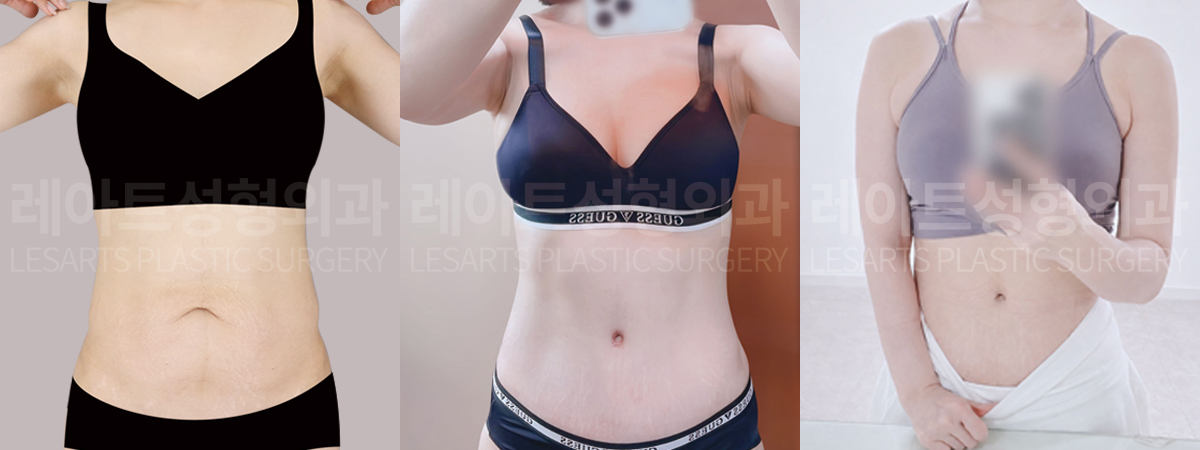
[Abdominoplasty: Selfie Comparison Before, 3 Months After, and 1 Year After Surgery]
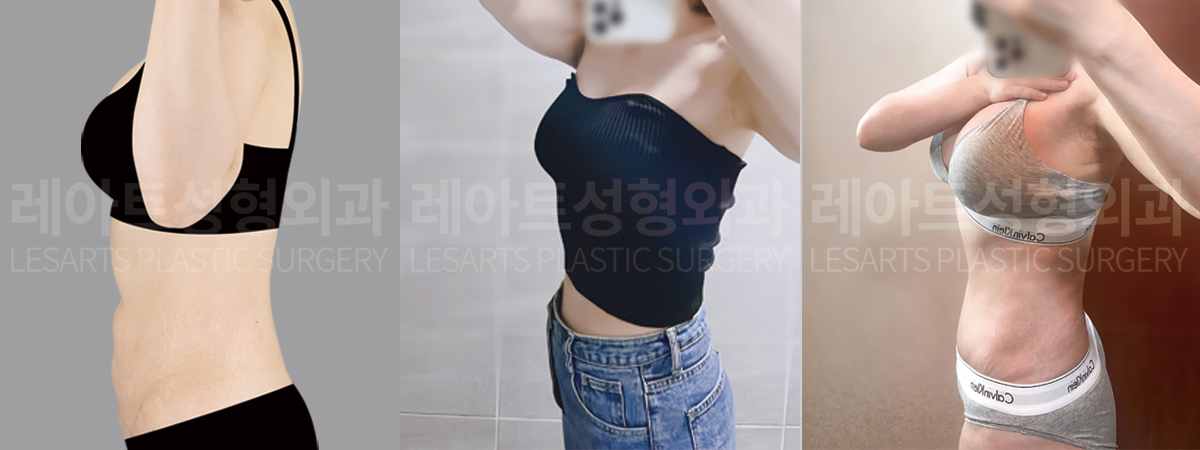
[Abdominoplasty: Selfie Comparison Before, 3 Months After, and 1 Year After Surgery]
The changes in the abdomen can also be seen in the patient's own photos
taken before surgery, at 3 months, and at 1 year.
Before surgery, excess skin folded below the navel,
making the lower abdomen look heavy, and wrinkles on the abdominal surface
were easily visible when moving.
At 3 months, with the loose skin removed, the front of the abdomen
appeared noticeably lighter,
and by 1 year, the navel and lower abdominal contours
had settled even more naturally.
This patient had been concerned about lower abdominal skin sagging
even about 20 years after childbirth.
At first, the patient thought the sagging was limited to the lower abdomen,
but examination revealed broad skin laxity starting from the upper abdomen,
along with stretched rectus abdominis muscles that were no longer adequately supporting the front abdomen.
Through an M-type full abdominoplasty,
we pulled down and removed the loose skin starting from the upper abdomen,
while performing rectus abdominis repair and umbilical reconstruction together.
One year after surgery, the irregularly wrinkled and sagging skin
from above the navel to the lower abdomen had been addressed, leaving the front abdomen firmer,
and the multiple skin folds that previously appeared when bending forward
were significantly reduced.
In particular, even without separate abdominal liposuction,
correcting both the skin and abdominal wall reduced the uneven side-view protrusion
and allowed the waistline to appear more naturally defined.
If lower abdominal skin sagging or a protruding abdominal shape continues to bother you
even long after childbirth and after your weight has stabilized,
rather than assuming it is simply remaining fat,
it is important to assess both your skin and abdominal wall condition together.
Even if visible sagging appears concentrated in the lower abdomen,
the actual area where skin laxity begins may be wider,
so an accurate diagnosis is recommended to determine whether a mini abdominoplasty
or a full abdominoplasty is needed.
▶ View More Lesarts Abdominoplasty Cases
Abdominoplasty FAQ
1. Is a full abdominoplasty needed even if only the lower abdomen appears to sag?
Even when sagging looks concentrated in the lower abdomen on the outside,
skin laxity may actually begin in the upper abdomen.
The surgical method should be decided after assessing
where the sagging starts and how far it extends.
2. If the rectus abdominis muscles stretch after childbirth, can exercise bring them back together?
It depends on the degree of laxity in the rectus abdominis muscles and fascia.
If there is already a significant structural change causing the abdominal wall to protrude forward,
exercise alone may not provide sufficient correction.
3. Does abdominoplasty also change the shape of the navel?
In a full abdominoplasty, as the skin is pulled downward,
reshaping and repositioning the navel
may also be necessary.
4. Can the waistline change even without abdominal liposuction?
As in this case, when fat volume is not large and skin sagging
and abdominal wall laxity are the main causes, correcting the skin
and abdominal wall alone can make the abdominal contour look lighter.
5. How does an abdominoplasty scar change over time?
Abdominoplasty leaves a long incision line in the lower abdomen.
Through consistent post-operative monitoring and appropriate scar care,
the scar is followed as its color and thickness gradually stabilize.
#Abdominoplasty
#M-type


Cases finding
similar to my profile
Customer Diagnostics


Select the surgery and
area you are interestedto see real
before andafter changes.


we
make you,
the art
Clinic hours
MON - FRI
10 am – 7pm
SAT
10 am – 4pm
Holiday
SUN, HOLIDAY
Location
Lesarts Moon Clinic Tower 4-5F, 40, Nonhyeon-ro 168-gil,
Gangnam-gu, Seoul, Republic of Korea

Medical institution name Lesarts Plastic Surgery
Address Lesarts Moon Clinic Tower 4-5F, 40, Nonhyeon-ro 168-gil, Gangnam-gu, Seoul, Republic of Korea
Representative Moon sung jun
