




Online Consultation
Please accurately enter the information below.
Quick Cost Consultation
Quick Consultation & Reservation
Cases finding
similar to my profile






Cases finding
similar to my profile
Customer Diagnostics
Arm Liposuction for Back Arm Bulge and Straight Arms: 3-Month Results | Best Liposuction Clinic in Gangnam, Seoul, Korea
2026-08-13
Arm Liposuction | Can It Reduce Bulging at the Back of the Upper Arms and Create Straighter Arms?
Does removing more fat during arm liposuction create straighter arms?
To make the arms look slimmer and longer,
you should not focus solely on reducing fat volume.
The size and side-to-side differences of the shoulder muscles,
as well as fat around the axillary breast and shoulder blade areas connecting to the arms,
must be assessed together to distinguish which areas to reduce and which to preserve
in order to create naturally straighter arms.
▶ Learn About Arm Liposuction at Lesarts
Many people researching arm liposuction
assume that removing more fat will give them
slim, long-looking arms like K-pop idols,
bringing them closer to what are commonly called
straight arms or right-angle shoulders.
However, the desired arm shape is not created
simply by removing a large amount of fat.
Not only arm thickness, but also shoulder muscle size, bone structure,
and fat distribution in the surrounding areas must be evaluated together.
In particular, aggressively reducing fat
around developed muscles may not make the arms look slimmer;
instead, it can make muscle contours stand out
or accentuate side-to-side differences.
Therefore, before surgery, it is important to plan the approach
by predicting not only how much the actual circumference can be reduced,
but also how slim and straight the arms can appear overall.
This patient was most concerned about the bulging fat
at the back of the upper arms,
and wanted an overall transition
toward naturally straighter arms.
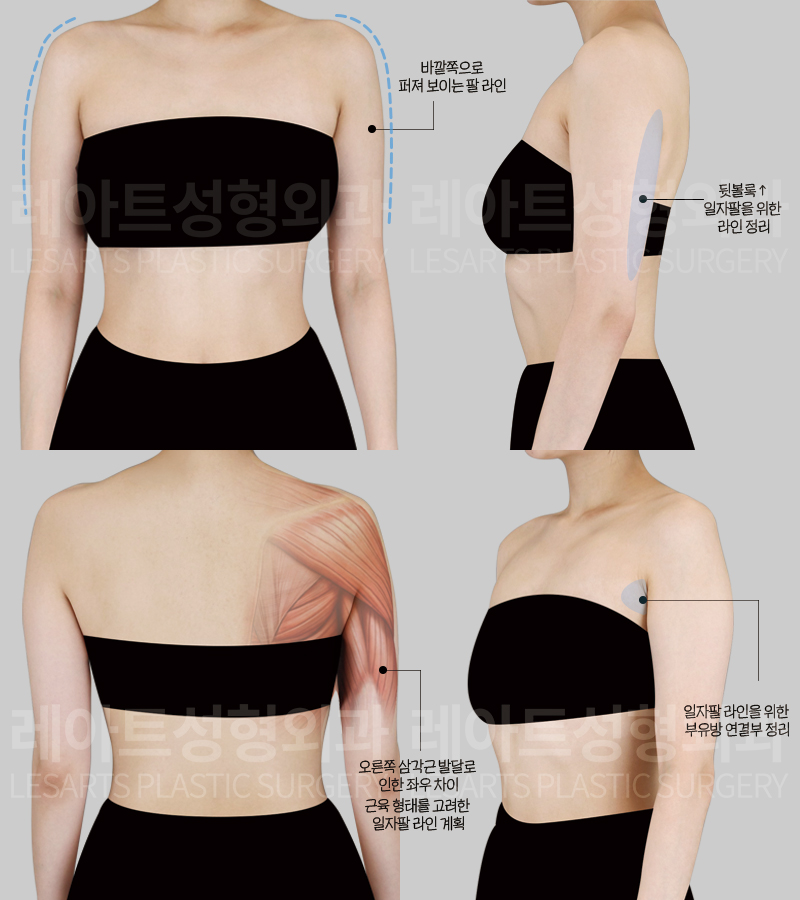
[Before Arm Liposuction: Assessing Posterior Upper-Arm Bulging and Shoulder Contours]
[Patient Information]
Age: 20s
Height: 165 cm
Weight: 51 kg
BMI: 18.9
Before surgery, the patient had a slim overall build,
but prominent bulging at the back of the upper arms
made the arms appear relatively thick compared with the rest of the body.
Fat requiring contouring was also identified
in the axillary breast area at the front and around the shoulder blades at the back.
Because of this, the arms alone appeared fuller,
lacking a light, smooth
overall transition into the upper body.
The preoperative design photos on page 2 also show
how the surgical scope was planned by assessing not only the outer and posterior arm volume,
but also the axillary breast
and shoulder blade areas together.
Surgical Plan Accounting for Shoulder Muscle Asymmetry
The patient's right deltoid muscle
was slightly more developed than the left.
Therefore, even when reducing arm thickness with liposuction,
there could be limits to making the side-to-side difference
caused by the shoulder muscles themselves
completely identical.
In such cases, removing as much fat as possible
could instead highlight the muscle boundaries
and make the asymmetry more noticeable.
Accordingly, in this surgery, we considered the shape of the shoulder muscles
and distinguished between areas where fat should be thoroughly reduced
and areas where volume should be preserved for a natural transition.
We planned to thoroughly address the posterior upper-arm bulge
while adjusting the removal volume so the muscles would not appear overly prominent,
and to contour the axillary breast and shoulder blade areas together
so the arms and upper body would flow as one continuous line.
▶ View More Arm Liposuction Before & After Cases
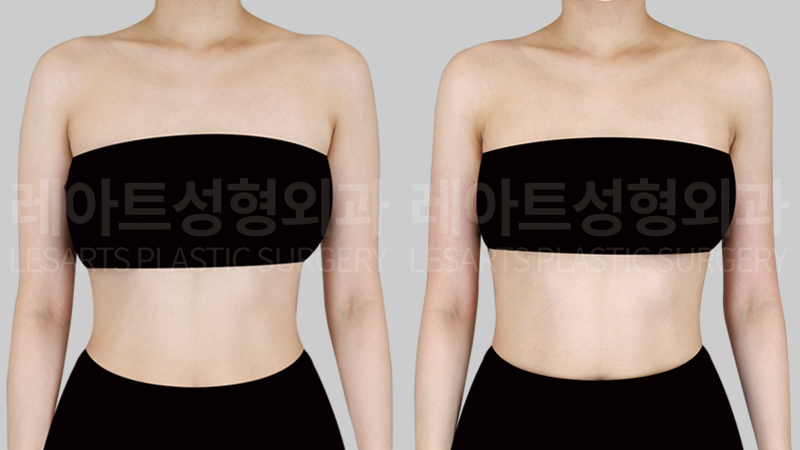
[3 Months After Arm Liposuction: Front-View Changes in Upper-Arm Thickness and Straight Contour]
Let's compare the before-and-after photos 3 months after surgery.
Before surgery, volume along the back and outer upper arms
made the arms curve outward on both sides of the torso.
After surgery, as the thickness of the posterior bulge decreased,
the outer contour from below the shoulders to the elbows
became noticeably straighter.
In particular, because the contour was refined
while accounting for the shoulder muscle asymmetry
without overly exposing the muscles,
the arms not only decreased in actual circumference,
but also appeared visually slimmer.
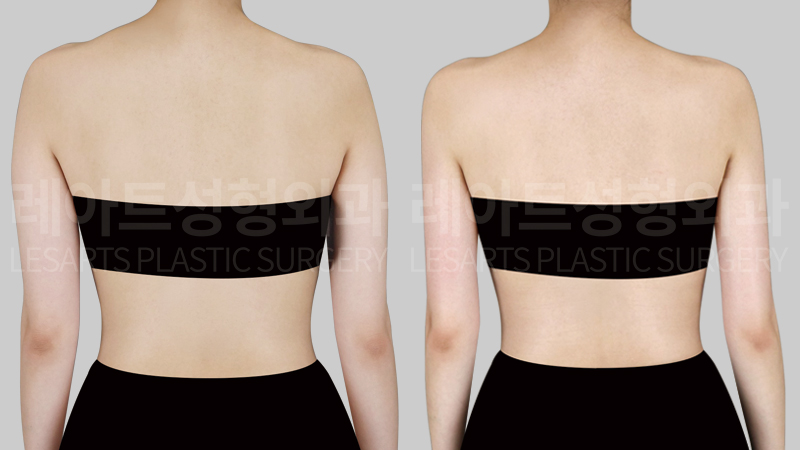
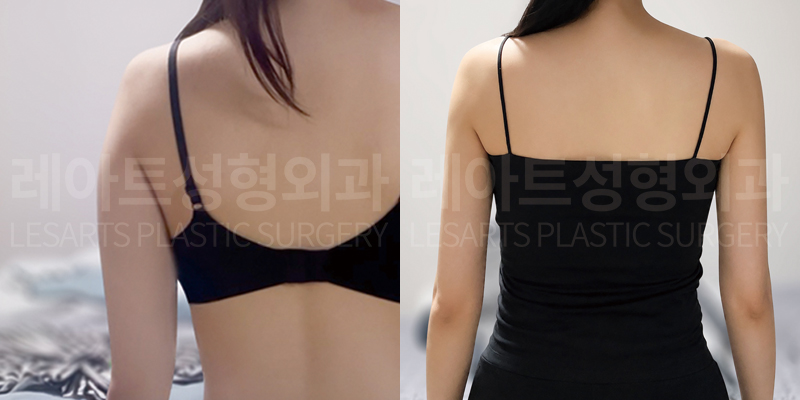
[3 Months After Arm Liposuction: Back-View Changes in Posterior Bulging and Shoulder Blade Contour]
In the back view, the change in the posterior upper arms
that concerned the patient most is even more apparent.
Before surgery, the posterior bulge curving outward
made the upper body appear wider.
Three months after surgery, with this area contoured,
the outer outline of the arms
flows in a much straighter line from top to bottom.
Fat around the shoulder blades was also addressed
so that the back of the arms would not look abruptly thin,
allowing the back and arms to connect naturally.
In addition, reducing the fullness of the axillary breast area
made the contour from the underarms to the torso
cleaner than before.
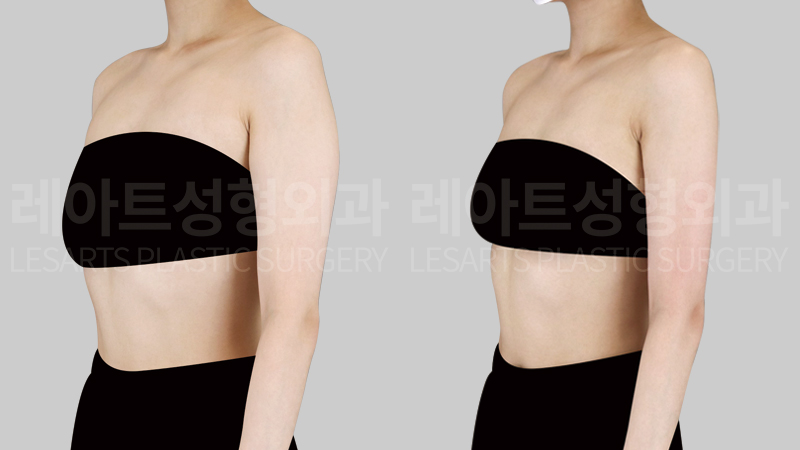
[3 Months After Arm Liposuction: Outer Contour Changes From the Axillary Breast Area to the Arms]
From an oblique angle, the change where the axillary breast area
meets the arm is clearly visible.
Before surgery, fullness at both the start of the arm and the axillary breast area
made the upper portion of the arm appear heavy.
After surgery, as the axillary breast volume decreased,
the starting point of the arm appears lighter,
and the contour from below the shoulder to the elbow
is naturally refined.
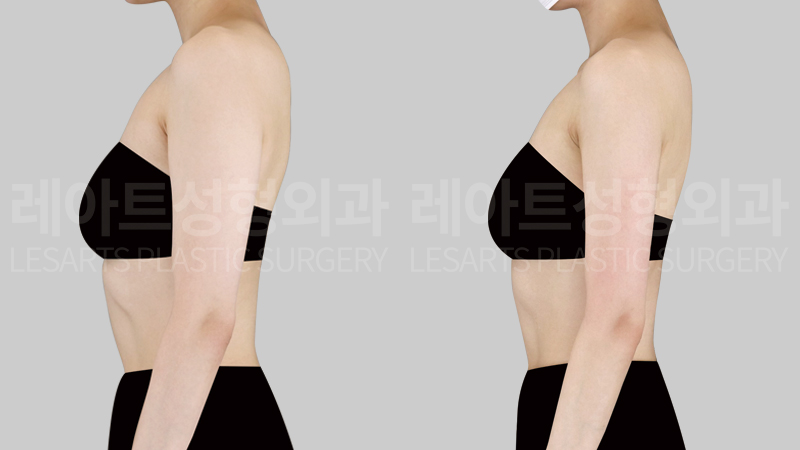
[3 Months After Arm Liposuction: Posterior Bulge Changes From Below the Shoulder to the Elbow]
From the side, the improvement in the posterior upper-arm bulge
that concerned the patient most is even clearer.
Before surgery, the front-to-back thickness of the arms
looked large relative to the patient's overall build.
After surgery, reducing the backward-projecting volume
created lighter arms that suit the patient's build.
With liposuction of the axillary breast and shoulder blade areas performed together,
the heavy appearance of the upper body also decreased,
giving an overall more delicate look.
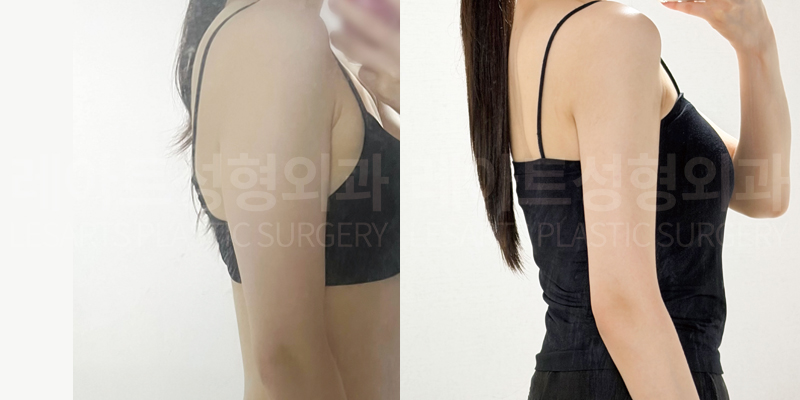
[Arm Liposuction: Selfie Comparison Before and 1 Month After Surgery]
In the patient's own before-and-after photos at 1 month,
the thickness at the back of the upper arms
had already begun to decrease.
Although some swelling can still remain during this early stage of recovery,
even in everyday poses the outer arms appeared
less wide and the upper body looked lighter.
[Arm Liposuction: Selfie Comparison Before and 3 Months After Surgery]
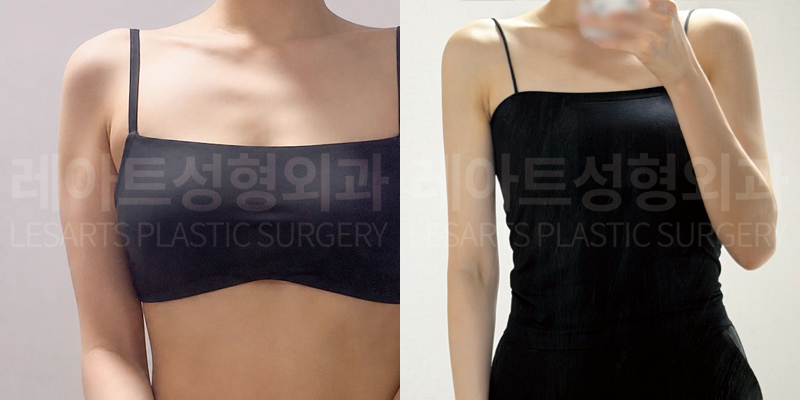
[Arm Liposuction: Selfie Comparison Before and 3 Months After Surgery]
At 3 months after surgery, the overall arm contours
had settled into a more natural shape.
The patient expressed satisfaction that the posterior upper-arm bulge—
their biggest concern—had decreased, and that the arms
looked slimmer and straighter.
In particular, the patient was pleased with how naturally
the straight arm and shoulder contours appeared in sleeveless tops.
With the previously bothersome axillary breast fullness also contoured,
the patient noted that not only the arms,
but the overall impression of the upper body felt noticeably lighter.
This patient had a generally slim build,
but bulging at the back of the upper arms and fat around the axillary breast and shoulder blade areas
made the arms appear relatively thick.
Because the right shoulder muscle was more developed,
simply removing a large amount of fat
would not have achieved the desired straight arm contour.
By thoroughly reducing the fat contributing to thickness at the back of the arms
while adjusting the removal volume so the muscles would not stand out excessively,
and contouring the axillary breast and shoulder blade areas together, at 3 months after surgery
we observed a straighter arm contour from below the shoulders to the elbows.
The patient was also pleased that the posterior bulge was reduced
and that the arm and shoulder contours looked natural in sleeveless tops.
To create naturally straighter arms like this,
rather than aiming simply to remove a large amount of fat,
it is important to assess the current fat distribution of the arms, the shape of the shoulder muscles,
and the volume of the surrounding areas together.
If your upper arms look particularly thick for your build or you are concerned about posterior bulging,
plan your surgical scope through a thorough consultation
to see how much straighter your arms can become given your bone structure and muscles,
and whether the axillary breast or shoulder blade areas should be contoured together.
▶ View More Arm Liposuction Cases at Lesarts
Arm Liposuction FAQ
1. Will removing a lot of fat during arm liposuction always create straight arms?
Removing too much fat can make muscle contours stand out
or make existing side-to-side differences more noticeable.
The amount removed should be adjusted while considering both fat volume and muscle shape.
2. Can bulging at the back of the upper arms be reduced with liposuction?
If there is sufficient removable fat distributed at the back of the upper arms,
liposuction can reduce the thickness and refine the outer contour of that area.
3. If my shoulder muscles differ in size, can liposuction make them even?
Adjusting the surrounding fat volume can make the difference less noticeable,
but liposuction cannot eliminate differences in the size of the muscles themselves.
4. Do the axillary breast and shoulder blade areas also need to be treated during arm liposuction?
If fat around the axillary breast and shoulder blade areas
makes the transition between the arms and torso look bulky,
they can be contoured together.
The required scope depends on each individual's fat distribution.
5. Is 3 months after arm liposuction the final result?
By 3 months, much of the swelling has subsided,
allowing the overall arm contours to be assessed.
As recovery continues afterward, the contours may settle a bit more naturally.
#Liposuction
#Arm #Etc
#BMIbelow20(Arm)


Cases finding
similar to my profile
Customer Diagnostics


Select the surgery and
area you are interestedto see real
before andafter changes.


we
make you,
the art
Clinic hours
MON - FRI
10 am – 7pm
SAT
10 am – 4pm
Holiday
SUN, HOLIDAY
Location
Lesarts Moon Clinic Tower 4-5F, 40, Nonhyeon-ro 168-gil,
Gangnam-gu, Seoul, Republic of Korea

Medical institution name Lesarts Plastic Surgery
Address Lesarts Moon Clinic Tower 4-5F, 40, Nonhyeon-ro 168-gil, Gangnam-gu, Seoul, Republic of Korea
Representative Moon sung jun
