




Online Consultation
Please accurately enter the information below.
Quick Cost Consultation
Quick Consultation & Reservation
Cases finding
similar to my profile






Cases finding
similar to my profile
Customer Diagnostics
Revision Arm Liposuction for Straight Arms: 3-Month Slim Arm Results | Best Liposuction Clinic in Gangnam, Seoul, Korea
2026-08-18
Revision Arm Liposuction | Residual Bulging 7 Years After the First Surgery: Straighter Arm Contours at 3 Months
Can you have revision surgery if bulging remains at the back of your upper arms after liposuction?
It may be possible.
However, revision surgery should not be approached
simply as removing more of the remaining fat.
The arm contours created by the first surgery,
the location of residual fat, skin adhesions and elasticity,
and muscle shape must all be assessed
to plan which areas to reduce and where to preserve volume.
▶ Learn About Revision Arm Liposuction at Lesarts
If you have already undergone arm liposuction
but have not achieved the shape you wanted,
you may wonder, “Would removing a little more fat give me straighter arms?”
In particular, if bulging at the back of the upper arms
or overall thickness remains after the first surgery,
you may begin considering revision surgery.
However, arms that have already undergone surgery
may differ from arms being treated for the first time.
This is because assessment must consider not only where fat remains,
but also whether the skin has become thinner, the extent of adhesions,
and how developed the muscles are.
This patient underwent arm liposuction
at another clinic 7 years earlier,
but the contours at the back of the upper arms had not improved as much as desired.
Still dissatisfied with not achieving the straighter arms expected from the first surgery,
the patient decided to undergo revision surgery.
The goal was to further reduce arm circumference
while creating a straighter contour
from just below the shoulders to the elbows.
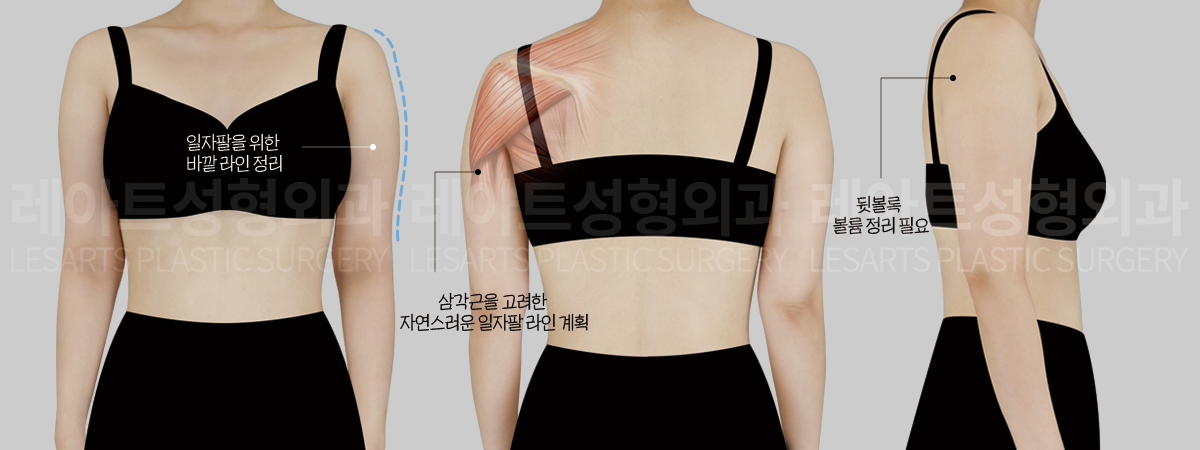
[Arm Contour Assessment Before Revision Arm Liposuction]
[Patient Information]
Age: 30
Height: 165 cm
Weight: 53.4 kg
BMI: 19.6
The patient had a slim overall build,
and there was not a large amount of fat
remaining throughout the upper arms.
However, with the arms resting naturally at the sides,
the contour from below the shoulders
toward the elbows bulged outward in the middle.
In particular, the bulging at the back of the upper arms
accentuated the thickness of the mid-upper arms,
creating a shape different from the straight contours
the patient had hoped to achieve.
The pre-operative marking photos on page 1 show
the mid-upper arm volume extending outward in the front, back, and side views,
as well as a relatively more developed right deltoid muscle.
Thin Skin and Developed Deltoids: Why We Did Not Simply Remove More Fat
There was some residual fat at the back of the upper arms
that could be addressed through revision surgery.
However, because the skin was thin and had reduced elasticity,
we needed to consider the possibility that excessive fat removal
could lead to loose skin or make surface irregularities more noticeable.
The deltoid muscles were also somewhat developed.
In arms with developed muscles, removing too much surrounding fat
can expose the boundaries of the deltoids and other arm muscles,
making the arms look more sharply contoured and muscular rather than simply slimmer.
For this revision surgery,
rather than removing all of the remaining fat,
we focused on reducing the rounded fullness at the back of the upper arms
without making the muscles
overly prominent.
The surgical plan was to reduce the outward-projecting width in the front view
and smooth the bulging at the back in the side view,
creating naturally straighter arm contours.
▶ View More Arm Liposuction Before & After Cases
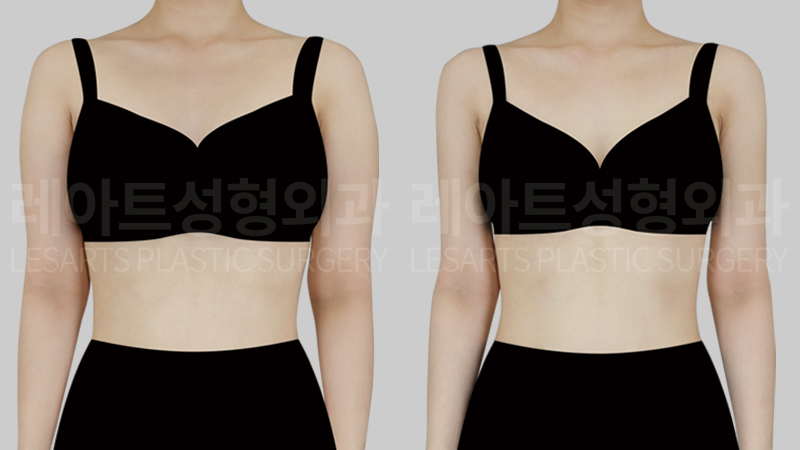
[Before and 3 Months After Revision Arm Liposuction: Front-View Changes in Upper Arm Width and Straightness]
Let's compare the appearance
3 months after revision surgery.
Before surgery, the mid-upper arms rounded outward
away from the torso, making the arms
appear relatively wide.
After surgery, reducing the residual fat at the back of the upper arms
decreased the outward bulging,
creating a straighter contour
from below the shoulders to the elbows.
The overall arm circumference also decreased, creating slimmer contours
that naturally complemented the patient's slender build.
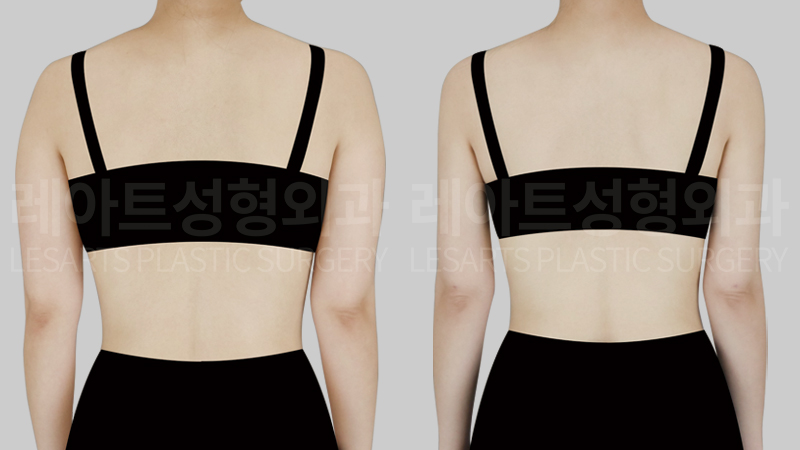
[Before and 3 Months After Revision Arm Liposuction: Back-View Changes in Posterior Upper Arm Bulging and Thickness]
The back view shows the change in the bulging
that had concerned the patient most even more clearly.
Before surgery, the backs of the upper arms
rounded outward, making the mid-upper arms appear wide.
Three months later, the reduced thickness in these areas
created a more consistent contour
from below the shoulders to the elbows.
Most importantly, avoiding excessive fat removal
kept the muscle boundaries from becoming overly pronounced,
creating a natural, straight contour
from the shoulders to the elbows. This was the aspect
the patient was most satisfied with.
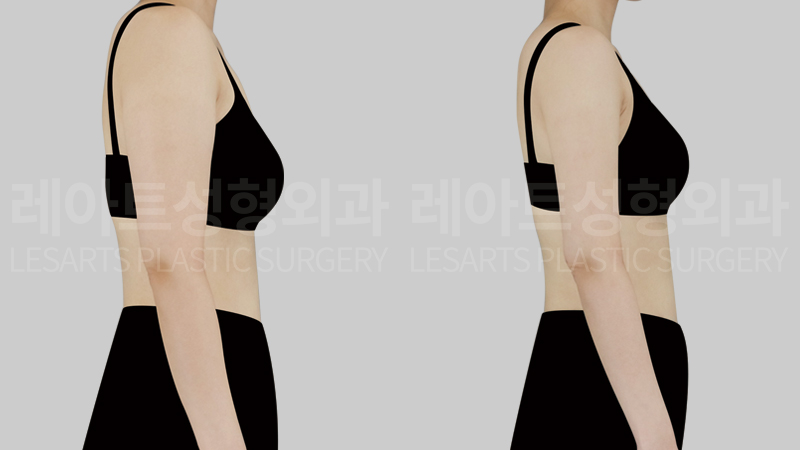
[3 Months After Revision Arm Liposuction: Side-View Changes in Posterior Upper Arm Bulging and Thickness]
The side view makes it easier to see
how much the thickness at the back of the upper arms changed.
Before surgery, there was a bulge
projecting backward from the mid-upper arms.
After revision surgery, this area was reduced,
naturally decreasing the arms' front-to-back thickness.
The arms became slimmer overall,
with smoother contours
that suited the patient's slender build.
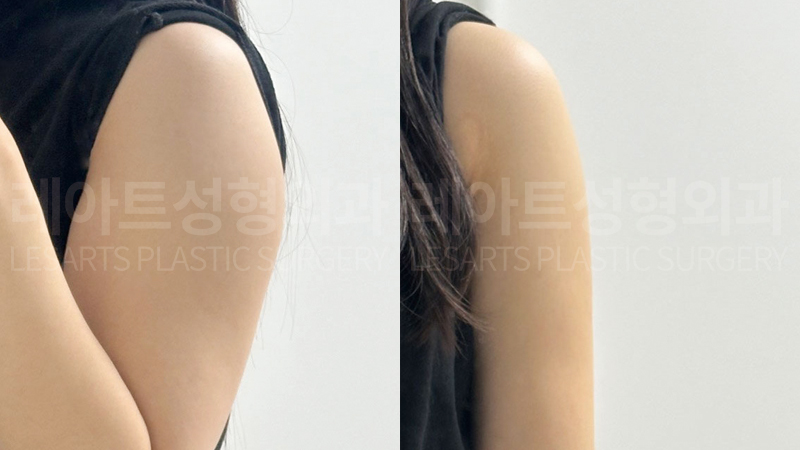
[Revision Arm Liposuction: Selfie Comparison Before and 2 Weeks After Surgery]
Two weeks after surgery is still an early stage of recovery,
when swelling and areas of tissue firmness may remain.
Even so, the photos taken in everyday settings show
that the outer upper arms were beginning to look less thick than before surgery.
Although it was too early to assess the final contours,
the bulging that remained after the first surgery was reduced,
making the arms appear to rest more naturally
alongside the torso.
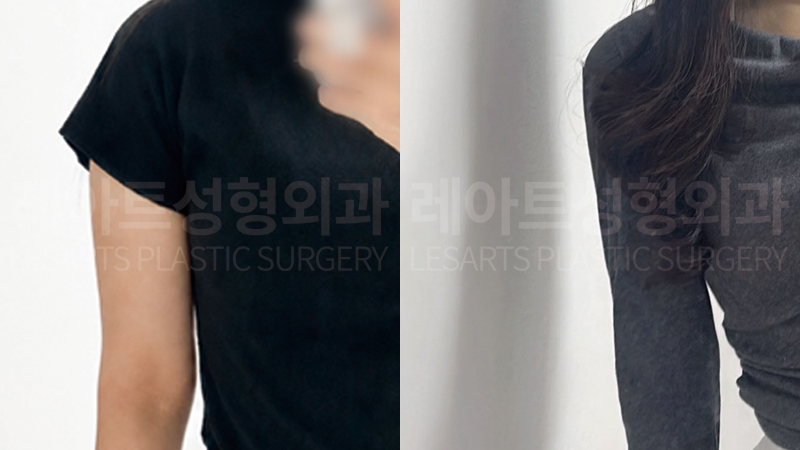
[Revision Arm Liposuction: Selfie Comparison Before and 5 Months After Surgery]
At 5 months, the arm contours had settled
into a more natural appearance.
The patient reported that after revision surgery,
the arms looked slimmer and smoother overall,
reducing concerns when getting dressed
and helping the patient feel more confident.
In particular, the patient shared that the arms looked noticeably different in sleeveless tops,
and that even when wearing clothes that covered the arms,
the entire upper body appeared more delicate—
a change the patient found both surprising and satisfying.
This patient had already undergone arm liposuction 7 years earlier,
but decided on revision surgery because the posterior upper arm bulging
and overall thickness had not decreased as much as desired.
Because the patient had a slim overall build
and only a limited amount of residual fat,
simply removing a large amount of fat again
would not have been enough to achieve the desired result.
Taking the thin skin, reduced elasticity,
and developed deltoid muscles into account,
we reduced the fat contributing to thickness at the back of the upper arms
while adjusting the amount removed to avoid making the muscles overly prominent.
Three months after revision surgery, the mid-upper arms,
which had previously appeared rounded and wide, were narrower. Both the back and side views
showed a naturally flowing contour from below the shoulders to the elbows,
closer to the straight arm shape the patient wanted.
The patient was pleased that the bulging that had remained
a long-standing concern after the first surgery was reduced,
and that the arms looked slimmer and smoother
in sleeveless clothing.
Revision arm liposuction should not be viewed
simply as another procedure to remove a large amount of remaining fat.
The contours created by the first surgery, the location of residual fat,
skin adhesions and elasticity, and the appearance of the muscles may all have changed,
requiring even more detailed assessment and surgical planning than the initial procedure.
The characteristics of the fatty tissue may also have changed following the first surgery,
so the procedure itself requires a more precise approach.
If bulging at the back of the upper arms remains after your first arm liposuction,
or you are still dissatisfied with the straightness of your arm contours,
rather than focusing only on “how much more fat can be removed,”
discuss which areas of your current arm contours
need to be addressed to bring you closer to your goals,
and develop a revision plan through a thorough consultation.
▶ View More Lesarts Arm Liposuction Cases
Revision Arm Liposuction FAQ
1. If fat remains after my first arm liposuction, can I simply have it removed again right away?
Revision surgery is not determined solely by the amount of remaining fat.
Existing contours, skin adhesions, elasticity, and muscle shape must all be assessed
to determine where additional liposuction is needed.
2. Can someone with a slim build undergo revision arm liposuction?
It may be considered if there is residual fat
and an area that can be improved.
However, when there is only a small amount of fat, it is especially important to control removal
so that the muscles or underlying skeletal contours do not become overly prominent.
3. Does poor skin elasticity make revision surgery more difficult?
If the skin is thin or has reduced elasticity,
the possibility of sagging or contour irregularities
after substantial fat removal must also be considered.
The amount removed may therefore need to be adjusted more precisely.
4. Do developed arm muscles make straight arm contours impossible?
The contours that can be achieved vary depending on muscle size,
but carefully deciding where to remove and preserve surrounding fat
can help minimize the prominence of muscle contours
while planning a straighter arm shape.
5. Can I see the results 3 months after revision arm liposuction?
By 3 months, much of the swelling has subsided,
allowing changes in overall arm thickness
and contour to be assessed.
As the tissues continue to settle afterward,
the arm shape may gradually become more natural.
#Liposuction
#Arm
#BMIbelow20(Arm)


Cases finding
similar to my profile
Customer Diagnostics


Select the surgery and
area you are interestedto see real
before andafter changes.


we
make you,
the art
Clinic hours
MON - FRI
10 am – 7pm
SAT
10 am – 4pm
Holiday
SUN, HOLIDAY
Location
Lesarts Moon Clinic Tower 4-5F, 40, Nonhyeon-ro 168-gil,
Gangnam-gu, Seoul, Republic of Korea

Medical institution name Lesarts Plastic Surgery
Address Lesarts Moon Clinic Tower 4-5F, 40, Nonhyeon-ro 168-gil, Gangnam-gu, Seoul, Republic of Korea
Representative Moon sung jun
