




Online Consultation
Please accurately enter the information below.
Quick Cost Consultation
Quick Consultation & Reservation
Cases finding
similar to my profile






Cases finding
similar to my profile
Customer Diagnostics
Gynecomastia With Chest Sagging: 3-Month Simon Grade 2B Male Chest Results | Best Gynecomastia Surgery Clinic in Gangnam, Seoul, Korea
2026-08-18
Male Gynecomastia Surgery | Simon Grade 2B With Chest Sagging: 3-Month Changes
If gynecomastia causes a large, sagging chest, will excess skin remain after surgery?
The surgical method for gynecomastia should be determined
by assessing not only chest size
but also the degree of skin sagging.
In particular, when sagging is present,
as in Simon Grade 2B or 3, it is important to plan surgery
and recovery care with consideration for the skin and creases
that may remain after glandular tissue and fat are removed.
▶ View Lesarts Male Gynecomastia Surgery Cases
[ Lesarts Gynecomastia Surgery Information ]
Some patients who visit the clinic for gynecomastia
say that not only the size of their protruding chest,
but also its downward-sagging appearance
causes them stress.
Especially when the chest sags, patients may worry
that a noticeable amount of excess skin will remain after surgery,
or that creases will form beneath the chest.
For this reason, assessing gynecomastia involves more than
checking the amount of glandular tissue and fat.
We also examine how enlarged the chest has become
and how much the skin is sagging.
One of the reference systems used for this assessment
is the Simon classification.
Simon Grades 2B and 3 describe chest enlargement
accompanied by skin sagging.
It is therefore important to explain the expected skin changes and aftercare
thoroughly before deciding on a treatment approach.
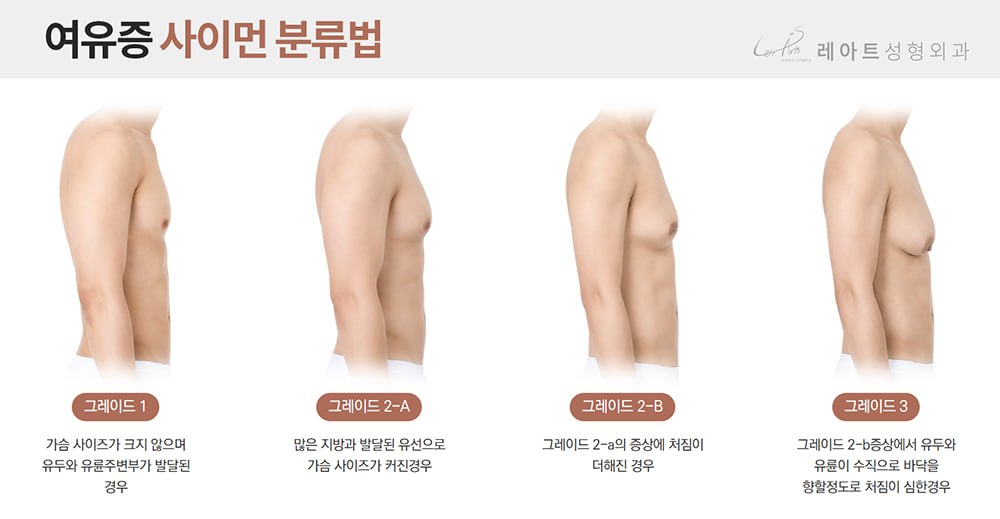
[Simon Classification of Gynecomastia - Lesarts Plastic Surgery]
The Simon classification categorizes gynecomastia
by considering both the degree of male chest enlargement
and the extent of skin sagging.
Unlike grades with little or no sagging, Grade 2B and above
require consideration not only of chest size
but also of the excess skin.
As the condition approaches Grade 3, chest enlargement and skin sagging may be more pronounced,
so surgical planning cannot simply end
with glandular tissue and fat removal.
For Grade 2B or 3 cases,
it is therefore necessary to anticipate how the skin will settle after surgery
and provide recovery care suited to those changes.

[Before Gynecomastia Surgery: Chest Protrusion With Skin Sagging]
This patient was in his 20s and had experienced
gynecomastia symptoms since his teenage years.
He had tried exercise and weight management,
but had not seen satisfactory changes in chest size or shape.
Recently, he had become more concerned because his areolas
also seemed larger and more raised.
He was also worried about the firm lumps
he could feel inside his chest.
[Patient Information]
Age Group: 20s
Height/Weight: 170 cm / 79 kg
Gynecomastia Diagnosis: Mixed-type gynecomastia (glandular tissue + fat), Simon Grade 2B
Skin Elasticity: Poor

[Simon Grade 2B Gynecomastia: Surgical Plan Considering Skin Sagging]
Before surgery, his chest was visibly enlarged overall,
and the skin sagged downward enough
to create deep folds beneath the chest.
Firm lumps could be felt on both sides during palpation,
and ultrasound examination confirmed enlarged
glandular tissue in those areas.
Based on his appearance, we assessed the condition
as true gynecomastia corresponding to Simon Grade 2B.
However, because the Simon classification evaluates
outward appearance,
the degree of enlargement and sagging was significant enough
that Grade 3 could also be considered, depending on the evaluator.
[Why a Chest Lift Was Not Performed Initially]
When sagging is this pronounced, a chest lift may be considered
to address the excess skin as well.
However, the patient was still young, in his 20s,
and we also needed to consider that a lift involving skin excision
would leave relatively long scars.
Rather than removing a broad area of skin from the outset,
we therefore decided to first remove the glandular tissue and use liposuction
to reduce overall chest volume,
then observe how the skin recovered.
If significant sagging remained afterward,
we planned to assess changes in skin elasticity and chest contour
before deciding whether further treatment
or surgery was needed.
In other words, rather than removing all sagging in a single procedure,
we took a staged approach, considering the patient's age,
concerns about scarring, and expected skin recovery
after surgery.
▶ View More Male Gynecomastia Surgery Before & After Cases

[3 Months After Gynecomastia Surgery: Front-View Changes in Chest Size and Skin Sagging]
Let's compare his front-view appearance before surgery and 3 months afterward.
Before surgery, the chest volume was large enough to look heavy even from the front,
with downward sagging and deep creases beneath the chest.
After surgery, as overall chest size decreased,
the previously heavy, forward-hanging contour became noticeably flatter.
The deep creases beneath the chest
also appear less pronounced than before.

[3 Months After Gynecomastia Surgery: Side-View Changes in Chest Protrusion and Sagging]
The side view shows the changes in chest protrusion
and the skin beneath the chest more clearly.
Before surgery, the chest projected significantly forward,
with the lower chest sagging into a deep fold.
Three months later, forward-projecting chest volume had decreased substantially,
and the previously sagging, folded lower chest contour
had become much smoother.

[3 Months After Gynecomastia Surgery: Oblique-View Changes in Chest Volume and Lower Chest Contour]
Because the patient's skin elasticity was poor,
how the remaining skin would settle after surgery
was an important consideration.
During recovery, we therefore used taping
to help the sagging skin adapt to the new chest shape.
With care aimed at helping the skin settle in a higher position,
the overall chest contour became more natural than before,
and the previously low-positioned nipples and areolas
also appear relatively higher.

[Gynecomastia With Skin Sagging: Side-View Changes in a T-Shirt 3 Months After Surgery]

[Simon Grade 2B Gynecomastia: Changes in Chest Contour Through a T-Shirt 3 Months After Surgery]
The photos in a T-shirt make it easier to see the chest changes
that address the patient's long-standing concerns since his teens.
Before surgery, his enlarged chest and protruding areolas
were clearly visible through thin T-shirts.
Three months after surgery, the flatter chest
allows him to wear more fitted clothing without
emphasizing the chest shape as before, revealing
a more natural upper body contour.
The patient also expressed satisfaction
with the reduction in self-consciousness and discomfort
he had experienced when wearing clothes.
[How Should the Remaining Skin Creases on the Left Be Assessed?]
Not all areas of sagging had improved equally within 3 months.
Some skin creases remained on the left side,
where sagging had been particularly pronounced before surgery.
There was a noticeable difference
between the two sides.
However, at 3 months after surgery, the skin
was still adapting to the new chest shape.
Because the remaining creases might
gradually improve over time, we decided to continue monitoring his progress.
Also, rather than automatically adding a chest lift, subsequent
pectoral muscle development through chest strength training could help fill out the remaining skin
naturally, potentially creating
a more balanced overall chest shape.
We explained these considerations to the patient
and emphasized the importance of ongoing body conditioning.
This patient had experienced gynecomastia since his teens
and was concerned not only about chest size and areolar protrusion
but also about the downward-sagging shape.
Examination confirmed mixed-type gynecomastia,
with both glandular tissue and fat on both sides, along with poor skin elasticity,
corresponding to Simon Grade 2B.
Based on the degree of sagging alone, a chest lift could have been considered,
but given the patient's age and the long scars that skin excision would leave,
we chose to first reduce chest volume through glandular tissue removal and liposuction
and then assess how the skin recovered.
Three months after surgery, the previously heavy, protruding chest
had become flatter, and the deep folds
beneath the chest were noticeably less pronounced.
Even with poor skin elasticity, post-operative
taping care was used alongside recovery,
and the nipples and areolas settled in a relatively higher position,
with a more natural upper body contour
visible even when wearing a T-shirt.
However, some creases remained
on the left side, where the original sagging was more severe,
and we are currently monitoring further recovery.
For gynecomastia accompanied by skin sagging,
such as Simon Grade 2B or 3, planning should involve more
than simply deciding how much glandular tissue and fat to remove.
It is important to assess how much skin may remain after surgery,
whether skin excision is needed from the outset,
or whether chest volume can first be reduced
and the recovery monitored before deciding on further treatment.
If you are considering gynecomastia surgery because of chest size, lower chest sagging, or deep creases,
have an accurate examination and consultation
to assess your Simon grade and skin elasticity,
and discuss the surgical method suited to you
along with a thorough plan for recovery and ongoing care.
▶ View More Lesarts Male Gynecomastia Surgery Cases
Simon Grade 2B Gynecomastia FAQ
1. What is Simon Grade 2B gynecomastia?
It describes chest enlargement accompanied by skin sagging.
Surgery should be planned with consideration for the skin
that may remain after glandular tissue and fat are removed.
2. Does Simon Grade 2B always require a chest lift?
Not in every case.
Depending on age, skin elasticity, the degree of sagging, and concerns
about long scars, gynecomastia surgery may be performed first,
followed by observation of how the skin changes.
3. Can sagging skin shrink after gynecomastia surgery?
This varies depending on skin elasticity, age, and other factors.
As the skin adapts to the new shape after chest volume is reduced,
some sagging and creases may improve.
4. Why is taping used after gynecomastia surgery?
For a sagging chest, taping may be used
as a post-operative care method to help the skin settle
into the new chest shape.
5. Will creases remaining 3 months after surgery stay the same?
At 3 months, recovery is still ongoing.
Remaining skin creases may improve further
over time,
and continued follow-up can help determine
whether additional treatment is needed.
#Male body contouring
#Gynecomastia
#Grade2-B #true gynecomastia


Cases finding
similar to my profile
Customer Diagnostics


Select the surgery and
area you are interestedto see real
before andafter changes.


we
make you,
the art
Clinic hours
MON - FRI
10 am – 7pm
SAT
10 am – 4pm
Holiday
SUN, HOLIDAY
Location
Lesarts Moon Clinic Tower 4-5F, 40, Nonhyeon-ro 168-gil,
Gangnam-gu, Seoul, Republic of Korea

Medical institution name Lesarts Plastic Surgery
Address Lesarts Moon Clinic Tower 4-5F, 40, Nonhyeon-ro 168-gil, Gangnam-gu, Seoul, Republic of Korea
Representative Moon sung jun
