




Online Consultation
Please accurately enter the information below.
Quick Cost Consultation
Quick Consultation & Reservation
Cases finding
similar to my profile






Cases finding
similar to my profile
Customer Diagnostics
Thigh Liposuction for Inner Thigh Gap and Scar Pigmentation Concerns: 3-Month Straight Leg Results | Best Liposuction Clinic in Gangnam, Seoul, Korea
2026-08-31
Thigh Liposuction | Worried About Scars & Pigmentation? 3-Month Straight Leg Transformation
Will significant scars or pigmentation remain after thigh liposuction?
Even when the same area is operated on, scars and pigmentation at the incision sites after liposuction
can vary in visibility and recovery progress depending on
skin tone and skin characteristics.
Therefore, before surgery, we examine not only fat distribution but also skin condition together,
and when needed, we also consider aftercare such as laser toning
after recovery.
▶ Learn About Lesarts Thigh Liposuction
When considering thigh liposuction, something that concerns patients just as much as
how much their leg line can improve
is post-operative scarring and pigmentation.
In particular, even when operating on the same area,
depending on skin tone or skin characteristics, the degree of remaining discoloration
at incision sites and recovery speed can differ.
Therefore, before surgery, it is necessary not only to check where fat
is concentrated, but also to examine skin condition,
the possibility of scarring and pigmentation,
and any aftercare needed afterward.
This patient wanted to reduce inner thigh thickness
and achieve a straight-leg transformation.
However, when checking her skin tone before surgery, this was also a case where
the possibility of incision scarring and pigmentation had to be considered together.
Let's look step by step from her pre-operative leg shape to her 3-month changes,
as well as aftercare tailored to her skin characteristics.
 [Pre-Operative Leg Line Analysis Before Thigh Liposuction]
Patient Information
Age: 24
Height: 162 cm
Weight: 52.7 kg
BMI: 20.1
※ Even with similar physical conditions, liposuction results may vary
by individual depending on fat distribution
and muscle shape.
Looking at her pre-operative condition, her inner thighs pressed together,
and with prominent saddlebags on the outer sides,
upper thigh thickness and curves stood out.
There was plenty of fat that could be refined in her inner thighs and saddlebags.
On the other hand, because her front thighs had a developed rectus femoris muscle,
we had to consider that even after reducing fat,
there would be some limits to how much the front contour could change.
Additionally, on her left inner thigh, there was a slightly indented
contour already present before surgery.
Because aggressively removing fat in this spot could make the existing indentation
even more noticeable, it was important to delicately refine the surrounding fat
so that the current unevenness would not stand out.
Checking the Possibility of Scarring and Pigmentation Based on Skin Tone
For this patient, we carefully examined not only fat distribution,
but also her skin condition before surgery.
Due to the characteristics of her skin tone, scarring or pigmentation
at the liposuction incision sites had a higher chance of being noticeable
compared to other skin tones.
Therefore, we explained this possibility in advance and also advised that
if discoloration remained after a certain period of post-operative recovery,
aftercare such as laser toning
might be needed.
In other words, in this surgery, we set the surgical direction by considering not only
reducing thigh thickness, but also existing leg contours, muscle shape,
and skin characteristics together.
▶ View More Thigh Liposuction Before & After Cases
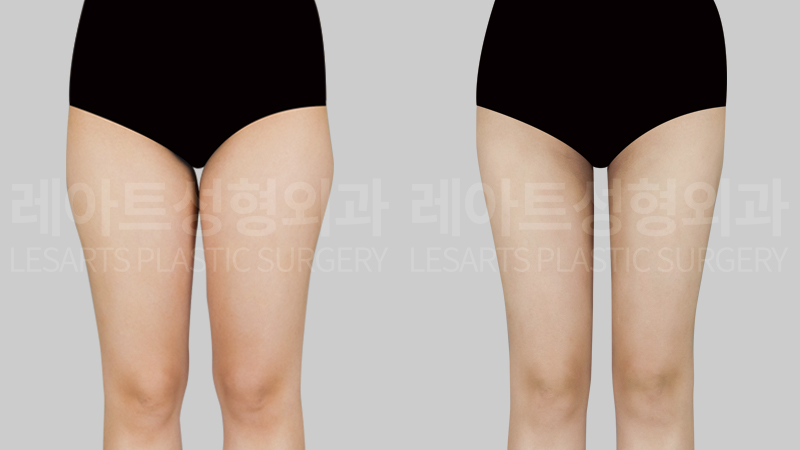
[Before & 3 Months After Thigh Liposuction: Front-View Inner Thigh Gap and Straight Line Changes]
Let's compare her appearance before surgery and 3 months after.
Before surgery, both inner thighs pressed together,
but after surgery, as volume in that area decreased,
you can see a clear gap formed between her thighs.
The previously rounded inner line
was also refined straighter than before,
bringing her closer to the straight-leg shape she desired.
In particular, you can also see how surrounding fat was carefully adjusted
so that the uneven contour present on her left inner thigh before surgery
would not become more prominent.
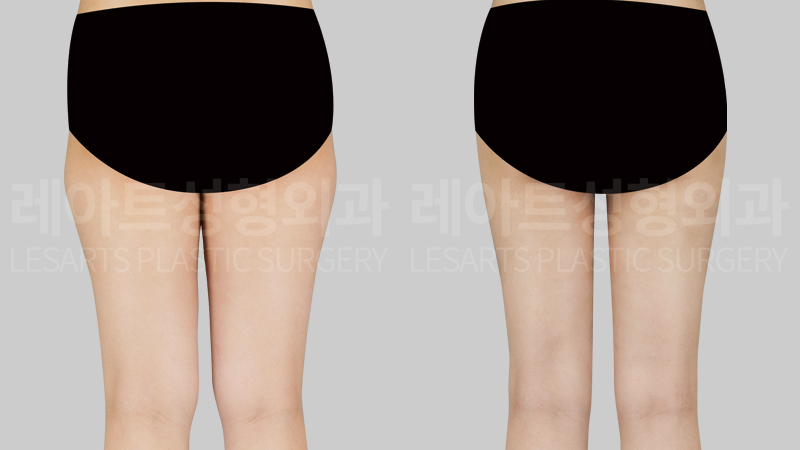
[Before & 3 Months After Thigh Liposuction: Back-View Inner and Outer Thigh Line Changes]
On the outer sides, as the volume of the previously prominent saddlebags decreased,
the line flowing down from the hips to the thighs
was refined more naturally than before.
When saddlebags protrude significantly, the hips are not clearly revealed,
which can make the legs feel
relatively short.
For this patient as well, protruding saddlebags hid the shape
of her hips and made her lower body
feel shorter.
After surgery, by reducing saddlebag volume so the hips appear as the starting point of the legs,
thigh circumference and width decreased,
bringing a noticeable change to her overall lower body proportions.
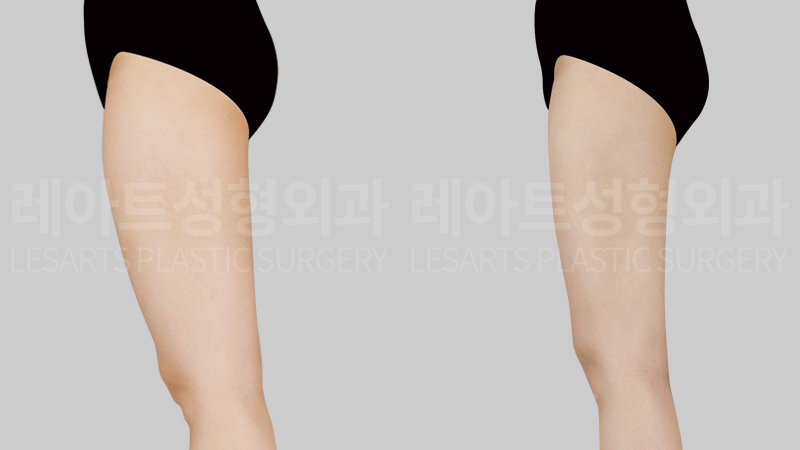
[3 Months After Thigh Liposuction: Side-View Front Thigh Volume and Leg Line Changes]
As mentioned earlier, the patient had a body type
with a developed rectus femoris muscle on her front thighs.
Therefore, rather than unconditionally removing a large amount of fat on the front thighs,
we focused on smoothly refining and naturally connecting the contour
considering her existing muscle shape.
Three months later, as the bulky protrusion of her front thighs decreased,
you can see the line flowing down to her knees
refined much more naturally than before.
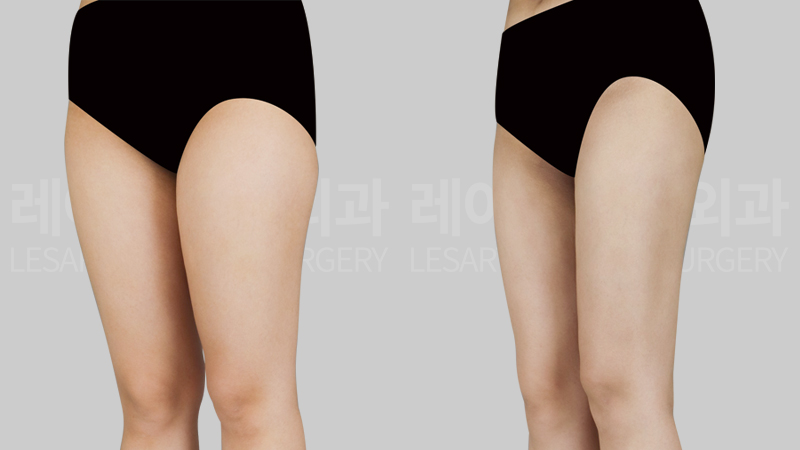
[3 Months After Thigh Liposuction: Oblique-View Saddlebag and Thigh Thickness Changes]
From the oblique view, the changes on the outer thighs stand out even more clearly.
As the previously outward-protruding saddlebag area was contoured three-dimensionally,
you can see the hip line and thighs connecting
much more smoothly.
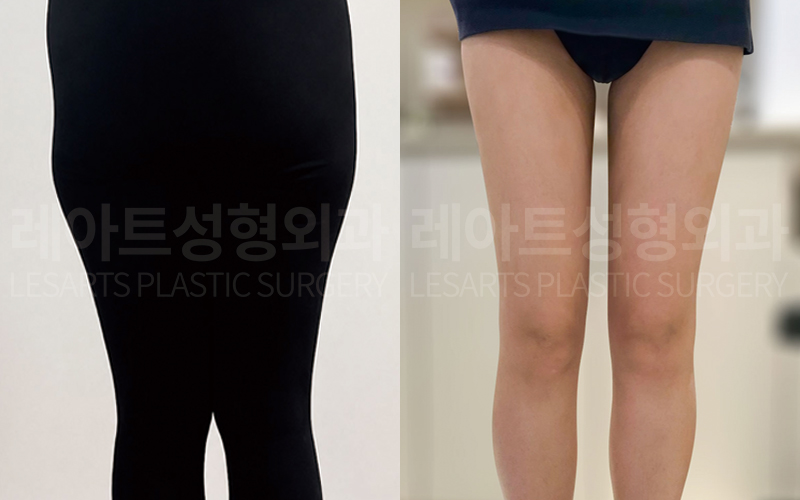
[Selfie Comparison: Before vs. 2 Months After Surgery]
Even in everyday photos taken directly by the patient,
you can clearly see the reduced thickness
of her inner thighs.
Whereas her inner thighs looked pressed together even while dressed before surgery,
two months later, as inner volume became lighter,
her leg line feels much straighter
than before.
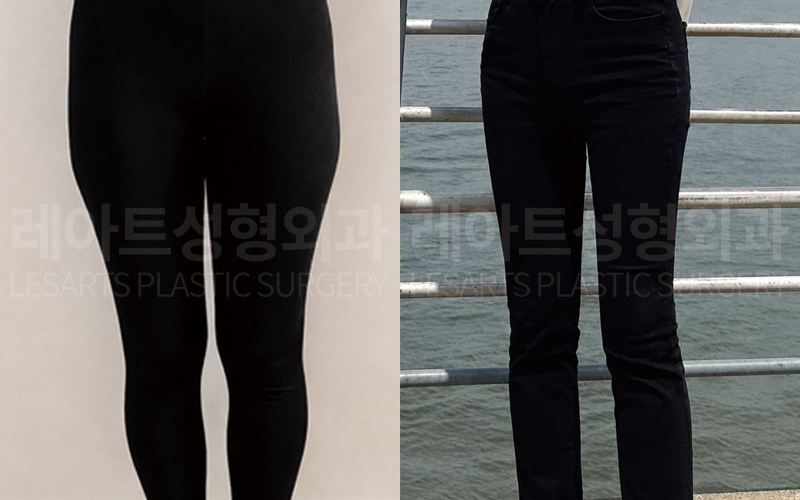
[Selfie Comparison: Before vs. 7 Months After Surgery]
The patient was also very satisfied that her inner thighs
and saddlebags—which had bothered her most—
were cleanly refined after liposuction.
A gap formed between her previously touching thighs,
and her overall leg line
became slimmer and straighter than before.
In particular, she left a review sharing her satisfaction that as thigh thickness decreased,
she was able to wear a wider variety of clothing styles than before
and had much more freedom
in choosing her everyday outfits.
To reduce thigh thickness while creating natural straight legs,
you should not think solely about removing a large amount of fat.
As with this patient, even when there is sufficient fat to refine in the inner thighs
and saddlebags, if front thigh muscles are developed
or certain spots are already indented,
the approach must differ for each area.
It is important to build a surgical plan that considers where fat is concentrated,
muscle shape, and existing leg contours
all together.
Furthermore, depending on skin tone and skin characteristics, the visibility of scarring
or pigmentation at liposuction incision sites can vary.
Therefore, after surgery, it is necessary to continue consistent aftercare
suited to your current skin condition
while monitoring recovery progress.
For this patient as well, we checked and explained this possibility
before surgery, and advised that if needed,
treatments such as laser toning could be considered
after a certain period of recovery.
Ultimately, rather than planning thigh liposuction based only on fat volume,
it is important to examine current leg shape, muscles,
and skin condition together to distinguish between areas to reduce
and areas requiring special care.
▶ View More Lesarts Thigh Liposuction Cases
Thigh Liposuction Q&A
Q1. Do scars and pigmentation after thigh liposuction look similar for everyone?
No, they do not. Depending on skin tone and skin characteristics,
the degree of discoloration remaining at incision sites and the recovery process
can differ.
Therefore, it is important to check skin condition together
before surgery.
Q2. How is pigmentation on liposuction scars managed?
If noticeable discoloration remains at incision sites
during recovery, aftercare such as laser toning
may be needed after checking
the skin condition.
The timing of care is decided according to recovery progress.
Q3. Can removing inner thigh fat create a gap between the thighs?
For this patient, as inner thigh volume that had pressed together before surgery
decreased, a gap formed between her thighs
3 months later.
However, the degree of change can vary depending on
fat volume, bone structure, and muscle shape.
Q4. Can liposuction create straight legs even if front thigh muscles are developed?
Because muscle size itself cannot be reduced with liposuction,
there may be limits to how much the front contour changes.
For this patient, considering her developed muscles,
we performed surgery to reduce front thigh protrusion and connect smoothly
down to the knees.
Q5. Does removing more fat in thigh liposuction always make the leg line better?
Not necessarily. Aggressively removing fat even from already indented areas
can make unevenness stand out more.
It is important to check where fat is concentrated, muscle shape,
and existing leg contours together to adjust suction volume
for each area.
#Liposuction
#Thigh
#BMIbelow30(thigh)


Cases finding
similar to my profile
Customer Diagnostics


Select the surgery and
area you are interestedto see real
before andafter changes.


we
make you,
the art
Clinic hours
MON - FRI
10 am – 7pm
SAT
10 am – 4pm
Holiday
SUN, HOLIDAY
Location
Lesarts Moon Clinic Tower 4-5F, 40, Nonhyeon-ro 168-gil,
Gangnam-gu, Seoul, Republic of Korea

Medical institution name Lesarts Plastic Surgery
Address Lesarts Moon Clinic Tower 4-5F, 40, Nonhyeon-ro 168-gil, Gangnam-gu, Seoul, Republic of Korea
Representative Moon sung jun
