




Online Consultation
Please accurately enter the information below.
Quick Cost Consultation
Quick Consultation & Reservation
Cases finding
similar to my profile






Cases finding
similar to my profile
Customer Diagnostics
Postpartum Lower Belly Fold: Mini Tummy Tuck or Full Tummy Tuck? 3-Month Results | Best Tummy Tuck Clinic in Gangnam, Seoul, Korea
2026-09-01
Tummy Tuck | Postpartum Lower Belly Folding: Is a Mini Tummy Tuck Alone Enough?
If only my lower belly looks folded, is a mini tummy tuck enough?
Even if skin sagging appears limited to the lower abdomen on the outside,
stretched skin may actually be descending from the upper abdomen,
or diastasis recti may also be present.
Therefore, rather than deciding the surgical scope based only on the shape of the lower belly,
it is important to examine upper and lower abdominal skin, the abdominal wall, and fat distribution together
to determine the necessary scope of correction.
▶ View Lesarts Tummy Tuck Cases
Abdominal skin and the abdominal wall that stretched significantly
during pregnancy may not recover fully
to their previous state even if weight decreases
after childbirth.
As a result, changes such as lower belly skin folding
or forward abdominal protrusion may remain.
In such cases, many people first assume remaining postpartum belly fat is the cause
and focus on losing weight or doing abdominal exercises.
However, problems involving stretched skin itself or a relaxed abdominal wall
can be difficult to improve as much as desired
simply by reducing body fat.
In particular, even if sagging looks concentrated only in the lower belly
from the outside and you consider a mini tummy tuck,
there are cases where correction is actually needed starting from the upper abdomen.
This patient also had deep lower belly folding after three C-section deliveries,
but during her physical exam, changes in her upper abdominal skin
and abdominal wall were also confirmed.
 [Lower Belly Folding After Three Deliveries: Condition Before Tummy Tuck]
This patient was a woman in her 40s who had been concerned about
overall abdominal sagging and lower belly folding
after three C-section deliveries.
Looking at her pre-operative condition, subcutaneous fat was distributed
across her entire abdomen, and as stretched skin gathered
in the lower abdomen below the belly button,
her lower belly folded
and sagged downward.
Especially when she bent forward, the excess skin
overlapped even more noticeably.
This was a condition accompanied by skin sagging that would be difficult to refine
simply by reducing abdominal fat volume alone.
 [Before Tummy Tuck: Surgical Plan Considering Lower Abdominal Sagging and Diastasis Recti]
The patient's most noticeable concern
was the deep, wide fold in her lower abdomen.
However, during the actual physical exam,
it was not just a lower belly issue.
As skin sagged downward starting from the upper abdomen,
her belly button position had also dropped lower,
and in the upper abdomen, forward pushing of the abdominal wall
due to diastasis recti was also confirmed.
In other words, this patient had:
1. Subcutaneous Fat Distributed Across the Entire Abdomen
Sufficient fat remained across the entire abdomen,
contributing together with skin sagging
to the volume of the front abdomen.
2. Skin Sagging Continuing from the Upper Abdomen
Although the lower abdominal fold looked largest on the outside,
skin was actually stretched and descending downward
starting from the upper abdomen.
3. Abdominal Wall Changes Due to Diastasis Recti
The rectus muscles were separated including in the upper abdomen,
and forward pushing of the abdominal wall caused by this
was also confirmed.
Therefore, rather than a mini tummy tuck
that only briefly refines lower belly skin,
we diagnosed her as needing a full tummy tuck,
liposuction, and rectus muscle repair together.
▶ View More Tummy Tuck Before & After Cases

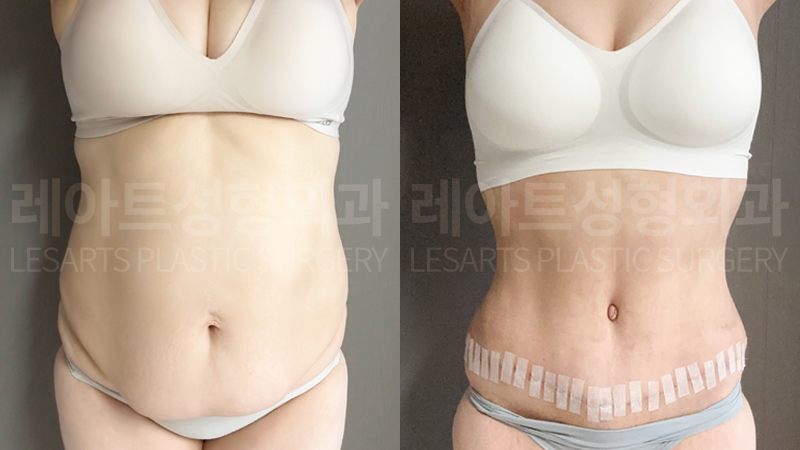
[3 Months After Tummy Tuck: Front-View Changes in Lower Abdominal Folding and Waistline]
Let's look at her before-and-after changes and recovery status
through photos taken 3 months after surgery.
Before surgery, stretched skin in the lower abdomen
was folded widely and deeply.
Three months later, with that skin removed, lower belly folding has decreased
and you can see the front abdomen flowing smoothly.
Abdominal volume that had pushed forward due to the abdominal wall and fat
also decreased, and as abdominal circumference reduced,
her waistline emerged more naturally than before.
[Lowering of the Belly Button Position Also Corrected]
Her belly button, which had dropped lower as upper abdominal skin sagged,
was also recreated during the surgery.
Considering the height of the patient's waistline, we reconstructed it into a vertical belly button
so it sits naturally and securely in the center of her abdomen.
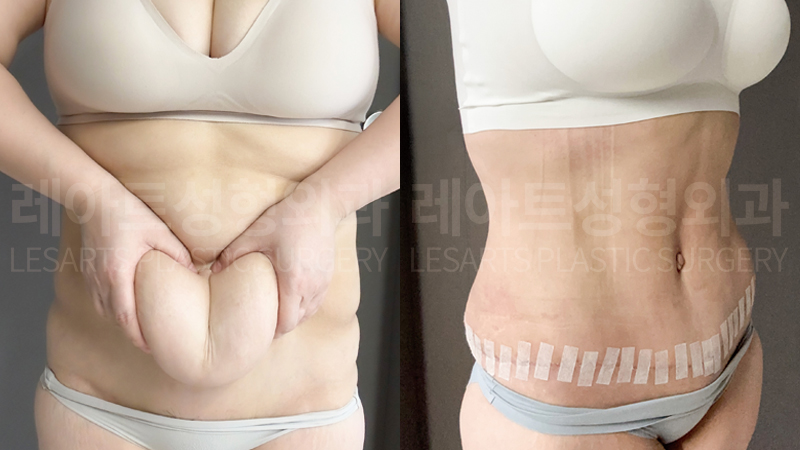
 [3 Months After Tummy Tuck: Oblique-View Changes in Front Abdominal Protrusion and Lower Belly]
From the oblique view, you can see that abdominal volume
that had projected forward before surgery has decreased.
Not only the lower abdominal folding seen from the front,
but also the forward-protruding abdominal volume
decreased together, transforming the overall shape of her front abdomen.
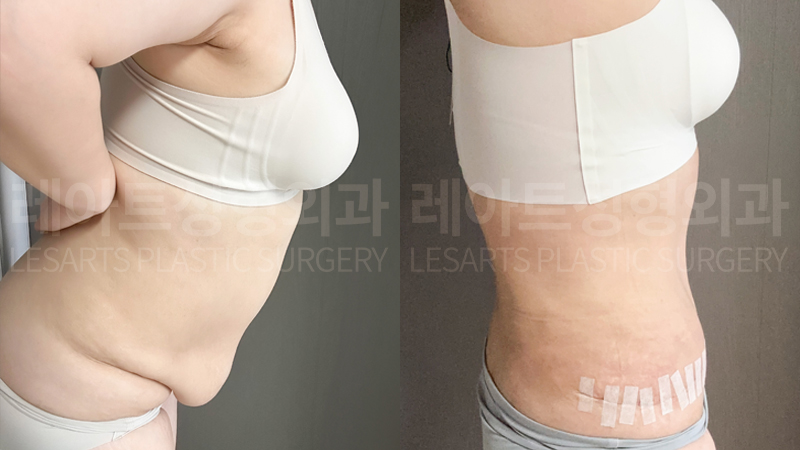
 [3 Months After Tummy Tuck: Side-View Changes in Front Abdominal Protrusion and Lower Belly Sagging]
From the side view, both the forward-protruding front abdomen
and the lower belly skin folding over the underwear waistband
were visible before surgery.
Three months later, with this excess skin refined,
you can see the front abdomen flowing
much more flatly than before.
 [3 Months After Tummy Tuck: Changes in Lower Abdominal Skin Sagging and Folding When Bending Forward]
Before surgery, when bending forward, excess skin
gathered downward, making folding appear even larger.
Three months later, with stretched skin refined
and diastasis recti repaired together, you can see that abdominal wall support
is maintained even when bending forward.
 [3 Months After Tummy Tuck: Lower Abdominal Incision Scar Healing Status]
Because a tummy tuck removes a sufficient amount of stretched skin,
a long incision line remains on the lower abdomen.
This patient also had a long scar, but it was positioned
where it is well covered when wearing underwear,
and because she felt such a big improvement in her abdomen after surgery,
she was not overly concerned about
the current pace of scar healing.
Because it is still the 3-month post-operative mark,
redness along the scar remains relatively noticeable.
Since this is the stage when full-scale scar aftercare begins,
it is necessary to continue consistent care suited to the scar condition
while monitoring progress going forward.
[Before Tummy Tuck and 1-Month Recovery Progress]
#Abdominoplasty
#L-type


Cases finding
similar to my profile
Customer Diagnostics


Select the surgery and
area you are interestedto see real
before andafter changes.


we
make you,
the art
Clinic hours
MON - FRI
10 am – 7pm
SAT
10 am – 4pm
Holiday
SUN, HOLIDAY
Location
Lesarts Moon Clinic Tower 4-5F, 40, Nonhyeon-ro 168-gil,
Gangnam-gu, Seoul, Republic of Korea

Medical institution name Lesarts Plastic Surgery
Address Lesarts Moon Clinic Tower 4-5F, 40, Nonhyeon-ro 168-gil, Gangnam-gu, Seoul, Republic of Korea
Representative Moon sung jun
