




Online Consultation
Please accurately enter the information below.
Quick Cost Consultation
Quick Consultation & Reservation
Cases finding
similar to my profile






Cases finding
similar to my profile
Customer Diagnostics
Tummy Tuck in the 50s After C-Section: 5-Month Lower Belly Sagging and Scar Results | Best Tummy Tuck Clinic in Gangnam, Seoul, Korea
2026-09-23
Tummy Tuck in Your 50s | Postpartum Lower Belly Sagging: 5-Month Changes After an M-type Full Tummy Tuck
Before & After M-type Full Tummy Tuck in the 50s for Long-Standing Postpartum Lower Belly Sagging
Q. Even if a long time has passed since childbirth and I am now in my 50s,
can I consider a tummy tuck if my lower belly sagging is severe?
A. Eligibility for surgery and its scope are not decided by age alone.
Current health status, the extent of stretched upper and lower abdominal skin,
and whether diastasis recti is present must all be checked together.
For this patient, after two C-section deliveries,
decreased skin elasticity from the upper to lower abdomen
and diastasis recti were confirmed, so we planned an M-type full tummy tuck
and abdominal liposuction.
[ Learn More About Lesarts Tummy Tuck Cases ]
As a long time passes after childbirth,
lower belly sagging deepens and skin aging adds to it,
leading many middle-aged patients to worry about a loose, stretched abdominal line.
Even without major weight changes,
some look into a tummy tuck because stretched skin sags downward or folds,
making the abdomen itself feel heavy.
This patient was also a woman in her 50s who visited us to improve
remaining lower abdominal sagging and an uneven abdominal contour
after two C-section deliveries.
 [Before Tummy Tuck: Assessment of Lower Abdominal Skin Sagging and Abdominal Wall Condition]
[Patient Information]
Age: 50s
Pre-Op Measurements: 164 cm / 56.8 kg / BMI 21.1
Procedures: M-type tummy tuck, abdominal liposuction
History: Two C-section deliveries
Looking at her condition confirmed during the pre-op consultation,
the skin below her belly button was sagging,
making her lower abdomen stand out heavily forward.
In particular, when bending forward,
both the skin and abdominal wall pushed downward unevenly from the upper abdomen,
making her decreased abdominal elasticity even more apparent.
This was not simply a matter of stretched skin alone.
Weakened support of the abdominal wall due to diastasis recti
was also contributing together.
Although the patient initially thought only her lower abdominal skin was sagging,
in reality, skin that had lost elasticity starting from the upper abdomen was pushing downward,
creating a deep fold in the lower abdomen.
As upper abdominal skin descended, her belly button was also pressed down,
changing from a round shape into an inverted V shape.
In addition, diastasis recti was confirmed across both
the upper and lower abdomen.
Therefore, rather than limited correction of only the lower abdomen,
we explained the need for an M-type full tummy tuck
to address both upper and lower abdominal skin and the abdominal wall together.
We also decided to perform abdominal liposuction together
to reduce step-offs with surrounding areas after the lift
and refine the overall abdominal contour.

[5 Months After Tummy Tuck in the 50s: Front-View Changes in Lower Abdominal Sagging and Belly Button Line]
Let's compare her appearance before the tummy tuck and 5 months after.
Before surgery, the front abdomen pushed forward unevenly,
but after surgery, as the loose skin was tightened,
you can see the front abdominal contour
flowing smoothly.
Lower abdominal skin sagging and protrusion—the patient's biggest concerns—also decreased.
The forward pushing starting from the upper abdomen
due to weakened abdominal wall support,
and the central abdomen that had spread loosely to the sides,
showed clear improvement as diastasis recti was repaired together.
Through combined abdominal liposuction, volume in the waist and flanks was also refined,
bringing out the curve flowing from the abdomen to the waist.
The shape of her belly button also changed.
Before surgery, skin descending from the upper abdomen pressed on her belly button,
making it appear in an inverted V shape.
During the tummy tuck, the belly button was corrected together
and repositioned into a vertically oriented shape.

[5 Months After Tummy Tuck in a Patient in Her 50s: Oblique-View Changes in Lower Belly Protrusion and Skin Folding]
When compared from an oblique angle,
you can see that the lower belly—which had sagged downward and protruded forward before surgery—
has been refined after surgery.
As the skin descending from the upper abdomen
and the central abdomen that had looked spread out due to abdominal wall laxity
were corrected together,
the front abdomen flows flatter than before
and volume in the waist and flanks has also decreased.

[5 Months After Tummy Tuck in the 50s: Side-View Changes in Lower Abdominal Protrusion and Abdominal Line]
From the side view,
how the lower abdominal skin had protruded forward
and overlapped above her underwear line before surgery is even more clearly visible.
In the surgery, we removed excess loose skin
and also performed diastasis recti repair
to restore support to the forward-protruding abdominal wall.
As a result, you can see that the front abdomen, which used to sag downward and push forward with movement,
has been smoothed out.

[5 Months After Middle-Aged Tummy Tuck: Changes in Lower Abdominal Folding When Bending Forward]
Before surgery, when bending forward,
loose skin pushed downward from the upper abdomen,
creating a deep fold in the lower abdomen.
This was not solely a lower abdominal issue as the patient had thought,
but a condition influenced together by decreased upper abdominal skin elasticity
and abdominal wall laxity.
After surgery, with the loose skin removed
and diastasis recti repaired together,
the heavy downward piling of abdominal skin
when bending forward has been reduced.

[5 Months After Middle-Aged Tummy Tuck: Incision Line Along the Panty Line and Lower Abdominal Folding Changes]
It has now been 5 months since surgery.
The tummy tuck incision site is going through the recovery process,
and she is currently continuing care with laser toning
to help the scar fade.
The patient shared that because the incision line is positioned where it is well covered
when wearing underwear in daily life,
it does not bother her much.
She also left a review saying she plans to continue scar care
patiently going forward.
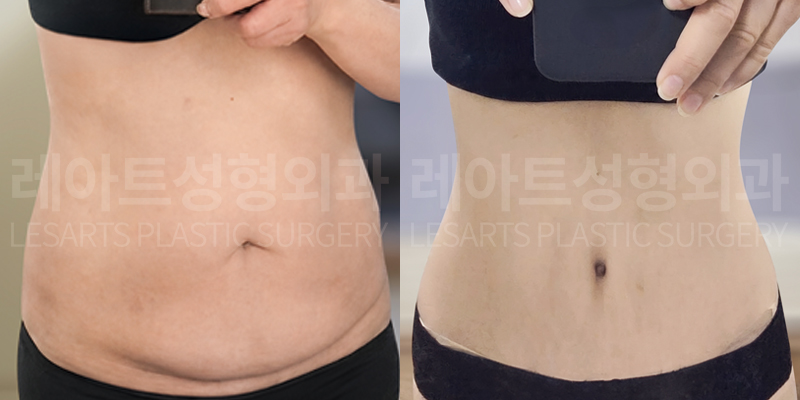
[Comparison of Patient's Self-Taken Photos: Before vs. 3 Months After Surgery]
Even in photos taken by the patient herself,
Even if a long time has passed after childbirth
and lower belly sagging or skin changes remain,
there is no need to assume a tummy tuck is difficult based on age alone.
What matters in a tummy tuck in your 50s—more than age itself—
is accurately checking your current health status, how far skin sagging extends,
and the degree of rectus muscle separation.
Like this patient, even if only the lower abdomen looks saggy on the outside,
loose skin may actually be descending from the upper abdomen
or diastasis recti may also be present together.
Therefore, rather than deciding the surgical scope based only on the visible lower belly,
it is important to check upper and lower abdominal skin condition, abdominal wall support, belly button shape,
and surrounding fat together to determine
the necessary range of correction.
If you accurately diagnose your current abdominal condition, plan the surgical scope suited to you,
and continue with follow-up monitoring and scar care afterward,
you can steadily see your recovery progress and changes.
If you are concerned about lower belly sagging or abdominal skin folding
that remains even long after childbirth,
we recommend checking your current skin and rectus muscle condition first
and consulting on the surgical method suited to your abdomen.
[ View More Lesarts Tummy Tuck Cases ]
Tummy Tuck in Your 50s FAQ
Q1. Can I still get a tummy tuck in my 50s?
Eligibility for surgery is not decided by age alone.
Current health status, the extent of skin sagging, and the condition of the rectus muscles are checked
to determine eligibility and the necessary scope.
Q2. Can a full tummy tuck be needed even if only the lower abdomen looks saggy?
Even if only the lower belly looks saggy externally,
stretched skin from the upper abdomen may be pushing downward
and creating a lower abdominal fold.
Upper and lower abdominal skin and abdominal wall condition must be checked together.
Q3. Does diastasis recti also affect the shape of the abdomen?
When the rectus muscles separate and abdominal wall support weakens,
the abdomen can push forward or the central area can look spread wide.
If needed, diastasis recti repair can be planned together with a tummy tuck.
Q4. Where does the tummy tuck scar remain?
The tummy tuck incision line is generally located in the lower abdomen,
and its length can vary depending on the surgical scope and amount of skin to be removed.
In this case, the incision line remained in a position
covered when wearing underwear.
Q5. Does a tummy tuck scar fade completely after 5 months?
Five months is a stage when the scar is still healing and changing.
The pace varies depending on skin condition and individual scar healing characteristics,
and care such as laser treatments can be combined if needed.
#Abdominoplasty
#M-type


Cases finding
similar to my profile
Customer Diagnostics


Select the surgery and
area you are interestedto see real
before andafter changes.


we
make you,
the art
Clinic hours
MON - FRI
10 am – 7pm
SAT
10 am – 4pm
Holiday
SUN, HOLIDAY
Location
Lesarts Moon Clinic Tower 4-5F, 40, Nonhyeon-ro 168-gil,
Gangnam-gu, Seoul, Republic of Korea

Medical institution name Lesarts Plastic Surgery
Address Lesarts Moon Clinic Tower 4-5F, 40, Nonhyeon-ro 168-gil, Gangnam-gu, Seoul, Republic of Korea
Representative Moon sung jun
