




Online Consultation
Please accurately enter the information below.
Quick Cost Consultation
Quick Consultation & Reservation
Cases finding
similar to my profile






Cases finding
similar to my profile
Customer Diagnostics
Male Chest Still Protruding After Weight Loss? 2-Week Gynecomastia Surgery Results | Best Gynecomastia Surgery Clinic in Gangnam, Seoul, Korea
2026-09-23
Male Gynecomastia Surgery | Chest Protrusion Remaining After Weight Loss:
2-Week Before & After T-Shirt Fit Changes
Male Chest Protrusion: If It Stays the Same Even After Losing Weight,
Is It Gynecomastia? 2-Week Before & After Surgery Changes
Q. If my chest alone stays the same even after losing weight and exercising, could it be gynecomastia?
A. While weight loss can reduce subcutaneous fat around the chest,
if the main cause of chest protrusion is overgrown glandular tissue,
it may be difficult to expect a change in size
through exercise or dieting alone.
In such cases, after checking glandular tissue development and
fat distribution through an ultrasound exam,
the necessary surgical scope—such as glandular removal and liposuction—is determined.
[ View More Lesarts Real Gynecomastia Surgery Cases ]
[ Lesarts Gynecomastia Surgery Information ]

[Before & After Male Gynecomastia Surgery: Changes in Chest Protrusion Visible Under a T-Shirt - Lesarts Plastic Surgery]
Among patients who visit for gynecomastia surgery,
many say, “No matter how much weight I lost and how hard I exercised, my chest never got smaller.”
.
When dieting succeeds, subcutaneous fat distributed
around the chest can also decrease together.
However, if the main cause of forward chest protrusion is overgrowth of glandular tissue,
losing weight alone may not sufficiently change chest size.
Therefore, if gynecomastia is suspected, it is necessary to first check
how much glandular tissue is currently developed through an ultrasound exam.
Based on the exam results, it is important to confirm whether glandular tissue needs to be removed
and whether surrounding liposuction is also needed,
and then establish a surgical plan.
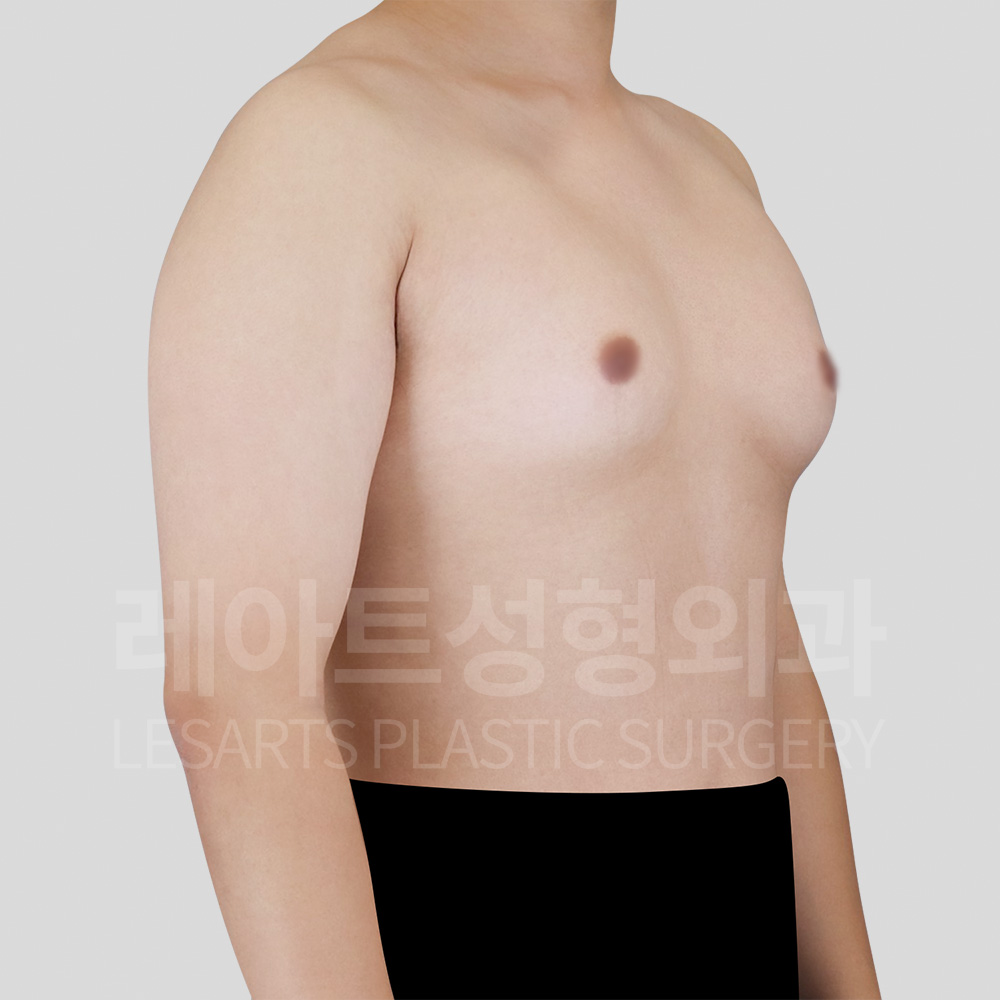
[Before Gynecomastia Surgery: Chest Shape Prominent Around the Nipples and Areolas]
The patient we are introducing this time is a man in his 30s
who had gynecomastia symptoms since his teenage years.
Although he consistently managed his weight and continued exercising,
he shared that the shape of his chest did not change.
[Patient Information & Gynecomastia Ultrasound Results]
Age: 30
Height / Weight: 180 cm / 83.1 kg
BMI: 25.6
Gynecomastia Diagnosis: Mixed-type true gynecomastia, Simon Grade 2A
Skin Condition: Mild skin laxity
[Gynecomastia Surgery Plan Considering Both Glandular Tissue and Surrounding Chest Fat]
Before surgery, the area around his nipples and areolas rose puffily,
and increased overall chest size was also clearly visible.
Externally, it was assessed as corresponding to Simon Grade 2A,
and upon palpation, firm lump tissue was felt in both sides of the chest.
As a result of the ultrasound exam,
we confirmed that overgrown glandular tissue was distributed
centered around that area.
Subcutaneous fat had also accumulated to some extent around the glandular tissue,
contributing together to the overall increase in chest volume.
Therefore, we planned this surgery to combine glandular excision and chest liposuction
to reduce puffy chest size and protrusion,
creating an overall masculine ribcage line.

[2 Weeks After Gynecomastia Surgery: Reduced Nipple–Areola Protrusion and Flattened Chest Line - Lesarts Plastic Surgery]
These photos were taken right after stitch removal,
2 weeks after surgery.
When compared from an oblique angle,
the first thing you notice is the reduction in shadows
that used to appear from the inner chest down to the lower chest before surgery.
Before surgery, chest volume created a curve
with shadows underneath, further emphasizing
its puffy shape.
After removing the glandular tissue and fat, we performed tissue rearrangement
so the chest surface could flow smoothly,
reducing the curves and chest protrusion that stood out before surgery.
Although it is still week 2—an early recovery period where swelling and tissue firmness
remain—
as chest size decreased and protrusion around the nipples and areolas was refined,
a masculine ribcage line is already emerging.
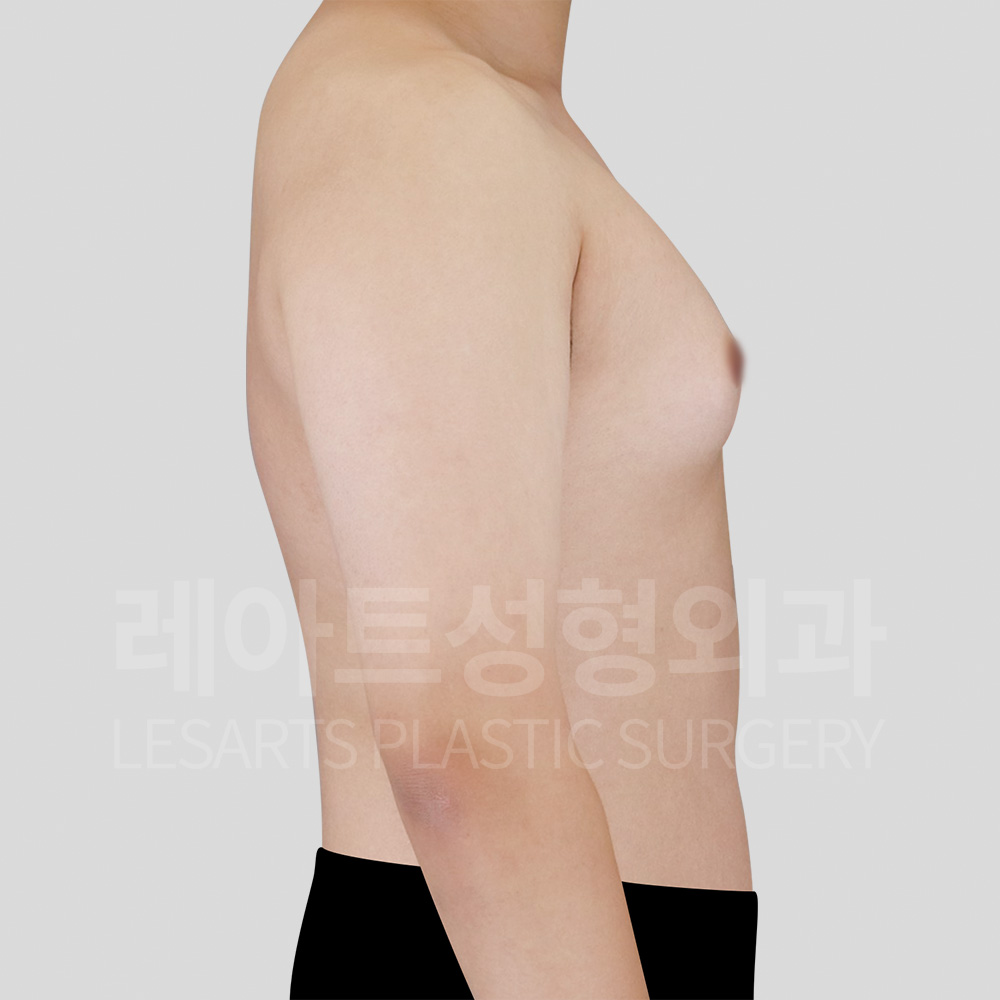
 [2 Weeks After Gynecomastia Surgery: Changes in Forward Chest Protrusion - Lesarts Plastic Surgery]
When compared from the side, you can see that the puffy forward-projecting
chest shape and volume seen before surgery have decreased.
In particular, as protrusion in the area flowing from the lower chest to the upper abdomen decreased,
the front chest now connects flatly.
 [Chest Protrusion Centered Around Nipples & Areolas Under a T-Shirt: Changes 2 Weeks After Gynecomastia Surgery - Lesarts Plastic Surgery]
The patient had been especially self-conscious about his chest
standing out forward when wearing a thin T-shirt.
Before surgery, volume around the nipples and areolas showed directly through a T-shirt,
making the chest area stick out prominently forward.
Two weeks after surgery, as volume in that area decreased,
you can see that the chest protrusion visible through clothing has also been reduced.
The patient expressed satisfaction with this improvement,
as well as with how his upper body shape was refined
as the convex line around his nipples and areolas decreased.
Rather than aiming simply to make the chest smaller,
it is important in gynecomastia surgery to consider both the current chest shape and overall ribcage line,
planning how the upper body will flow after surgery.
To do this, it is necessary to check not only individual bone structure,
but also chest muscle development, the size and distribution of glandular tissue,
and surrounding body fat distribution together.
Like this patient, if protrusion around the nipples and areolas and chest volume remain
despite consistent weight management and exercise,
rather than simply repeating further weight loss,
it is necessary to check via ultrasound how much glandular tissue
is contributing to the current chest protrusion.
We also recommend checking whether glandular removal alone is sufficient,
or whether surrounding liposuction and tissue rearrangement are needed,
and consulting on a surgical plan tailored to your chest condition.
[ View More Lesarts Real Gynecomastia Surgery Cases ]
[ Lesarts Gynecomastia Surgery Information ]
Male Gynecomastia FAQ
Q1. If my chest stays the same even after losing weight, is it gynecomastia?
Just because chest protrusion remains after weight loss
does not automatically confirm gynecomastia in every case.
However, if overgrown glandular tissue is the main cause, weight loss alone
may not bring major change, so checking through an ultrasound exam is important.
Q2. Why does the area around the nipples and areolas become puffy in gynecomastia?
When glandular tissue develops beneath the nipples and areolas, it can push that area forward,
making it stand out puffily. If surrounding fat is also distributed there,
it can affect overall chest size as well.
Q3. Does gynecomastia surgery only require removing the glandular tissue?
If subcutaneous fat around the chest is also developed in addition to glandular tissue,
liposuction can be combined. The necessary surgical scope
is determined through an ultrasound exam and physical examination.
Q4. Has the chest shape fully settled 2 weeks after gynecomastia surgery?
Two weeks after surgery is still an early recovery stage when swelling and tissue firmness may remain.
While changes in chest size and protrusion can be seen, progress must be monitored
until tissues fully settle afterward.
Q5. Can T-shirt fit also change after gynecomastia surgery?
When protrusion around the nipples, areolas, and front chest decreases, chest volume visible
under a thin T-shirt can also change.
The actual degree of change depends on the pre-op distribution of glandular tissue and fat.
#Male body contouring
#Gynecomastia
#Grade2-A #true gynecomastia


Cases finding
similar to my profile
Customer Diagnostics


Select the surgery and
area you are interestedto see real
before andafter changes.


we
make you,
the art
Clinic hours
MON - FRI
10 am – 7pm
SAT
10 am – 4pm
Holiday
SUN, HOLIDAY
Location
Lesarts Moon Clinic Tower 4-5F, 40, Nonhyeon-ro 168-gil,
Gangnam-gu, Seoul, Republic of Korea

Medical institution name Lesarts Plastic Surgery
Address Lesarts Moon Clinic Tower 4-5F, 40, Nonhyeon-ro 168-gil, Gangnam-gu, Seoul, Republic of Korea
Representative Moon sung jun
