




Online Consultation
Please accurately enter the information below.
Quick Cost Consultation
Quick Consultation & Reservation
Cases finding
similar to my profile






Cases finding
similar to my profile
Customer Diagnostics
Revision Tummy Tuck After Previous Mini Tummy Tuck and Liposuction: 2-Year-3-Month Results | Best Tummy Tuck Clinic in Gangnam, Seoul, Korea
2026-09-23
Revision Tummy Tuck | Existing Scars, Adhesions & Upper Abdominal Sagging: Changes at 2 Years and 3 Months
Before & After Revision Tummy Tuck: How Did Remaining Skin Sagging and Uneven Abdominal Contours Change?
Q. If upper abdominal sagging, adhesions, or uneven contours remain
even after a mini tummy tuck and abdominal liposuction, is revision surgery possible?
A. Revision surgery can be planned after re-evaluating the previous surgical scope, remaining excess skin,
diastasis recti, and the presence of adhesions.
For this patient, only the lower abdomen had been lifted in her previous surgery, leaving upper abdominal skin sagging
and diastasis recti unresolved, with adhesions also confirmed in the lower abdomen,
so we planned a revision M-type full tummy tuck together with rectus muscle repair, adhesion release,
umbilicoplasty (belly button correction), and front abdominal liposuction.
[ Learn More About Lesarts Revision Tummy Tuck Cases ]

[Before Revision Tummy Tuck: Remaining Skin Sagging and Irregular Abdominal Line After Previous Surgery]
In this post, we will explain a revision tummy tuck case
of a patient in her 40s who had a history of undergoing a mini tummy tuck
and abdominal liposuction at another clinic.
Although the patient had undergone a lower abdominal lift and diastasis recti repair in her previous surgery,
skin sagging in the upper abdomen remained unchanged,
creating a situation where the skin condition of the upper and lower abdomen felt completely different.
In addition, diastasis recti had not been repaired up into the upper abdomen,
so forward protrusion of the abdominal wall was also observed.
With some body fat remaining as well,
bulk above the belly button appeared even more emphasized.
[Lower Abdominal Adhesions and Firm Tissue Texture]
In the lower abdomen, uneven surface irregularities, adhesions,
and firm tissue texture were confirmed at the site of the previous mini tummy tuck.
We estimated this to be a remaining encapsulated seroma
that had occurred after her past surgery.
Therefore, we explained that in revision surgery, rather than simply pulling the skin again,
it would be necessary to remove the existing adhesions first
and then re-lift the skin so the surface could flow smoothly.
 [Pre-Op Diagnosis and Surgical Plan for Revision Tummy Tuck]
For this revision surgery, we examined not only the currently visible abdominal sagging,
but also the issues remaining after her previous surgery, and planned as follows:
Overall upper & lower abdominal skin sagging → Revision M-type tummy tuck
Upper abdominal diastasis recti → Rectus muscle repair
Severe lower abdominal adhesions → Adhesion release
After skin excision → Umbilicoplasty (belly button reconstruction)
Abdominal protrusion and bulk → Front abdominal liposuction
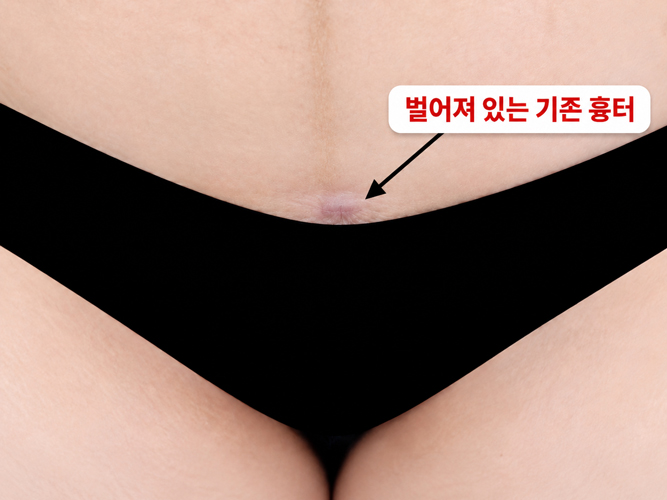
[Existing Widened Scar - Lesarts Plastic Surgery]
The patient's remaining scar from her previous mini tummy tuck
was in a widened state.
We also explained in advance that during the revision surgery, the existing scar would be removed along with the skin,
leaving only the new tummy tuck scar
after surgery.
 [2 Years & 3 Months After Revision Tummy Tuck: Changes in Lower Abdominal Skin Sagging and Long Incision Scar - Lesarts Plastic Surgery]
This is how she looks 2 years and 3 months after surgery.
Before revision surgery, upper abdominal skin and diastasis recti
had not been sufficiently corrected,
and adhesions and skin sagging remained together in the lower abdomen,
making the entire front abdomen protrude irregularly.
After revision surgery, as both the upper and lower abdominal skin were tightened together,
you can see the previously bumpy, forward-protruding abdominal line
flowing smoothly.
 [2 Years & 3 Months After Revision Tummy Tuck: Changes in Upper Abdominal Protrusion and Abdominal Line - Lesarts Plastic Surgery]
By correcting the remaining upper abdominal skin sagging and diastasis recti together,
the forward-pushed central abdomen seen before revision surgery was also smoothed out.
As the skin shifts during the lift,
the original belly button position also changes.
The belly button was newly created to match her waistline height
so it could connect naturally with the overall abdominal contour.
While the patient was satisfied that her sagging front abdomen was refined,
she was especially pleased that the firm adhesion tissue
and bumpy surface irregularities remaining in her lower abdomen
from her previous surgery were gone.
 [2 Years & 3 Months After Revision Tummy Tuck: Changes in Front Abdominal Protrusion and Skin Folding - Lesarts Plastic Surgery]
When compared from the side, the changes in the excess front abdominal skin
and diastasis recti remaining after her previous surgery are even clearer.
Although she had already undergone a mini tummy tuck and abdominal liposuction,
before revision surgery her upper and lower abdominal lines were unbalanced,
with overlapping skin and a forward-pushed abdominal wall present together.
Through revision surgery, we refined the volume of the waist and front abdomen
and re-repaired the rectus muscles so the abdominal wall could be properly supported.
In addition, by releasing the adhesions and tightening the loose skin together,
the overlapping skin and irregular contours remaining before surgery were reduced.
 [2 Years & 3 Months After Revision Tummy Tuck: Changes in Lower Abdominal Skin Sagging
and Folding When Bending Forward - Lesarts Plastic Surgery]
In a forward-bending posture as well,
you can see the excess skin, adhesions,
and abdominal wall laxity that had remained before revision surgery.
Previously, as the skin folded in multiple layers,
the bumpy shape in the lower abdomen stood out strongly.
After revision surgery, with the adhesions removed
and the loose skin and diastasis recti repaired together,
even when bending forward, the heavy overlapping of skin
and irregular forward pushing of the front abdomen seen before surgery have decreased.
 [2 Years & 3 Months After Revision Tummy Tuck: Lower Abdominal Incision Scar Recovery Status - Lesarts Plastic Surgery]
As for the scar, the existing widened scar from her previous mini tummy tuck
was removed during the revision surgery.
The currently remaining scar is the newly created incision line from the revision surgery,
showing a healing pattern where color is fading overall starting from both ends.
Because the patient's skin type carried a possibility of scars and pigmentation
lingering for a long time,
she has continued scar care up to the present, combining laser and injection treatments
when needed.
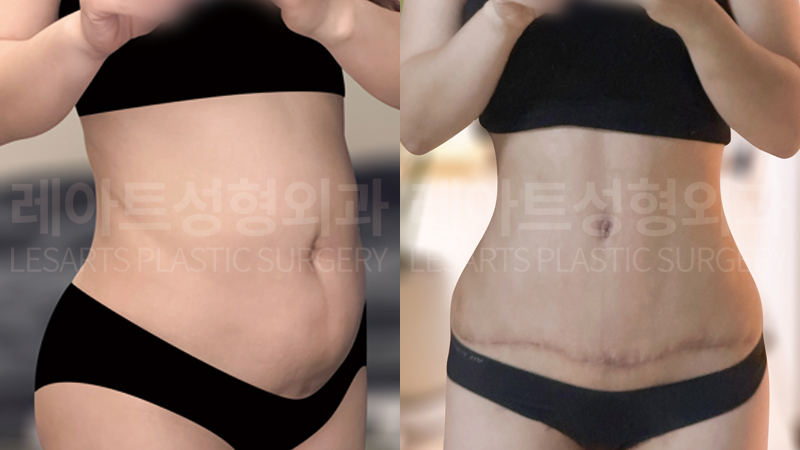
[Comparison of Patient's Self-Taken Photos: Before vs. 1 Month After Revision Tummy Tuck]
Even during the early recovery period at 1 month after revision surgery,
the patient expressed satisfaction with her changed abdominal line
and the reduction in stress from the under-correction and adhesion tissue
that had remained after her previous surgery.
A revision tummy tuck is a surgery that cannot be approached simply
by checking currently visible skin sagging and pulling the skin again.
It is necessary to examine how far the previous surgery extended,
which area of the rectus muscles was repaired,
whether adhesions or firm tissue remain,
and the current condition of the skin and subcutaneous tissue all together.
For this patient as well, although her lower abdomen had already been lifted once,
skin sagging and diastasis recti remained in her upper abdomen,
while adhesions and her existing scar were also present in her lower abdomen.
Therefore, after re-evaluating her entire abdominal condition from the beginning,
we planned the necessary scope together—including a revision M-type tummy tuck, rectus muscle repair,
adhesion release, umbilicoplasty, and liposuction.
Similarly, if upper abdominal sagging or front abdominal protrusion remains
even after a previous tummy tuck,
or if you are considering revision surgery due to bumpy lower abdominal adhesions
or a widened existing scar,
we recommend accurately checking your current abdominal condition and previous surgical scope,
diagnosing the necessary range of correction, and then planning your surgery.
Please also remember that consistent follow-up monitoring and scar care
remain important after revision surgery.
[ View More Lesarts Revision Tummy Tuck Cases ]
Revision Tummy Tuck FAQ
Q1. If my upper abdomen still sags after a mini tummy tuck, can I get revision surgery?
If the previous surgery focused on the lower abdomen, leaving upper abdominal skin sagging or diastasis recti,
a revision full tummy tuck can be considered after re-evaluating your current condition.
Q2. Can bumpy adhesions after a tummy tuck also be resolved with revision surgery?
After checking the location and degree of adhesions, releasing or removing them
during revision surgery can be considered.
The achievable scope varies depending on tissue condition.
Q3. Does the existing scar disappear if I get a revision tummy tuck?
If the existing scar is included within the newly excised skin area, it can be removed together.
However, because a new incision is needed for revision surgery,
a new tummy tuck scar will remain.
Q4. Do I still need scar care after a revision tummy tuck?
Yes. Depending on individual skin characteristics and incision range, the speed at which scar color
and thickness settle varies.
Additional care such as laser or injection treatments can be combined as needed.
Q5. How is a revision tummy tuck different from a first surgery?
Because not only remaining skin and fat after the first surgery, but also the existing incision line, adhesions, rectus repair range,
and tissue condition must be checked, pre-op diagnosis
and careful planning of the surgical scope are especially important.
#Abdominoplasty
#M-type


Cases finding
similar to my profile
Customer Diagnostics


Select the surgery and
area you are interestedto see real
before andafter changes.


we
make you,
the art
Clinic hours
MON - FRI
10 am – 7pm
SAT
10 am – 4pm
Holiday
SUN, HOLIDAY
Location
Lesarts Moon Clinic Tower 4-5F, 40, Nonhyeon-ro 168-gil,
Gangnam-gu, Seoul, Republic of Korea

Medical institution name Lesarts Plastic Surgery
Address Lesarts Moon Clinic Tower 4-5F, 40, Nonhyeon-ro 168-gil, Gangnam-gu, Seoul, Republic of Korea
Representative Moon sung jun
