




Online Consultation
Please accurately enter the information below.
Quick Cost Consultation
Quick Consultation & Reservation
Cases finding
similar to my profile






Cases finding
similar to my profile
Customer Diagnostics
Thigh Liposuction for Saddlebags and Inner Thigh Fat: 4-Month Body Proportion Results | Best Liposuction Clinic in Gangnam, Seoul, Korea
2026-09-28
Thigh Liposuction | Thighs Thicker Than the Upper Body:
Upper-to-Lower Body Proportion Changes at 4 Months
Thighs Thicker Than the Upper Body:
Can Liposuction Balance Upper and Lower Body Proportions?
4-Month Before & After Comparison
Q. Should more fat simply be removed from particularly prominent areas like saddlebags or above the knees?
A. Even if an area stands out, unconditionally suctioning
a large amount may not be appropriate.
Because the thigh line is influenced not only by fat, but also by muscle development,
bone structure, and skin condition, it is necessary to check
how much fat actually affects each area
and adjust the suction volume and depth accordingly.
[ Learn More About Lesarts Thigh Liposuction Cases ]
Among those considering thigh liposuction,
some say they want to reduce a bit more fat
in areas that look particularly prominent,
such as the outer thigh saddlebags or above the knees.
Because of the protrusion and volume in these areas,
the upper body can look relatively slim while only the lower body feels thick,
making overall body proportions feel somewhat unbalanced.
However, the thighs are not an area
whose contour is determined by fat volume alone.
Because muscle development and bone structure
also affect the leg line,
rather than simply removing a large amount of fat,
it is important to check the structure of each area
and plan different degrees of suction depending on the location.

[Before Thigh Liposuction: Saddlebags and Line Above the Knees]
This patient was concerned that her thighs looked thick compared to her upper body
and that her legs appeared short.
In particular, she wished to refine the outer thigh saddlebags
and the line flowing above her knees.
[Patient Information]
Age: 20s
Height: 157 cm
Weight: 46.4 kg
BMI: 18.8
*Even with similar physical conditions, liposuction results
may vary from person to person depending on fat distribution, bone structure,
and muscle shape.
Upon diagnosis, there was sufficient removable fat
in the outward-protruding saddlebag area.
There was also fat distributed on the inner thighs that could be refined,
so we could expect a reduction in upper thigh thickness
and a decrease in overall circumference.
However, the area around the knees that the patient was also concerned about
was not influenced by fat alone.
Bone structure and skin had a large influence
on the protruding line on the inner knee and when viewed from the side,
and in the area flowing from the knees to the front thighs,
the shape of the front thigh muscles had a greater impact on the line than fat.
Therefore, reducing fat on the front thighs aggressively
could have actually made the contours of her already developed muscles
stand out even more.
Considering this, we planned the surgery
by adjusting suction volume and depth for each location
so that the contour would flow smoothly
when viewing the entire thigh.
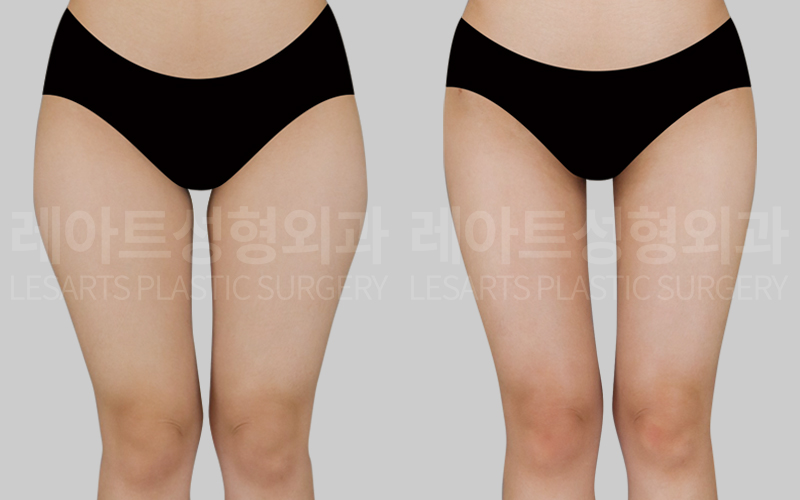
[Before & 1 Month After Thigh Liposuction: Changes in Saddlebags and Inner Thigh Line]
Let's look at the changes in her thigh line
through photos taken 1 month after surgery.
The first thing you notice
is the reduction in the horizontal width of her upper thighs.
Before surgery, because the saddlebags spread wide below her pelvis,
the starting point of her thighs appeared lower than her actual bone structure,
making her legs feel shorter as well.
As the saddlebag volume decreased,
the outer thigh width was refined and her hip line became more visible,
changing into a shape where her legs look longer and slimmer.
On the inner thighs as well,
as the bulging volume at the top decreased,
you can see the inner line flowing straighter downward.
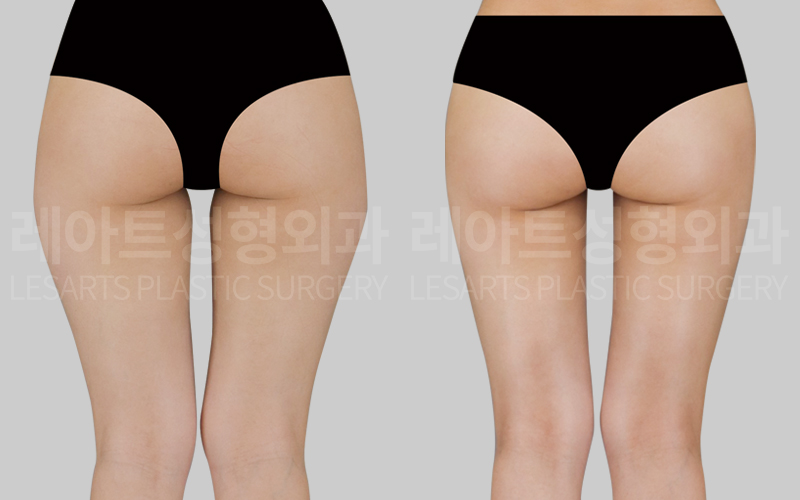
[Before & 1 Month After Thigh Liposuction (Back View): Changes in Saddlebags and Outer Thigh Width]
When viewed from behind as well,
you can see that the outer contour flowing from her waist and hips to her thighs
connects more smoothly than before surgery.
Previously, because of the outward-protruding saddlebags,
lower body volume looked concentrated lower down.
After surgery, as the saddlebags were refined,
thigh width decreased, and the starting point flowing
from the hips to the legs also looks higher.
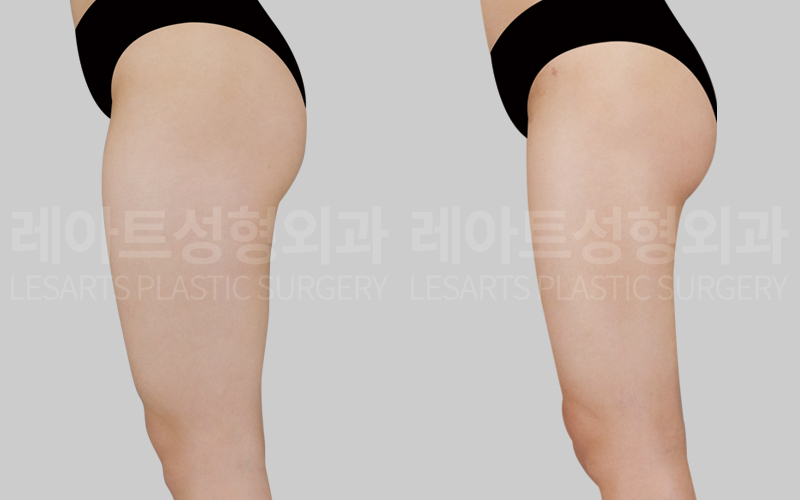
[1 Month After Thigh Liposuction (Side View): Changes in Front/Back Thigh Thickness and Knee Line]
When compared from the side,
as the thigh volume that had felt bulky front-to-back before surgery
decreased,
you can see the overall line flowing straighter.
In particular, because bone structure influenced the knee area
and muscles were developed in the front thighs,
rather than removing a lot of fat,
it was important to adjust suction depth
considering her current muscle shape and bone structure.
As a result, while reducing noticeable volume,
we refined the line so that existing muscle contours would not be overly exposed.
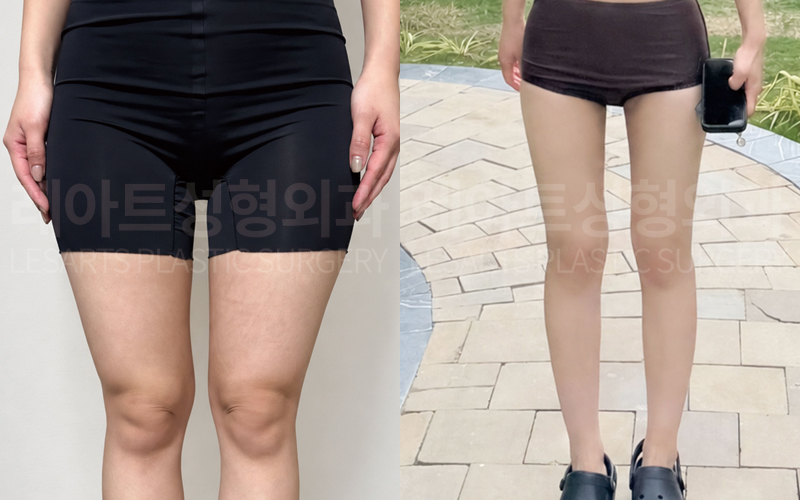
[Photo Comparison: Before vs. 4 Months After Thigh Liposuction]
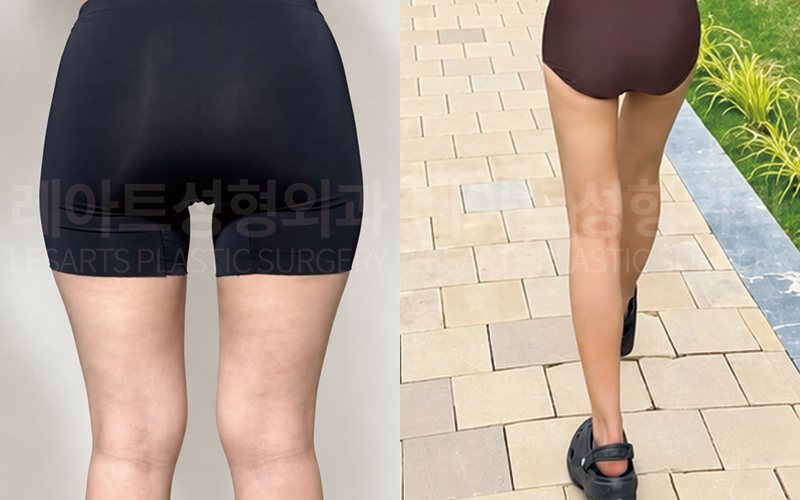
[Photo Comparison: Before vs. 4 Months After Thigh Liposuction]
These are 4-month post-op photos sent directly
by the patient as a review.
As the volume in her inner thighs and saddlebags—
which concerned her most before surgery—decreased,
you can see her overall leg line refined
into a slimmer, more balanced shape.
Since the patient had a relatively slim upper body,
before surgery her upper thigh width and
saddlebags stood out relatively more,
making the difference between her upper and lower body feel large.
After surgery, as the horizontal width and thickness of her thighs decreased,
the patient shared that she is satisfied that her upper and lower body proportions feel balanced
and her legs look longer.
Thigh liposuction is not a surgery
that unconditionally removes as much fat as possible
from prominent areas.
If sufficient fat is actually present, as in saddlebags,
active volume reduction can be planned,
but in areas heavily influenced by bone structure and muscles—such as the front thighs or around the knees—
the more fat is reduced, the more the underlying
structure may actually stand out.
Therefore, it is important to check where and how much fat is distributed,
what the bone structure looks like, and how developed the muscles are,
and apply different suction ranges and degrees by area.
Like this patient, if your lower body looks thick compared to your upper body
and you are concerned about overall proportions,
or if you are planning thigh liposuction because fat in specific areas like saddlebags or inner thighs does not easily shrink,
we recommend checking your current body type and desired leg line together
and thoroughly consulting on the surgical scope
and degree of suction suited to you.
[ Learn More About Lesarts Thigh Liposuction Cases ]
Thigh Liposuction FAQ
Q1. Can saddlebags be reduced significantly with liposuction?
If sufficient subcutaneous fat is distributed in the saddlebag area,
you can expect a reduction in volume.
However, the suction range must be determined while considering
the overall line connecting the hips and thighs.
Q2. If the area above the knees protrudes, should a lot of fat be removed?
Protrusion around the knees can be influenced not only by fat,
but also by bone structure and skin condition.
If actual fat volume is not large, there may be limits
to the changes achievable through liposuction alone.
Q3. If the front thighs protrude, can liposuction make them flat?
If muscle has a large influence on front thigh protrusion,
removing fat excessively may not be appropriate.
Because existing muscle lines can stand out more,
it is important to adjust the degree of suction by area.
Q4. Can thigh liposuction make legs look longer?
When fat that widens the upper thigh, such as saddlebags,
is reduced, the hip line becomes more visible and the starting point of the legs
can appear higher.
Accordingly, overall lower body proportions
can also look different.
Q5. Can slim body types also get thigh liposuction?
Even if body weight is low, if fat is concentrated in specific areas,
liposuction can be considered. However, overall fat volume,
muscles, bone structure, and skin condition must be checked together to determine the removable range.
#Liposuction
#Thigh
#BMIbelow20(thigh)


Cases finding
similar to my profile
Customer Diagnostics


Select the surgery and
area you are interestedto see real
before andafter changes.


we
make you,
the art
Clinic hours
MON - FRI
10 am – 7pm
SAT
10 am – 4pm
Holiday
SUN, HOLIDAY
Location
Lesarts Moon Clinic Tower 4-5F, 40, Nonhyeon-ro 168-gil,
Gangnam-gu, Seoul, Republic of Korea

Medical institution name Lesarts Plastic Surgery
Address Lesarts Moon Clinic Tower 4-5F, 40, Nonhyeon-ro 168-gil, Gangnam-gu, Seoul, Republic of Korea
Representative Moon sung jun
