




Online Consultation
Please accurately enter the information below.
Quick Cost Consultation
Quick Consultation & Reservation
Cases finding
similar to my profile






Cases finding
similar to my profile
Customer Diagnostics
C-Section Scar and Loose Lower Belly Skin: 3-Month Results After M-Type Full Tummy Tuck | Lesarts Plastic Surgery, Gangnam, Seoul, Korea
2026-09-29
Tummy Tuck | Skin Folding Above a C-Section Scar: 3-Month Changes After an M-type Full Tummy Tuck
Skin Overlapping and Sagging Above a C-Section Scar: 3-Month Changes After an M-type Full Tummy Tuck
Q. Even if a long time has passed since childbirth, can lower belly sagging remaining
above a C-section scar be corrected with a tummy tuck?
A. Eligibility for a tummy tuck is not decided
solely by how much time has passed since childbirth.
The necessary surgical scope is determined by checking current skin elasticity,
the extent of sagging, diastasis recti, and fat distribution.
For this patient, both overall skin laxity across the upper and lower abdomen
and diastasis recti were confirmed, so we performed an M-type full tummy tuck
together with rectus muscle repair, umbilicoplasty (belly button correction), and abdominal liposuction.
[ Learn More About Lesarts Tummy Tuck Cases ]
[3 Weeks After Tummy Tuck: Changes in Lower Abdominal Skin Sagging and Folding - Lesarts Plastic Surgery]
Even if the changed shape of the abdomen after childbirth bothers you,
while raising children and focusing on daily life,
concerns about your own body shape often get pushed aside.
Then, as time passes, some people begin looking into a tummy tuck
when long-standing lower belly sagging or loose abdominal skin
catches their eye again.
During actual consultations, we often hear questions like:
“It's been a long time since I gave birth—is it still okay to have surgery now?”
“Can skin that stretched a long time ago also be corrected with a tummy tuck?”
.
A tummy tuck is not decided—nor is its scope determined—
based solely on the time elapsed since childbirth.
It is important to check the current abdominal condition—
including remaining skin elasticity, the extent of sagging, the state of the rectus muscles, and abdominal fat distribution—
and then determine
the necessary surgical method.
In this post, we will look at an M-type full tummy tuck case
of a female patient in her late 40s who had remaining lower abdominal skin sagging
above her C-section scar
after two deliveries.
 [Before Tummy Tuck: Lower Abdominal Skin Sagging and Upper Abdominal Laxity]
[Patient Information]
Age: Late 40s
Pre-Op Measurements: 157 cm / 51.7 kg / BMI 21
Procedures: M-type full tummy tuck / rectus muscle repair / umbilicoplasty / abdominal liposuction
History: Two deliveries / history of C-section and laparoscopic surgery
Examining the patient's abdomen during the pre-op consultation,
skin elasticity was reduced across both the upper and lower abdomen,
and loose skin descending below the belly button
was creating folds and wrinkles.
In particular, skin folding stood out even more
above her existing C-section scar.
When bending forward, the loose skin overlapped in multiple layers,
making the wrinkles appear even more pronounced.
 [Before Tummy Tuck: Surgical Plan Considering Upper & Lower Abdominal Skin Laxity]
At the time of consultation,
what bothered the patient most
was lower abdominal skin sagging.
However, upon examining her actual abdominal condition,
skin sagging was present not only in the lower abdomen,
but also in the upper abdomen.
For this reason, we determined that a mini tummy tuck,
which only pulls the lower belly partially,
would not be able to correct
to the extent the patient desired.
Diastasis recti was also confirmed.
Therefore, we explained the need for an M-type full tummy tuck
that tightens loose upper and lower abdominal skin together
while also including rectus muscle repair.

[3 Months After Tummy Tuck in Late 40s: Changes in Lower Abdominal Skin Sagging and Belly Button Line]
These are the before-and-after photos 3 months after the tummy tuck.
While refining the surrounding contours with abdominal liposuction,
we tightened the loose skin and repaired the separated rectus muscles.
The first thing you notice is that as the loose skin
remaining below the belly button was removed,
the folds and wrinkles formed on the lower belly
and above the C-section scar decreased.
You can also see that the front abdomen flowing from the upper to the lower abdomen
connects more smoothly than before surgery.
The belly button, which had looked horizontally flattened due to skin sagging,
was newly created during the tummy tuck
and positioned to match her waistline height.

[3 Months After Tummy Tuck: Changes in Forward-Protruding Lower Belly and Abdominal Skin Line]
Before surgery, as excess lower abdominal skin sagged downward,
a fold formed above the C-section scar,
making the front abdomen stand out heavily.
After surgery, as the excess skin was removed,
folding and wrinkling in the lower belly decreased,
and the flow of the front abdomen from the upper to the lower abdomen
also connects smoothly.

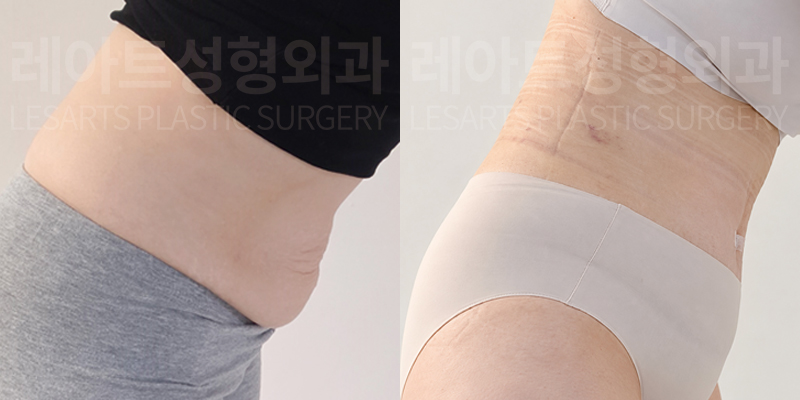
[3 Months After Tummy Tuck: Side-View Changes in Lower Belly Protrusion and Front Abdominal Line]
When compared from the side, the before-and-after difference is even clearer.
Before surgery, the lower abdomen bulged forward convexly
and the remaining skin sagged downward.
After surgery, as this excess skin was refined,
the front abdomen changed into a flatly flowing contour.
By repairing diastasis recti at the same time,
you can also see that the forward protrusion of the abdominal wall
has decreased.

[3 Months After Tummy Tuck: Changes in Lower Abdominal Skin Sagging and Folding When Bending Forward]
When bending forward,
the lower abdominal skin folding in multiple layers
and deepening wrinkles were even more pronounced before surgery.
The patient had also been very bothered by how her skin folded
and wrinkled depending on her posture.
After surgery, with the loose skin tightened,
the way lower abdominal skin used to pile down in multiple layers
when bending forward has decreased.
The patient also expressed satisfaction that her lower belly,
which used to fold with changes in posture, has been smoothed out.

[3 Months After Tummy Tuck: Lower Abdominal Incision Scar Recovery Status]
This patient had an existing C-section scar
remaining on her lower abdomen.
Because that C-section scar was included in the area of sagging skin
excised during the tummy tuck,
the existing scar was removed together.
Currently, only the new incision scar
for the tummy tuck remains
at a low position on the lower abdomen.
Since it has been 3 months after surgery,
redness in the scar is still relatively noticeable.
However, because it is located where it is covered by underwear,
the patient shared that it does not bother her much
in daily life.
Tummy tuck scars go through a process
of gradually maturing and fading in color over time.
Therefore, rather than judging the final scar appearance from its current state alone,
consistent monitoring and care going forward are necessary.

[Side View Comparison: Before vs. 3 Months After Full Tummy Tuck]
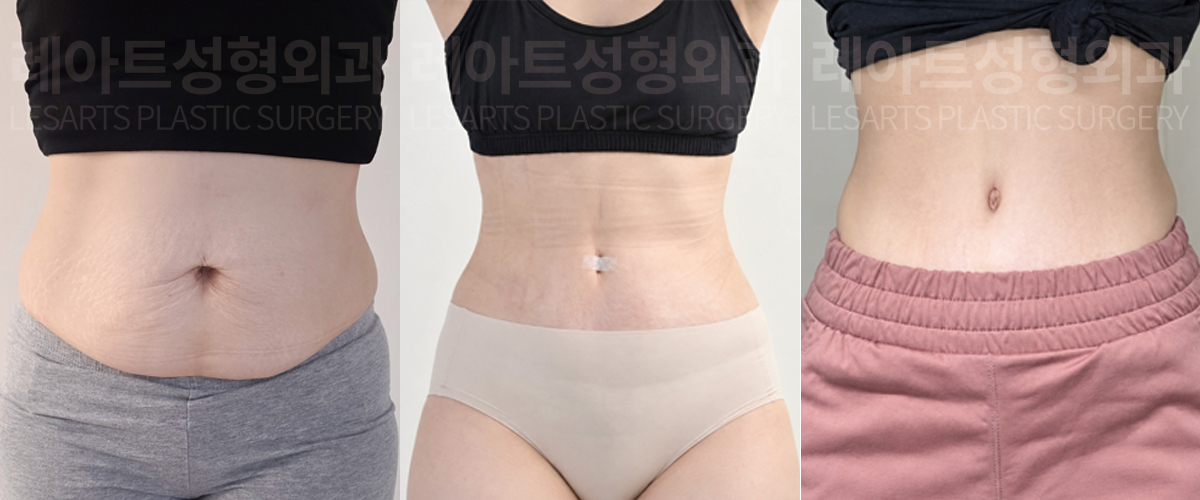
[Front View Comparison: Before vs. 1 Month & 3 Months After Full Tummy Tuck]
In the photos and review sent directly by the patient after surgery,
we could also see her changed abdominal line and the difference she feels in everyday life.
Experiencing her refined lower belly and changed abdominal shape firsthand,
the patient expressed satisfaction with the surgical results.
When a long time has passed after childbirth,
some people wonder, “Can a tummy tuck still make a difference now?”
.
However, as seen in this case, a tummy tuck
is not a surgery decided solely based on
how many years have passed since childbirth.
It is necessary to examine how far the skin is currently stretched,
the elasticity of both the upper and lower abdomen,
whether diastasis recti is present,
and the condition of existing C-section scars
and fat distribution together.
In particular, even if you think only the lower abdomen looks saggy,
upper abdominal skin laxity and diastasis recti
often exist together,
so the necessary surgical scope between a mini tummy tuck and a full tummy tuck
can vary depending on your current abdominal condition.
Even if a long time has passed since childbirth,
if wrinkles remain on your lower belly
or you are bothered by skin repeatedly folding
above your C-section scar,
rather than assuming it is only a lower abdominal issue,
we recommend thoroughly checking the extent of sagging, the state of your rectus muscles,
the necessary surgical method, and recovery care
before deciding on surgery.
[ Learn More About Lesarts Tummy Tuck Cases ]
Tummy Tuck FAQ
Q1. Can I still get a tummy tuck even if a long time has passed since childbirth?
Eligibility for surgery is not decided solely by the time elapsed since childbirth.
The necessary surgical method is determined by checking your current health status,
the extent of skin sagging, and whether diastasis recti is present.
Q2. Can skin folding above a C-section scar also be corrected with a tummy tuck?
If the existing C-section scar is included within the area of sagging skin to be excised,
the scar can be removed together while refining the overlapping skin above it.
The actual achievable scope varies depending on the current scar location and degree of skin sagging.
Q3. Can a full tummy tuck be needed even if only the lower abdomen looks saggy?
Yes, it is possible. If lower abdominal sagging is caused by loose skin descending
from the upper abdomen, or if diastasis recti is also present,
a mini tummy tuck alone may not be able to correct to the desired extent.
Q4. Does the belly button shape also change after a tummy tuck?
In a full tummy tuck, as the skin shifts, there are cases where the belly button
must be newly created and positioned.
The position and shape of the belly button are planned
considering your current abdominal proportions and waistline.
Q5. Is it okay if the scar is still red 3 months after a tummy tuck?
Three months after surgery is a period when the scar is still maturing.
Redness may remain and can gradually change
over time. If needed, scar care is continued
according to medical staff guidance.
#Abdominoplasty
#M-type


Cases finding
similar to my profile
Customer Diagnostics


Select the surgery and
area you are interestedto see real
before andafter changes.


we
make you,
the art
Clinic hours
MON - FRI
10 am – 7pm
SAT
10 am – 4pm
Holiday
SUN, HOLIDAY
Location
Lesarts Moon Clinic Tower 4-5F, 40, Nonhyeon-ro 168-gil,
Gangnam-gu, Seoul, Republic of Korea

Medical institution name Lesarts Plastic Surgery
Address Lesarts Moon Clinic Tower 4-5F, 40, Nonhyeon-ro 168-gil, Gangnam-gu, Seoul, Republic of Korea
Representative Moon sung jun
