




Online Consultation
Please accurately enter the information below.
Quick Cost Consultation
Quick Consultation & Reservation
Cases finding
similar to my profile






Cases finding
similar to my profile
Customer Diagnostics
Male Gynecomastia Surgery for Simon Grade IIa: Changes in Chest Projection and Clothing Fit After 2 Weeks
2026-10-07
Male Gynecomastia Surgery | Simon Grade IIa: 2-Week Post-Op Changes in Chest Protrusion and Sweatshirt Fit - Lesarts Plastic Surgery
Male Gynecomastia Surgery (Simon Grade IIa): Changes in Chest Protrusion and Clothing Fit 2 Weeks After Surgery
Q. If chest protrusion is visible even when wearing thicker clothes
like sweatshirts or knitwear, could it be gynecomastia?
A. If the thickness of the front chest or a puffy prominence
around the nipples and areolas stands out regardless of clothing thickness,
it is worth checking whether it is simply due to body fat
or gynecomastia involving developed glandular tissue.
Checking the distribution of glandular tissue and subcutaneous fat through palpation and ultrasound
allows for a more specific assessment of your current chest condition and the necessary surgical scope.
[ View More Lesarts Real Gynecomastia Surgery Cases ]
[ Learn More About Lesarts Gynecomastia Surgery ]
As the weather has turned quite chilly,
there are more days when we reach for sweatshirts, knitwear, and light outerwear.
You might think that thicker clothing would lessen concerns about gynecomastia,
but in reality, there are quite a few cases where chest thickness or puffy protrusion
around the nipples and areolas still shows directly through clothes.
During consultations,
some patients share that even when wearing relatively thick tops like sweatshirts or sweaters,
the front of the chest stands out, making the fit look awkward,
or that layering thicker clothes to hide it
makes their entire upper body look bulky and large,
which causes them stress.
If you have been putting off surgery because wearing a compression garment
or recovering during the summer felt burdensome,
checking your current chest condition and planning your surgery schedule
during a season when clothing is relatively looser
can be one good approach.
In this post, through the case of a patient who treated gynecomastia in his 30s
that had persisted since his teens,
we will look at how chest protrusion and clothing fit changed
during the early recovery stage of 2 weeks after surgery.
[Before Gynecomastia Surgery: Protrusion Around the Nipples & Areolas and Chest Thickness - Lesarts Plastic Surgery]
This patient's gynecomastia symptoms began during his teenage years,
and he decided to seek treatment in his 30s.
Although he had consistently maintained exercise and weight management,
he visited the clinic because chest enlargement and protrusion continued to remain.
[Patient Information and Gynecomastia Ultrasound Findings]
Age: 30s
Height / Weight: 164 cm / 81.1 kg
BMI: 30.2
Gynecomastia Diagnosis: Mixed-type true gynecomastia, Simon Grade IIa
Skin Elasticity: Mild skin laxity, no distinct chest sagging
[Male Gynecomastia Surgery Plan: Glandular Tissue Removal and Chest Liposuction - Lesarts Plastic Surgery]
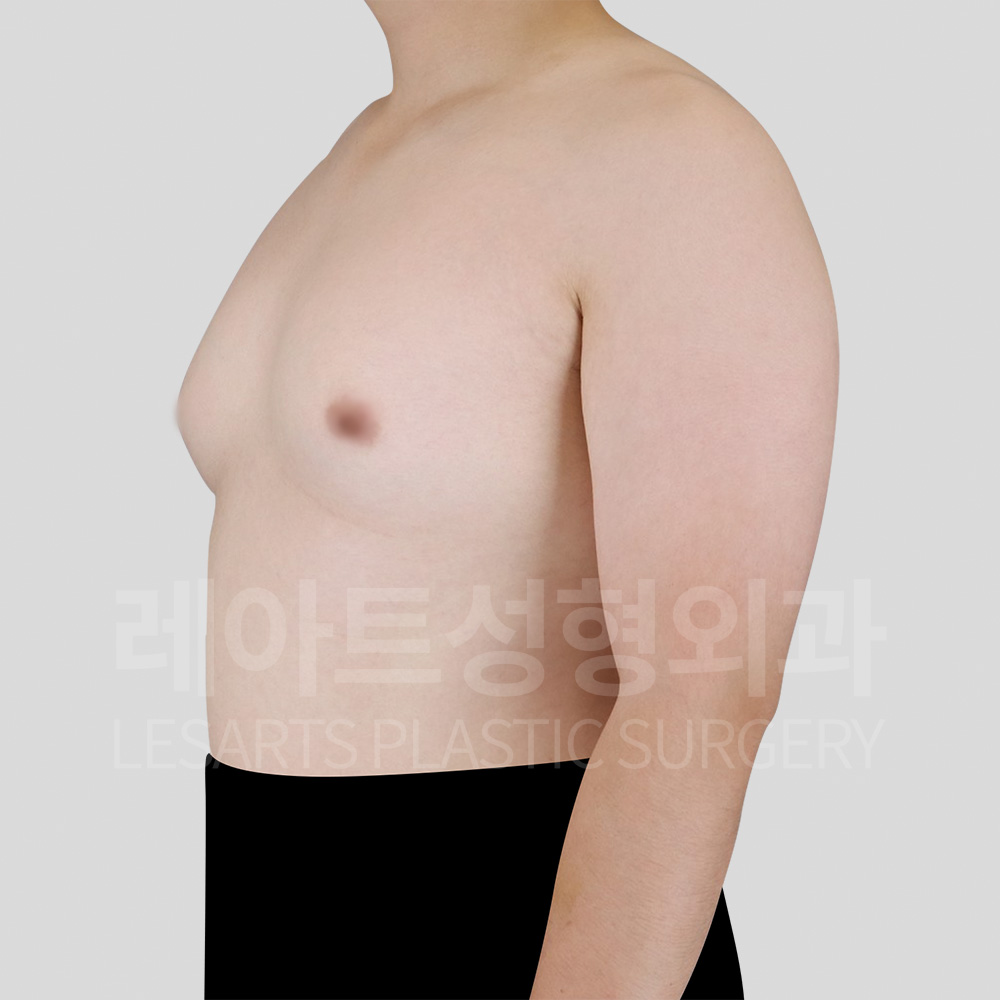
Looking at his pre-operative condition,
not only was the overall size of his chest increased,
but a puffy forward prominence around the nipples and areolas
was also clearly visible.
As rounded volume settled around the lower chest,
the overall contour resembling a female chest
was causing significant stress for the patient.
Upon palpation,
firm lumps were felt beneath
both nipples and areolas.
Ultrasound examination confirmed that this tissue
was excessively developed glandular tissue.
While there was a slight decrease in skin elasticity,
there was no distinct downward sagging.
However, glandular tissue was not the only factor
contributing to his chest size.
Because subcutaneous fat distributed around the gland
also affected overall chest thickness,
we planned the surgery to combine glandular removal
with chest liposuction.

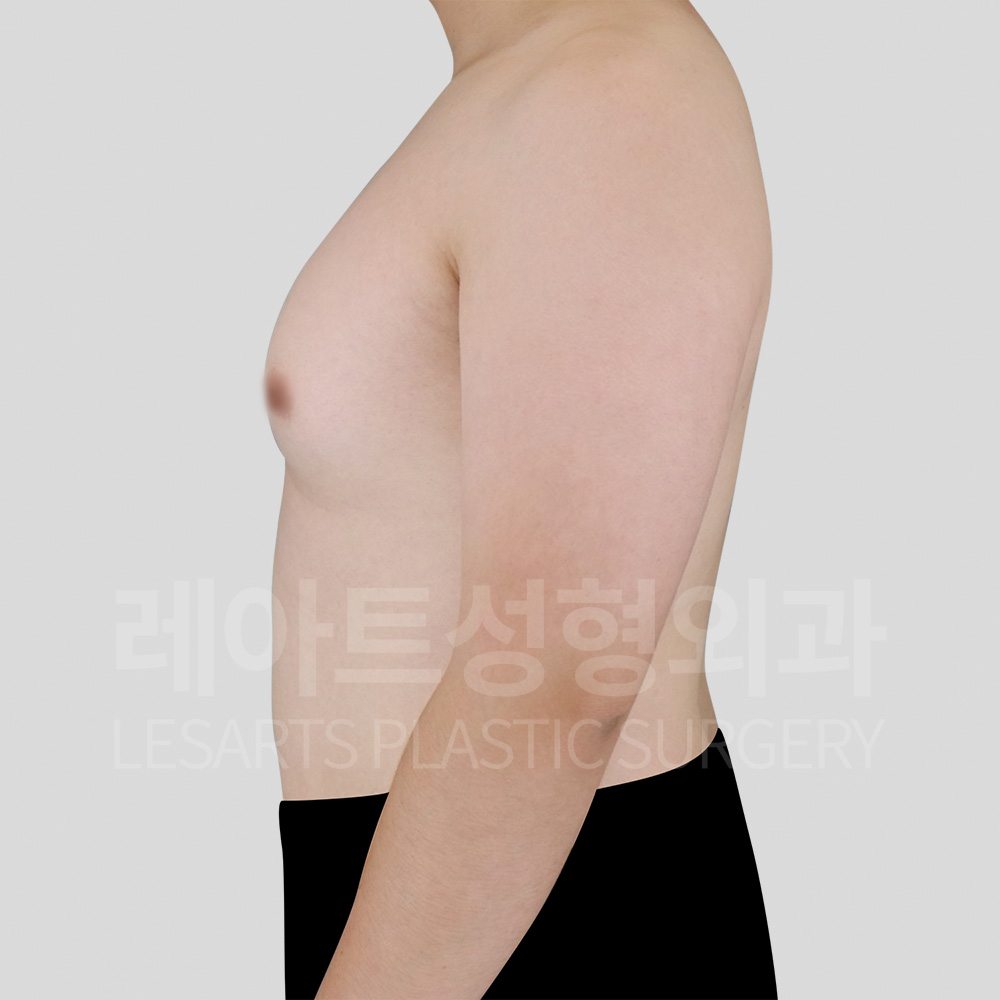
[2 Weeks After Gynecomastia Surgery: Changes in Nipple–Areola Protrusion and Chest Thickness - Lesarts Plastic Surgery]
These photos were taken during the early recovery period,
about 2 weeks after surgery.
Although swelling and bruising still remain
and internal tissues are still in the process of settling,
even taking this into account, you can see that the forward chest protrusion
seen before surgery has decreased
and overall thickness has been reduced.
In particular, before surgery, the puffy projection around the nipples and areolas
made the central chest appear noticeably raised.
After addressing the glandular tissue and surrounding fat,
protrusion around the nipples and areolas lowered,
creating a much smoother contour across the front of the chest.

[2 Weeks After Gynecomastia Surgery: Changes in Chest Protrusion and Lower Volume - Lesarts Plastic Surgery]
Not only when bare-chested,
but also when wearing clothes, the changes can be seen.
Before surgery, even when wearing a sweatshirt,
volume stood out forward along the chest line,
pushing the front of the top outward puffily.
After surgery, as chest protrusion and thickness decreased,
the front chest volume that used to be emphasized under a sweatshirt diminished,
allowing the top to drape much flatter than before.

[2 Weeks After Gynecomastia Surgery: Changes in Chest Protrusion and Lower Volume - Lesarts Plastic Surgery]
Before surgery, rounded volume centered in the lower chest
created shadows along the lower chest crease,
making the chest boundary appear even more pronounced.
After surgery, as the lower chest volume decreased,
the shadows around the lower chest disappeared, and the line flowing into the front abdomen
was smoothed out flatly.
Because 2 weeks is still an early stage,
the current appearance does not represent the final chest line,
but the protrusion and thickness that concerned him before surgery
have already decreased noticeably even at this early recovery stage.

[2 Weeks After Gynecomastia Surgery: Side-View Changes in Chest Thickness Under a Sweatshirt - Lesarts Plastic Surgery]
When compared from the side,
the difference in chest thickness visible through clothing is even clearer.
After surgery, the patient himself noticed most strongly
that the volume emphasized along his chest line when wearing clothes
had decreased.
He expressed satisfaction that the burden of constantly feeling self-conscious
about his chest no matter what clothes he wore
had been reduced.
This patient had experienced discomfort from chest protrusion
and enlargement for a long time since his teenage years.
Although he consistently maintained exercise and weight management,
with developed glandular tissue present,
it was difficult to achieve the desired level of change.
Seeing his chest volume decrease quickly after surgery,
the patient was satisfied with the result, while also sharing
that he felt some regret about having put off surgery
for so long.
There is no fixed season or specific time
required for gynecomastia surgery.
However, if stress from chest protrusion persists
and discomfort repeatedly occurs when dressing or going about daily life,
rather than only trying to hide it or lose more weight,
it is necessary to first identify the cause of the chest enlargement.
In particular, if chest thickness or protrusion around the nipples and areolas
has remained unchanged for a long time
despite ongoing exercise and weight management,
it is advisable to check the development of glandular tissue
and the distribution of surrounding subcutaneous fat through palpation and ultrasound.
After accurately assessing your current gynecomastia type and skin condition,
we recommend thoroughly consulting about the surgical scope suited to you and the recovery process.
[ View More Lesarts Real Gynecomastia Surgery Cases ]
[ Learn More About Lesarts Gynecomastia Surgery ]
Male Gynecomastia Surgery FAQ
Q1. If my chest stays the same despite exercise and weight loss, could it be gynecomastia?
Weight loss can reduce subcutaneous fat around the chest,
but if true gynecomastia with developed glandular tissue is also present,
chest protrusion may not decrease sufficiently.
It is best to confirm the exact cause
through a physical examination and ultrasound.
Q2. Is puffiness around the nipples and areolas also a symptom of gynecomastia?
If glandular tissue develops beneath the areola,
it can push the nipple and surrounding areola forward,
making them appear puffy.
It is necessary to distinguish whether this is due to the size of the nipple and areola itself
or the influence of glandular tissue.
Q3. Does gynecomastia surgery only require removing the glandular tissue?
If surrounding subcutaneous fat is also contributing to chest size
and thickness in addition to glandular tissue, chest liposuction
can be planned together.
The necessary surgical scope depends on the distribution of glandular tissue and fat.
Q4. Can I see the final chest line 2 weeks after gynecomastia surgery?
Two weeks is still an early recovery stage when swelling, bruising, and tissue firmness remain.
While reduced chest protrusion can be seen, the contour can continue to change
as swelling subsides and internal tissues settle.
Q5. Is it better to get gynecomastia surgery in the fall or winter?
There is no strictly set season for gynecomastia surgery.
However, considering compression garment wear and your personal schedule,
it is important to choose a time when you can secure
sufficient recovery time.
#Male body contouring
#Gynecomastia
#Grade2-A #true gynecomastia


Cases finding
similar to my profile
Customer Diagnostics


Select the surgery and
area you are interestedto see real
before andafter changes.


we
make you,
the art
Clinic hours
MON - FRI
10 am – 7pm
SAT
10 am – 4pm
Holiday
SUN, HOLIDAY
Location
Lesarts Moon Clinic Tower 4-5F, 40, Nonhyeon-ro 168-gil,
Gangnam-gu, Seoul, Republic of Korea

Medical institution name Lesarts Plastic Surgery
Address Lesarts Moon Clinic Tower 4-5F, 40, Nonhyeon-ro 168-gil, Gangnam-gu, Seoul, Republic of Korea
Representative Moon sung jun
