




Online Consultation
Please accurately enter the information below.
Quick Cost Consultation
Quick Consultation & Reservation
Cases finding
similar to my profile






Cases finding
similar to my profile
Customer Diagnostics
Thigh Liposuction and Hip Dip Fat Grafting in Korea: Why Combine Them? | Lesarts Plastic Surgery, Gangnam, Seoul
2026-10-07
Thigh Liposuction & Hip Fat Grafting | Why Hip Dips and Saddlebags Are Corrected Together - Lesarts Plastic Surgery
Thigh Liposuction and Hip Fat Grafting: Why Combine Them?
Q. If I have hip dips when getting thigh liposuction, should I also consider hip fat grafting?
A. If areas with excess fat, such as the inner thighs or saddlebags,
coexist with sunken hip dips on the sides of the pelvis, reducing fat alone
may not sufficiently smooth out the connecting line of the lower body.
In such cases, reducing areas with excess fat and supplementing volume
in areas lacking it allows you to adjust the overall proportions
flowing from the waist to the hips and thighs.
[ Learn More About Lesarts Thigh Liposuction Cases ]
Among patients who visit for liposuction,
many are concerned not only about the thickness of the thighs themselves,
but also about hip dips—hollow indentations along the sides of the pelvis—
that make the lower body line appear broken
in the middle.
In particular, when fat is thickly distributed
in the inner thighs or outer saddlebag areas,
while the sides of the pelvis dip inward,
reducing thigh fat alone
may have limitations in refining overall lower body proportions
in the desired direction.
Therefore, rather than focusing on only one side between removing and adding fat,
it may be necessary to assess the current fat distribution and hip line together
and plan a combined approach
of liposuction and fat grafting.
In this post, through the case of a patient in her 30s
who visited with these lower body line concerns, we will look at how her contours changed
after thigh liposuction and hip fat grafting.
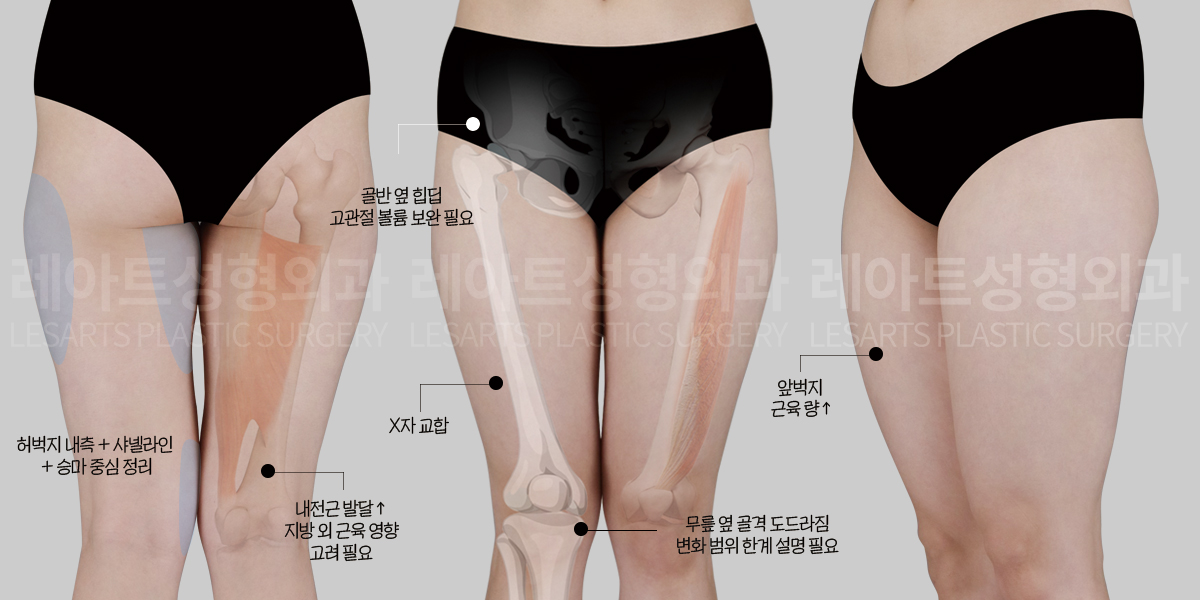
[Before Thigh Liposuction & Hip Fat Grafting: Inner Thigh Fat and Hip Dips - Lesarts Plastic Surgery]
The patient was 169 cm, 58.4 kg, with a BMI of 20.4,
and had been maintaining her current weight without major fluctuations.
What bothered her most was
the thickness of her inner thighs.
In addition, she wanted to improve the sunken hip dips along the sides of her pelvis
to bring out the curve flowing from her waist to her hips.
Upon examination,
sufficient fat was distributed in her inner thighs and outer saddlebags,
and the muscles across her thighs
were also relatively well-developed.
In particular, due to her knock-kneed (X-shaped) leg alignment and
the influence of developed adductor muscles,
we determined that even after reducing inner thigh fat,
there would be a limit to creating
a completely straight leg line.
On the other hand, the outer thigh saddlebags
were in a condition where the protruding fat
could be sufficiently refined.
Furthermore, we judged that supplementing the sunken hip dip area
with hip fat grafting
could create a significant change in the line flowing from the waist
to the hips and outer thighs,
so we planned both procedures together.
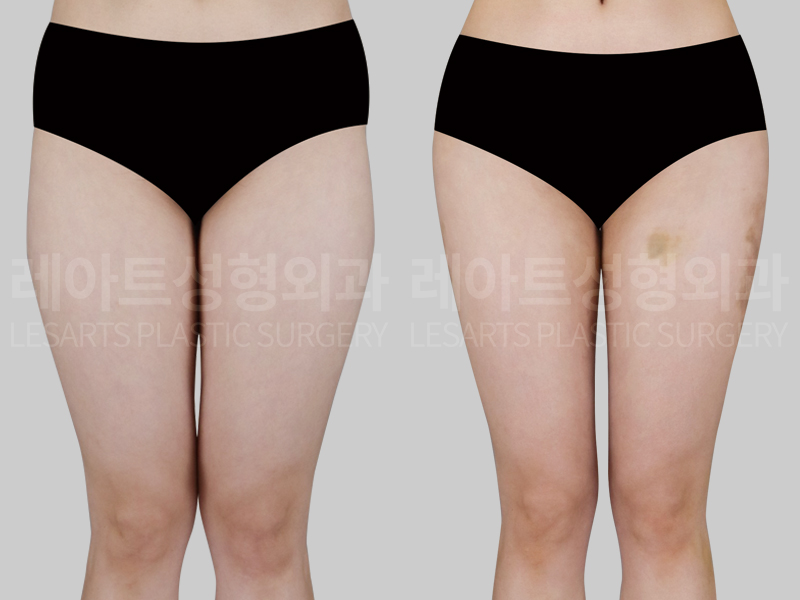
[2 Weeks After Thigh Liposuction & Hip Fat Grafting: Changes in Inner Thighs and Hip Line - Lesarts Plastic Surgery]
This comparison shows her before surgery and 2 weeks after.
Although it is still an early recovery period with considerable swelling remaining,
the difference in contour before and after surgery is already visible.
As the inner thigh volume—which concerned the patient most—decreased,
space between her previously touching legs began to appear.
As the outward-protruding saddlebags were also refined,
you can see that the overall horizontal width of her thighs has decreased.
In addition, in the sunken hip dip area along the sides of her pelvis,
the lacking volume was filled through hip fat grafting.
As a result, a shape was created where the starting point of the lower body
appears to flow from relatively higher up,
bringing a noticeable change to her overall proportions.
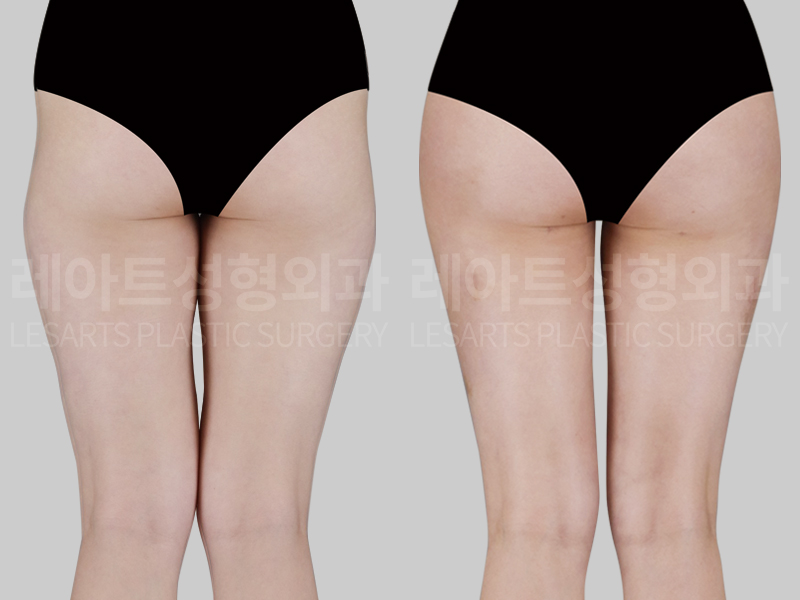
[2 Weeks After Thigh Liposuction & Hip Fat Grafting: Changes in Saddlebags and Hip Line - Lesarts Plastic Surgery]
From the back view as well, changes in both the saddlebags and hip area are visible together.
Before surgery, because the sides of her pelvis dipped inward,
the line flowing from the buttocks to the thighs
looked broken in the middle.
After supplementing volume in the hip dip area,
the sunken side hip line was filled in, and the hip contour
changed into a fuller, continuous curve.
Because we did not simply fill the hip dips,
but also reduced the volume of the outer saddlebags at the same time,
the difference in the outer contour flowing from the hips to the thighs is even clearer.
[Inner Thigh Liposuction Considering X-Shaped Lower Body Alignment - Lesarts Plastic Surgery]
Because the patient had knock-kneed (X-shaped) leg alignment,
approaching the surgery by aggressively removing as much inner fat as possible
could have made her underlying skeletal characteristics stand out even more.
Therefore, while adjusting the suction depth
so that skeletal features would not be emphasized,
we reduced the thickness of the inner thighs
while keeping the inner line neat
without an overly sharp inward angle.

[2 Weeks After Hip Fat Grafting: Changes in Hip Dips and Side Hip Line - Lesarts Plastic Surgery]
As the outward-protruding saddlebags decreased
and volume was added to the sunken hip dip area above them,
you can see the connecting line from the waist to the hips and thighs
flowing in a smooth curve.
Although she had relatively well-developed thigh muscles,
adjusting both areas with excess fat and areas lacking volume together
also reduced the heavy impression of her overall lower body.
Considering that 2 weeks after surgery is a time when considerable swelling and bruising still remain,
this stage should be viewed as checking initial changes
rather than judging the final line.
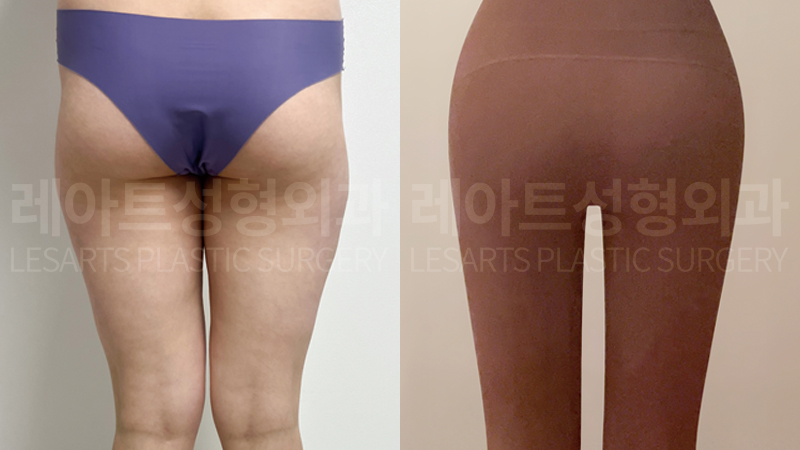
[Back View Comparison: Before Surgery vs. 4.5 Months After - Lesarts Plastic Surgery]

[Front View Comparison: Before Surgery vs. 4.5 Months After - Lesarts Plastic Surgery]
In photos taken by the patient herself after the recovery period,
the changes in the areas that concerned her before surgery are clearly visible.
As the thickness of her inner thighs decreased,
the space between her legs became more visible than before,
and as the hip dips on the sides of her pelvis were filled,
the curve flowing from her waist to her hips
also appears more defined than before.
What the patient expressed the greatest satisfaction with
was not simply that her thigh size decreased.
She expressed satisfaction that the very proportion connecting her hips and thighs changed,
making her overall lower body line look longer
and more balanced.
Among those considering thigh liposuction,
there are cases where areas they want to reduce
and areas lacking volume that they want to fill
exist at the same time.
If the inner thighs and saddlebags are thick
while the hip dips along the sides of the pelvis dip deeply inward,
the volume difference between each area
can prevent the outer lower body line from flowing smoothly
and make you self-conscious about your body shape even when wearing clothes.
In such cases, rather than focusing simply on
removing as much thigh fat as possible,
you can assess the current thigh fat distribution and hip line together
and approach it by refining areas with excess fat
while supplementing areas lacking volume.
In particular, because bone structure and muscles also influence the lower body line,
it is important to distinguish between
changes achievable through liposuction alone and areas that can be supplemented
when fat grafting is combined.
If you are concerned about hip dips along with inner thigh fat or saddlebags,
we recommend thoroughly assessing your current body shape, fat distribution, and desired lower body line
and consulting on the scope of thigh liposuction and hip fat grafting
together.
[ View More Lesarts Thigh Liposuction Cases ]
Thigh Liposuction & Hip Fat Grafting FAQ
Q1. Do thigh liposuction and hip fat grafting always need to be done together?
Both procedures are not necessary in every case.
If fat is concentrated in the thighs while hip dips along the sides of the pelvis also make
the overall line look broken, addressing both areas together can be considered.
Q2. Can hip fat grafting make legs look longer?
When the sunken area along the sides of the pelvis is supplemented,
the starting point of the outer contour flowing from the waist to the hips and thighs
can appear higher, which may make lower body proportions look different.
Q3. Can knock-kneed (X-shaped) legs become stick-straight with thigh liposuction?
When bone structure or muscles have a large influence,
there is a limit to creating a completely straight shape with liposuction alone.
It is necessary to assess both fat distribution and bone structure together
and refine the line within a range that does not overly highlight existing skeletal features.
Q4. Does removing all saddlebags make the hip line prettier?
Not necessarily. It is important to assess the overall proportions connecting
not only the saddlebags, but also the pelvis, buttocks, and thighs,
as removing even necessary volume can make the connecting line look unnatural.
Q5. Does the volume after hip fat grafting stay the same permanently?
Some of the grafted fat may be absorbed during the initial recovery process,
and the final retention rate varies from person to person.
Actual fat survival is evaluated by monitoring progress over a certain period.
#Liposuction #Etc
#Thigh
#BMIbelow30(thigh)


Cases finding
similar to my profile
Customer Diagnostics


Select the surgery and
area you are interestedto see real
before andafter changes.


we
make you,
the art
Clinic hours
MON - FRI
10 am – 7pm
SAT
10 am – 4pm
Holiday
SUN, HOLIDAY
Location
Lesarts Moon Clinic Tower 4-5F, 40, Nonhyeon-ro 168-gil,
Gangnam-gu, Seoul, Republic of Korea

Medical institution name Lesarts Plastic Surgery
Address Lesarts Moon Clinic Tower 4-5F, 40, Nonhyeon-ro 168-gil, Gangnam-gu, Seoul, Republic of Korea
Representative Moon sung jun
