




Online Consultation
Please accurately enter the information below.
Quick Cost Consultation
Quick Consultation & Reservation
Cases finding
similar to my profile






Cases finding
similar to my profile
Customer Diagnostics
Is Gland Removal Alone Enough for Male Gynecomastia Surgery? | Lesarts Plastic Surgery, Gangnam, Seoul, Korea
2026-11-02
Male Gynecomastia Surgery: Is Glandular Removal Alone Enough?
Q. If it is true gynecomastia, is removing only the developed glandular tissue enough?
A. Removing glandular tissue can reduce chest size and protrusion,
but if fat remains around it or if indentation or adhesion occurs
where the gland used to be, the chest line may not look smooth.
Therefore, it is important to check both the current fat distribution and remaining tissue
to decide whether to combine liposuction and tissue rearrangement.
[ Learn More About Lesarts Male Gynecomastia Surgery Cases ]
Gynecomastia surgery is a procedure that reduces chest size and protrusion
by removing overgrown glandular tissue.
However, just as important as removing the glandular tissue
is predicting how the chest shape will change
afterward.
Because the space where the glandular tissue used to sit becomes empty,
the skin can dip inward,
or it can adhere unevenly to surrounding tissue,
making the chest surface look bumpy.
Also, if only the gland is removed,
even though chest size decreases, remaining fat around the area
can leave the overall shape or the line flowing into the lower chest
looking less refined.
Therefore, gynecomastia surgery is not just about removing developed glandular tissue;
it is important to smoothly rearrange the remaining tissue
and consider the chest line connecting naturally with surrounding areas.
[Before Male Gynecomastia Surgery in His 30s: Protrusion Around the Nipple/Areola and Chest Shape - Lesarts Plastic Surgery]
This patient was a man in his 30s
whose gynecomastia symptoms first appeared in his 20s.
Although there was no major change in chest size after symptoms began,
the forward-protruding shape around the nipple and areola remained,
and he shared that over time, the discomfort he felt in daily and social life
grew larger.
Even though he continued weight management and chest exercises,
there was no change in this chest shape, so he visited us for surgery.
[Gynecomastia Surgery Patient Information]
Age: 30s
Height / Weight: 185 cm / 78.4 kg
BMI: 22.9
Gynecomastia Diagnosis: True Gynecomastia, Simon Grade 2A
Skin Condition: Mild skin laxity, no chest sagging
Notes: Taking hair loss medication (finasteride, minoxidil)
[Gynecomastia Surgical Plan Considering Nipple/Areola Protrusion and Glandular Tissue Development - Lesarts Plastic Surgery]
Looking at his chest before surgery,
he did not have a body type with a lot of fat overall.
However, because the area around the nipple and areola stood out forward,
protrusion in the center of the chest appeared emphasized.
Upon palpation, a firm lump
was felt beneath both areolas,
and ultrasound examination confirmed
developed fibrous glandular tissue in that area.
Skin laxity was mild and there was no distinct chest sagging,
so visually he was diagnosed with Simon Grade 2A true gynecomastia.
Although the patient did not have a very large amount of fat across the entire chest,
the area extending from the side chest to the lower chest
needed liposuction to refine the chest line.
Therefore, we planned the surgery
to perform glandular excision and liposuction together.
In addition, to reduce the risk of skin indentation from the empty space after glandular removal
or an uneven chest surface due to adhesion,
we decided to also perform tissue rearrangement and anti-adhesion treatment at the final stage of surgery.

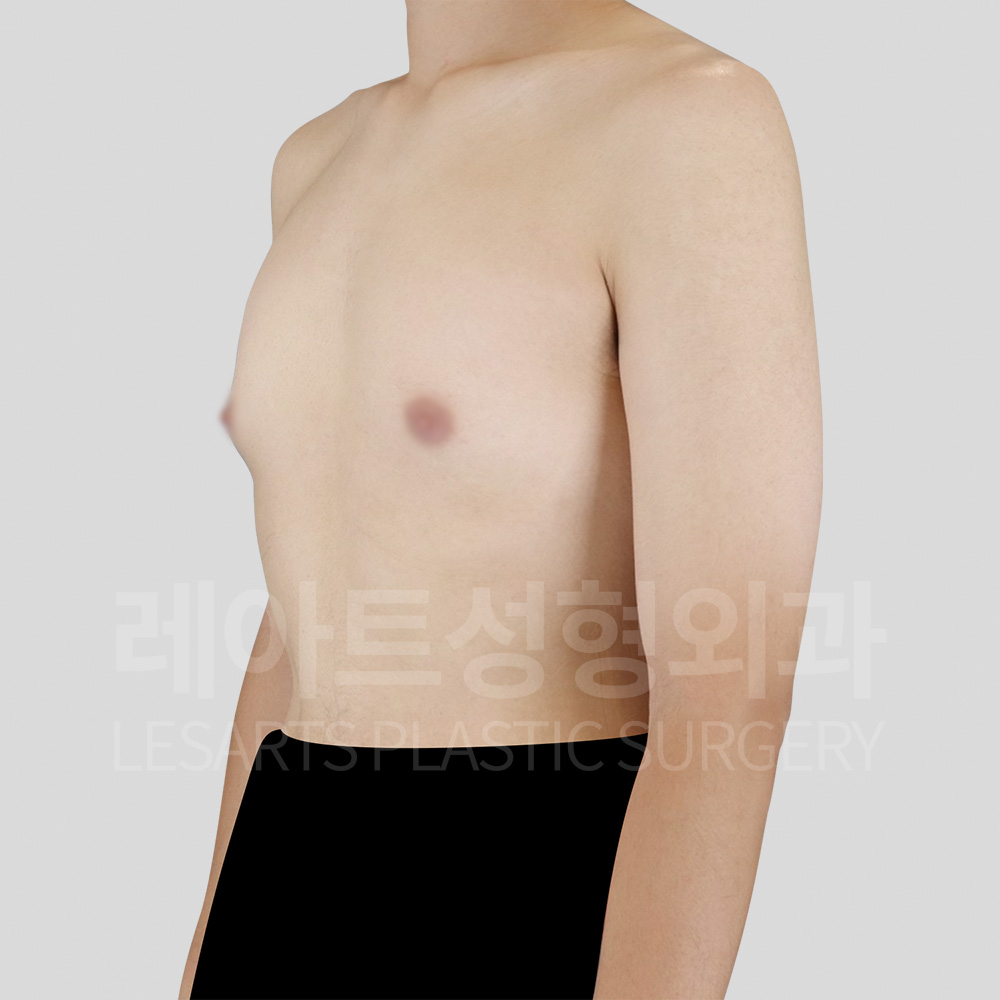
[45-Degree View 13 Days After Male Gynecomastia Surgery in His 30s: Changes in Central Chest Protrusion and Lower Chest Line - Lesarts Plastic Surgery]
Here is how he looks about 13 days after gynecomastia surgery.
As the puffed-up protrusion around the nipple and areola decreased,
you can see that the center of the chest has been smoothed out more gently than before.
Although the patient's overall chest volume was not very large,
the forward-standing area around the areola
had been particularly noticeable.
After surgery, as the prominent volume in the center of the chest decreased,
the line flowing into the lower chest has also become much more naturally refined.

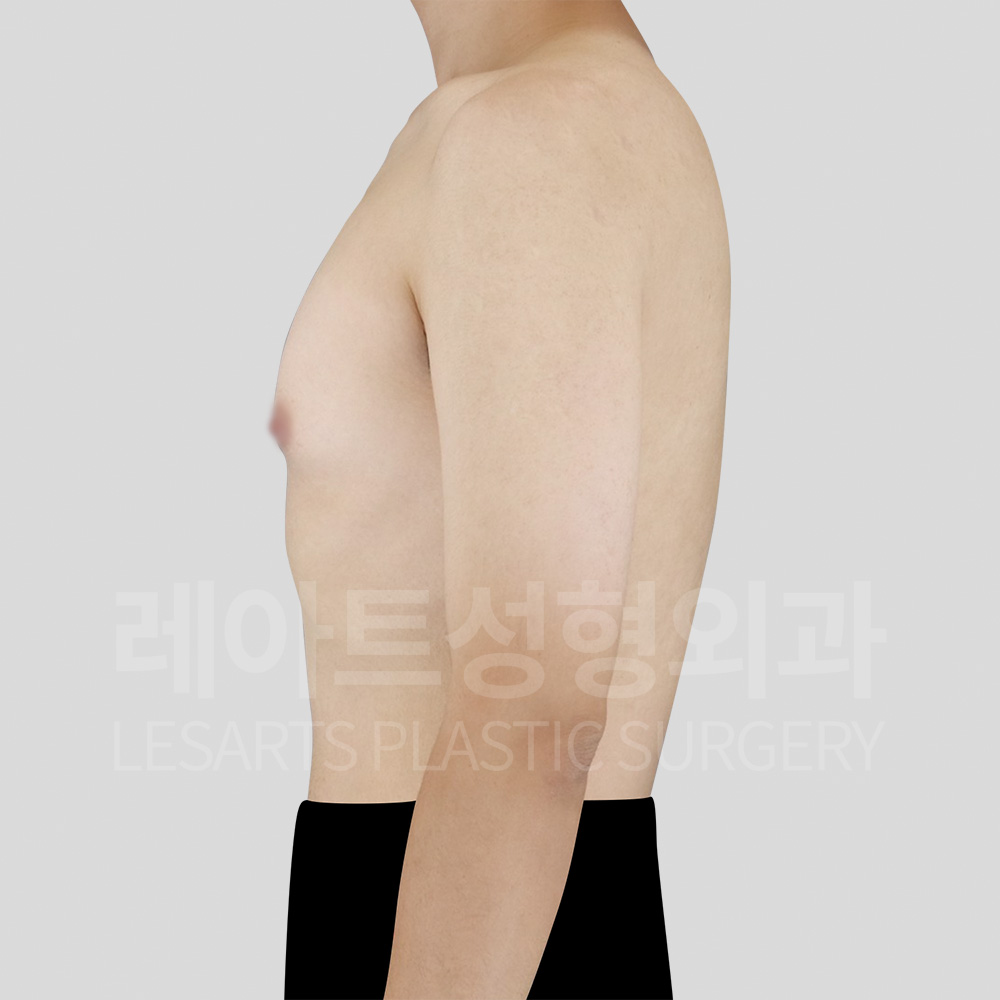
[Side View 13 Days After True Gynecomastia Surgery: Changes in Forward-Protruding Chest Contour - Lesarts Plastic Surgery]
From the side view as well, you can see that the thickness
of the chest that used to protrude forward has decreased.
As protrusion in the center of the chest decreased,
the contour of the front chest also appears clearer than before.

[13 Days After Male Gynecomastia Surgery in His 30s: Changes in Chest Protrusion Under a T-Shirt - Lesarts Plastic Surgery]

[Front Chest Line Changes When Wearing a T-Shirt Before and 13 Days After True Gynecomastia Surgery]
Even when wearing a T-shirt,
you can see the reduction in central chest protrusion
that used to show through clothing before surgery.
In gynecomastia surgery, smoothing the chest surface
and creating a chest shape that suits your overall body frame
is just as important as reducing chest size.
Especially even after removing glandular tissue,
so that the curve from around the nipple and areola to the lower chest
connects naturally,
both the condition of the remaining tissue
and the overall chest shape must be considered together.
[Why Gynecomastia Surgery Doesn't End with Glandular Removal Alone]
In true gynecomastia,
removing the overgrown glandular tissue is an important step.
However, when considering the chest shape after surgery,
removing only the glandular tissue may not be enough.
As the space where the gland used to be becomes empty,
the skin can dip inward or adhesions can form,
and if fat remains around it, even though the center of the chest is reduced,
the transition to the side chest or lower chest can look awkward.
Therefore, it is necessary to check not only the extent of the current glandular tissue,
but also the surrounding fat distribution and the condition of the remaining tissue.
When contouring is needed in the area flowing from the side chest
to the lower chest, as in this patient's case,
glandular excision and liposuction can be combined,
and if needed, tissue rearrangement and anti-adhesion treatment can also be applied
to plan a surgery that connects the entire chest contour smoothly.
If you have been experiencing discomfort for a long time due to chest protrusion or shape,
we recommend getting an accurate diagnosis and consulting about
the gynecomastia surgery method suited to your current chest condition.
Gynecomastia Surgery FAQ
Q1. In true gynecomastia, is it enough to remove only the glandular tissue?
Even if glandular tissue is the main cause, if fat is also distributed around it,
removing only the gland may not sufficiently refine the overall chest line.
Fat distribution is checked, and liposuction is combined if necessary.
Q2. Can the chest dip inward after gynecomastia surgery?
Because the area where glandular tissue used to be becomes empty, the skin may indent or adhere to surrounding tissue.
To reduce this, adjusting and rearranging the remaining tissue can be considered.
Q3. Is liposuction still performed even if there isn't much fat across the whole chest?
Even if overall fat volume is not large, if remaining fat in the side chest or lower chest
affects the overall chest contour, liposuction focusing on those areas can be combined.
Q4. Why is tissue rearrangement performed in gynecomastia surgery?
After removing glandular tissue, it can be performed to adjust the remaining tissue
so the center of the chest does not look indented or uneven,
connecting the overall chest line naturally.
Q5. Is 13 days after gynecomastia surgery the final result?
Thirteen days is still an early recovery period. Since swelling or tissue changes may still remain,
it is necessary to monitor the recovery process afterward to see how the chest contour settles.
We recommend getting an accurate diagnosis and consulting about the gynecomastia surgery method suited to your current chest condition.
#Male body contouring
#Gynecomastia
#Grade2-A #true gynecomastia


Cases finding
similar to my profile
Customer Diagnostics


Select the surgery and
area you are interestedto see real
before andafter changes.


we
make you,
the art
Clinic hours
MON - FRI
10 am – 7pm
SAT
10 am – 4pm
Holiday
SUN, HOLIDAY
Location
Lesarts Moon Clinic Tower 4-5F, 40, Nonhyeon-ro 168-gil,
Gangnam-gu, Seoul, Republic of Korea

Medical institution name Lesarts Plastic Surgery
Address Lesarts Moon Clinic Tower 4-5F, 40, Nonhyeon-ro 168-gil, Gangnam-gu, Seoul, Republic of Korea
Representative Moon sung jun
