




Online Consultation
Please accurately enter the information below.
Quick Cost Consultation
Quick Consultation & Reservation
Cases finding
similar to my profile






Cases finding
similar to my profile
Customer Diagnostics
Why Can a Face Look Flat Even With Full Cheeks? 2-Week Facial Fat Grafting Results | Lesarts Plastic Surgery, Gangnam, Seoul, Korea
2026-11-03
Why Faces Look Flat Even with Cheek Fat: Before and After Facial Fat Grafting
Q. Can my face still look flat and tired even if I have a fair amount of cheek fat?
A. Facial dimensionality is not determined solely by how much
or how little fat you have.
If volume is lacking in specific areas like the forehead or front cheeks,
the center of the face can feel flat
and the horizontal width may appear wider.
In such cases, grafting fat into the deficient areas
to naturally connect the facial contours can be considered.
[ Learn More About Lesarts Facial Fat Grafting Cases ]
“I have cheek fat, so why does my face look flat and tired?”
Some patients visit us for facial fat grafting consultations with this exact concern.
Even though they have a fair amount of cheek fat,
their forehead is flat or part of their cheeks is sunken,
making their overall face look flat and tired.
Facial dimensionality is not decided simply by how much fat
is on the face.
Depending on how the volume of each area—such as the forehead and cheeks—connects,
facial contours and overall impression can change significantly.
Therefore, in facial fat grafting,
rather than simply filling in sunken spots,
it is important to naturally connect the facial curves
to create a softer, more vibrant impression
while balancing overall volume
so that the face appears relatively slimmer.
In this post, through an actual case,
we will look at how the dimensionality of the forehead and cheeks
changed after facial fat grafting.

[Before Facial Fat Grafting: Surgical Plan Considering Forehead and Cheek Dimensionality - Lesarts Plastic Surgery]
Looking at her before surgery,
the patient had a fair amount of cheek fat.
However, the center of her forehead was somewhat sunken,
and from the side view,
the forehead line flowing from the brow bone to the upper hairline
was relatively flat and sloped back.
Although her front cheeks were not severely sunken,
their volume did not stand out much.
Her cheekbone area also felt somewhat flat,
making her overall facial line look wide horizontally.
Therefore, in this facial fat grafting procedure, we planned to add rounded volume to the forehead
and create a facial contour that connects naturally
through the front cheeks, side cheeks, and around the nasolabial folds.

[2 Weeks Before and After Facial Fat Grafting: Dimensionality Changes Added to Front and Side Cheeks - Lesarts Plastic Surgery]
Comparing from the 45-degree angle, it is easy to see the volume added
to the front cheeks and side cheeks.
Before surgery, even though she had cheek fat,
dimensionality below the cheekbones and in the center of the face
did not stand out.
After fat grafting, as balanced, non-excessive volume was added,
the curve flowing from the center of the face outward
connects much more naturally than before.
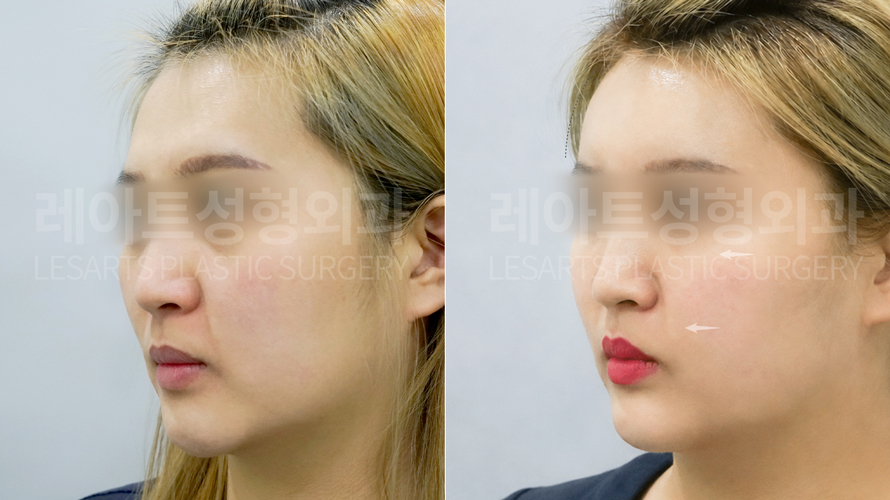
[2 Weeks Before and After Facial Fat Grafting: Rounded Curve of Previously Flat Forehead and Front Cheek Volume Changes - Lesarts Plastic Surgery]
From the side view, as volume was added to the forehead line
that had been relatively flat before surgery,
you can see that the line flowing from the hairline to the center of the forehead, glabella, and nose tip
connects more naturally than before.
In particular, before surgery, the center of her forehead was low,
making her brow bone look relatively more prominent.
As forehead volume was supplemented, her previously strong impression
also softened compared to before.
For the cheeks as well, as balanced volume was added to the gentle curve below the cheekbones,
an overall vibrant impression appeared.
In addition, as the facial line extending down to the chin was refined,
you can see that the area around her mouth also changed naturally.
The patient also expressed satisfaction that as volume in her forehead and cheeks was supplemented,
her overall facial contour became softer and gained a more dimensional image.
Just because you have some fat on your face
does not mean volume is evenly filled in every area.
As in this case, even if you have cheek fat,
if the center of your forehead is flat
or dimensionality in the front and side cheeks does not show enough,
the entire face can feel wide and flat.
Therefore, when planning facial fat grafting,
rather than focusing solely on adding volume to the face,
it is important to check which areas are relatively lacking
and how the volume of each area should connect
to look natural.
If you are concerned that your face looks flat and tired
due to a flat forehead or lack of cheek dimensionality,
we recommend accurately diagnosing your current facial shape and volume by area
and consulting about the facial fat grafting method
that suits you.
[ Learn More About Lesarts Facial Fat Grafting Cases ]
Facial Fat Grafting FAQ
Q1. Can I get facial fat grafting even if I have cheek fat?
More important than total facial fat is checking the balance of volume by area.
Even if you have cheek fat, if volume is lacking in specific areas like the forehead or front cheeks,
fat grafting focusing on those areas can be considered.
Q2. Won't forehead fat grafting make my face look bigger?
Adding needed volume to the center of the forehead connects a previously flat forehead
in a rounded curve, changing the dimensionality of the face.
The grafting range and amount should be adjusted to match your existing facial shape.
Q3. Can front cheek fat grafting make my face look chubbier?
Rather than placing a large amount of fat into the front cheeks blindly,
volume is adjusted according to how much is lacking.
When appropriate dimensionality is added to the center of the face,
the horizontal width can actually appear narrower.
Q4. Is 2 weeks after facial fat grafting the final result?
Two weeks is still an early stage for checking progress.
As swelling subsides and the grafted fat stabilizes over time,
facial volume and contours can continue to change.
Q5. Is facial fat grafting only for filling in sunken areas?
Beyond simply filling sunken areas, it can also be performed to connect the volume of each area—
such as the forehead, front cheeks, and side cheeks—to adjust overall facial contours
and dimensionality.
#Etc


Cases finding
similar to my profile
Customer Diagnostics


Select the surgery and
area you are interestedto see real
before andafter changes.


we
make you,
the art
Clinic hours
MON - FRI
10 am – 7pm
SAT
10 am – 4pm
Holiday
SUN, HOLIDAY
Location
Lesarts Moon Clinic Tower 4-5F, 40, Nonhyeon-ro 168-gil,
Gangnam-gu, Seoul, Republic of Korea

Medical institution name Lesarts Plastic Surgery
Address Lesarts Moon Clinic Tower 4-5F, 40, Nonhyeon-ro 168-gil, Gangnam-gu, Seoul, Republic of Korea
Representative Moon sung jun
