




Online Consultation
Please accurately enter the information below.
Quick Cost Consultation
Quick Consultation & Reservation
Cases finding
similar to my profile






Cases finding
similar to my profile
Customer Diagnostics
Tummy tuck after childbirth: 3-month comparison of loose skin and diastasis recti correction
2025-04-08
Changes in abdominal shape
after childbirth are a common concern
for many women.
During pregnancy, the abdominal skin
and rectus muscles rapidly stretch.
After delivery, the sudden decrease in size
leads to decreased skin elasticity
and weakened abdominal wall muscles,
resulting in stretched rectus abdominis
that visibly alters the belly’s appearance.
As time passes,
many notice that the upper belly sags
and the abdominal center loses support,
causing a drooping or collapsed look.
This type of change has its limits
when it comes to natural recovery,
and it's especially difficult
to restore loose skin and diastasis recti
with only exercise or weight loss.
For this reason,
an increasing number of patients
consider a tummy tuck
after childbirth or surgery
to treat loose abdominal skin
and restore the collapsed midsection.
A tummy tuck is a lifting procedure
focused on reshaping the waistline,
and is very different from liposuction,
which targets size reduction.
It removes loose skin
and sutures the separated abdominal muscles
to rebuild core structure
and restore overall body balance.
In this post, we’ll take a close look
at a patient case
who experienced abdominal laxity
and structural damage,
and see how a tummy tuck
can improve both bodyline and core function
at the same time.
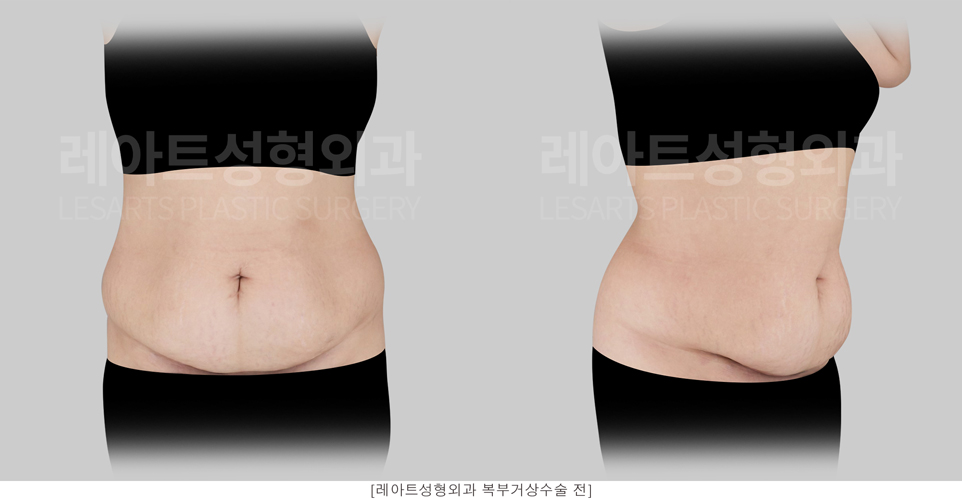
The patient in this tummy tuck case
is a woman in her 50s
who experienced three natural deliveries.
After the first childbirth in her 20s,
she had no major body shape concerns,
but after delivering two more children in her 40s,
she began to notice significant skin laxity
and abdominal sagging caused by decreased elasticity.
Later, she underwent a general surgery
due to health issues,
which led to adhesions and tissue damage
within the abdomen.
When she visited us for consultation,
she had also recently gained around 10kg,
which added weight to her midsection
and worsened the loose abdominal skin.
The abdominal wall had become sunken and weak,
causing the upper belly center to collapse
and lose its structure entirely.
Due to long hours sitting at her office job,
she had developed diastasis recti
and navel asymmetry caused by constant intra-abdominal pressure.
She also had a naturally protruding rib cage,
which made the abdominal contour look
even more irregular and unbalanced.
On top of this, she had fat deposits
not just on the front of her belly,
but also around the sides and lower back,
which contributed to a heavier-looking body shape
that she found extremely stressful.
She realized that exercise and dieting alone
would not resolve these underlying issues
and came to our clinic
seeking a comprehensive solution
to strengthen the abdominal muscles
and remove loose, sagging skin
through surgery.
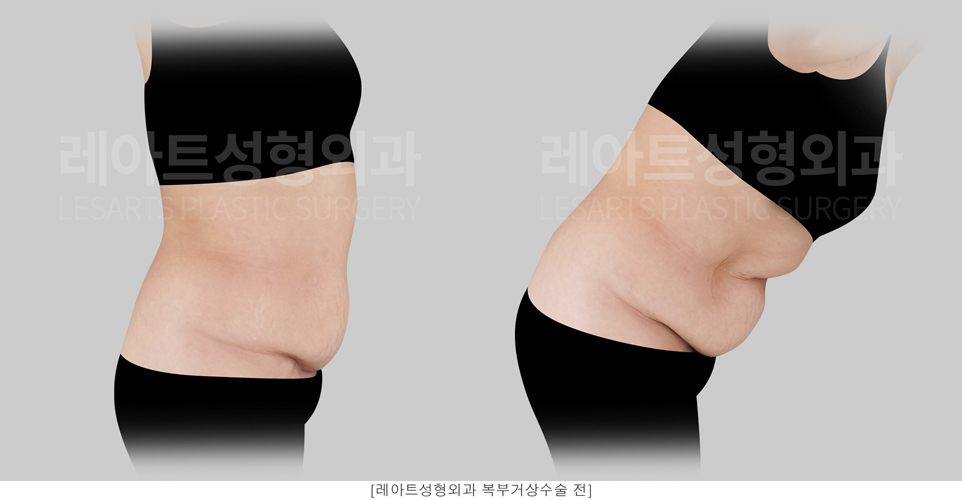
Before planning the tummy tuck surgery,
we thoroughly evaluated the patient's condition.
The abdominal skin had significantly lost elasticity,
and due to a history of previous abdominal surgeries,
there was severe internal tissue adhesion throughout the area.
She also had diastasis recti,
causing the abdominal center to collapse,
with visible rib cage protrusion on the upper torso,
while most abdominal volume was pulled downward,
creating an imbalance between the upper and lower belly.
The loose skin stretched from the upper abdomen
down to below the navel, and the weakened abdominal wall
was pushing the belly outward in a bulging shape.
In terms of proportions,
the rib cage appeared broad while the waist seemed low,
making the upper and lower body appear mismatched.
Fat accumulation around the abdomen and waist
further blurred her natural waistline.
Additionally, the sagging skin that started from the upper abdomen
pulled the navel downwards,
causing it to sit lower than normal.
The area around the belly button also developed wrinkles,
and its shape had noticeably deformed.
Given these findings,
we recommended a tummy tuck combined with diastasis recti repair
to remove the sagging skin from the upper to lower abdomen
and restore core support and firmness from the muscle layer.
As part of the abdominal lift,
we also planned to reshape and reposition the deformed belly button,
realigning it with its original stem
and matching it harmoniously to the corrected waist level.
To complete the contouring,
we also proposed liposuction for the front abdomen, flanks,
and lower back fat to create a refined, 3D silhouette.
Below are the medical photos taken
before surgery and at the 3-month post-op mark.
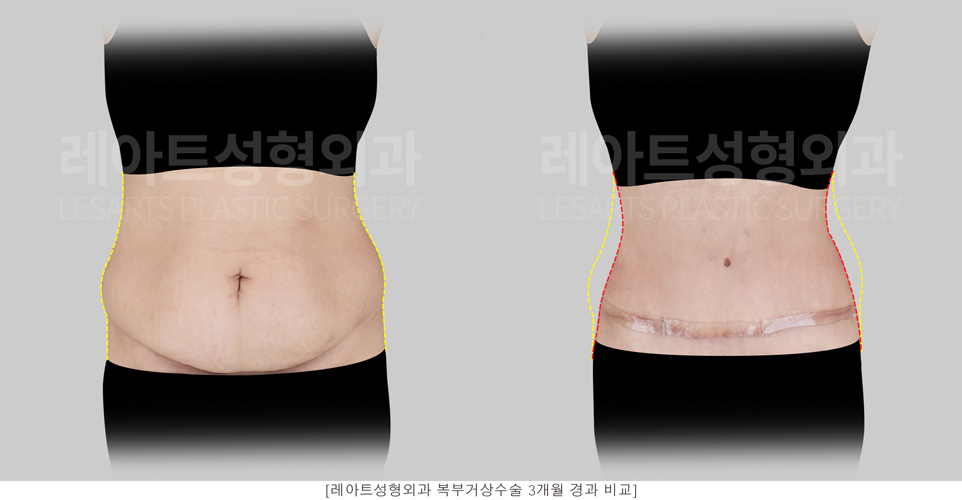
At the 3-month post-op check for this tummy tuck surgery,
we compared before and after photos
to assess the recovery and results.
Before surgery, the lower abdomen showed
significant skin sagging with deep folds,
and the waist curve was not visible,
making the upper and lower body proportions look imbalanced.
The diastasis recti had weakened the abdominal core,
causing the midsection to collapse,
and the belly button area was asymmetrical.
The entire abdomen appeared bulky and uneven,
with a blunt, heavy impression.
Through the combination of tummy tuck and abdominal muscle repair,
we lifted and flattened the sagging lower belly,
tightened the abdominal wall,
and significantly improved the skin laxity,
resulting in a smoother, firmer abdominal contour.
Importantly, the excess skin above the belly button
was removed, and a new navel shape was created
at an ideal position through belly button correction,
restoring overall visual balance and proportion.
In addition, liposuction was performed on the front abdomen,
enhancing the slim appearance and
creating a tighter waistline,
which gave the patient a much more youthful and defined figure overall.
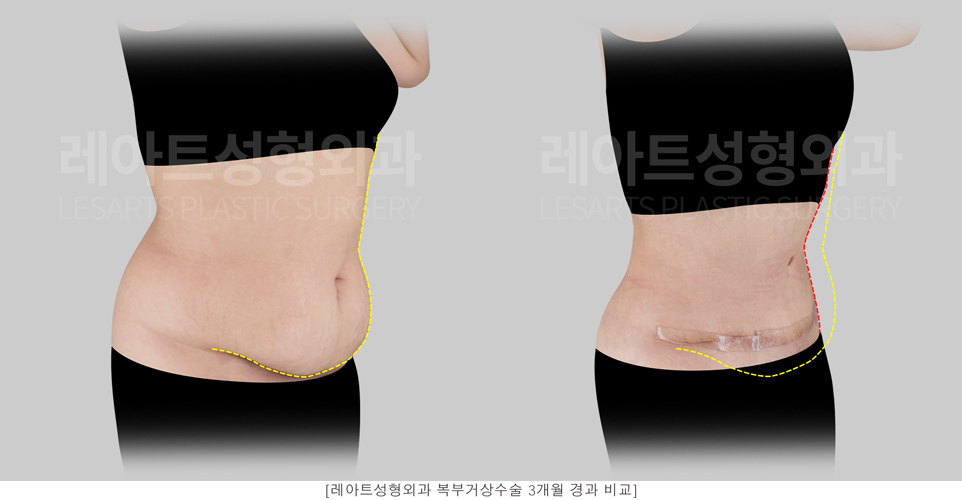
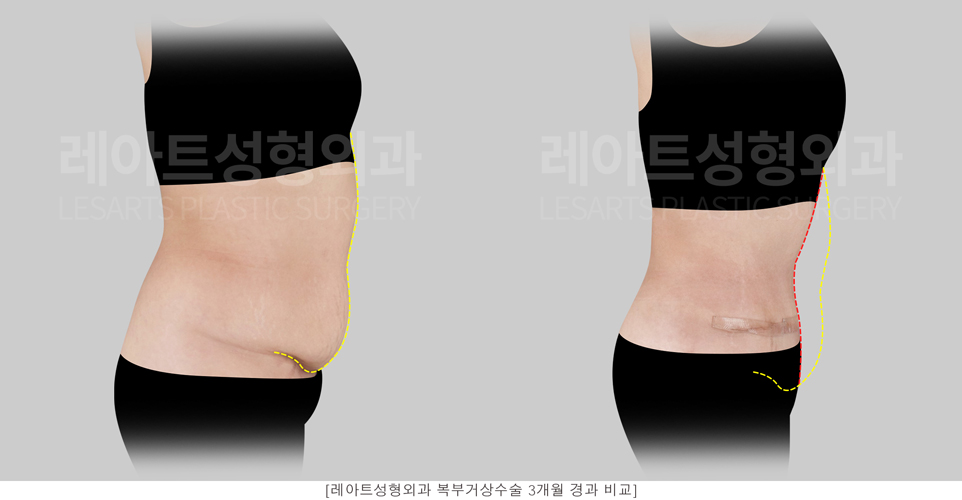
From the side view, the patient's
tummy tuck surgery results are even clearer.
The abdominal contour and volume changes,
which were less noticeable from the front,
become more defined.
Before surgery, the lower belly skin and fat
had drooped forward, creating a bulging,
heavy-looking shape.
The skin folded under itself,
forming thick creases that added to
the visual bulk and imbalance.
At the 3-month post-op check,
the severely sagging lower abdomen
was lifted and tightened,
and the excess volume was reduced.
The result is not only a flattened abdomen,
but a more centered and balanced upper body line
with a stable silhouette and improved posture.
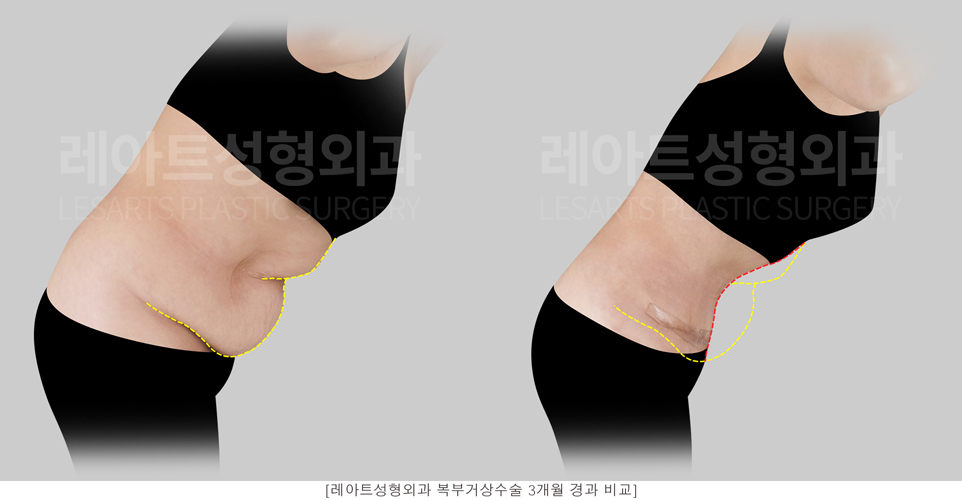
From the forward-bending view,
the tummy tuck results show a dramatic change.
Before surgery, the lower belly skin and fat
dropped downward without resistance,
forming multiple deep folds at the bottom of the abdomen.
These skin folds not only caused cosmetic concerns,
but also led to discomfort due to
trapped sweat and skin irritation,
making daily life stressful.
At 3 months post-op,
the sagging skin was removed,
and the abdominal wall support was restored
through diastasis repair,
allowing the abdominal line to hold firm
even in a bent posture,
without drooping or folding.
In particular, the tummy tuck incision
was made low along the deep bikini line,
minimizing exposure and contributing greatly
to the patient’s overall satisfactio
Before surgery, the patient had undergone
three pregnancies and deliveries,
along with abdominal surgery,
which led to a significant loss of abdominal elasticity.
Combined with rectus diastasis
and tissue adhesion,
the central abdominal line had collapsed.
In the lower abdomen, the sagging skin and fat
added visible bulk and heaviness,
while the navel appeared asymmetrically low,
making the entire body line unbalanced.
The folded skin caused additional
discomfort and inconvenience.
To address both external appearance
and structural abdominal issues,
a customized surgical plan was performed—
including abdominoplasty,
rectus muscle plication,
umbilicoplasty, and liposuction.
At 3 months post-op,
the central abdomen has been corrected
to a firmer and more defined shape.
Now, the body shows stable proportions
with a smooth silhouette,
providing both functional and aesthetic satisfaction.
The surgical scar from the abdominoplasty
is healing well, and the patient
has been following proper scar care
and hydration protocols,
so the outcome is expected to continue
improving positively.
Abdominoplasty is not just a cosmetic procedure—
it offers a fundamental solution
to structural changes in the abdomen
caused by childbirth or surgery.
This patient, too, has regained a
balanced waistline and abdominal shape,
restoring confidence in daily life.
The once collapsed and sagging abdomen
has been reshaped,
and a more three-dimensional waistline
has been restored,
relieving long-standing physical and emotional stress.
With regular follow-up checks
and attentive post-op care,
we expect the patient to continue
toward a more stable and satisfying outcome.
#Abdominoplasty
#M-type
#Abdominal liposuction(M)


Cases finding
similar to my profile
Customer Diagnostics


Select the surgery and
area you are interestedto see real
before andafter changes.


we
make you,
the art
Clinic hours
MON - FRI
10 am – 7pm
SAT
10 am – 4pm
Holiday
SUN, HOLIDAY
Location
Lesarts Moon Clinic Tower 4-5F, 40, Nonhyeon-ro 168-gil,
Gangnam-gu, Seoul, Republic of Korea

Medical institution name Lesarts Plastic Surgery
Address Lesarts Moon Clinic Tower 4-5F, 40, Nonhyeon-ro 168-gil, Gangnam-gu, Seoul, Republic of Korea
Representative Moon sung jun
