Even among individuals with a slim body type,
some may find that their lower body appears bulky,
or that the silhouette looks unbalanced when wearing clothes,
making the overall fit seem awkward.
When the lower body feels disproportionately heavy
regardless of actual body weight,
it often stems from imbalanced proportions
and issues with body contour.
Typical examples include excess fat on the inner thighs,
hollows in the hip area (hip dips),
and pronounced saddlebag fat along the outer thighs.
In such cases, even if someone weighs less and
has a smaller actual size, the disproportions
can make their figure appear awkward,
and their leg line may look blunt— creating the impression
of being heavier than they actually are.
Because of this, more people are now considering
body contouring procedures—such as liposuction and fat grafting—
with the goal of improving body proportions.
Rather than focusing solely on size reduction,
these procedures aim to enhance overall balance and shape.
Liposuction helps refine the contours,
while fat grafting fills in underdeveloped areas—
together bringing noticeable transformation to the figure.
[Patient Information]
Age: Mid-30s
Occupation: Office worker
Height: 165 cm
Weight: 55 kg
BMI: 20
Please note: Even with similar body types,
liposuction results may vary.
The case we’ll be reviewing today through before-and-after photos
involves a patient who maintained a slim figure overall,
but was consistently dissatisfied with stubborn inner thigh fat,
unrefined leg lines, and hip dips with noticeable saddlebags—
areas that didn’t improve even with regular exercise.
In particular, as she was preparing for her wedding,
she felt a strong need to refine her lower body silhouette.
That’s why she visited our clinic to undergo
thigh liposuction and hip fat grafting.
After analyzing the patient’s body prior to surgery,
we found that fat was primarily concentrated in the lower body,
with clearly defined areas that required liposuction.
This patient had a body type where the target zones
for fat removal were distinctly outlined.
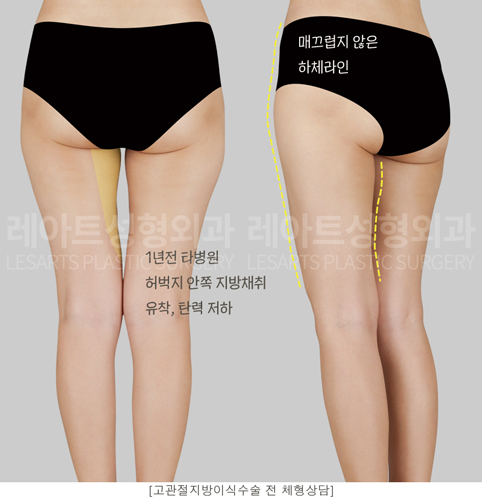
In particular, she had previously undergone
fat harvesting from the inner thighs about a year ago
at another clinic for facial fat grafting.
As a result, there were signs of adhesion
and reduced skin elasticity
in the inner thigh area.
This led to uneven contours and
visible wrinkling in that region,
which required improvement.
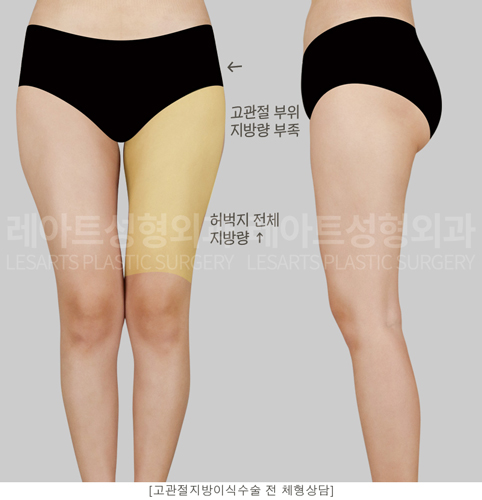
Additionally, the hip area
(lateral pelvis) lacked volume
and had a noticeable dip,
which made the outer thigh fat appear
more prominent and created an unnatural transition
betweenthe pelvis and the thighs.
Because of this, the starting point of the
legs appeared lower, giving the entire lower body
silhouette an uneven and unrefined look.
In cases like this—where both inner thigh fat
and hip dips are present— liposuction alone has
its limitations in achieving the ideal contour.
Therefore, we recommended a combined approach:
thigh liposuction to remove unwanted fat,
and hip fat grafting to fill in volume-deficient areas.
We explained this surgical plan as a way to
simultaneously sculpt and volumize
for a balanced lower body line.
Now, let’s take a look at the changes
in the leg contour through photos taken one month
after the thigh liposuction and hip fat grafting procedures.
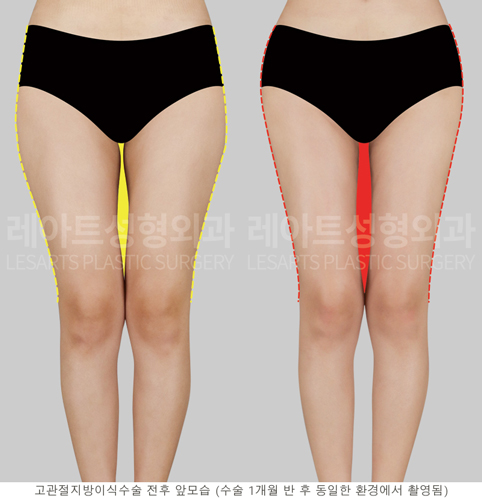
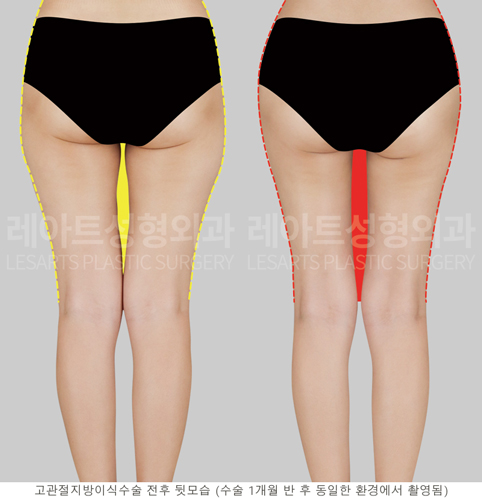
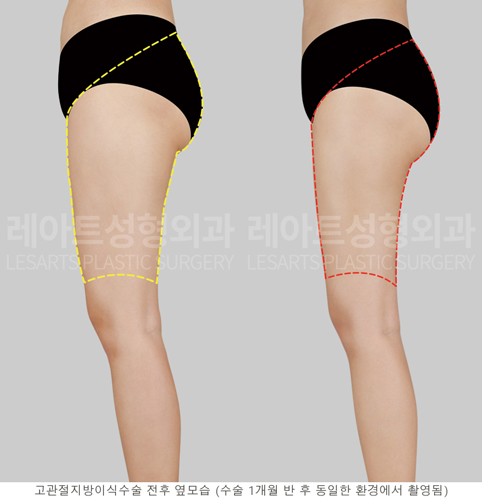
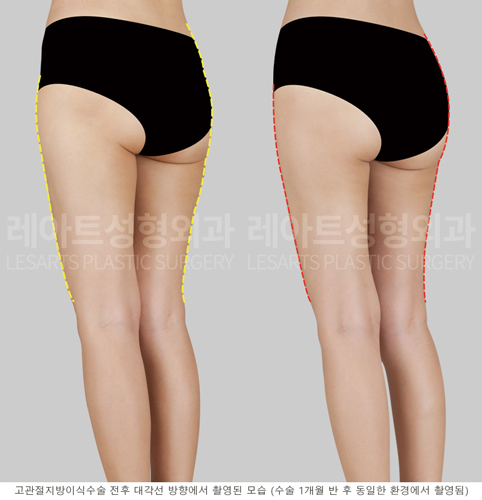
Through thigh liposuction and hip fat grafting,
the patient achieved the slim and well-balanced
leg line she desired, with a natural transformation
in her lower body contour.
Before surgery, the patient had almost no gap
between her thighs due to excess inner thigh fat,
and the presence of some adhesions
resulted in uneven contours.
She also expressed concern about the
lack of volume in her hip area, which made her lower body
appear shorter and less streamlined.
At one and a half months post-surgery,
the fat around the inner and outer thighs
had been effectively removed,
creating a visible thigh gap and
smoothing out the saddlebag area.
In particular, fat grafting added volume to the hip dips,
naturally connecting the line from the pelvis to the thighs.
This also raised the visual starting point of the legs,
creating a proportion-enhancing effect
that made her legs appear longer.
As mentioned earlier, the surgical plan was not
just to create a thigh gap or eliminate saddlebag fat,
but to sculpt a 360-degree ideal lower body
that appears balanced and harmonious from every angle.
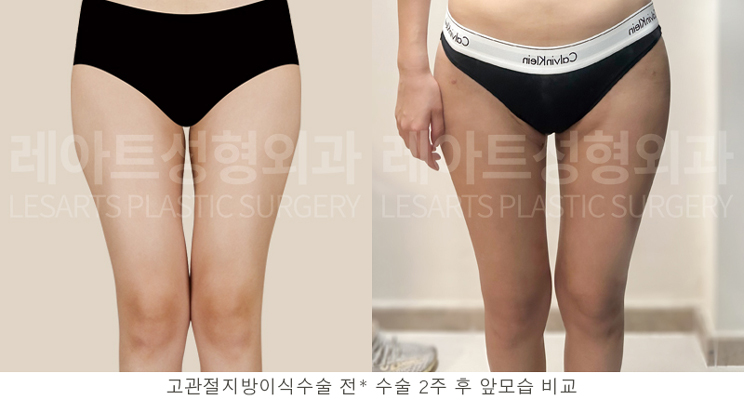
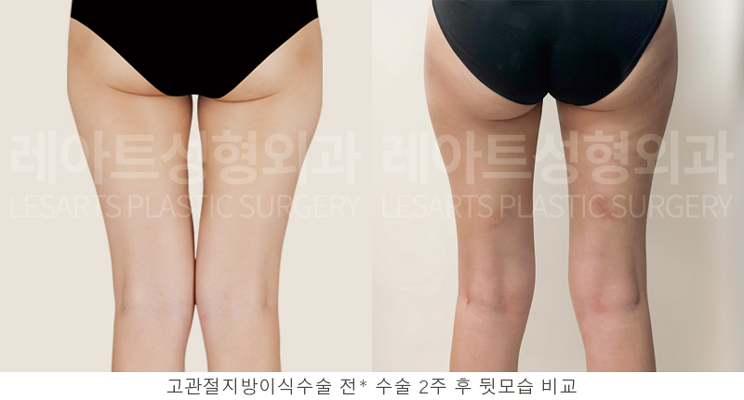
in the selfies taken two weeks after surgery,
the improvement in body proportions
is even more clearly noticeable.
The inner and outer thigh fat was
precisely sculpted into smooth lines
without any unevenness, and a thigh gap was created,
giving the legs a cleaner, more refined shape.
In addition, the hip fat grafting enhanced the pelvic line,
making it appear more feminine and three-dimensional.
The patient also expressed satisfaction
with the overall smoother body line,
and noted that the raised starting point of the legs
made her lower body appear significantly longer.
Although it has been less than two months since surgery,
and some swelling and BioBond material are
still present as part of the recovery process,
the current results already show very positive progress.
We expect that with further healing,
the outcome will become even more natural
and firm in appearance.