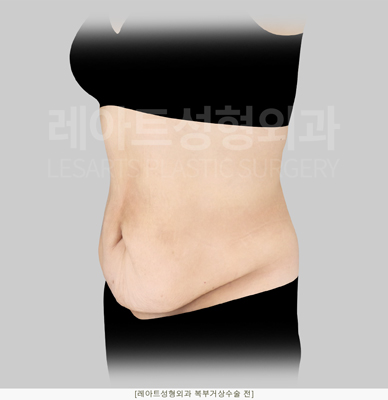
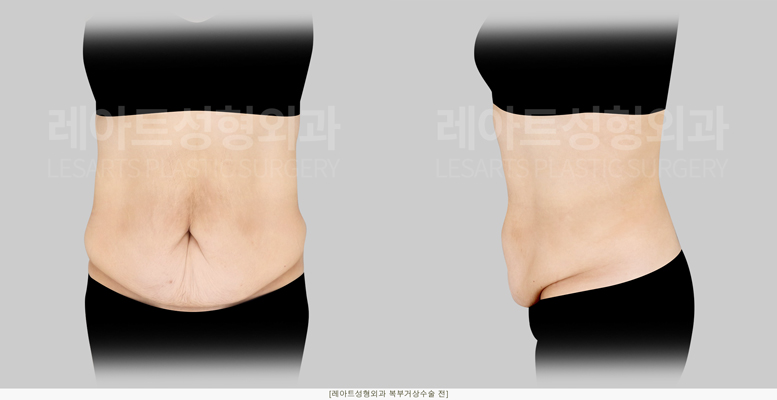
Even after successfully losing weight
through dieting, not all results
are as satisfying as expected.
In cases of significant weight loss
or repeated yo-yo dieting,
skin may lose its elasticity
and not return to its original state—
creating a new kind of discomfort.
Since skin and abdominal wall laxity
are difficult to resolve through dieting alone,
many patients seek out plastic surgery
as a possible solution.
The patient in this case had reached
her goal weight in terms of numbers,
but visited our clinic due to persistent
sagging skin and body contour issues
that dieting alone couldn’t resolve.
This patient in her 30s had maintained
a stable weight through consistent
exercise and dietary control.
However, repeated yo-yo weight fluctuations
left her abdominal skin unable to recover its elasticity,
with noticeable sagging especially in the lower belly,
where the skin would fold over.
The sagging extended to the sides of the waist,
so even slightly fitted clothing would highlight
her waistline and add stress to her daily life.
Realizing that the sagging could not be
corrected through exercise or dieting alone,
she decided to undergo a tummy tuck.
Upon examining the degree of sagging
through consultation, we found that
the lower abdominal area was
significantly affected.
The weight of the skin, combined with gravity,
caused it to droop downward and fold.
From the front, skin beneath the navel
hung vertically, distorting the waistline.
From the side, the lack of elasticity
created a bulging appearance,
making her upper body seem heavier.
There was no clear case of rectus diastasis.
We proposed the following surgical plan
to address the abdominal sagging:
1. M-Type Tummy Tuck
Since the sagging affected the full abdomen,
we planned an M-type tummy tuck
to lift skin from the upper abdomen down
and restore a tighter, more toned contour.
2. Upper Abdominal Liposuction
Though the fat volume was not large,
we included front abdominal liposuction
to create smoother lines and refine
the waistline shape.
Let’s now look at the changes
5 months after the tummy tuck procedure.
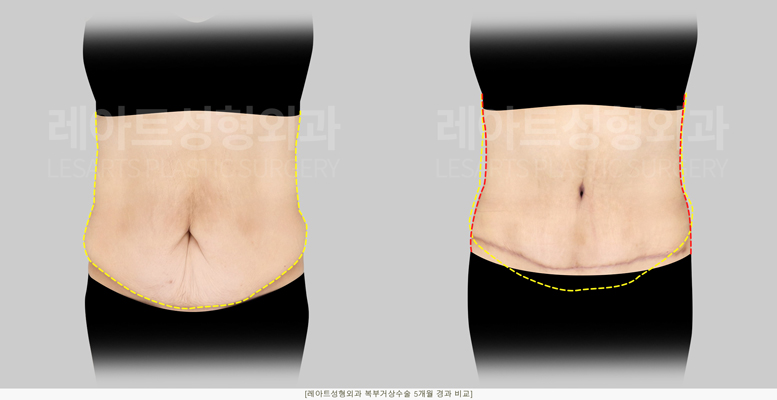
Before surgery, sagging skin below the navel
folded visibly and distorted the abdominal shape.
The navel itself was stretched and misaligned,
and the waist appeared widened,
making the upper body look heavier.
But 5 months after surgery,
the sagging belly skin was lifted,
the navel was reshaped and repositioned,
and the abdomen now appears more defined.
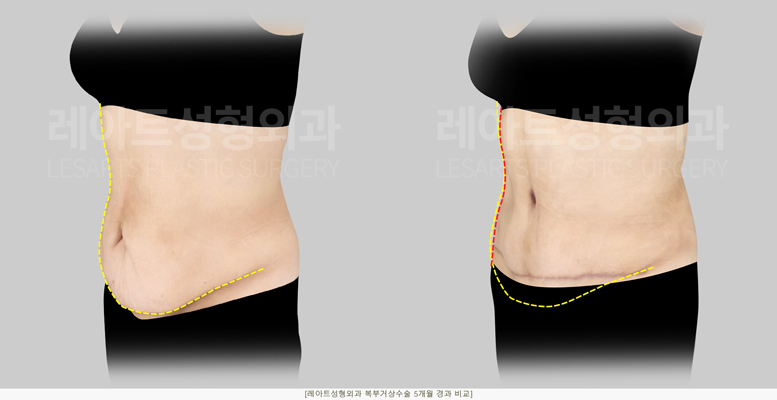
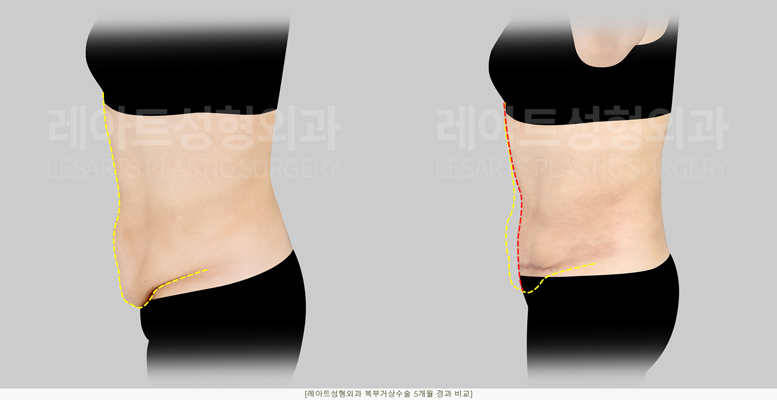
Before the surgery, sagging lower belly skin
curled outward, throwing off the upper body's balance.
After the tummy tuck,
this balance was visibly improved.
Clothing no longer pinches or bunches at the waist,
and the side profile shows
a smoother, cleaner waistline.
Most notably, in the side view before surgery,
the protrusion of sagging skin was very apparent.
Post-surgery, the excess skin was corrected,
resolving the main concern of bulging and drooping—
and resulting in a highly satisfying outcome.
While external correction appears to be complete,
at 5 months post-op, some swelling remains,
and scar healing will still take time.
With an accurate diagnosis of your body type
and recovery conditions,
combined with thorough consultation and planning,
you can expect a more natural and stable transformation.