Postpartum skin laxity and sagging in the abdomen
are common changes,
but the surface appearance alone
does not reveal the actual condition.
This is because these issues
are often accompanied by rectus diastasis,
a functional problem involving the abdominal muscles.
To resolve this through surgery,
a precise diagnosis and surgical plan
are essential.
Some may think that simply trimming off
part of the lower abdominal skin
can solve the sagging,
but if the separated rectus muscles
or collapsed abdominal core
are not corrected together,
the result may be incomplete.
Therefore, a comprehensive tummy tuck
that includes skin lifting,
muscle tightening,
and fat removal
Let’s take a closer look at the case
of a woman in her 30s
who had twins via C-section
and underwent a tummy tuck with liposuction and fat grafting
to correct the abdominal core structure.
After childbirth,
she was diagnosed with rectus muscle damage,
and over time,
the central abdominal skin sagged and folded downward.
When bending forward,
creases formed in her abdomen,
and from the front view,
the volume below the navel was prominent,
causing her waistline to appear uneven.
To address these combined concerns
and refine the line from waist to pelvis,
she chose to undergo:
-
M-type Tummy Tuck
-
Abdominal Liposuction
-
Hip Dip Fat Grafting
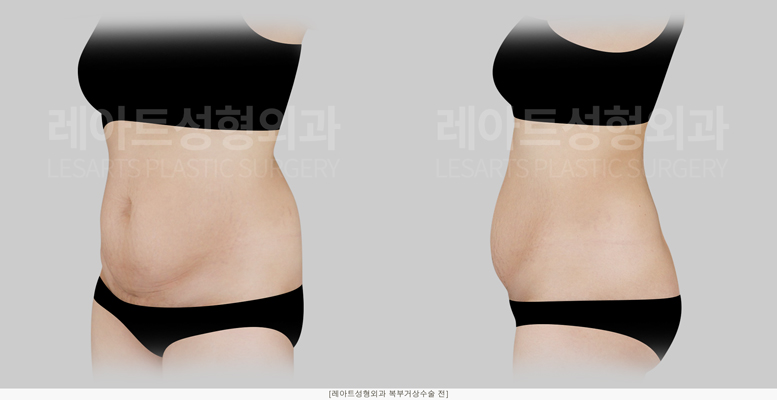
Before the tummy tuck,
her central abdominal skin sagged
and formed deep creases.
The folding areas were easily irritated
during daily movements.
Her abdominal center also protruded outward
due to rectus diastasis,
causing an imbalanced body profile.
In particular,
a significant difference in skin elasticity
between the upper and lower abdomen
blurred the line from waist to pelvis,
creating a heavy midsection appearance.
To resolve this, we recommended:
-
M-Type Tummy Tuck
To lift the broadly sagging skin
and reconstruct the collapsed lower abdomen.
-
Abdominal Liposuction
To remove accumulated fat
around the abdomen and flanks
and achieve better balance.
-
Hip Dip Fat Grafting
To graft harvested fat
into the hip dips near the pelvis,
creating a curvier and more feminine contour
from waist to hip.
This multi-step plan
targeted not only external appearance
but also body balance and function.
Now let’s look at the results and recovery
after the tummy tuck, rectus plication,
umbilical correction, liposuction,
and fat grafting.
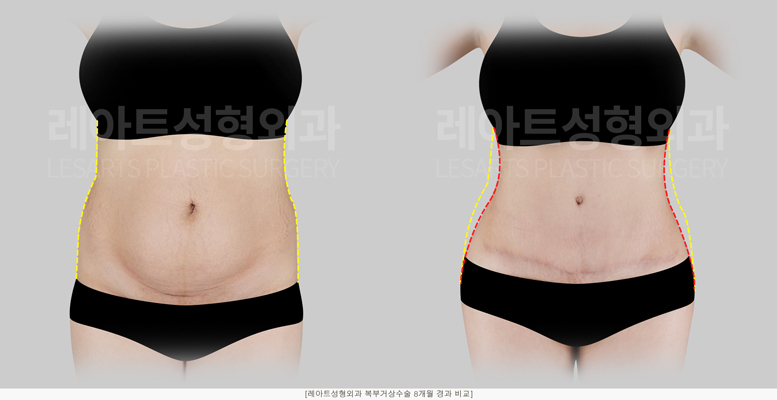
Before surgery,
the lower abdomen had deep creases
and sagged heavily,
disrupting overall balance.
8 months post-op,
the sagging skin was lifted,
and liposuction of the abdomen and flanks
created a lighter, firmer silhouette.
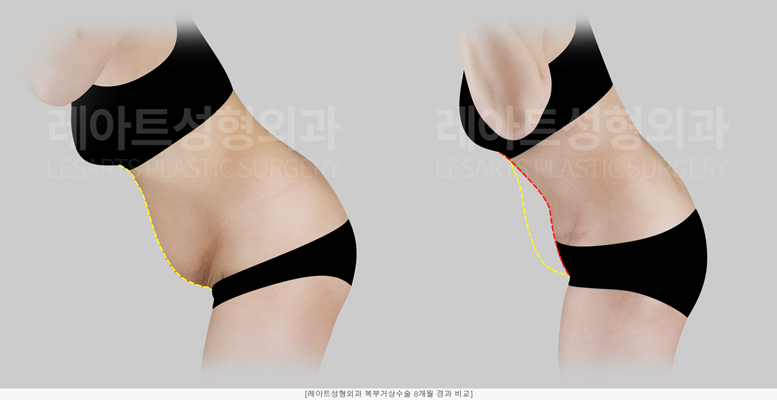
In the forward bending posture,
prior to surgery,
the abdominal wall and excess skin
drooped downward under gravity.
The skin folds were prominent,
and even the upper abdomen
bulged outward without strength.
After tummy tuck and rectus plication,
the lifted skin and reinforced muscle wall
created a firm core,
allowing her to bend without sagging
or creasing.
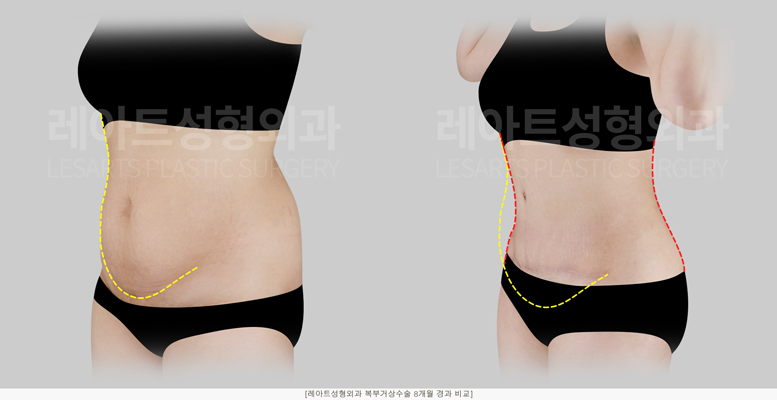
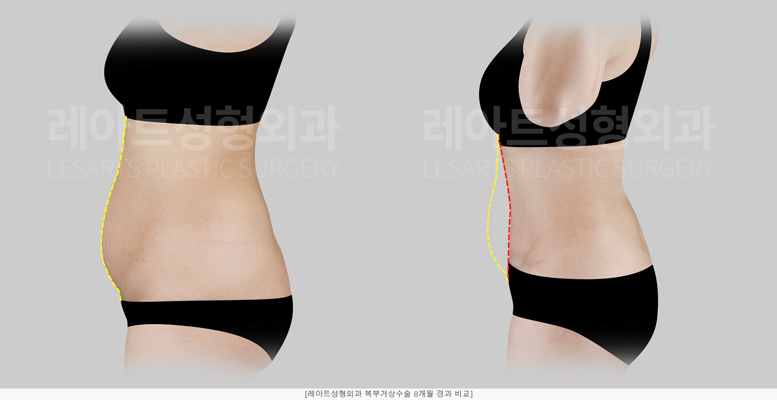
From the side and oblique view,
the pre-op lower abdomen protruded
and broke the flow from waist to hip.
After the combined tummy tuck,
muscle repair, liposuction,
and hip dip fat grafting,
the sagging was resolved,
and the line from waist to pelvis
became smooth and dimensional.
This result was possible
not only because of skin removal
but due to the comprehensive approach
considering abdominal muscles,
fat distribution, and body contour.
To achieve high-quality results
from a tummy tuck,
every step from diagnosis
to post-op care
must flow seamlessly.
In this case,
although the folding appeared localized
in the lower abdomen,
the skin laxity and muscle separation
extended to the upper abdomen.
The navel was also positioned high,
making a mini tummy tuck insufficient.
Through the M-type tummy tuck,
liposuction, and fat grafting,
we achieved visible improvement
not only in the abdominal core
but also in the waist and pelvis contour.
The recovery progressed smoothly,
and at 8 months post-op,
the firm lines are being maintained,
and the skin around the incision
has also stabilized.
Scar care will continue
through regular checkups.
Remember:
the extent of skin lifting
and the length of scars
should be tailored
to the degree of sagging
for more stable and satisfying outcomes.