Gaining weight isn’t just
about the number on the scale.
It’s about your body feeling heavier,
clothes fitting tighter,
sweating more, and
not liking how your silhouette looks.
When fat builds up in the lower body,
your leg line appears bulky,
and the boundary between your hips and thighs
gets lost—making your whole figure
look wider than it is.
And you can’t reverse that easily
just by losing weight.
Many people realize this
as they try and fail
to fix it with weight loss alone.
That’s why those looking for
targeted reshaping
often choose thigh liposuction—
especially in the inner thighs,
outer saddlebags,
and the chanel line below the buttocks,
which are key to lower body balance.
Let’s look at one such case
where a patient underwent full thigh liposuction
and achieved more balanced proportions.
[Patient Info]
Age: Early 30s
Occupation: Office worker
Height: 178cm
Weight: 64kg
BMI: 20
(*Results may vary depending on individual body condition.)
This patient had gained over 10kg
within a year and saw visible changes
in her lower body, especially the hips and thighs,
creating a “bottom-heavy” figure.
She noticed that her inner thighs touched,
and her hip line drooped,
making her silhouette look
blunt and heavy overall.
Her goal wasn’t just reducing circumference.
She wanted to create space
between her thighs and lift her hips—
so we planned a balanced liposuction
targeting the areas ruining her body proportions.
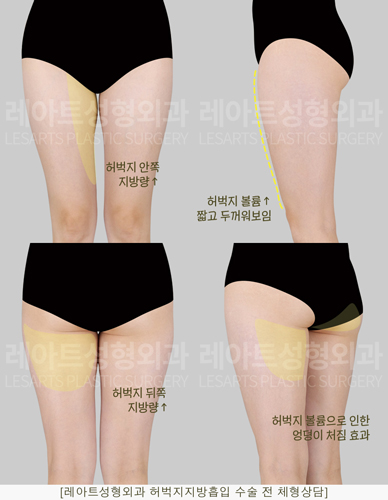
From her pre-op photos and consultation,
we found fat evenly distributed
on the inner/outer thighs
and underneath the hips,
creating lower-body heaviness.
From the front, the inner thighs were touching
with little to no gap.
From the side, the fat on the front thighs
extended down toward the knees,
making her legs look shorter and bulkier.
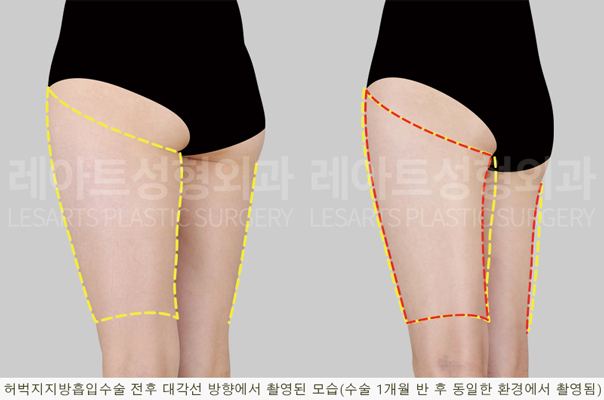
From the back, the fat beneath the buttocks
blurred the boundary between the hips and thighs,
causing a sagging appearance.
This gave her a short and wide lower body
from every angle—front, side, and back.
So we performed comprehensive thigh liposuction
to reshape all these lines.
Now let’s check
the results from 1.5 months post-op.
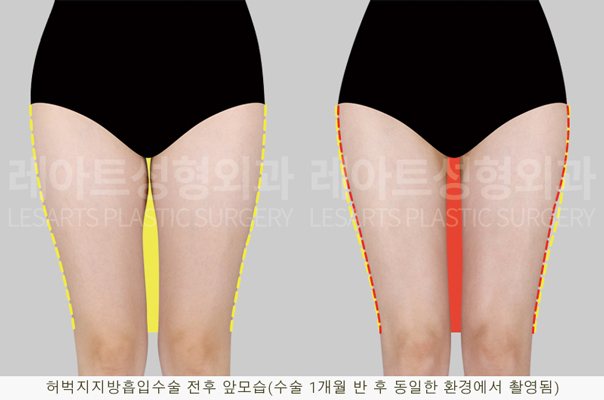
Before surgery, fat on the inner and outer thighs
eliminated any gap between her legs.
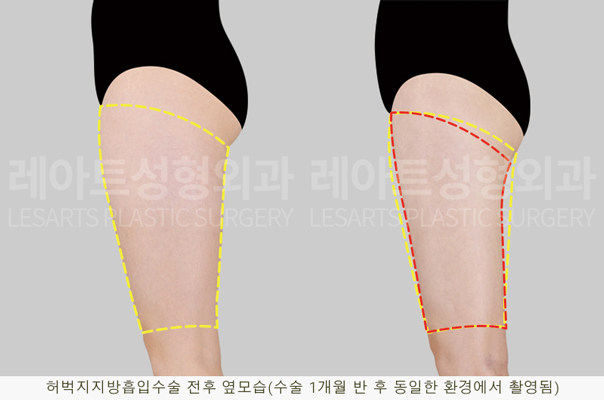
Excess fat extending from the hips
made her legs look short and heavy.
But 1.5 months after surgery,
her inner thigh fat had been removed,
creating a visible thigh gap,
and slimming the overall leg width.
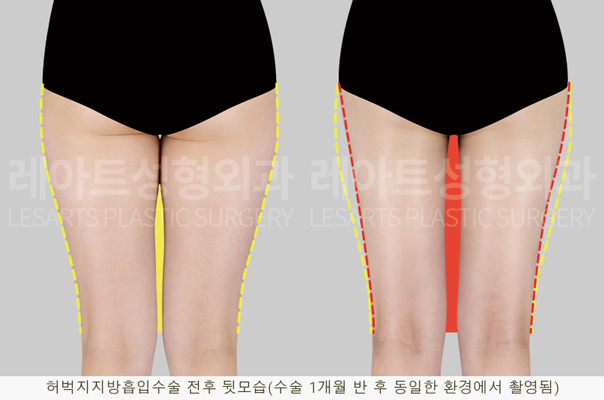
Sagging fat beneath the buttocks
was also reduced,
softening the transition
between the hips and thighs
and creating a lifted appearance.
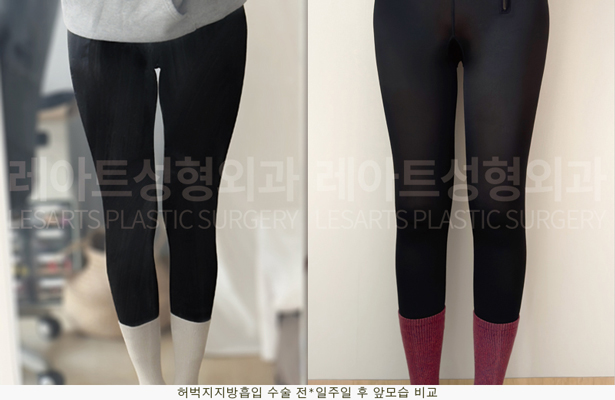
Selfies provided by the patient
also show that her inner thighs slimmed down
and a natural gap formed between her legs.
By 130 days post-op,
the bulges beneath her buttocks
had been fully cleared,
and her leg silhouette became smoother and lighter.
Her outer thigh fat (“saddlebags”)
had made her legs look shorter
and widened the lower body overall—
but this was also resolved through liposuction,
giving the illusion of longer legs.
In this case, our focus wasn’t just on circumference,
but also on removing fat that disrupted proportions—
like the inner thighs, saddlebags, and under-hip area.
The result?
Not only did she shed the look of “lower-body obesity,”
but her overall body balance improved as well—
leading to high satisfaction.