Men suffering from
enlarged breasts often experience
daily discomfort and even psychological stress.
This is especially true for
lean individuals who appear to have
breasts resembling a female chest.
In such cases, the issue may not be fat accumulation,
but abnormal growth of glandular tissue—
a condition known as gynecomastia.
In these cases,
exercise and weight loss often fail
to reduce the chest size.
In fact, reducing fat around the chest
can make the protrusion look even worse.
Men with gynecomastia may struggle
to choose shirts, avoid exposing their chest,
and suffer subtle but persistent emotional impacts.
Without identifying and addressing
the root cause,
self-care and natural remedies
rarely lead to improvement.
Today’s patient, who was diagnosed
and treated for true gynecomastia,
had a relatively average build
but was troubled by
his prominently enlarged chest.
Since adolescence,
he had noticed the bulging chest,
and even after consistent workouts
as an adult, the shape did not improve.
He reported puffiness
around the nipples
and visible chest protrusion
under clothes,
causing increasing discomfort.
Despite regular diet and exercise,
his chest remained unchanged,
and the psychological burden worsened.
He ultimately came to us
seeking an accurate diagnosis and solution.
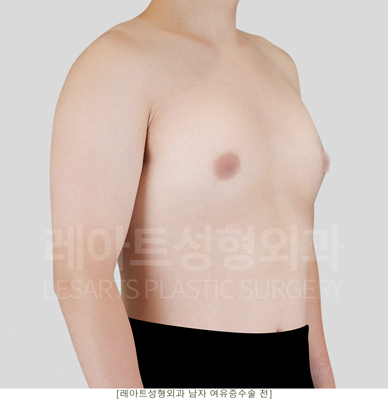
Before surgery,
both sides of his chest
were visibly protruding.
The nipples and areola were also
significantly swollen.
Upon palpation,
we could feel a firm glandular mass
beneath the nipples.
Ultrasound imaging also confirmed
glandular hyperplasia,
leading to a diagnosis of
Simon Grade 2A true gynecomastia.
Based on this, we proposed
the following surgical plan:
1. Glandular Tissue Excision
Remove the enlarged gland tissue
around the areola
to reduce breast volume.
2. Liposuction
To prevent shape imbalance
from leftover fat on the lower or side chest,
we also removed fat in these areas
for a flatter, more masculine contour.
3. Prevention of Adhesion & Depression
To avoid post-surgical hollowing or adhesion,
we repositioned deeper tissues
to support a smooth recovery.
4. Medication History & Recurrence Risk
The patient was taking hair loss medication
known to influence hormones.
We explained the potential for recurrence
and emphasized the need for
long-term monitoring and care.
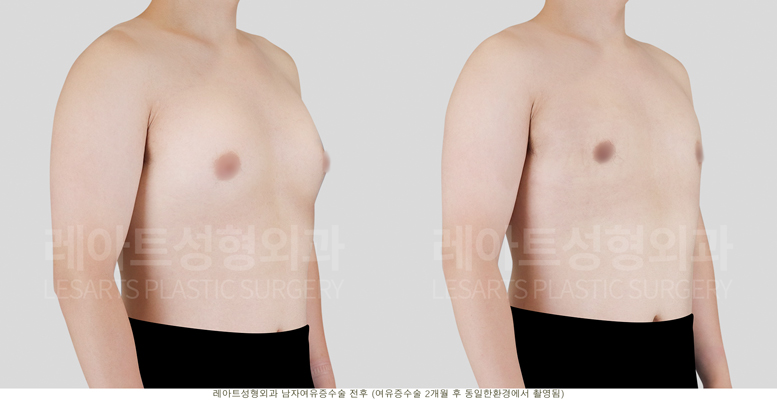
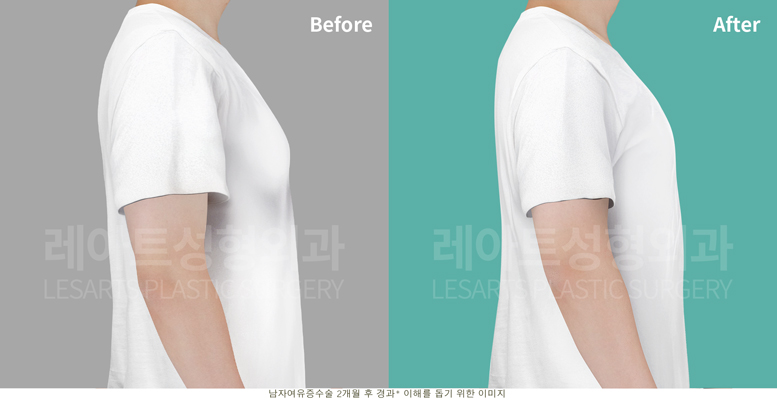
Let’s look at the results
2 months after gynecomastia surgery.
Before the procedure,
his chest volume stood out,
with fullness around the nipple area
and a rounded lower chest profile.
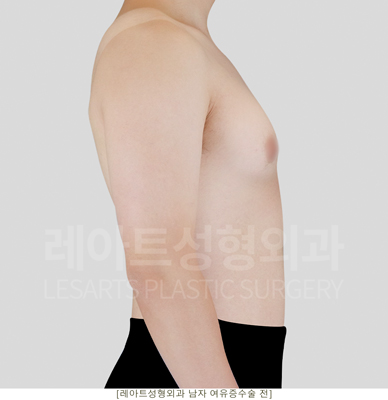
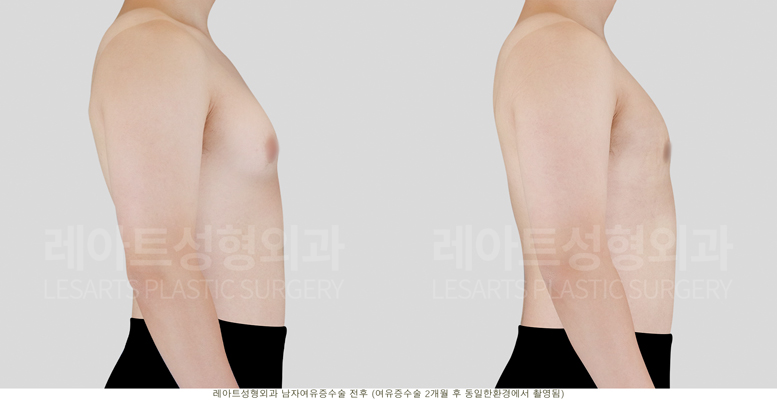
From the side,
the combined fat and glandular tissue
caused sagging,
and nipple-area swelling
made the chest appear even more prominent.
After two months,
the glandular tissue was removed,
and liposuction was performed
on the lower and side chest.
The chest became flatter and cleaner,
creating a more defined, masculine shape.
The nipple projection also decreased,
and the chest-to-torso transition
looked smoother and more balanced.
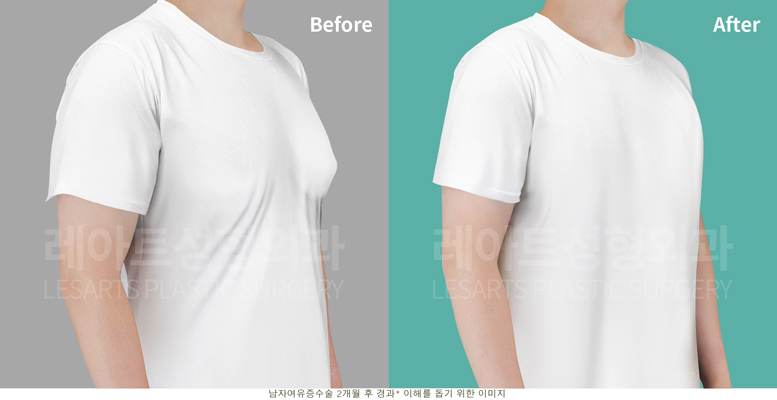
Even in casual clothing,
the improvement was obvious.
Before surgery,
the bulging chest showed clearly
under tight T-shirts,
with puffiness around the nipples
and lower chest disrupting the fit.
After surgery,
the chest protrusion disappeared,
and the T-shirt lay naturally against his torso.
Gynecomastia surgery isn’t just
about reducing visible chest volume—
it requires a three-dimensional approach
that considers individual anatomy,
gland distribution, and fat layers.
While the visual improvement
is often immediate,
patients like this—
who take hormone-influencing medications
or have endocrine-related risks—
should prioritize regular checkups
and lifestyle care
to ensure lasting results.