The impression a body gives
is less about weight,
and more about proportional balance
between specific areas.
For example, when fat is concentrated in the lower body,
it can make a person appear shorter,
and if the hip line lacks volume,
the whole figure may look off-balance.
The thighs and calves have
different muscle and fat compositions,
and if the flow between them is disrupted,
legs may appear short and disconnected.
In these cases, it's more effective
to manage lower body contouring
based on overall proportions and continuity,
rather than just reducing circumference.
[Patient Information]
Age: Early 20s
Occupation: University student
Height: 161cm
Weight: 51kg
BMI: 20
Results may vary depending on individual factors
even with similar physical stats.
This patient had long been concerned
about the bulky appearance of her calves.
She had even tried calf Botox,
hoping for a smoother leg line.
However, because both muscle and fat were involved,
Botox alone did not yield visible improvement.
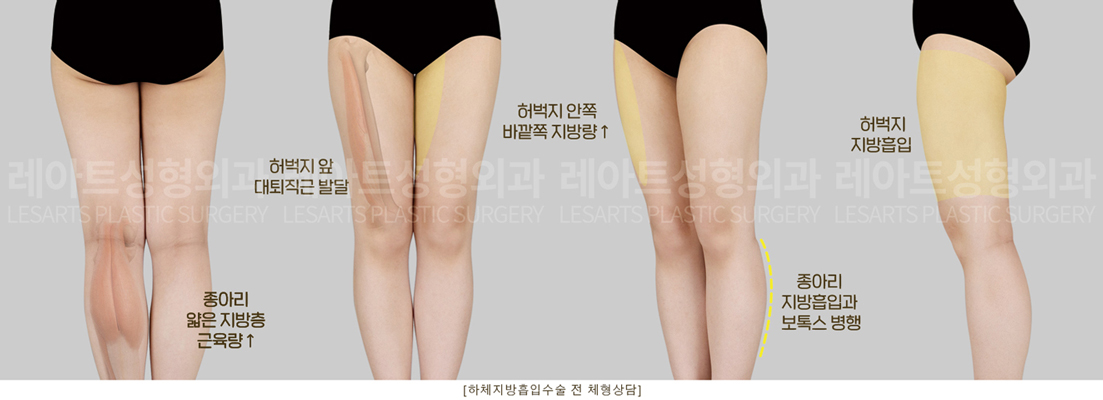
Consultation revealed that the patient
had significant fat around the inner and front thighs,
and her thighs were closely touching,
giving a heavy, compressed appearance.
In lower body liposuction,
the degree and shape of muscle development
is crucial to design.
Her rectus femoris (front thigh) was mildly developed,
while her calves had a thinner fat layer
but clearly defined muscles.
Though her main concern was her calves,
removing volume from only that area
would have left the thighs still heavy,
disrupting the flow of the leg line.
Thus, we decided to treat both the thighs and calves
for a more balanced transformation.
In her thigh liposuction,
care was taken to avoid emphasizing
the underlying muscle too much.
A small layer of fat was intentionally left
to prevent the muscle lines from protruding,
while the calves were treated with
liposuction and Botox to reduce muscle bulk
and create a lighter silhouette overall.
This customized approach
was designed not just for circumferential reduction,
but to ensure smooth transition
from thigh to calf.
Let's take a look at the changes
3 months after surgery.
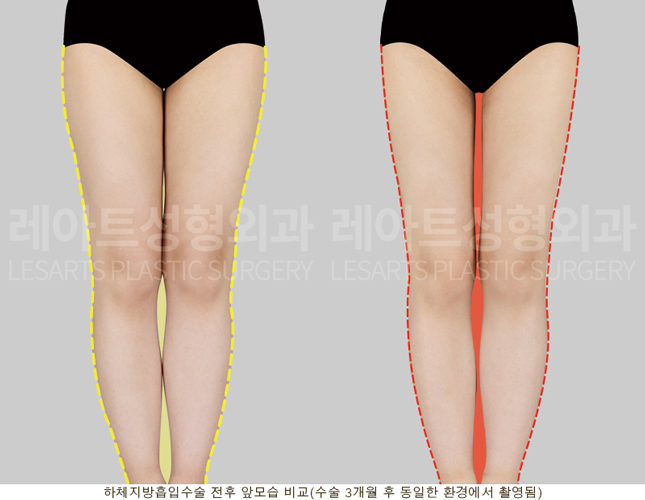
A gap appeared between the inner thighs,
and the volume in the front thigh was reduced,
creating a neater overall leg shape.
Volume in the back of the thighs and calves
was also reduced,
resulting in a smoother, slimmer leg silhouette
with a more straight-lined appearance.
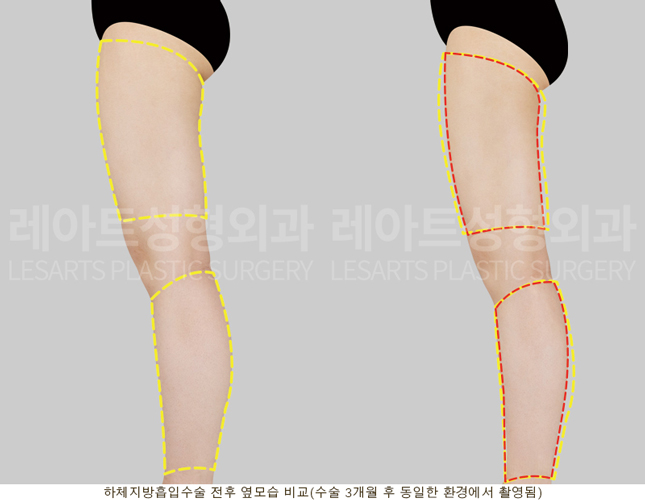
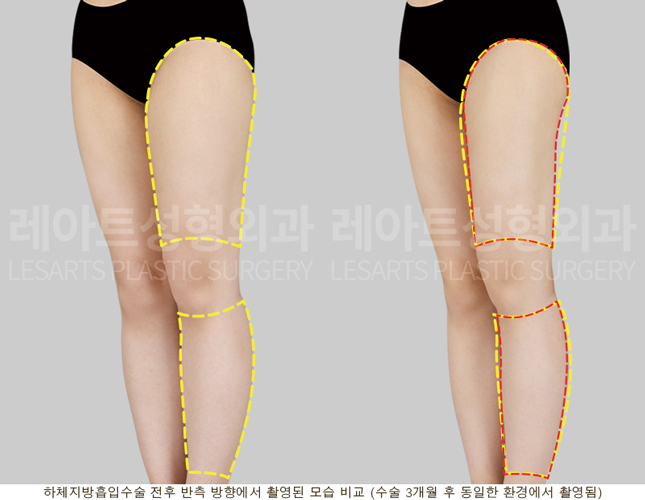
From the side,
the reduction in front thigh and calf bulk
is even more noticeable.
The entire leg line appears more defined,
with no abrupt transitions or bulges,
offering a lighter and firmer impression.
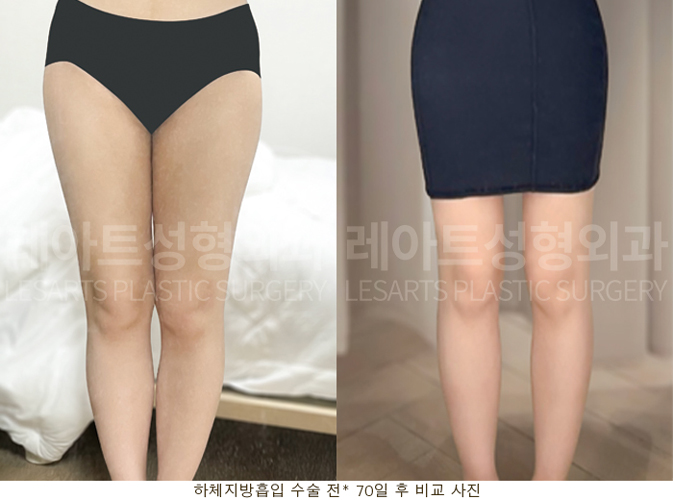
In the selfie taken by the patient herself,
you can clearly see the reduction
in both thigh and calf volume.
Before surgery,
the inner thighs were touching,
and the calves had bulging points
that also came into contact—
making her legs look short and heavy.
But after thigh and calf liposuction,
those problem areas were significantly improved.
The line from thigh to calf
became straight and natural,
resulting in a lighter, longer, and sharper appearance.
By addressing both the thighs and calves,
we were able to reshape the entire lower body
for a more proportional and refined silhouette.
As mentioned earlier,
the thigh and calf are both muscle-dense regions,
and their structures differ.
Therefore, over-aggressive liposuction
should be avoided.
It's important to design the procedure
to preserve natural flow and proportions,
while ensuring a smooth recovery
for high patient satisfaction.